


More news on this day
Strobe Talbott, the former U.S. deputy secretary of state who helped shape Washington’s approach to Russia, the post-Soviet space and India in the 1990s before leading the Brookings Institution, died on November 26, 2026, at his home in Springs, New York, aged 80, following a long illness confirmed by his family.
Get the latest news straight to your inbox!
From Midwestern Roots to a Life in Foreign Affairs
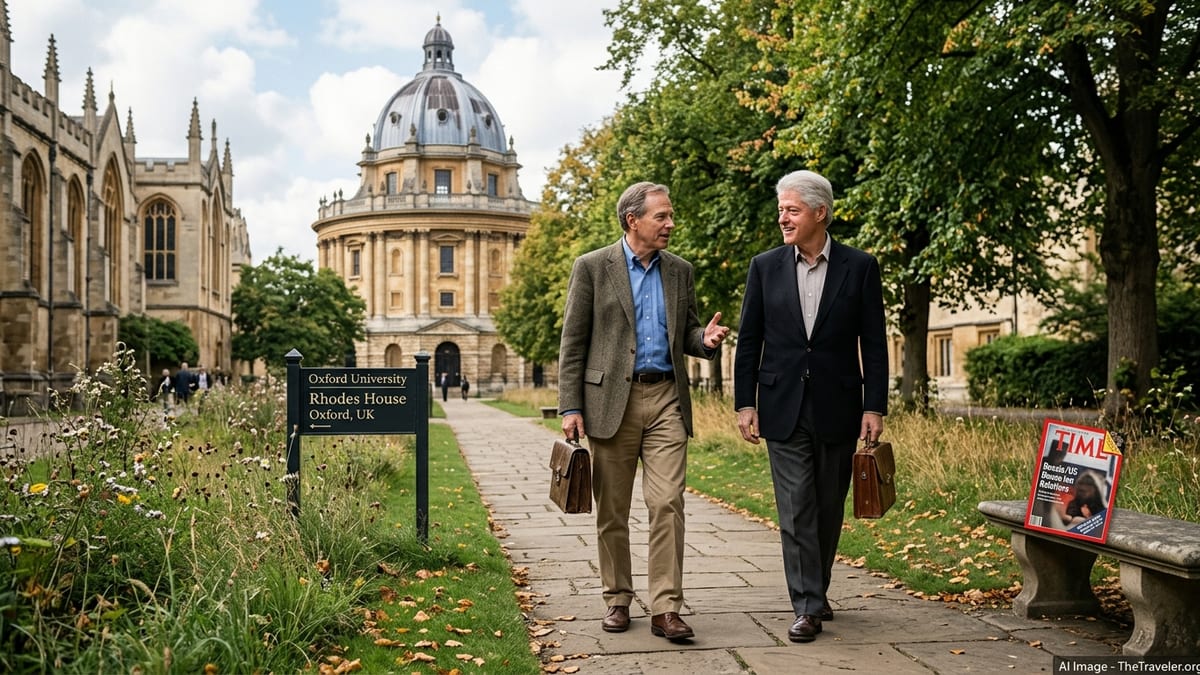
Born in Dayton, Ohio, in 1946, Nelson Strobridge “Strobe” Talbott grew up far from the corridors of Washington but entered them early in his professional life through journalism and scholarship focused on global affairs. Educated at the Hotchkiss School and Yale University, he became part of a postwar generation of American elites who viewed international engagement and alliance-building as central to U.S. security. After graduating from Yale in 1968, he continued his studies as a Rhodes Scholar at the University of Oxford, a period that cemented both his interest in U.S.–Soviet relations and his personal connection to future president Bill Clinton, with whom he shared a room.
Talbott’s first sustained contact with the Soviet Union and its politics came through Time magazine, where he interned in Moscow during his student years. That experience led the magazine to enlist him to help translate and interpret leaked memoirs attributed to former Soviet leader Nikita Khrushchev, a high-profile project that brought him early prominence as a young specialist on Soviet affairs. The assignment helped secure him a full-time role at Time and set the direction for much of his early career.
Over the next two decades, Talbott remained with Time for roughly 21 years, rising to positions including Washington bureau chief and foreign affairs columnist. His work concentrated on arms control, nuclear strategy and the complicated interplay between Washington and Moscow in the later stages of the Cold War. Those years gave him an insider’s understanding of how American diplomacy was conducted, as well as a reputation in policy circles as a journalist who combined access to senior officials with detailed knowledge of Soviet and later Russian politics.
Architect of Clinton-Era Policy Toward Russia and the Former Soviet Union
Talbott moved from observing foreign policy to helping direct it after Bill Clinton’s election in 1992. Initially appointed ambassador at large and special adviser to the secretary of state on the newly independent states that emerged from the Soviet Union’s collapse, he became one of the administration’s central figures on Russia, Ukraine and other former Soviet republics. In 1994 he was confirmed as U.S. deputy secretary of state, the number two position in the department, a post he held until the end of Clinton’s second term in January 2001.
In that capacity, Talbott worked under secretaries of state Warren Christopher and Madeleine Albright during a period when the United States was attempting to define its role in a post-Cold War security order. He was closely involved in efforts to remove nuclear weapons from Belarus, Kazakhstan and Ukraine, three former Soviet republics that had inherited strategic arsenals after 1991. He also supported the eastward expansion of NATO, a policy intended by its advocates to consolidate democratic transitions in Central and Eastern Europe while remaining a point of contention in U.S.–Russian relations.
Talbott’s remit extended beyond arms control and alliance questions to some of the decade’s most pressing conflicts. He played a role in U.S. diplomacy in the Balkans, where the Clinton administration backed NATO interventions aimed at ending wars in Bosnia and later Kosovo. As a senior figure in the department, he was frequently part of high-level discussions on sanctions, peacekeeping and post-conflict stabilization in the region, contributing to decisions that affected military deployments, refugee movements and wider European security arrangements.
Managing Nuclear Diplomacy with India and Engagement with Russia
Beyond Europe and the former Soviet Union, Talbott became a key point of contact in U.S. engagement with India following New Delhi’s underground nuclear tests in 1998. The tests brought international criticism and raised concerns in Washington about a potential South Asian arms race. In response, the Clinton administration launched a series of intensive high-level talks with India, with Talbott leading the U.S. side in multiple rounds of negotiations. Those discussions did not roll back India’s nuclear program, but they contributed to easing immediate tensions and laid groundwork for a more structured bilateral dialogue on security and nonproliferation that subsequent administrations sought to build upon.
Throughout the 1990s, Talbott also worked on the evolving U.S. relationship with Russia under President Boris Yeltsin, a period marked by political volatility in Moscow and differing views in Washington on how closely to tie U.S. policy to Russian domestic developments. Supporters of the Clinton-era approach credited Talbott’s engagement with helping to maintain cooperation on nuclear security and arms reductions at a time of economic turmoil in Russia. Critics later questioned whether NATO enlargement and aspects of Western economic advice contributed to Russian resentment. Talbott himself acknowledged the complexity of the period in later writings and interviews, framing it as an attempt to secure both democratic transitions and strategic stability with no guarantee of success.
Beyond state-to-state negotiations, Talbott’s responsibilities as deputy secretary included internal management of the State Department and coordination across regional bureaus. Colleagues described him in public accounts as a demanding but meticulous policymaker who preferred lengthy analytical memoranda and long working hours. The role placed him at the center of a policy agenda that included nonproliferation, democracy promotion and crisis response in locations from the Middle East to Africa, even when his name was most publicly associated with Russia policy.
Leader of the Brookings Institution and Voice on American Power
After leaving government in 2001, Talbott transitioned to the think-tank world, becoming president of the Brookings Institution in 2002. Under his leadership, Brookings continued to position itself as a prominent, nonpartisan policy research organization in Washington, expanding work on global governance, development, climate and national security. He remained in the role until 2017, a fifteen-year tenure that coincided with wars in Afghanistan and Iraq, the global financial crisis and renewed tension in relations with Russia and China.
During his Brookings years, Talbott remained involved, in a non-governmental capacity, in wider foreign policy debates. He chaired the U.S. State Department’s Foreign Affairs Policy Board, an external advisory group, bringing his diplomatic experience to bear on questions ranging from alliance management to counterterrorism. He also continued to write and speak frequently on nuclear security, the evolution of NATO and the balance between idealism and pragmatism in U.S. strategy.
An author of more than a dozen books over his career, Talbott used his later works to reflect on the state of American democracy and its role abroad. His 2020 book, “Our Founders’ Warning: The Age of Reason Meets the Age of Trump,” examined what he saw as strains on constitutional norms at home and their implications for U.S. credibility overseas. Earlier publications had focused on arms control, U.S.–Soviet diplomacy and the internal politics of Russia and its neighbors, underscoring his long-standing focus on the nuclear age and East–West relations.
Personal Life, Tributes and What His Legacy Means Now
Talbott’s public roles were accompanied by a personal life intertwined with journalism, public service and literature. His first wife, journalist and public servant Brook Shearer, died in 2009. He later married author Barbara Lazear Ascher. He is survived by two sons, Devin and Adrian, and six grandchildren, according to family statements issued after his death. Relatives confirmed that he died peacefully after a prolonged illness at his home in Springs, part of the East Hampton area on Long Island.
In statements following his death, former president Bill Clinton praised Talbott as both a close friend and a figure who, in Clinton’s words, helped make the world “more peaceful and secure.” Clinton and former secretary of state Hillary Clinton described him as a valued adviser and a “world-class human being,” highlighting not only his policy contributions but also his personal loyalty and long-standing ties to their family. Former colleagues from journalism, government and the think-tank community have similarly emphasized his intellectual rigor and his willingness to engage with complex and sometimes unpopular policy choices.
For readers trying to understand why Talbott’s passing matters now, his career offers a through line connecting late–Cold War diplomacy, post-Soviet transitions and debates that still shape today’s world, including NATO’s role in Europe, nuclear nonproliferation and the relationship between Washington and Moscow. Many of the files he worked on in the 1990s, from nuclear security in former Soviet republics to engagement with India, continue to influence current policy frameworks. As officials and scholars reassess the period in light of subsequent events, Talbott’s record is likely to remain a reference point for discussions about how the United States handles major geopolitical transitions.
What To Watch Next For Those Following His Work
With news of Talbott’s death still recent, institutions he helped shape are beginning to take stock of his influence. Brookings, which in recent years established a security and strategy center that bears his name, is expected to continue research agendas that parallel many of his long-standing interests, including arms control, great-power competition and international governance. For readers following his legacy, events and publications emerging from such programs will likely offer ongoing assessments of the issues that defined his time in government.
In the near term, additional tributes and evaluations of his record are likely to appear in official statements, academic forums and memoirs from former colleagues. Those interested in a more detailed understanding of his approach to diplomacy may turn to his published books and to archival materials such as oral histories and State Department records, which document negotiations on Russia, the former Soviet republics, India and the Balkans. These sources provide insight into how he and his contemporaries perceived the options available at a moment when many assumed that post-Cold War integration could be achieved, even as events later showed how contested that vision would remain.
There has been no indication so far of any major public ceremonies beyond the usual arrangements for a figure of his stature, and specific plans had not been publicly detailed at the time of writing. Those wishing to track official commemorations or institutional events connected to Talbott’s life and work should look for updated information from the State Department, Yale University, the Brookings Institution and other organizations with which he was closely associated. As those details emerge, they will help define how his contributions to U.S. diplomacy and foreign policy are formally remembered in the months ahead.