


More news on this day
US air travelers are facing another stretch of widespread delays in late November 2026, as the fallout from a mid‑month nationwide FAA ground stop, a Delta Air Lines automation failure and a powerful Thanksgiving nor’easter continues to ripple through already crowded holiday schedules.
Get the latest news straight to your inbox!
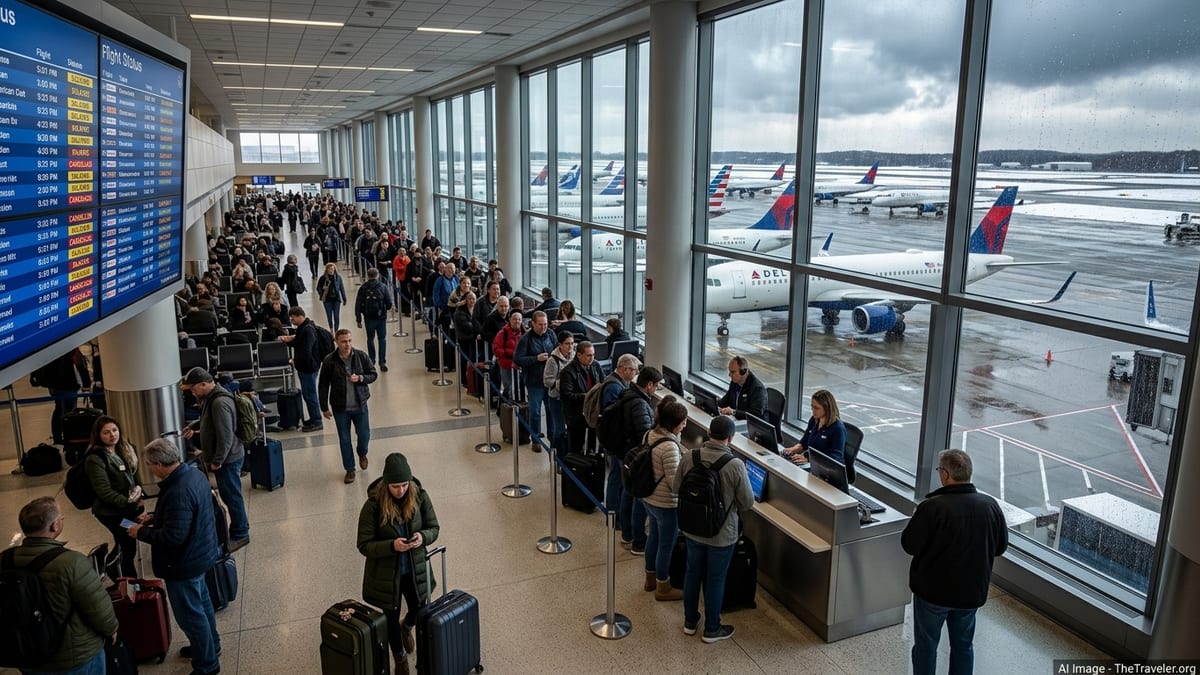
Nationwide FAA ground stop still reverberates through November schedules
The most disruptive single event behind the current pattern of delays was the Federal Aviation Administration’s unprecedented nationwide ground stop on November 13 2026, which halted departures across the United States for several hours while officials investigated a problem linked to newly expanded air traffic management technology. According to an FAA and Department of Transportation briefing, network switches and routers became overloaded with data from the agency’s SMART system, which had been rolled out to all 22 air route traffic control centers three days earlier. The agency has since restored normal airspace operations, but federal officials have warned that the large backlog of aircraft and crews created that day would take time to clear.
By November 15, two days after the ground stop, more than 11,500 flights within, into or out of the United States had been canceled or delayed, according to flight-tracking data cited in public summaries of the disruption. Transportation Secretary Sean Duffy said during a mid‑November update that while the airspace was open again, passengers should expect lingering delays and cancellations as airlines repositioned aircraft and rebalanced schedules. Those knock‑on effects have coincided with one of the busiest travel periods of the year, magnifying the impact for travelers even as day‑to‑day operations have largely resumed.
The FAA has not announced any new ground stop since November 13, and as of the afternoon of November 27 its national airspace status page showed no nationwide or multi‑airport delay programs in effect. However, the earlier shutdown compressed already‑tight airline schedules heading into Thanksgiving week, and federal officials have acknowledged that the event will feature prominently in the Department of Transportation’s consumer protection reviews and in forthcoming Air Travel Consumer Reports that track delays, cancellations and complaints by carrier.
Thanksgiving nor’easter brings fresh wave of weather‑related delays
Just as airlines were working through the backlog from the federal systems failure, a fast‑developing coastal storm brought a new round of disruption during Thanksgiving week itself. A nor’easter that intensified between November 25 and 27 flooded coastal communities in the Mid‑Atlantic and Northeast, knocked out power to hundreds of thousands of customers and forced the unprecedented postponement of the Macy’s Thanksgiving Day Parade in New York City from Thursday November 26 to Saturday November 28. The heavy rain and high winds associated with the storm also slowed air traffic up and down the Eastern Seaboard at the peak of the holiday travel period.
On Thanksgiving Day, November 26, flight‑tracking data reported by multiple outlets showed more than 2,200 flights to, from or within the United States delayed and at least 400 canceled, with East Coast hubs seeing some of the worst impacts. By November 27, the broad national picture had improved, with one independent newsroom citing around 100 cancellations and under 700 delays across the US flight network by mid‑afternoon, and the FAA reporting no active nationwide delay programs. Even so, airlines were still operating through localized weather‑driven constraints and residual schedule imbalances, particularly at airports near the storm’s track.
The combination of extreme weather and already busy Thanksgiving traffic has made delays highly uneven by location and time of day. Forecast and historical analysis published ahead of the holiday suggested that Thanksgiving Day itself is typically one of the more punctual days in the nine‑day Thanksgiving travel window, but that the Sunday and Monday after the holiday often see significantly higher percentages of flights arriving late or being canceled. With the nor’easter pushing strong winds and low cloud toward major hubs, travelers returning home over the November 29 and 30 peak are being advised to monitor live FAA status updates and their airline’s apps closely for evolving gate, time and routing changes.
Airline tech outages and local ground stops deepen disruption
Technical issues at major hubs have added a further layer of complexity on top of weather and the federal ground stop. On November 22, a failure in Delta Air Lines’ automated weight‑and‑balance system led the carrier to pause departures into its Atlanta hub while the problem was diagnosed and resolved. According to a detailed timeline shared in public reporting and traveler accounts, the FAA initially issued a formal ground stop for Delta flights to Hartsfield‑Jackson Atlanta International Airport early that morning, then shifted to a ground delay program at 8:32 a.m. Eastern and lifted the restrictions at 11:26 a.m. The combination of the system outage and the brief halt in arrivals contributed to more than 1,900 flight delays across the United States that day as Delta worked through its schedule.
Although the airline said later that afternoon that operations had returned to normal and the underlying automation issue had been fixed, the disruption at the country’s busiest hub had a knock‑on impact on flights throughout Delta’s network and on some shared airport resources. Passengers reported seeing delays not only in Atlanta but at other major airports where the carrier has a large presence, including New York, Washington, Boston, Minneapolis and several Southeastern and Texas cities. Because aircraft and crews cycle through multiple legs in a single day, delays on early‑morning flights can propagate through the network, resulting in late‑evening departures arriving far behind schedule even after the original issue is resolved.
Local air traffic management decisions during the Thanksgiving rush created additional pockets of congestion. In the days before the holiday, Chicago O’Hare and other large hubs experienced temporary ground stops and ground delay programs tied to low visibility, storms or volume. Although these local programs are routine tools used by the FAA to meter traffic into constrained airports, they can sharply increase delays at specific times and airports. For travelers, the result has been a series of overlapping disruptions with different causes and timeframes, which together have made it more difficult to predict whether a given flight would operate on time.
Data shows delays rising, but impact varies widely by day and airport
Government and independent data released in recent months indicate that 2026 is on track to be one of the more disrupted years for US air travel since the early 2010s, though performance varies significantly between carriers and airports. An analysis of federal Bureau of Transportation Statistics flight records for the last two months of 2025, released ahead of this year’s Thanksgiving rush, found that roughly a quarter of flights at some airports departed late in November and December 2025, with December particularly affected. At one regional hub, nearly 27 percent of departures arrived late in December 2025, and airline‑related causes accounted for more than 40 percent of total delay minutes, compared with under 20 percent attributed to air traffic control or airport operations.
Early 2026 Air Travel Consumer Reports from the US Department of Transportation show that complaints about flight problems, including delays and cancellations, remain elevated compared with pre‑pandemic norms, although monthly volumes fluctuate with storms, operational meltdowns and the seasonal travel calendar. The Department launched a modernized Aviation Complaint, Enforcement and Reporting System in early 2026, partly to capture more detailed information about which specific airlines and ticket agents are associated with particular complaints. Officials have emphasized that a complaint does not by itself mean a law was violated, but say the data help prioritize enforcement and transparency efforts, including on chronic delay issues.
More recent tallies of extended tarmac delays suggest that the on‑the‑ground experience for some passengers has worsened this year. One national analysis using DOT statistics concluded that 2026 is on pace to see the highest average daily number of tarmac delays over three hours since 2009. New York‑area airports, which are operating near capacity and are frequently affected by weather in the congested Northeast corridor, appear as particular trouble spots in those data. The Department of Transportation has the authority to levy substantial fines for extended tarmac delays under rules first enforced in 2010, but has not announced any enforcement actions related to this year’s events as of late November.
What travelers can expect through the end of the holiday period
Looking ahead to the remaining days of the Thanksgiving travel window and into December, transportation officials and airlines are signaling a mixed outlook for delays. The Department of Transportation has highlighted that scheduled flight volumes for the nine‑day Thanksgiving period from November 21 to November 29 exceed 417,000, which it describes as the busiest Thanksgiving air travel period in 16 years. At the same time, live FAA status updates as of the afternoon of November 27 indicate that there are currently no nationwide ground stops or broad multi‑airport delay programs in effect, and that most delays are confined to normal weather and volume‑related constraints at specific airports.
Historical analyses of flight performance around Thanksgiving suggest that travelers returning home on the Sunday and Monday after the holiday typically face the highest likelihood of delays. Aggregated federal data from 2023 to 2025 show that while roughly 21 percent of US domestic flights across the year arrived at least 15 minutes late or were canceled, that figure rose to around 27 percent during Thanksgiving week, with delay rates especially elevated on the Sunday after the holiday. In contrast, Thanksgiving Day itself has tended to see relatively fewer delayed arrivals. Whether that pattern repeats exactly this year will depend on the evolution of the nor’easter’s remnants, localized storms and any further operational issues.
For individual travelers, the practical implications remain straightforward but important. Airlines are urging passengers to arrive early at the airport, particularly at large hubs and during peak morning and evening banks, and to use carrier apps and text alerts for up‑to‑the‑minute gate and schedule information rather than relying solely on printed boarding passes. The Department of Transportation has once again reminded passengers that if an airline cancels a flight or makes a significant schedule change or delay and the passenger chooses not to travel, they are generally entitled to a refund to their original form of payment rather than a voucher under federal rules. Travelers are being advised to check the DOT’s customer service dashboards and the FAA’s national airspace status page before leaving for the airport, especially through the end of the Thanksgiving travel window and during other busy periods in December.