


More news on this day
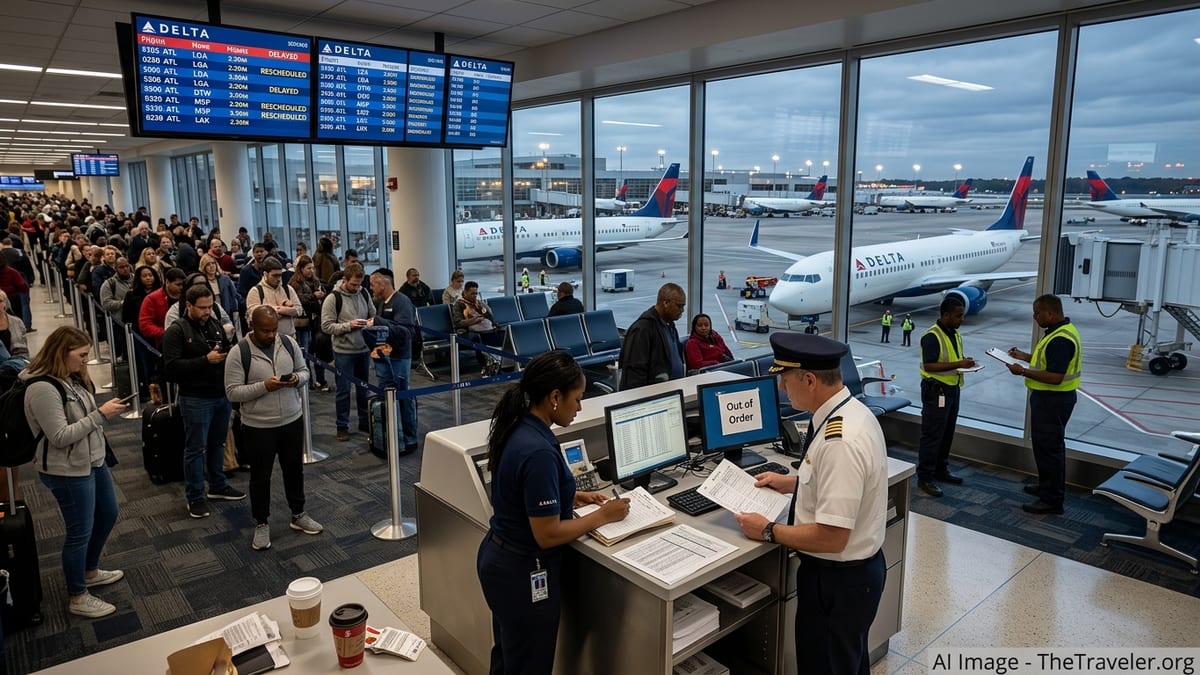
More than 1,600 Delta Air Lines flights were delayed across the United States on Sunday, November 22, after an outage in the carrier’s automated weight-and-balance system disrupted operations at its Atlanta hub and beyond just days before the peak Thanksgiving travel period.
Get the latest news straight to your inbox!
What happened to Delta’s weight-and-balance system
Delta confirmed on Sunday that a technical issue affected an automated system used to calculate weight and balance for departing flights, a safety-critical step required before pushback and takeoff. The malfunction primarily impacted operations at Hartsfield–Jackson Atlanta International Airport, Delta’s largest hub and the world’s busiest airport by passenger numbers, but the effects were felt across the network as aircraft and crews fell out of position.
According to flight-tracking data cited by several outlets, more than 1,600 Delta flights were delayed at some point during the day, with roughly half of the airline’s schedule running late by Sunday evening and a smaller percentage cancelled. The disruption occurred as Thanksgiving travel was ramping up, amplifying the impact for passengers who had limited rebooking options on already crowded flights.
Delta stated that the outage was confined to its internal weight-and-balance automation and not related to any Federal Aviation Administration air traffic control or communications systems. The FAA separately noted that the delays were not linked to its own infrastructure, characterizing the incident as an airline system problem rather than a broader airspace issue.
How the outage affected flights in Atlanta and nationwide
The epicentre of the disruption was Atlanta, where Delta operates a large majority of departures. At various points on Sunday, departures for Delta flights in Atlanta were held on the ground while dispatchers and crews resorted to manual procedures to complete weight and balance checks. Passengers at other Delta stations reported extended gate holds while flight crews waited for performance numbers from operations and dispatch centres.
Because many Delta routes connect through Atlanta, delays there quickly cascaded to other hubs and spokes. Aircraft arriving late into cities such as New York, Detroit, Minneapolis and Los Angeles often turned around late as crews bumped up against duty-time limits and airport curfews. Airlines can sometimes isolate problems to a region, but the central role of Atlanta in Delta’s network meant that a technical issue at the hub rapidly translated into nationwide disruption.
By late afternoon, Delta said the affected automation systems had been restored and that operations were improving. However, schedules did not immediately return to normal. Flights already delayed needed to depart and arrive, crews required mandated rest periods, and aircraft needed to be repositioned, resulting in knock-on delays and some cancellations into Sunday evening and on the morning of Monday, November 23. At some airports, travellers still reported delays while dispatchers manually confirmed weight-and-balance numbers even after the airline said automation was back online.
Connection to the recent nationwide FAA ground stop
The Delta outage came just over a week after a nationwide ground stop ordered by the FAA on Friday, November 13, following a telecommunications failure tied to work on the agency’s network infrastructure. That earlier incident temporarily halted departures across the United States and led to thousands of delays and cancellations as airlines and air traffic control centres worked to restore normal communications and clear congestion in the system.
In its subsequent explanation, the FAA attributed the nationwide event to issues that arose during a router installation as part of an ongoing modernization of its telecommunications network. Lawmakers in Washington have since pressed the agency for detailed timelines and safeguards around the upgrade program, citing the November 13 disruption as evidence of the potential risks when core systems are modified during periods of heavy traffic.
Although the timing of the Delta incident so soon after the FAA ground stop has raised questions among travellers, current information from the FAA and Delta indicates that the two events were technically separate. The FAA has said that Sunday’s Delta delays did not stem from its air traffic or communications systems, and Delta has emphasised that its problem was an internal automation outage focused on the airline’s own weight-and-balance platform. At this stage, there is no authoritative evidence that both incidents share a common technical cause, even if they form part of a broader pattern of stress on aviation IT systems.
Why weight and balance systems matter for flight safety
Before every flight, airlines must ensure that an aircraft’s total weight and its distribution across the airframe remain within certified limits. These calculations determine how baggage and cargo are loaded, how much fuel can be carried, and where passengers are seated, and they underpin performance figures such as required takeoff distance and climb capability. Going beyond weight or balance limits can compromise structural safety or make an aircraft more difficult for pilots to control, particularly in abnormal situations.
Modern airlines typically rely on integrated software to perform these tasks quickly and consistently. Dispatch systems draw on up-to-date data for each aircraft type, planned route, payload and weather to produce load sheets, trim settings and engine power requirements. Automation has significantly reduced the time needed to turn aircraft around and has reduced the risk of arithmetic errors that can arise when crews perform calculations manually.
When that automation fails, as it did at Delta on November 22, operations slow sharply. Crews and dispatchers can revert to manual or semi-manual procedures using performance tables, backup tools and cross-checks, but every step takes longer and requires closer coordination. On a typical day, Delta operates thousands of flights, so even moderate additional time per departure quickly compounds into widespread delays, particularly at a congested hub like Atlanta.
How Delta responded and what affected travelers can do
Throughout Sunday, Delta said its teams were using manual workarounds to complete weight and balance checks while technicians worked to restore automation. After the system returned to normal operation later in the day, the airline stated that customers whose flights were cancelled and who chose not to travel could receive refunds, and that impacted travellers were being rebooked on the next available itineraries. Where overnight delays occurred, Delta said it was arranging hotel rooms and meals for eligible passengers under its internal policies.
For travellers still dealing with the aftermath into Monday, standard U.S. Department of Transportation rules on refunds and significant delays remain an important reference point. Under regulations updated in 2024, passengers are generally entitled to a cash refund, rather than a voucher, if their flight is cancelled or if a significant delay meets defined thresholds and they choose not to take the rebooked journey. The exact thresholds depend on whether the itinerary is domestic or international and on how long the delay extends, so affected customers should check both federal guidance and the specific conditions attached to their tickets.
Those whose flights are rebooked may also encounter full or nearly full services in the days leading up to Thanksgiving, which can limit options for same-day alternatives. Travellers with time-sensitive plans, such as international connections or holiday gatherings, may wish to contact Delta directly or use the airline’s digital channels to explore routing changes, standby options or departure from alternative airports. Travel insurance policies that include trip interruption coverage can sometimes help recoup additional costs such as accommodation and meals, depending on the terms and on whether the insurer treats an airline IT outage as a covered event.
What Thanksgiving-week flyers should expect next
By Monday, November 23, Delta’s automation systems were reported to be back in service, and the carrier was working to normalize its schedule. Nonetheless, some residual delays and equipment swaps remained likely as aircraft and crews gradually returned to their planned positions. Travellers booked to fly with Delta in the days immediately following the outage should anticipate the possibility of minor timing changes, gate reassignment or altered connection windows, particularly on routes touching Atlanta.
Passengers planning to travel for Thanksgiving this week can take several practical steps in light of the recent disruption. Checking flight status frequently, including just before leaving for the airport, can help avoid unnecessary waiting if further adjustments occur. Arriving earlier than usual, especially at major hubs and on peak travel days, provides extra buffer for longer security queues and potential knock-on delays from earlier flights. For those with tight connections, monitoring inbound aircraft and considering earlier departures where feasible can reduce the risk of misconnecting.
Regulators and lawmakers are likely to continue scrutinising both the FAA’s network modernization and airlines’ reliance on complex IT systems after a series of recent outages affecting air travel. For now, the immediate focus for travellers is short term: ensuring that flights around the Thanksgiving holiday period operate as close to schedule as possible and that any residual impacts from Delta’s November 22 weight-and-balance outage are clearly communicated and managed as the busy travel week progresses.