


Winter in the Swiss Alps usually runs from early or mid December into early April in most major resorts, with higher areas sometimes opening earlier and running later depending on snow and lift operations. For a current assignment, you should always confirm exact opening and closing dates directly with each resort or lift company rather than relying on generic ranges. What follows is a planning framework for visitors focused on winter conditions in the Swiss Alps, comparing leading Swiss resorts for skiers and non skiers, and outlining the practicalities of travel, passes, safety and timing.
Get the latest updates straight to your inbox!
Understanding the Swiss Alpine Winter Season
Across Switzerland, the core winter sports season typically covers the months from December to April, with local variations based on altitude, terrain and snowmaking. Higher altitude destinations can offer lift served skiing from around November into late April or even May, while many mid mountain family resorts concentrate operations into a shorter high winter window. When preparing a detailed guide or itinerary, always verify the current winter season dates, daily operating hours and any planned maintenance closures with the resort’s official lift company for the specific year.
The main winter holiday peaks are Christmas and New Year, followed by national and regional school holiday periods in January and especially February. During these weeks, lift queues are longer, beginner areas are notably busy, and accommodation in the most popular resorts sells out far in advance. Writers should advise readers to book lodging and ski school months ahead for the last two weeks of December and for the core February school holiday weeks, and to consider late January or March for a calmer atmosphere if their dates are flexible.
Climate patterns are changing, and snow reliability now depends heavily on both altitude and snowmaking capacity. High mountain resorts with many pistes above 2,000 metres remain among the most dependable for early and late season skiing, while lower areas may focus operations on snow sure zones and may rely more on snow guns in warm spells. A current article should emphasise that guests must check live snow reports and lift status close to departure and that off piste itineraries are particularly sensitive to conditions.
Winter in the Alps is not only about skiing. Even when snow cover is thin on the lower slopes, many destinations maintain winter hiking paths, toboggan runs, ice rinks and spas. This mixed offer is essential for readers who are travelling with non skiers or with very young children and should influence resort choice as much as the size of the ski domain.
Zermatt and the Matterhorn: High Altitude Icon for Skiers and Non Skiers
Zermatt sits at around 1,600 metres and is backed by one of the highest lift systems in the Alps, with skiing rising to nearly 3,900 metres on the Klein Matterhorn and glacier terrain that supports year round snow sports in many years. The Matterhorn Ski Paradise area above Zermatt offers extensive intermediate and advanced terrain, and is linked across the Italian border to Cervinia and Valtournenche to create a large international domain for confident skiers. Exact piste kilometres vary by source and by which sectors are included, so writers should confirm current figures from official Zermatt Bergbahnen or resort publications before quoting them.
The character of Zermatt’s skiing suits solid intermediate and expert skiers especially well, with long red runs, steep descents off the glacier and significant off piste possibilities for those hiring qualified mountain guides. There are beginner areas near the village and on Sunnegga, but the overall feel is more “all mountain” than gentle local hill. For assignment work, it is more accurate to describe Zermatt as one of Switzerland’s larger and higher ski areas, particularly strong for intermediates and experts, rather than to focus on exact kilometre counts that may change with reclassified pistes.
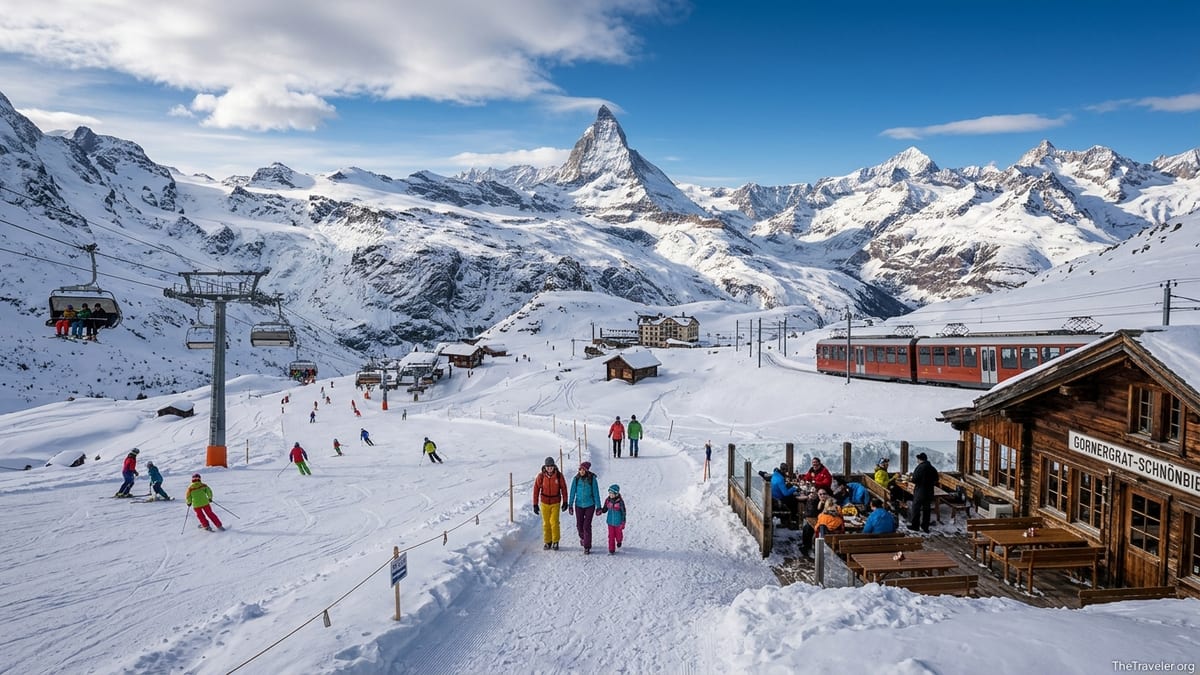
For non skiers, Zermatt is one of Switzerland’s strongest bases. The cog railway to Gornergrat, cable cars to Sunnegga and Rothorn, and the Matterhorn Glacier Paradise lift give pedestrians easy access to panoramic terraces with restaurant terraces and marked winter walking trails. In good conditions there are sledging runs, waymarked winter paths above Riffelberg and in the Gornergrat sector, and atmospheric strolls through the car free village with its historic barns and church square. Non skiers can buy pedestrian or “excursion” tickets rather than full ski passes; a current guide should always instruct readers to compare what each product includes in the latest tariff tables for Zermatt.
Zermatt is fully car free, which has key logistical implications. Drivers leave vehicles in large car parks or garages at Täsch in the valley and transfer onto frequent shuttle trains up to Zermatt. This makes the village pleasant to walk, but it also means luggage and ski equipment must be packed to handle the final train leg and a short walk or electric taxi ride to accommodation. Travel writers should highlight that heavy hard sided luggage can be inconvenient on snowy streets and narrow hotel alleys in mid winter.
Verbier and the 4 Vallées: Big Terrain for Experts and Mile Hunters
Verbier sits on a sunny plateau at around 1,500 metres in the canton of Valais and forms the central hub of the 4 Vallées, a linked ski region that connects Verbier to Bruson, La Tzoumaz, Nendaz, Veysonnaz and Thyon. The lift system reaches approximately 3,300 metres at Mont Fort, with most pistes above 2,000 metres, which contributes to strong snow reliability. The 4 Vallées is widely described in official information as Switzerland’s largest linked ski area by piste length, but writers should still double check current official piste figures before quoting any specific kilometre totals in copy.
The terrain mix around Verbier strongly favours confident intermediates and advanced skiers. There is some beginner friendly space on gentle slopes near the village and in La Tzoumaz and Bruson, but the resort’s reputation rests on its steep reds, moguls, itinerary routes and freeride lines reached from lifts such as Mont Fort and Mont Gelé. For expert skiers researching Swiss options, Verbier is a prime candidate for big verticals, challenging descents and off piste days with guides, while still offering expansive on piste mileage for strong intermediates.
Non skiers in Verbier can still enjoy the mountain scenery thanks to gondolas leading to mid mountain viewpoints with restaurants, sun terraces and short winter walks. The village itself is lively, with a dense concentration of bars, restaurants and spas, appealing to mixed groups where some people ski all day and others favour wellness and long lunches. Pedestrian lift tickets are usually sold separately from full ski passes, and inclusions can differ by season and by lift, so any up to date article should instruct readers to review the current price lists from the 4 Vallées lift company.
Verbier also illustrates how dynamic ski pass pricing now works in practice. Recent winter information from Swiss comparison sites shows example adult one day 4 Vallées passes at around 70 to 90 Swiss francs depending on the date and how far in advance they are purchased, with approximately 79 francs quoted for a representative day in the 2026 to 2027 season. These figures must be clearly labelled as dated examples and writers should direct readers to current online sales platforms or the official ticket shop for precise prices for their travel dates.
St. Moritz and the Upper Engadine: Glamour, Lakes and Scenic Rail
St. Moritz lies in the Upper Engadine valley in the canton of Graubünden at roughly 1,800 metres, above a string of frozen lakes and surrounded by several ski sectors including Corviglia, Corvatsch and Diavolezza/Lagalb. Corviglia is the main ski area directly above town, with lifts rising to over 2,400 metres and a dense network of mostly intermediate pistes. Corvatsch reaches roughly 3,300 metres at its highest point and offers longer, colder snow conditions and night skiing on selected dates, while Diavolezza and Lagalb provide high alpine glacier style terrain at similarly elevated altitudes. Official Engadin St. Moritz resources should be consulted for precise altitude figures and piste lengths for each sector.
The region’s skiing generally favours confident intermediates who enjoy long red runs, well prepared carving pistes and sunny slopes, though there are beginner areas close to town and at mid stations. Experts find steeper pitches and freeride options off Corvatsch and on certain FIS race pistes, but the overall tone is more about cruising and high mountain panoramas than purely about extreme terrain. St. Moritz also functions well for mixed groups who combine skiing with shopping, culture and spa time.
For non skiers, the Upper Engadine is exceptionally appealing. In winter the frozen lakes host walking and sometimes events, and the valley maintains an extensive network of winter walking and cross country ski trails between towns such as St. Moritz, Celerina, Pontresina and Sils. The Glacier Express and Bernina Express panoramic trains both pass through the region, providing spectacular winter rail journeys that do not require any skiing at all. Luxury hotels, designer boutiques, fine dining and thermal spas make St. Moritz a classic choice for readers seeking a high end winter atmosphere with or without time on the slopes.
Access is efficient by rail, with trains from Zurich or Chur climbing into the Engadine via the Albula or Vereina routes and depositing travellers close to the lakefront and resort centre. For drivers, winter tyre regulations and possible snow covered passes should be highlighted, and writers should emphasise the advantages of the well timed train and bus connections that link St. Moritz to its ski bases without the need for a car in town.
Jungfrau Region: Grindelwald, Wengen and Mürren for Views and Variety
The Jungfrau Region in the Bernese Oberland brings together the linked ski areas around Grindelwald and Wengen, plus the separate but nearby Mürren Schilthorn sector above the Lauterbrunnen valley. Official slope data for the Grindelwald Wengen ski domain shows base elevations just above 1,000 metres and top lifts around 2,300 metres, while the Mürren Schilthorn area starts higher and climbs to roughly 2,960 metres at the Schilthorn summit. These altitude ranges contribute to a mix of classic mid mountain tree lined skiing and more alpine, high ridge runs in good conditions.
The character of the Jungfrau skiing is predominantly intermediate, with long reds and blues winding beneath the Eiger, Mönch and Jungfrau peaks. Wengen and Mürren have historic village atmospheres, while Grindelwald offers a larger base with newer lift infrastructure. Beginners will find dedicated learning zones near village level and at mid mountain stations, while strong skiers can tackle steeper slopes and, in Mürren’s case, some more demanding terrain near the Schilthorn peak. For copy aimed at families and mixed ability groups, it is accurate to describe the Jungfrau Region as one of Switzerland’s more balanced and scenic mid sized ski regions.
For non skiers, the Jungfrau Region is outstanding. The mountain railways and cableways leading to Kleine Scheidegg, Männlichen, First and Schilthorn all accept pedestrians with separate excursion tickets, and in winter there are snow sure sledge runs and winter walking tracks linking many lift stations. The famous Jungfraujoch excursion operates year round, giving access to ice caves and high glacier viewpoints. It is important to distinguish between ski passes, which cover climbing lifts for skiers, and excursion or pedestrian products, which may bundle specific train and cableway journeys; inclusions change regularly, so a current guide must point readers to the latest Jungfrau Region tariff documents.
Wengen and Mürren are also either fully or largely car free. Visitors typically park in Lauterbrunnen or Stechelberg and continue by cog railway or cable car to the villages. This car free model shapes the visitor experience: streets are quiet and walkable, but transfers with luggage and ski equipment require an extra transport step. For family readers arriving by plane, it is worth stressing that the train journey from Zurich or Geneva via Interlaken adds scenic value, turning the transfer day into part of the holiday.
Family Friendly and Mid Sized Resorts: Saas-Fee and Central Switzerland
Alongside the headline names, Switzerland offers numerous mid sized and family oriented resorts that can suit readers who prioritise relaxed ambience, shorter queues and more manageable ski domains. In Valais, Saas Fee is a notable example: a high altitude, largely car free village at about 1,800 metres, encircled by glaciers and peaks above 4,000 metres. The ski area rises to over 3,500 metres, providing reliable snow and extensive intermediate terrain. There are beginner slopes close to the village and on the plateau above Felskinn and Morenia, making it a strong option for families who want snow sure conditions without the intensity of a giant interconnected region.
Non skiers in Saas Fee can walk through the compact, traffic free centre, use cable cars to reach panoramic restaurants, and follow marked winter trails above the valley. Toboggan runs, ice skating and child friendly snow parks are common in the winter programme. As with other car free destinations, travellers must park in large lots at the entrance to the village and continue on foot or by small electric taxi, so good luggage organisation and winter capable footwear are important.
In Central Switzerland, resorts such as Engelberg and the family focused areas of the Lucerne and Lake Lucerne region offer a different mix. Engelberg combines a historic monastery village with the high altitude Titlis sector, where lifts reach over 3,000 metres, and a lower, gentler area at Brunni that is well suited to beginners and children. Other nearby ski hills may have more modest altitude and piste figures but offer quieter slopes, short transfer times from cities such as Zurich and Lucerne, and lake views that appeal to non skiers who prefer walks and boat trips to continuous downhill skiing.
When profiling these mid sized resorts, writers should use relative language such as “compact family friendly ski area” or “one of the larger mid sized ski domains in Central Switzerland” rather than quoting precise kilometre totals from inconsistent sources. Emphasise altitude ranges, access from major airports and the balance between beginner, intermediate and advanced terrain over simple size comparisons.
Non Skiers and Pedestrian Access in Winter Resorts
Many readers research the Swiss Alps specifically as mixed groups that include keen skiers and companions who do not intend to ski. Resort choice is especially important for them. Zermatt, St. Moritz and the Jungfrau Region stand out for their extensive pedestrian lift access, winter walking trails and strong village ambience, while Verbier and Saas Fee also offer significant non skier infrastructure alongside their more ski centric appeal. When assessing a resort, a writer should consider how many major viewpoints are accessible to pedestrians, the variety of marked winter walking paths, and whether the village itself is attractive for strolling, shopping and café time.
Cable car and railway systems typically sell different products for skiers and pedestrians. A ski pass usually covers unlimited or time limited use of specific lifts and pistes for downhill skiing and snowboarding, but may or may not include high mountain excursions that are popular with non skiers. Pedestrian or “excursion” tickets focus on return journeys to scenic points and may bundle several routes into a pass valid for one or more days. Prices, age categories, seasonal promotions and included lifts vary significantly and change each winter, so professional travel writing should always urge readers to consult the latest tariff charts from local lift operators and tourism offices.
Winter hiking and sledging have become important alternatives to skiing in many Swiss resorts. Prepared winter walking paths are groomed separately from ski pistes and are often accessible from mid mountain lift stations, allowing non skiers to enjoy snowy landscapes without technical equipment. Sledge runs, such as those in Zermatt, Grindelwald and other resorts, are popular family activities but are also dependent on snow and safety inspections, so their operating days and hours can vary. A useful guide will mention these options and remind visitors to check daily information once in resort.
For non skiers, accommodation location matters just as much as lift access does for skiers. Staying close to a village centre or near a key lift base reduces time spent on cold, slippery walks and makes it easier to dip in and out of activities. Travel writers should encourage readers in mixed groups to choose base areas where non skiers can independently access cafés, shops, lakeside promenades or spa facilities without relying on a car or shuttle every time.
Logistics: Trains, Luggage and Car Free Resorts
Switzerland’s rail network is one of the most efficient ways to reach the Alps in winter. Direct or one change trains run from Zurich Airport and Geneva Airport to key gateways such as Visp and Brig for Valais resorts, Chur for Graubünden, and Interlaken for the Bernese Oberland. From these hubs, connecting mountain railways or postbuses lead into high valleys and up to resort bases. For many car free destinations, including Zermatt and Wengen, these final legs are not optional but the standard access route.
Travelling with ski equipment and winter luggage requires some planning. Swiss trains and buses accommodate skis and snowboards, but long changes with heavy bags can be tiring. Readers should be advised to use wheeled soft bags, pack boots and essentials in carry on size pieces they can lift easily, and to consider luggage forwarding services where available. In car free resorts, it is common to walk from the station to accommodation or to use small electric taxis or hotel snow shuttles; sturdy footwear and simple, easily handled luggage systems make this far more comfortable in snowy or icy conditions.
For visitors who prefer to drive, winter preparation is crucial. Mountain roads may require winter tyres and drivers must be prepared for snow, ice and occasionally closed passes. Many resorts operate valley parking schemes where guests leave vehicles in large car parks and continue by train, gondola or cable car. In Zermatt, parking is at Täsch; in Wengen and Mürren, parking is normally in Lauterbrunnen or Stechelberg. Detailed destination specific articles should explain these parking arrangements clearly so that readers factor parking fees and transfer times into their plans.
Within resorts, local buses, ski buses and short train shuttles link base stations and neighbourhoods. Their timetables often align with lift opening hours, but frequencies can reduce in shoulder periods. Writers should encourage travellers to download current timetables and resort apps before arrival and to allow extra time for connections on snowy days when services may slow due to weather.
Costs, Ski Schools and Rentals: Dated Examples
Prices for ski passes, lessons and equipment rentals in Switzerland are variable and increasingly dynamic, changing by date, demand and pre booking windows. Instead of claiming fixed costs, travel articles should offer clearly dated examples to give readers an order of magnitude, while directing them to official price lists for final figures. Recent comparisons for the 2026 to 2027 winter show adult one day passes in major areas like Verbier 4 Vallées often starting around the high 60s to 70s Swiss francs on off peak days and rising higher in peak periods when bought late, with example published figures around 79 francs for a representative day in that season. Such numbers must always be labelled as examples and tied to a specific season.
Ski school rates for children also vary by resort and by whether lessons are half day or full day. Contemporary Swiss ski school price lists for the 2026 to 2027 season show typical group lesson rates for children in mainstream resorts in the approximate range of around 90 to 120 Swiss francs for a single half day, with discounted per day rates when booking multi day packages. Higher profile or very high altitude resorts can be more expensive, while smaller local schools may offer slightly lower prices. Writers should advise readers to compare offers between official Swiss Ski and independent schools in their chosen resort and to book popular school holiday weeks early.
Equipment rental is widely available through chains and independent shops. Recent Swiss rental network data for 2026 indicates that a standard adult ski, boot and pole set hired for a week can equate to per day costs in the low to mid 40s Swiss francs when averaged across a multi day rental. Shorter hires and higher category equipment are usually more expensive per day, while children’s packages are cheaper. Again, these figures should be clearly presented as dated examples and readers should be directed to current rental price lists and possible online pre booking discounts in their chosen resort.
Whatever the exact prices, the key message is that winter sports in Switzerland are a significant investment and that budgeting should include not only lift passes and accommodation but also lessons, rentals, travel, mountain restaurant meals and insurance. Clear cost framing helps readers decide whether to concentrate budget on a shorter stay in a flagship resort like Zermatt or St. Moritz, or to opt for longer stays in more moderately priced mid sized resorts.
Safety, Conditions and Peak Period Crowding
Winter in the Alps involves real mountain risks. Avalanche danger is a central consideration for all off piste activities and sometimes affects open pistes and access roads. Resorts operate avalanche control systems and publish daily bulletins that classify risk levels, but these are only useful if visitors pay attention and follow local advice. Any responsible article on Swiss winter travel should stress that skiers and snowboarders must stay on open, patrolled runs unless they are with a qualified mountain guide and equipped with appropriate safety gear; ignoring closed signs or ropes can have serious consequences.
Cold weather and altitude also demand preparation. Even in sunshine, windchill at 2,500 to 3,500 metres can be severe, and conditions can change quickly. Layers of technical clothing, proper gloves, helmets, goggles and face protection are essential. High altitude sun exposure is intense in winter because of snow reflection, so high factor sunscreen and UV protective eyewear are necessary even on cloudy days. Visitors who are new to altitude should be reminded to hydrate, moderate exertion on the first day and pay attention to any symptoms such as headaches or dizziness.
Travel can be disrupted by heavy snowfall or strong winds that force lifts to close temporarily or that slow trains and road traffic. Switzerland’s infrastructure is robust, but storm days do occur each season. Writers should encourage a flexible mindset, with indoor activities, spas or village walks lined up as alternatives when weather shuts higher lifts. Travel insurance that covers delay and disruption is a sensible recommendation for international readers planning tightly timed trips.
Crowding is another form of risk and a practical concern. Around Christmas and New Year and during European school holidays, beginner zones and key lifts in famous resorts can become congested, which is stressful for novices and families. Prospective visitors should be advised that ski schools, rentals and popular hotels in Zermatt, Verbier, St. Moritz and the Jungfrau Region often book out for these weeks and that prices are at their highest. Those who can travel in early or mid January, or in the later part of March, often benefit from lower crowds, more lesson availability and sometimes better value.
Choosing the Right Winter Base: Matching Resorts to Traveller Types
With so many options, readers benefit from a simple decision framework. For expert skiers who prioritise challenging terrain, big verticals and off piste with guides, Verbier and Zermatt are strong first candidates, with Saas Fee, St. Moritz Corvatsch and Mürren Schilthorn as additional options. These areas combine high altitude, demanding runs and serious freeride reputations. However, writers should remind readers to cross check their choices against current piste maps, open lift plans and recent snow records for the precise winter they intend to travel.
For families with beginners, the priorities shift toward gentle slopes, good ski schools, shorter transfers and plenty of off snow distractions for children. The Jungfrau Region, Saas Fee, Engelberg and other mid sized Central Swiss resorts can work particularly well, as can the quieter sectors of large domains such as La Tzoumaz within the broader 4 Vallées. A well balanced article will suggest that families research where nursery slopes sit relative to accommodation, what languages local instructors teach in, and how crowded the resort tends to be at school holiday times.
Non skiers or mixed groups where only some members ski are often happiest in resorts with strong pedestrian infrastructure and attractive villages. Zermatt, St. Moritz and the Jungfrau villages of Wengen and Mürren stand out here, as each combines iconic viewpoints, winter walking routes and a village centre with cafés, restaurants and shops. Clear guidance should be given about the difference between ski lifts and excursion tickets, and readers should be told to compare pedestrian passes and scenic train offers in current brochures before committing to a base.
For luxury focused couples, St. Moritz and Zermatt are classic choices with five star hotels, high end dining and spa facilities, followed by Verbier for a more contemporary, nightlife driven feel. These readers may ski less intensely and care more about ambience, gastronomy and exclusive experiences such as private guides, helicopter sightseeing or gourmet mountain lunches. Whatever the profile, the final editorial message should emphasise that choosing a resort is only the first step; travellers should always validate their selection by checking up to date piste maps, snow histories, transport connections and price structures for the specific year of travel before they book.