


More news on this day
Switzerland’s tourism industry is riding a powerful upswing as the Grand Train Tour of Switzerland marks its 10th anniversary, aligning a decade of rail-based Alpine discovery with a run of record overnight stays and renewed global demand for sustainable, scenery-rich travel.
Get the latest news straight to your inbox!
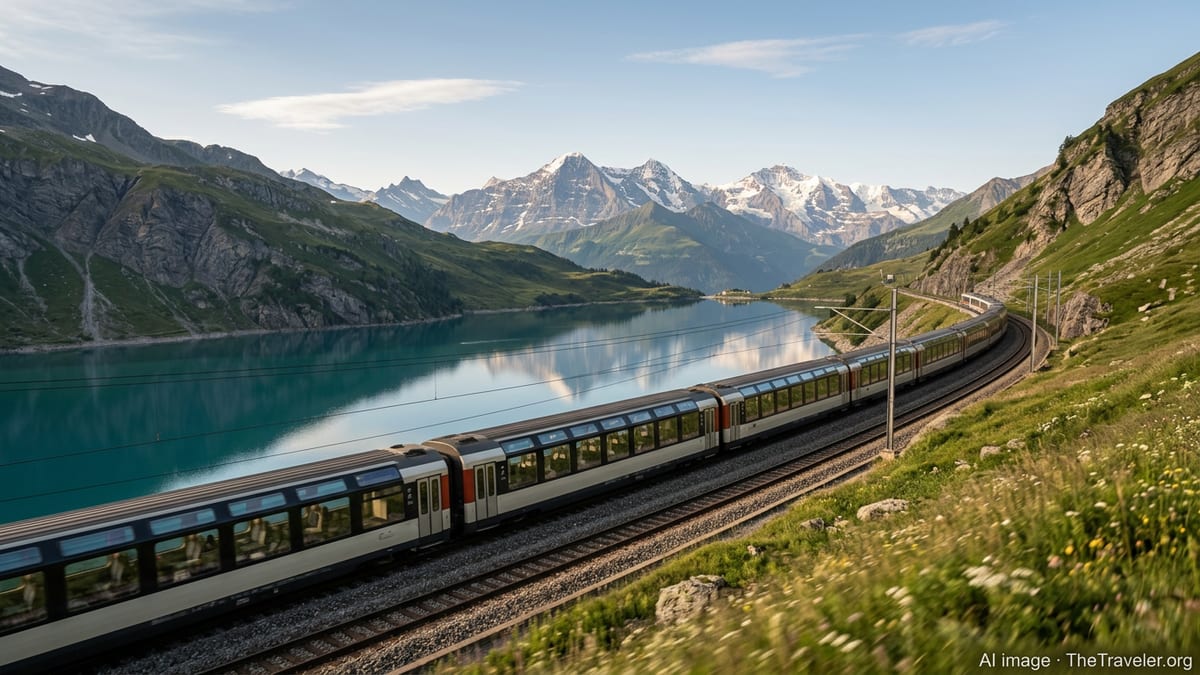
Rail Anniversary Coincides With Record Visitor Numbers
The Grand Train Tour of Switzerland was launched in 2014 as a rail itinerary that links the country’s most celebrated panoramic routes into a single, continuous journey. Publicly available information describes a roughly 1,280 kilometer loop that can be joined at multiple points and travelled year-round, connecting lakeside cities, glacier landscapes and historic mountain resorts across the country’s dense railway network.
The 10 year milestone comes at a moment of sustained strength for Swiss tourism. Data from the Swiss Federal Statistical Office indicates that hotel overnight stays reached a record 41.8 million in 2023, then climbed again in 2024 to around 42.8 million, and rose further in 2025. These consecutive records point to a robust recovery from the pandemic period and a structural increase in demand for stays in the country’s destinations.
Federal figures also show that foreign visitors have been driving much of the recent acceleration, with international overnight stays growing faster than domestic demand in both 2023 and 2024. Industry analysts note that this renewed international appetite is particularly visible in key Alpine regions served by the long-distance rail lines that make up the Grand Train Tour, such as central Switzerland, Graubünden and the Bernese Oberland.
Tourism agencies and transport operators are using the anniversary to emphasize Switzerland’s distinctive model of rail-centered holidaymaking, presenting the Grand Train Tour as a flagship product at a time when the country’s overall visitor economy is expanding in both volume and geographic reach.
A Decade Linking Iconic Alpine Rail Journeys
Conceptually, the Grand Train Tour stitches together several of Switzerland’s best known scenic railways into a single package. Public descriptions highlight routes that include the Glacier Express between Zermatt and St. Moritz, the Bernina line over the Bernina Pass toward Italy, the GoldenPass corridor linking Montreux with Interlaken and Lucerne, and the Gotthard panorama axis through the historic north south Alpine crossing.
Rather than a single ticketed train, the tour functions as a curated framework. Travelers can start in major gateways such as Zurich, Geneva or Basel, then follow signposted legs that loop through Lucerne, Interlaken, Montreux, Zermatt, St. Moritz and Lugano, among others. The route passes four language regions, 11 lakes and a series of UNESCO listed landscapes, turning the national timetable into an integrated sightseeing circuit.
Reports indicate that over its first decade the concept has increasingly appealed to visitors seeking slower, more immersive trips through the Alps, in contrast to rapid, city hopping itineraries. The ability to disembark for several nights in mountain valleys, spa towns or compact cities while remaining on a single coherent rail route has been promoted as a key differentiator compared with traditional point to point rail tickets.
Travel trade coverage suggests that the Grand Train Tour has also become a useful marketing platform for regional railways, mountain cableways and local tourism boards, which align their products with specific stages of the loop. As the tour enters its second decade, many of these partners are tying new offers, upgraded rolling stock and station refurbishments to the rail journey’s anniversary year.
Tourism Boom Driven by International Demand and Year Round Travel
The timing of the anniversary underlines how central rail based discovery has become to Switzerland’s tourism boom. Federal Statistical Office data for 2024 shows record hotel nights across both winter and summer seasons, with particularly strong growth from foreign guests in major Alpine cantons. The most recent figures for 2025 indicate that total overnight stays have continued to rise, supported by higher international arrivals.
Industry observers link this momentum to several structural trends. One is the broad reopening of long haul markets, including North America and parts of Asia, which is feeding back into classic Alpine rail itineraries that feature on many first time European trips. Another is the renewed popularity of combined city and mountain holidays, for which the Grand Train Tour’s loop between Zurich, Lucerne, Interlaken and Lake Geneva provides a straightforward template.
Year round operation is also helping to smooth seasonal peaks. The panoramic sections of the tour run in all four seasons, offering winter views of snowbound passes and summer access to hiking regions from the same core rail infrastructure. Hotel statistics point to particularly strong performances in the winter 2023 2024 and winter 2024 2025 seasons, when demand from both skiers and non skiers using rail to reach mountain resorts exceeded previous records.
Reports from booking platforms and destination marketing organizations further indicate that visitors are staying slightly longer and spending more on experiences connected to landscape appreciation, such as lake cruises, mountain excursions and scenic detours on branch lines that link into the main Grand Train Tour corridor.
Rail Sustainability Narrative Resonates With Global Travelers
Switzerland’s wider reputation for efficient public transport is giving additional weight to the anniversary narrative. Publicly available performance summaries from Swiss Federal Railways and regional operators emphasize high train frequencies, extensive electrification and clockface timetables that make it possible to traverse large sections of the Grand Train Tour without long waits or complex planning.
In an era of growing climate awareness, the fact that the Grand Train Tour is built almost entirely on electrified lines has become a key marketing point. Tourism campaigns increasingly highlight rail holidays as a lower emission alternative to rental car itineraries in the Alps, positioning the country as a destination where iconic landscapes can be accessed while keeping transport footprints relatively modest.
Academic and policy discussions on sustainable tourism frequently single out Switzerland as a case study in how infrastructure and marketing can reinforce one another. The Grand Train Tour encapsulates this dynamic by using an existing network of intercity and regional trains as a branded experience, encouraging visitors to explore more widely without adding new high impact roads or air links to sensitive mountain environments.
Travel media coverage notes that this alignment of sustainability messaging with a tangible, easy to follow product has resonated particularly strongly with younger and long haul travelers, many of whom now seek out rail based journeys as a core part of their European itineraries rather than as an add on.
Regional Destinations Position for the Next Decade
As the Grand Train Tour moves into its second decade, destinations along the route are adjusting their offerings to capture a larger share of the growing visitor base. Resorts in regions such as Graubünden, Valais and central Switzerland are promoting new hotel concepts, upgraded mountain transport and expanded cultural programming that dovetail with rail arrival patterns and encourage multi night stays.
Several cantons are also refining their visitor management strategies in response to higher volumes. Publicly available planning documents describe efforts to better distribute guests across seasons and subregions, with more marketing of shoulder season hiking, wellness and gastronomy experiences reachable by train. The goal is to reduce pressure on a handful of overcrowded viewpoints while spreading the economic benefits of the tourism boom.
At the same time, transport authorities and rail companies are investing in capacity and comfort enhancements on key panoramic corridors. New rolling stock on routes such as the Glacier Express and Bernina line, station upgrades in cities that serve as gateways to the tour, and digital tools that simplify seat reservations are all being framed as part of a longer term strategy to keep the rail journey attractive even as passenger numbers rise.
Analysts expect that, if current overnight stay trends continue and international connectivity remains stable, the Grand Train Tour will play an even larger role in shaping how visitors experience Switzerland over the next decade. The combination of strong tourism growth, a mature rail network and global interest in low impact, scenery led travel is positioning the anniversary not only as a look back at 10 years of Alpine discovery but as a preview of the journeys to come.