


More news on this day
Hundreds of flights at Sydney Airport have faced delays and cancellations in recent weeks as a shortage of air traffic controllers triggers repeated capacity restrictions and exposes pressure points in Australia’s busiest aviation hub.
Get the latest news straight to your inbox!
Rostering constraints trigger widespread disruption
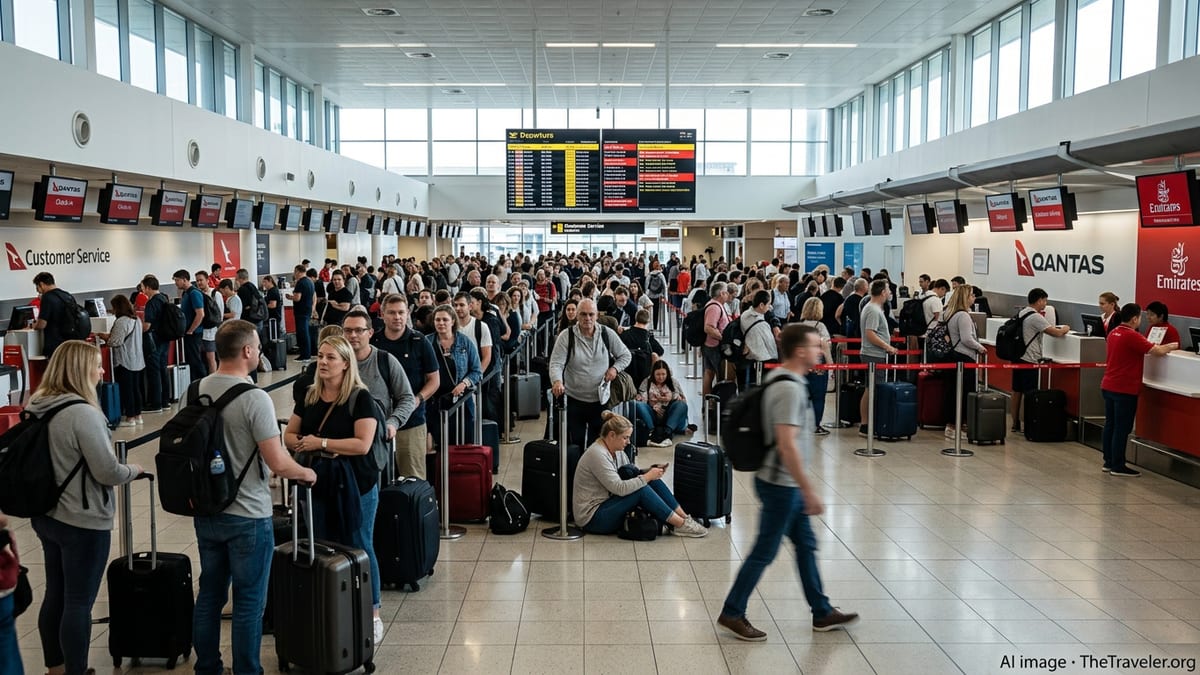
Operational reports from early August indicate that Sydney Airport experienced more than 150 flight delays in a single morning as the air traffic tower operated under roster constraints, forcing traffic flow restrictions and long queues throughout the terminals. Airlines reduced takeoff and landing rates during peak periods, leading to rolling knock-on delays across domestic and international networks.
Publicly available information shows that capacity limits linked to air traffic management, rather than weather, were a key factor behind the disruption. Ground delay programs were introduced to manage the volume of aircraft allowed to depart and arrive, meaning some services left hours behind schedule while others were cancelled outright when aircraft and crew could no longer be efficiently repositioned.
Because Sydney handles the majority of Australia’s trunk-route traffic and serves as a critical hub for connections nationwide, disruptions at the airport rapidly cascaded into other capitals and major regional centres. Passengers reported extended waits at check-in and security screening, with some travellers facing missed connections and forced overnight stays as flight banks were reshuffled.
Airlines urged travellers to monitor flight status closely and arrive early, while also reshaping schedules on short notice to work within the reduced hourly movement limits. The pattern of delays underlined how sensitive the network has become to even small reductions in airside capacity when staffing is stretched.
Safety incidents highlight staffing pressures
The wave of delays has unfolded alongside increased scrutiny of safety performance at Sydney Airport, where recent near-miss incidents have drawn national attention to the demands on controllers. Published coverage describes a ground incident involving Jetstar and Qatar Airways aircraft in August, when one aircraft was forced to brake on the tarmac to avoid a potential collision as traffic operated under temporary restrictions.
Additional reports detail multiple safety events on or near the runways in recent months, prompting questions from Australia’s transport safety investigators about how and when these occurrences were reported. The incidents have intensified debate about whether chronic staffing pressures in the control tower and ground control positions are contributing to operational risk, even as the system continues to prioritise separation and conservative flow management.
Industry analysis notes that safety protocols require air traffic managers to slow or cap movements when staffing falls below planned levels so that remaining controllers can handle traffic safely. While this reduces risk in the short term, it also leads directly to longer taxi times, airborne holding and cancellations, especially during morning and evening peaks when demand significantly exceeds the constrained capacity.
Public documents submitted to government inquiries in recent years have warned that staff shortages at Sydney Airport can trigger widespread disruption when unplanned absences occur. These submissions point to ground delay programs, limited spare capacity to cover sick leave and growing traffic volumes as key elements in a structural challenge that has now spilled into full public view.
Structural controller shortage years in the making
Background material from regulators, unions and operators indicates that the current shortage of air traffic controllers is the result of long-running workforce and training dynamics rather than a sudden shock. Airservices Australia, the national air navigation provider, has acknowledged a structural shortfall and pointed to constraints in training pipelines, retirement patterns and the time required to qualify new recruits.
Official network reports show that, even as controller numbers have been gradually increased in recent years, demand for services at major airports such as Sydney has rebounded strongly from the pandemic downturn. The combination means that rosters often rely on overtime and a small pool of available standbys, leaving little resilience when illness or other absences arise at short notice.
Evidence provided to recent government reviews of Sydney Airport operations highlights the significance of this imbalance. Documentation from both the airport operator and airlines estimates that staff shortages in air traffic control have been responsible for a notable share of delays and cancellations, particularly when they trigger flow restrictions during high-demand periods. These papers argue that, with passenger and flight numbers approaching or exceeding pre-2020 levels, resolving controller shortages should be treated as a priority for the national aviation system.
Industry observers also note that Sydney’s noise curfew, hourly movement caps and runway configuration can amplify the impact of any staffing constraint. When the number of permitted movements is already tightly regulated, there is less flexibility to absorb schedule changes or clear backlogs once flow rates are reduced.
Airservices outlines remedial steps
According to public statements from Airservices Australia’s leadership, a series of remedial steps is under way to stabilise operations at Sydney. The agency describes a program to build a larger pool of standby controllers, reduce reliance on overtime and deliver more predictable rosters in the tower and approach units that serve the airport.
Recent updates indicate that eight new tower controllers have been endorsed at Sydney over the past 18 months, with further recruitment of both experienced controllers and trainees in progress. A new Sydney Tower simulator has also been installed to expand training capacity, which Airservices says will support a pipeline of additional controllers over the coming years as courses progress and ratings are achieved.
Government ministers have referenced targets for dozens of new controllers to be endorsed nationally by the end of the year, with a portion expected to be placed in Sydney. However, because full training and on-the-job assessment for tower roles can take up to two years, aviation analysts caution that the benefits of current recruitment efforts will arrive gradually rather than immediately resolving the present bottlenecks.
Airservices has also pointed to a reported reduction in delays attributed to its operations over the past two years across the national network, while acknowledging that Sydney remains a particular pressure point due to its traffic density and regulatory constraints. The organisation has signalled that addressing Sydney’s controller shortage and roster resilience will remain a central focus for its performance improvement work.
Impact on travellers and the broader network
For passengers, the most visible impact of the controller shortage at Sydney has been longer waits, missed connections and reduced reliability on some of Australia’s busiest routes. Travel data and media coverage show that high-frequency corridors such as Sydney to Melbourne, Brisbane and key regional centres are especially exposed when capacity is reduced, because there are few spare aircraft and limited slots available to re-accommodate disrupted travellers.
Airlines have responded by adjusting schedules, using larger aircraft on some services and holding additional reserve capacity where possible, though this can raise operating costs and constrain flexibility elsewhere in their networks. Some carriers have also emphasised that air traffic management issues are just one contributor to disruption alongside weather, engineering checks and crew availability, even if they are currently prominent at Sydney.
Observers suggest that continued transparency about the causes of delays, along with realistic passenger communication, will be important as remedial programs progress. With more controllers moving through training and new rostering practices being introduced, the expectation across the industry is that the frequency and severity of disruption should ease over time, provided recruitment targets are met and demand does not outstrip planned capacity.
For now, Sydney Airport remains a case study in how staffing constraints in a single critical function can reverberate throughout an entire aviation network, turning local roster gaps into a national travel headache.
ABC News: Sydney Airport faces delays as passengers advised to check with airlines
SBS News: Runway near-miss and significant delays at Sydney Airport
Airservices Australia: Statement from the CEO on Sydney disruptions
The Guardian: What is behind Sydney Airport’s heavy delays and near-miss incident