


More news on this day
A rapidly shifting map of no fly zones across Iran, Iraq, Israel and much of the Gulf has pushed airlines into an improvised web of Mediterranean and Levant corridors in 2026, with Syria now joining Turkey, the United Arab Emirates, Qatar, Saudi Arabia, Jordan, Lebanon, Egypt, Cyprus, Greece and others as thousands of flights abandon traditional Middle East routes.
Get the latest news straight to your inbox!
A Regionwide Closure Triggers Historic Rerouting
Beginning with joint strikes on Iran in late February 2026, a cascade of airspace shutdowns and severe restrictions has redrawn the map of global aviation. Publicly available NOTAM summaries and government travel advisories indicate that Iran remains fully closed to civil overflights, while Iraq and Israel are subject to extensive restrictions tied to ongoing military operations and missile threats. Several Gulf states, including Qatar and the United Arab Emirates, have periodically suspended or sharply curtailed flight activity during peak escalation periods.
Industry analyses describe the disruption as the largest rerouting of commercial traffic in the Middle East since the early 2000s conflicts in Iraq. Data collated by aviation consultancies and trade bodies suggests that tens of thousands of flights that would normally cross Iranian, Iraqi or Israeli airspace have been forced onto longer, more circuitous paths, adding hours to flight times between Europe, Asia and East Africa and significantly increasing fuel burn and operating costs.
The sudden shrinkage of usable skies over the Gulf comes on top of longstanding closures over parts of Syria and Yemen and earlier restrictions linked to GPS spoofing and drone activity. Airlines that had already been skirting Russian and Ukrainian airspace due to the war in Eastern Europe now face an additional layer of constraints, concentrating global traffic into a handful of remaining corridors.
This confluence of conflicts and regulatory advisories has compressed flows into the eastern Mediterranean basin and the Levant. Traffic data cited in recent economic reports shows a marked jump in overflights through the flight information regions of Turkey, Cyprus, Greece and Egypt as carriers search for stable, insurable routes that still allow commercially viable long haul operations.
Syria Reopens Corridors and Joins the Detour Network
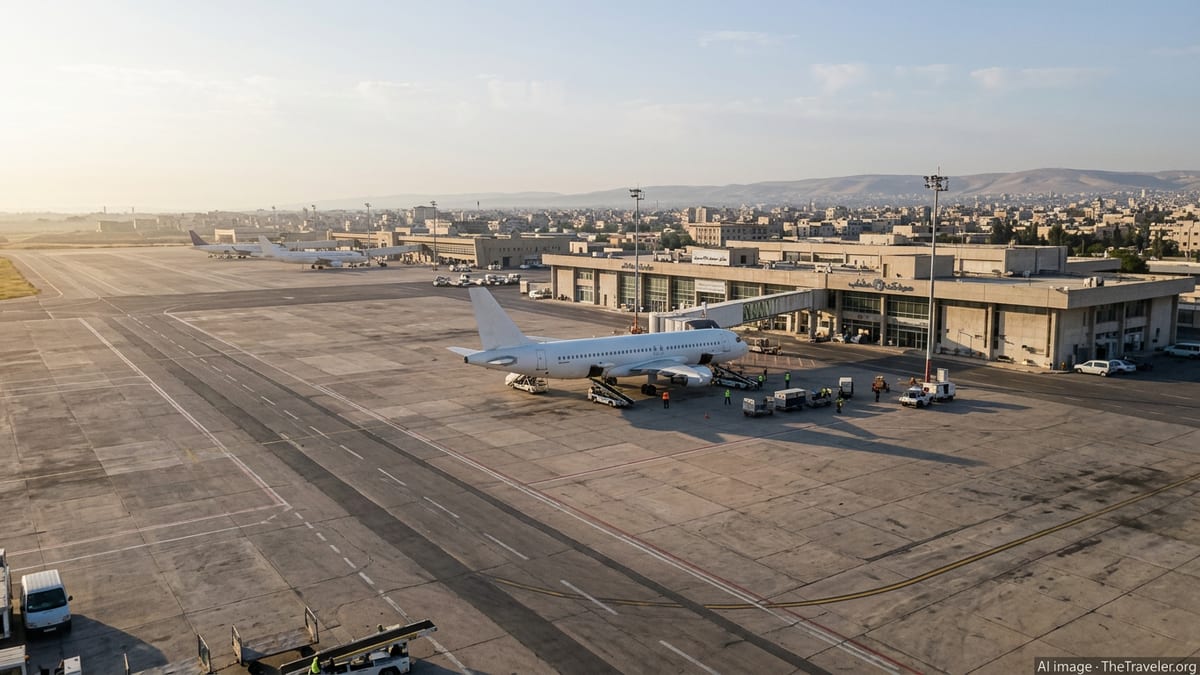
A notable twist in 2026 has been Syria’s reappearance on international flight maps. After years in which most major airlines avoided Syrian airspace due to security concerns and regulatory guidance, the country’s civil aviation authority has moved to reopen selected corridors, pitching them as a safety valve for the wider regional snarl.
In early March, official Syrian channels announced the activation of a corridor from Aleppo toward the Mediterranean Sea and new routings in the northern portion of Syrian airspace toward Turkey, following what authorities described as operational and security assessments. In June, further statements confirmed that southern air corridors had reopened and that flights had resumed at Damascus International Airport, following a lull in cross border strikes involving Iran and Israel.
These steps have allowed certain carriers, particularly those already operating to or near Syrian destinations, to incorporate Syrian-controlled segments into alternative routings between the eastern Mediterranean and Turkey. While many large Western and Asian airlines continue to avoid Syria in line with insurance and regulatory guidance, regional operators and cargo carriers appear to be making greater use of the newly opened tracks to thread between closed or high risk zones further east.
The reopening also aligns Syria, at least partially, with a broader ring of states that have become critical to keeping intercontinental traffic moving. Together with Turkey, Jordan, Lebanon, Egypt, Cyprus and Greece, Syrian airspace now forms part of an evolving mosaic of north south and east west routes that divert aircraft away from Iran, Iraq and Israel while still connecting Europe with the Gulf, the Indian subcontinent and Southeast Asia.
New Mediterranean and Levant Corridors Take Shape
As traditional Gulf centric corridors have narrowed or shut entirely, airlines have stitched together new paths that hug the Mediterranean and skirt the Levant. Flight tracking data and route maps published by aviation research groups show a pronounced shift of Europe Asia services toward two broad families of alternatives, both of which intersect with the eastern Mediterranean.
One pattern routes aircraft from major European hubs over southeastern Europe into Turkish or Greek airspace, then across Cyprus and parts of the Levant before dipping south through Egypt and onward to the Red Sea or Arabian Sea. This structure effectively replaces direct Gulf transits with a longer dogleg, using Mediterranean littoral states as stepping stones to open sections of Saudi and Omani airspace en route to South and East Asia.
A second pattern sends aircraft deeper into the northern arc, using Turkey as a gateway to Caucasus and Central Asian routings that avoid both the Gulf and the most heavily militarised sectors of the Middle East. Even in these cases, however, Mediterranean segments often feature in departure or arrival legs, funnelling additional flights into skies above Greece, Cyprus and the Aegean.
Across both patterns, Jordan, Lebanon and now Syria play varied roles as waypoints or adjacent control zones, depending on the carrier, destination and insurance limitations. Some airlines appear to prefer routings that technically remain just outside the most heavily risk flagged flight information regions, relying on close coordination between neighbouring air navigation service providers to maintain safe separation as flows intensify.
Economic Shock for Gulf Hubs, Windfall for Mediterranean Gateways
The redirection of traffic has produced starkly divergent fortunes for airports and air navigation providers. Gulf super hubs built on the promise of unconstrained overflight and rapid east west connectivity have experienced sharp declines in throughput as closures and conflict risk undercut their ability to function as global crossroads. Industry monitoring platforms report that in key months of 2026, some major Gulf airports recorded double digit percentage drops in movements and tens of thousands of cancelled or diverted flights compared with the previous year.
At the same time, Mediterranean and Levant hubs are seeing a surge in overflight fees and, in some cases, additional passenger traffic as airlines restructure schedules. Economic analysis by airline associations indicates that certain European and North African states along the new corridors have registered year on year increases in transit volumes, even as overall global demand softens in response to higher fares and traveller anxiety about the region.
For carriers, the financial impact is substantial. Reports by aviation consultancies suggest that detour routes around Iran and the central Gulf can add hundreds of kilometres to a typical Europe Asia sector, translating into several tonnes of extra fuel consumption per flight. Combined with elevated oil prices and war risk premiums, these longer routings have pushed up operating costs and contributed to fare increases on affected city pairs.
Airspace and airport authorities in the Mediterranean are moving to capitalise on the trend where possible, announcing capacity enhancements, slot adjustments and upgraded air traffic management systems. Yet many also caution that their apparent windfall is rooted in regional instability and could reverse if conflict dynamics change or if regulators impose new limits on overflights for safety reasons.
Uncertain Outlook as Safety Advisories and Politics Evolve
The sustainability of the new Mediterranean and Levant corridors remains highly uncertain. European and international regulators continue to issue and update conflict zone bulletins that advise operators to avoid wide swathes of Middle Eastern airspace at all altitudes, citing risks from missiles, drones and sophisticated air defences. Insurers, meanwhile, are frequently recalibrating premiums and coverage criteria for airlines operating anywhere near the conflict envelope.
Publicly available information suggests that, even where airspace is not formally closed, many carriers choose to avoid certain regions entirely due to the risk of sudden escalations or the possibility that navigation systems could be degraded. Experts who track GPS interference and spoofing incidents describe the broader Middle East as one of the world’s most challenging environments for aviation navigation, further complicating decisions about whether to restore pre war routings.
Against this backdrop, the role of Syria and its neighbours as alternative corridors is likely to remain fluid. Any renewed cross border strikes, domestic instability or changes in international sanctions policy could quickly alter the calculus for airlines and regulators, either enhancing or undermining the appeal of these routes. Conversely, a durable ceasefire and coordinated steps to reopen key Gulf and Iranian flight information regions would reduce the pressure on Mediterranean skies and could shift traffic back toward traditional hubs.
For now, airlines, air traffic managers and travellers are operating in a landscape defined by contingency. The rise of Syria and other Levant states as critical waypoints in 2026 underscores how swiftly geopolitical shocks can reorder global aviation, turning once marginal or avoided airspaces into essential arteries almost overnight.