


Since the powerful earthquake that hit Taiwan’s east coast on 3 April 2024, traveling from Taipei to Hualien and into the Taroko region has changed in important ways. Trains are running and Taroko National Park has partly reopened, but many classic gorge attractions remain closed and access depends on strict mountain road controls. This guide explains how to book trains, what still works for visitors in late 2026, and how to plan a realistic trip that puts safety first.
Get the latest updates straight to your inbox!
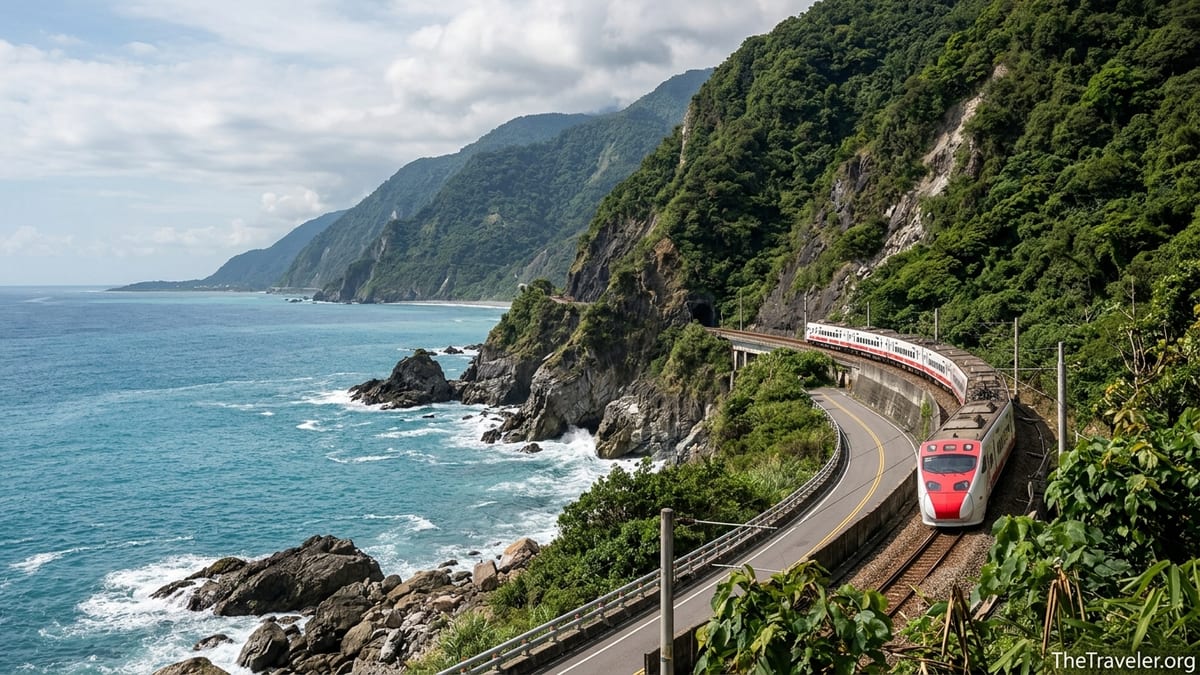
Understanding the Taipei–Hualien Rail Route
The main way most travelers reach Hualien from Taipei is on the Taiwan Railways Administration’s Eastern Line, which follows the northeast coast before cutting through the rugged mountains of Hualien County. On this route you will see trains labeled Puyuma Express, Taroko Express, Tze-Chiang Limited Express, Chu-Kuang Express and local “區間” services. All are operated by Taiwan Railway, not the separate high-speed rail company, and nearly all long-distance Taipei–Hualien trains are timed to connect the capital with Hualien in roughly two to three and a half hours.
The fastest services are Puyuma Express and Taroko Express trains, which are fully reserved express services using tilting trainsets designed for curvy tracks. On the current timetable, a non-stop or limited-stop Puyuma or Taroko between Taipei and Hualien can complete the journey in about two hours, with fares around NT$440 one way in standard class according to official Hualien County transport information. Slower Tze-Chiang Limited Express services, including the newer EMU3000 sets, usually take between about 2 hours 20 minutes and 3 hours depending on how many intermediate stops are scheduled.
Chu-Kuang Express and local trains form an important backup if express tickets sell out. They are significantly slower, commonly taking from just under three hours up to about four hours, but they run along the same basic route. Local trains stop at every station, which can be helpful if you want to get off at smaller stations between Taipei and Hualien, though tourists rarely choose them unless everything else is sold out.
Train frequency on the Taipei–Hualien section remains high by international standards, with a mix of express and local services throughout the day. However, Puyuma and Taroko Express departures in particular are popular with both tourists and local residents. On weekends, national holidays and during peak travel seasons such as Lunar New Year or long weekends, seats on the fastest trains often sell out soon after tickets are released, so forward planning is important.
Puyuma, Taroko, Tze-Chiang and Booking Rules
The key operational difference among long-distance services on the Eastern Line is whether seats are reserved only or a mix of reserved and non-reserved. Puyuma Express and Taroko Express services are classified as Tze-Chiang class but require reserved seats for all passengers. Taiwan Railway’s own information makes clear that Taroko, Puyuma and other EMU3000 Tze-Chiang trains require advance seat reservations and do not allow standing tickets between Taipei and Hualien. By contrast, some conventional Tze-Chiang services still allow a small number of standing or non-reserved passengers, though this is not guaranteed when trains are busy.
According to the official Taiwan Railway online booking guidelines, reservations for most trains open four weeks, or 28 days, before the date of travel. On Fridays, an additional booking window sometimes opens for Sunday travel four weeks ahead, which can help if you are trying to secure a specific weekend train. Tickets reserved online must be paid for and collected within two days of booking, either at a station ticket counter, at ticket machines, or at major convenience store chains across Taiwan. If you book within two days of departure, payment needs to be completed by 24:00 the day before travel.
International visitors can book directly on the Taiwan Railway website or via the official TRA app in English. You will generally enter your passport number when reserving, then collect the tickets after arrival in Taiwan using the booking code and the same passport at any staffed station or at convenience stores. Recent traveler reports in 2025 and 2026 confirm that foreign-issued credit cards often work more reliably through the official app than the website, and that Apple Pay or Google Pay integration has made payment easier for some users. However, technical issues are still common, so it is sensible to create an account and test the system a few days before your 28-day purchase window opens.
For popular departure slots, such as a Friday afternoon Puyuma from Taipei to Hualien, tickets can disappear within minutes of the 28-day release. For off-peak midday departures on regular weekdays, seats on Tze-Chiang and some express services can still be available much closer to the day of travel. If you cannot secure a Puyuma or Taroko, checking for an EMU3000 or other Tze-Chiang Limited Express on the same route often yields acceptable journey times with a slightly longer schedule.
Hualien vs Xincheng Taroko Stations and Luggage
Travelers headed for Taroko National Park can choose between two main arrival stations: Hualien and Xincheng (Taroko). Hualien Station is the regional hub located in Hualien City, about 30 minutes by car from the main Taroko National Park entrance. Trains from Taipei stop here most frequently, with a large number of Puyuma, Taroko, Tze-Chiang and local services each day. Hualien is the best choice if you plan to use the city as a base for two or more nights, connect to taxis or car rentals, or explore other coastal attractions such as Qixingtan.
Xincheng (Taroko) Station is a smaller station closer to the park entrance in Xincheng Township. Some express trains to and from Taipei stop here, though not all. From the station, it is a relatively short taxi ride or a longer walk to the Taroko Visitor Center and the park’s east gate. If your main goal is to maximize time inside or near the park and stay in one of the guesthouses around Xincheng, it can be convenient to arrive directly at Xincheng. However, your options for restaurants and evening activities will be limited compared with Hualien City, and not every train category runs to or stops at Xincheng, which narrows your booking choices.
Luggage rules on Taiwan Railway are straightforward but worth noting. The railway allows passengers to take hand luggage and larger suitcases as long as they can be stored safely in the overhead racks, under the seat, or in designated luggage spaces without blocking aisles or doors. Bicycles usually require specific bike-friendly trains or packing in bags according to TRA rules. Very large or heavy items may be refused at the discretion of station staff or conductors. In practice, visitors carrying one large suitcase and one small backpack per person rarely encounter problems on Taipei–Hualien services, although overhead rack space on Puyuma and Taroko Express trains can fill up quickly during peak holiday periods.
Accessibility has gradually improved on the Eastern Line. Newer EMU3000 Tze-Chiang sets and many major stations, including Taipei and Hualien, provide wheelchair spaces, accessible toilets and step-free station access. Taiwan Railway’s seat booking interface lists wheelchair seat options for Tze-Chiang 3000, Taroko and Puyuma services. However, some older platforms and smaller stations may still involve gaps or small steps between train and platform, so travelers with limited mobility should plan extra time for boarding and, if possible, contact Taiwan Railway or their hotel in advance to confirm the most suitable trains and stations.
Scenery, Disruptions and What Happens When Trains Go Wrong
The Taipei–Hualien railway is one of Taiwan’s most scenic mainline routes. After leaving the built-up Taipei basin, trains follow the northeast coast past Keelung and Yilan, with frequent views of the Pacific Ocean. On a clear day, passengers on the right-hand side when traveling from Taipei can enjoy dramatic coastal views, including sections where the tracks run just inland from rocky headlands. South of Yilan, the line threads through tunnels and along the base of steep hills before emerging into the broader Hualien plain.
Following the April 2024 earthquake, repair crews worked to stabilize slopes and bridges along the Eastern Line, and as of late 2026 there is no sustained rail closure between Taipei and Hualien attributable to the quake itself. However, Taiwan is seismically active and vulnerable to typhoons, and temporary suspensions still occur due to heavy rain, landslides or technical faults. When sections of the line close, Taiwan Railway may either cancel trains outright or arrange replacement buses on part of the route. Real-time information is announced at stations and through the TRA app.
If your train is cancelled before departure, station staff will usually offer the option of switching to another train, re-routing via a different service, or receiving a refund. If you have a reserved Puyuma or Taroko Express that is significantly delayed, compensation policies depend on the length and cause of the delay, and refunds usually have to be requested on the day of travel at a staffed counter. If disruption is serious enough that you cannot reach Hualien on the same day, station staff may help with rebooking but do not normally provide accommodation, so independent travel insurance remains essential.
For visitors, the most practical way to respond to unexpected disruption is to build flexibility into travel days. For example, on a Friday afternoon in typhoon season, consider allowing extra transfer time and not scheduling non-refundable activities in Hualien for the evening of arrival. Keeping a screenshot or printout of your ticket and knowing at least one or two later trains on the timetable can make it easier to ask staff about alternatives if your original service is not running.
Taroko National Park After the 2024 Earthquake
Taroko National Park itself suffered extensive damage in the 3 April 2024 earthquake, and repairs have proven complex and slow. Official announcements from the park headquarters in the weeks after the quake stated that all trails and facilities in the park were closed while safety assessments were carried out. In 2025 and 2026, reopening has been gradual and partial, with some roadside viewpoints, short low-risk trails and parts of the Lushui and Tianxiang areas reopening under strict conditions, while much of the gorge’s most famous hiking infrastructure remains shut.
As of late 2026, reliable updates from tour operators and local news outlets that cross-check the park’s Chinese-language notices indicate that several iconic trails remain closed. Shakadang Trail, which suffered deadly rockfalls during and immediately after the earthquake, is still closed to the public. Swallow Grotto, Baiyang Trail and the steep Zhuilu Old Trail are likewise reported as closed or unbookable, with repair work and rockfall risk cited as reasons and no firm timeline publicly announced for full reopening. Some sources conflict over the status of the Tunnel of Nine Turns, with scattered reports of limited or guided access, but up-to-date English information from the park is difficult to verify and visitors should treat this section as closed unless an on-site ranger or the official visitor center confirms otherwise in person.
On the other hand, specific areas near the eastern entrance and around Tianxiang have reopened in limited ways. The Taroko Visitor Center and the short Dekalun Trail near the park entrance generally operate as the first stop for information and safety briefings. Higher up the gorge, Tianxiang’s small cluster of facilities, including the Xiangde Temple trail and the Tabiduo or Tabito area above the river, has been highlighted by both local authorities and recent visitor reports as being open, with some short walks available. In early 2026, local radio news reported that a short section of the Lushui Trail had reopened, roughly 250 meters in length, while the remainder of the trail system around Lushui stayed closed pending further stabilization work.
The crucial point for trip planning is that the Taroko of pre-2024 guidebooks, where independent travelers could easily sample multiple dramatic gorge hikes in a single day using public buses, no longer exists in the same form. Instead, access is patchwork, relatively short, and closely tied to the status of the main gorge road, Provincial Highway 8. If you arrive expecting long walks through Shakadang’s turquoise river canyon or the full Baiyang tunnels and waterfall, you will be disappointed and may face closed gates and prominent “no entry” signs at trailheads.
Highway 8, Bus Suspension and Safety Restrictions
Provincial Highway 8, the Central Cross-Island Highway, is the only road that runs through the deepest part of Taroko Gorge to Tianxiang and beyond. The earthquake triggered large landslides and damaged bridges and tunnels along this road, and long segments have remained in a work zone throughout 2025 and 2026. Current guidance from local car rental and travel operators, which reflect official Highway Bureau notices checked in November 2026, confirms that between the Taroko entrance and Tianxiang, traffic is controlled by timed release windows during the day and closed overnight.
Recent guidance for late 2026 describes five main daytime release windows, for example early morning, late morning, midday, mid-afternoon and late afternoon. One published schedule lists windows around 06:30–08:00, 10:00–10:05, 12:00–13:00, 15:00–15:05 and 17:00–18:00, with the road fully closed from about 18:30 until early the next morning so that heavy equipment can operate without traffic. These times can change with new construction stages or after major weather events, so visitors must check the latest park or Highway Bureau announcements the day before visiting, and again on the morning of departure, rather than relying on older print guidebooks or blog posts.
Before the earthquake, the public bus line commonly known as the 302 ran from Hualien City through Taroko to Tianxiang, providing a simple way for backpackers to hop on and off at trailheads. Multiple confirmed 2026 reports state that this through service remains suspended inside the gorge. Buses that use the 302 number or equivalent routes typically terminate at or near the Taroko Visitor Center, and do not continue through the most damaged section of Highway 8. In practical terms, that means there is no longer a regular public bus that will take you from Hualien all the way up the gorge to Tianxiang and back on a simple day ticket.
In place of the old bus-based pattern, most visitors who go beyond the visitor center now do so either in private vehicles, chartered taxis, or on specialized tours that are scheduled around the traffic-release windows. Some travelers also report hitchhiking with construction workers or other tourists during release windows, but this is informal and cannot be relied upon, especially if you have limited time or are traveling with children. Every visitor should also understand that walking or cycling through long tunnels and work zones is often prohibited for safety reasons and may be blocked outright by police or road workers.
A Realistic Two-Day Hualien and Taroko Itinerary
Given the restricted state of Taroko’s classic hikes, the most rewarding approach in late 2026 is to treat Hualien as a mixed coastal and mountain base and to scale back expectations about time deep inside the gorge. A realistic two-day itinerary might start with a mid-morning Puyuma or Tze-Chiang train from Taipei to Hualien, arriving around lunchtime. After checking in to a hotel near Hualien Station, you can spend the afternoon exploring Qixingtan, a sweeping pebble beach north of the city that faces the Pacific with mountain views behind. Taxis from central Hualien to Qixingtan typically cost in the low hundreds of Taiwan dollars one way, so a round trip plus a simple seafood dinner at one of the nearby restaurants might add roughly NT$600 to NT$800 to your day’s budget.
The same afternoon or evening, a stroll along Hualien’s waterfront parks and the Dongdamen Night Market area offers easy walking, street food and a chance to adjust plans based on weather and the latest road reports. Accommodation near Hualien Station spans simple guesthouses up to mid-range hotels, often clustered within a 10 to 15 minute walk. Prices vary, but visitors in 2026 commonly report paying somewhere in the low to mid thousands of Taiwan dollars per night for a clean double room in a central location.
On day two, an early taxi or prearranged driver can take you from Hualien to the Taroko Visitor Center, where you can gather updated information from rangers about which short walks and viewpoints are open that day. Given the ongoing closures, a typical day might include the Dekalun Trail near the entrance, roadside views of the marble cliffs where safe pull-outs are available, and, if Highway 8 conditions allow, a timed drive up to Tianxiang during one of the midday release windows. Around Tianxiang, visitors in late 2026 usually focus on the short Xiangde Temple trail, which climbs to a viewpoint, and the Tabiduo or Tabito area that preserves traces of an Indigenous village.
Because road closures are strict in the late afternoon, it is important to plan to be back at the visitor center or out of the most controlled section of Highway 8 by the final release window. If you have arranged a private driver from Hualien, they will usually schedule the return around the current official timetable. A full-day taxi or driver service from Hualien that covers the visitor center, open viewpoints, and Tianxiang, then returns to Hualien, can cost in the low to mid thousands of Taiwan dollars depending on car size and exact route. Splitting this cost among three or four people can make the trip more affordable while still avoiding the risks and uncertainties of hitchhiking.
Optional Third Day: Qingshui Cliffs and Coastal Stops
If you have a third day in the area and road access is confirmed safe, consider focusing on the coastal scenery north of Hualien rather than trying to repeat gorge visits. The stretch of coastal highway between Hualien and Xincheng and further north toward Chongde features dramatic views of the Qingshui Cliffs, where the mountains drop almost vertically into the ocean. Some officially designated viewpoints, reachable by car and sometimes by short roadside walks, have been identified in 2026 updates as accessible and safe for visitors. These include points near Chongde and Dachingshui where parking and viewing platforms have been reinforced.
A practical day plan would be to hire a taxi or rental car from Hualien, drive north along the coast with photo stops at Qixingtan and Qingshui viewpoints, have a simple lunch in Xincheng or at a small roadside restaurant, and then return to Hualien by mid-afternoon. This avoids the time windows and heavy construction farther inside the gorge while still delivering some of Taiwan’s most impressive seascapes. If Highway 8 access to certain viewpoints is temporarily suspended due to rockfall or ongoing works, your driver can often suggest alternative low-risk spots along the coastal Highway 9 where views are almost as good.
Because coastal viewing platforms and small car parks can close without much notice after storms or earthquakes, it is essential not to walk into signed-off areas or onto damaged paths even if other visitors appear to be doing so. Authorized lookout points are clearly marked with safety railings and maintained surfaces. If a barrier or “no entry” tape is present, treat that location as off-limits and move on to the next officially open viewpoint.
Spending this third day on or near the coast also gives you more flexibility if the mountain weather deteriorates or if new landslides prompt sudden changes to Highway 8 traffic windows. It is easier to improvise along the coastal road network, where alternative routes typically exist, than inside the narrow gorge where a single blockage can close the only through road.
Where to Stay: Hualien City vs Xincheng Taroko
Choosing between Hualien City and Xincheng Taroko as your base is more important under post-earthquake conditions than it used to be. Hualien City offers robust train connections, a wide range of hotels and guesthouses, and plenty of food options. Almost every Taipei–Hualien express service stops there, and there are numerous convenience stores, cafes and tour offices within walking distance of the station. If you are traveling without a car, staying in Hualien makes it easier to adjust your departure time back to Taipei and to find same-day trains if your original plan changes.
Xincheng, by contrast, is quieter and closer to the park entrance but has fewer trains and facilities. Only some Puyuma, Taroko and Tze-Chiang trains stop at Xincheng, and the last trains of the day may not align well with traffic-release windows up the gorge. Accommodation around Xincheng ranges from small guesthouses to a few resort-style properties, often with higher prices than equivalent rooms in Hualien City. Dining options are more limited and may close early, especially outside of peak domestic tourist seasons.
For many visitors in late 2026, a hybrid strategy works best: base in Hualien City for two or three nights, with a single early-morning taxi or driver transfer through Xincheng into the park, then return to Hualien that evening. This avoids the need to move luggage into and out of smaller guesthouses near Xincheng and keeps you within walking distance of the train station for your onward journey. If your main goal is a relaxed stay in nature rather than easy train access, one or two nights in Xincheng combined with Hualien nights can make sense, as long as you are comfortable planning transfers carefully around the reduced train and road schedules.
Whichever base you choose, confirm with your accommodation how they currently recommend guests reach Taroko’s open areas. In 2026, many Hualien hotels and hostels either cooperate with specific taxi drivers or can share up-to-date information about which drivers are familiar with the Highway 8 time windows and willing to handle longer waits at roadblocks as part of a fixed daily rate.
Sample Costs, Budgets and a Final Verdict
Budgeting accurately helps set expectations for a late 2026 Taroko-area trip. A one-way Taiwan Railway ticket between Taipei and Hualien on a Puyuma or Taroko Express is around NT$440 in standard class, based on recent Hualien County transport and TRA fare information. A return journey for two people therefore costs roughly NT$1,760. A mid-range hotel near Hualien Station might charge somewhere in the NT$2,000 to NT$3,000 range per night for a double room, while simpler guesthouses or homestays can be cheaper. Two nights of accommodation for a couple can easily reach NT$4,000 to NT$6,000 depending on comfort level.
Local transport within Hualien and to Taroko will likely account for another significant share of your budget. Short taxi rides inside Hualien usually fall in the NT$150 to NT$250 range, while a one-way trip from central Hualien to the Taroko Visitor Center can cost a few hundred Taiwan dollars. A full-day private taxi or hire car with driver to cover the visitor center, currently open viewpoints, Tianxiang and back often costs in the ballpark of NT$3,000 to NT$5,000, sometimes less for shorter or limited itineraries. Sharing such a service among three or four travelers brings the per-person cost down substantially.
Meals in Hualien range from inexpensive night market snacks under NT$200 per person for a filling assortment of small dishes, to sit-down seafood or hotpot dinners that might cost NT$400 to NT$700 per person. Simple lunches near Taroko or in Xincheng are often in the NT$200 to NT$400 range. For a two-day, two-night trip for two people, a reasonable ballpark budget including round-trip train fares, accommodation, taxis or one day of private transport, and meals would be somewhere between NT$10,000 and NT$18,000 in total, depending on choice of hotel and whether you book a private driver for the park day.
Given the state of Taroko in late 2026, whether the trip is worthwhile depends heavily on your expectations. If you imagine broad, cliff-hugging hikes on Shakadang, Swallow Grotto or Baiyang, this is not yet possible and may not be for some time. Many English-language guidebooks and older online blogs still promote itineraries that rely on these now-closed trails and on the pre-earthquake 302 bus service. Following such outdated guides can lead not only to disappointment but also to serious safety risks if you attempt to bypass closures or enter partially collapsed tunnels.
If you are prepared instead for a more modest combination of coastal views, short authorized walks around the Taroko entrance, a cautious drive to Tianxiang during traffic-release windows, and relaxed evenings in Hualien City, the journey from Taipei can still be richly rewarding. The train ride itself, Qixingtan’s Pacific panorama, and the glimpses of marble cliffs from safe lookouts offer a strong sense of eastern Taiwan’s landscape even without the gorge’s most famous trails. The crucial requirement is to base your plans on information updated in late 2026, heed all official closures and warnings, and avoid tours or online guides that promise access to prohibited areas or advertise pre-2024 style “full Taroko” itineraries. With realistic expectations and a safety-first mindset, a Taipei–Hualien–Taroko trip remains a compelling part of an east-coast Taiwan itinerary, albeit a different one from the pre-earthquake era.