


The Temple of Olympian Zeus in Athens is one of the easiest major archaeological sites to visit in the city, but the ticketing system has changed several times in recent years. Prices, combo passes and time slots have all been updated, and many travelers still rely on outdated advice. This guide walks you through how to buy official tickets for the Olympieion today, what to expect on site, and the most common ticket mistakes to avoid so you do not waste time or money.
Get the latest updates straight to your inbox!
Understanding Temple of Olympian Zeus Tickets in 2026
The Temple of Olympian Zeus, often called the Olympieion, is a standalone archaeological site in central Athens that uses the Hellenic Ministry of Culture’s national ticketing system. Unlike earlier years when a popular multi‑site combo pass bundled the Acropolis, Ancient Agora, Roman Agora and the Temple of Olympian Zeus, that combined ticket has been discontinued. Travelers visiting in 2026 should plan on buying an individual ticket for the Olympieion or accessing it through a city pass or guided tour that clearly states it includes the official entrance fee.
In practice, this means you will typically purchase a single dated ticket for the Temple of Olympian Zeus, separate from your Acropolis or museum tickets. Many visitors still arrive expecting to use an old “Acropolis & 6 sites” combo they saw mentioned in older blogs or guidebooks; at the gate they are told it no longer exists and must buy a fresh ticket. Building your plan on current information, not a 2019 itinerary you find in a random forum thread, is essential.
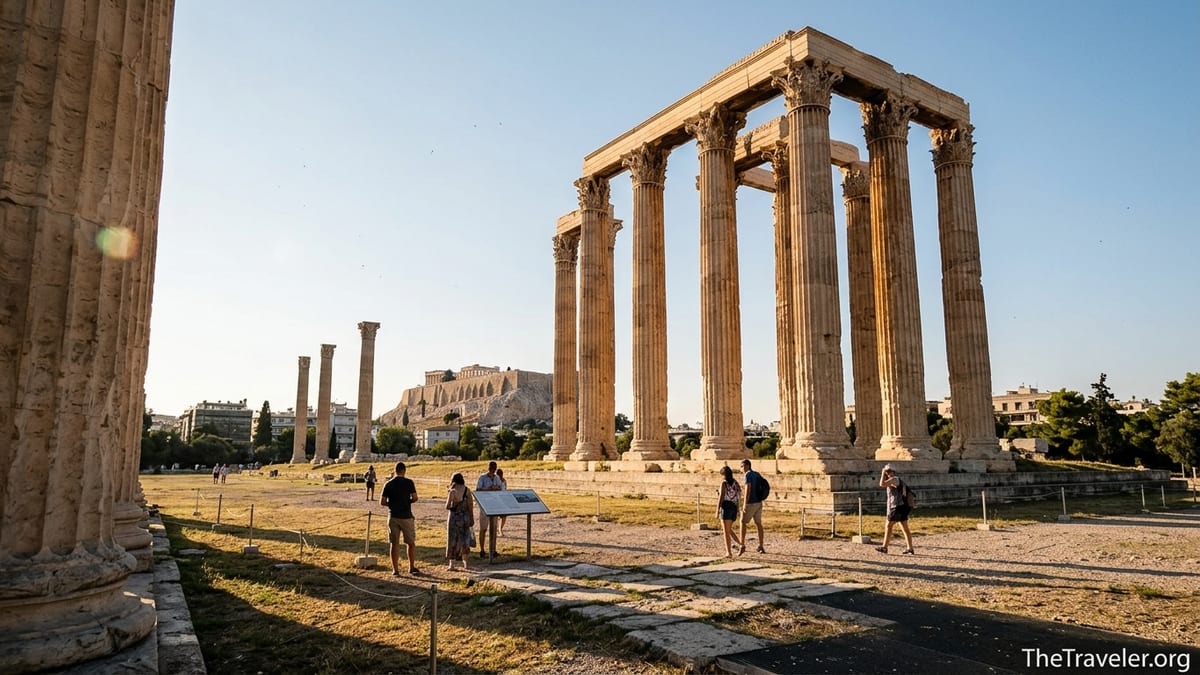
The site itself is compact. Most travelers spend 30 to 60 minutes walking among the remaining Corinthian columns and the nearby Arch of Hadrian, which is fenced within the same archaeological zone. As a result, the main ticketing questions are less about how long you need inside and more about whether you should book online, which discounts you qualify for, and whether third‑party “skip‑the‑line” products are worth the extra cost.
Because the Temple of Olympian Zeus rarely sees the kind of crushing queues found at the Acropolis, same‑day access is usually straightforward. However, in July and August or on free‑admission days, lines at the on‑site booth can still form. Knowing when it actually makes sense to book online, and which website to trust, will spare you confusion and unnecessary fees.
Official Prices, Seasons and Opening Hours
The Temple of Olympian Zeus follows the standard Greek archaeological site calendar: a higher “summer season” price from roughly 1 April to 31 October and a lower “winter season” price from 1 November to 31 March. As of 2026, full‑price tickets for major Athens sites like the Olympieion are typically in the low to mid‑teens in euros during summer, with a reduced winter rate roughly half that amount. Exact prices are periodically adjusted by the Ministry of Culture, so treat any specific figure you see on a tour site as indicative rather than guaranteed.
Opening hours track other major sites in Athens. In high season, the Temple of Olympian Zeus generally operates from early morning, around 8:00, until early evening. During midsummer, closing may be close to sunset, while in shoulder months last entry can shift earlier. In winter, the site often closes by mid‑afternoon, around 15:30. Practical example: a traveler visiting in late October might find the Olympieion open 8:00 to 18:00, while someone coming in January finds it open 8:00 to 15:30. Arriving in the first two hours of the day or after 16:00 in summer usually means quieter conditions and less glare for photos.
Heat and light are real considerations. On a typical July afternoon, the exposed site around the columns has little shade. Booking a morning or late‑day visit is not just pleasant; it is also safer in a city that often sees temperatures above 35°C. A realistic itinerary could place the Temple of Olympian Zeus at 8:30, followed by the nearby Acropolis Museum at 10:00, when you will appreciate the air‑conditioned galleries.
Remember that Greek archaeological sites observe several national free‑admission days and some partial closures for holidays. On free days such as selected Sundays in winter, entry to the Temple of Olympian Zeus is free, but lines at the ticket control still form because staff must scan or issue zero‑value tickets. If you see a winter Sunday packed with families near Hadrian’s Arch, you are likely seeing one of these free‑entry days in action.
How and Where to Buy Official Temple of Olympian Zeus Tickets
Official tickets for the Temple of Olympian Zeus are sold through the Greek Ministry of Culture’s e‑ticket platform and at the on‑site ticket booth next to the entrance on Vasilissis Amalias Avenue. You can either buy in advance online and arrive with a QR code on your phone, or walk up on the day and pay by card or cash at the booth. The e‑ticket system requires you to choose a date and, for some high‑demand sites, a time slot; for the Olympieion, the date matters more than an exact entry minute, but you should still aim to arrive within your chosen window.
For many visitors, the most efficient approach is to buy all your Athens archaeological tickets on the official platform in one sitting: Acropolis & Slopes, Ancient Agora, Roman Agora, Kerameikos, Aristotle’s Lyceum and the Temple of Olympian Zeus, each as separate entries. For example, a couple planning a two‑day stay in central Athens might book the Acropolis at 8:00 on day one, then choose flexible daytime entries for the Olympieion and Agora on day two. Everything lives under a single booking account and can be re‑downloaded if you lose a file.
On‑site purchase is still perfectly viable, especially outside peak summer. Many independent travelers report walking straight up to the Olympieion kiosk in March or November, buying a ticket in under five minutes, and entering immediately. A realistic situation: you land in Athens on a Monday afternoon in May, drop your luggage near Syntagma Square at 16:00, stroll down Leoforos Vasilissis Amalias, see the columns glowing in the low sun, and decide to buy a last‑entry ticket at the booth. This spontaneous approach usually works at the Temple of Olympian Zeus in shoulder seasons.
Whichever route you choose, focus on the words “official ticket” or “entrance fee included” if booking via a third‑party platform. Reputable sellers will make it explicit that they are issuing or pre‑purchasing the same Ministry of Culture ticket you would buy yourself. If a listing describes a “visit” or “view” of the Temple of Olympian Zeus without clear mention of an entrance ticket, assume that you will only see the site from outside the fence.
Online vs On‑Site: Skip‑the‑Line and Third‑Party Confusion
The phrase “skip the line” causes particular confusion at the Temple of Olympian Zeus. Unlike the Acropolis, where early‑morning queues at the main gate can wrap down the hill, the Olympieion usually has only a short line at the booth, and often none at all. Third‑party platforms still market “skip‑the‑line” Olympieion tickets that cost a few euros more than the official rate. What you are really buying in these cases is convenience and pre‑booking, not a special VIP gate or radically faster access.
In a real‑world example, a family visiting in August might buy a Temple of Olympian Zeus “skip‑the‑line” ticket from a large international reseller a week before arrival. On the day, they enter through the same security control as people who bought at the on‑site booth. Their QR code is scanned from a smartphone, they walk in within seconds, and they effectively skip only the payment queue, which might have been five or ten minutes long. That time savings may be worth it on a short layover or a day packed with back‑to‑back activities, but it is not essential for most travelers.
A second source of confusion is whether a guided walking tour that “includes the Temple of Olympian Zeus” actually includes your official ticket. Some city tours walk along the perimeter and discuss the site from outside the fence, using the iconic view of the columns with the Acropolis in the background. Others explicitly state “entrance ticket included” and schedule time to go inside the archaeological area. When you compare options, read the inclusions list carefully and mentally add the cost of a separate official ticket if necessary.
Bear in mind that dynamic tour pricing means a product that seems like a bargain one day can be poor value the next. For example, if the official summer ticket is around the low‑teens in euros and you see a standalone “Temple of Olympian Zeus ticket with audio guide” offered at roughly double that, ask yourself whether the extra cost is justified by the audio narration, customer support and easier mobile delivery, or if you would rather buy the entrance directly and pick up a self‑guided audio tour via a separate app.
Reduced and Free Entry: Who Qualifies and What to Bring
Greek law provides a long list of visitors who qualify for reduced or free entry at state archaeological sites, including the Temple of Olympian Zeus. In broad strokes, children and teenagers from EU countries, students at EU institutions, and certain professional groups such as licensed tour guides typically receive free admission year‑round. Non‑EU children and teens usually receive a 50 percent reduced ticket. Adults over a certain age threshold, often 65, from both EU and many non‑EU countries may receive reduced admission as well. The exact categories can change, so always cross‑check the current rules shortly before you travel.
In practice, eligibility is only half the story. You must be able to prove it on site. A 17‑year‑old German citizen can enter the Temple of Olympian Zeus free of charge in many cases, but only if they show a passport or EU ID card that confirms their age and nationality. Likewise, a Canadian student at a European university will usually be granted free or reduced entry by presenting both their passport and a valid student card with an expiration date. Without documentation, staff are within their rights to charge the standard adult fare.
Free‑admission days apply to everyone, not just specific categories. On some national holidays and several Sundays during the winter season, the Temple of Olympian Zeus waives entrance fees entirely. For example, a local Athenian family might choose a January free‑entry Sunday to visit multiple sites in one day, starting at the Olympieion, walking up to the Roman Agora, then ending in the Ancient Agora before sunset without paying any ticket at all. International visitors staying several days in winter can take advantage of the same dates if their schedule is flexible.
Remember that reduced and free categories typically apply to the official base price only. If you book through a reseller that bundles the entrance ticket with an audio guide, handling fee or guided tour, you may pay for the extras even if your personal status would qualify you for free or discounted entry at the gate. For example, a 19‑year‑old EU student could walk up to the booth and pay nothing, but if they buy a commercial audio tour that “includes ticket and app,” they will still pay the package price because the operator cannot reclaim the student discount on their behalf.
Common Ticket Mistakes to Avoid at the Temple of Olympian Zeus
One of the biggest mistakes in 2026 is assuming that the old multi‑site combo ticket still exists and organizing your trip around it. Travelers sometimes arrive with printouts from years‑old blog posts suggesting they can buy a five‑day Acropolis plus six sites pass that includes the Temple of Olympian Zeus. At the first site they visit, they discover that this product has been discontinued or significantly changed. The practical fix is simple: approach each major site, including the Olympieion, as a separate ticket unless an up‑to‑date source clearly states otherwise.
A second common error is double‑paying for the same entrance through two different channels. This often happens when a visitor books a city pass that quietly includes the Temple of Olympian Zeus, then, unaware of the inclusion, buys a separate official ticket online. For instance, some versions of the Athens city card products bundle multiple archaeological sites. If you hold such a pass and buy an individual Olympieion ticket “just in case,” you have effectively paid twice for the same right to enter. Always check your pass or tour voucher for a list of included sites before purchasing standalone tickets.
Third, many travelers over‑buy skip‑the‑line products for sites that rarely have long queues. A realistic scenario: someone planning an August weekend in Athens sees a package of skip‑the‑line tickets for the Acropolis, Ancient Agora and Temple of Olympian Zeus at a heavy markup over official prices. The Acropolis portion might be worth it on a tight schedule, but the Olympieion entry would probably have been easy and cheap to handle directly at the booth. Matching the product to the actual crowd profile of each site will save unnecessary costs.
Finally, some visitors misjudge timing and run into closing‑time frustrations. Because the Temple of Olympian Zeus closes earlier in winter, it is easy to linger too long at the Acropolis Museum or in Plaka and arrive at the Olympieion gate a few minutes after last entry. The guard will turn you away even if you hold a valid e‑ticket for that date. A practical rule is to aim to arrive at least 45 minutes before the published closing time, especially outside of summer, giving yourself a comfortable buffer to explore.
Building an Itinerary: Combining the Olympieion with Other Sites
The Temple of Olympian Zeus sits in an ideal location for a walking circuit of central Athens. It stands just beyond Hadrian’s Arch, a short stroll from the Acropolis Museum and the pedestrian street Dionysiou Areopagitou. Many travelers naturally pair an Olympieion visit with either the Acropolis Museum or a loop through Plaka and the Ancient Agora. For example, a well‑paced morning plan could start with an 8:00 Acropolis entry, descend to the Acropolis Museum by 10:30, then reach the Temple of Olympian Zeus on foot before midday heat builds.
This proximity also affects how you think about tickets. Because you will often pass the Temple of Olympian Zeus en route to or from other attractions, it is easy to be tempted into buying an extra on‑site ticket “just because you are passing by,” even if you already saw the site earlier with a tour. A realistic case: a cruise passenger joins a half‑day guided tour that includes official entry to the Olympieion in the morning, then, later that day, forgets and buys a second ticket when walking past the illuminated columns at dusk. Keeping a simple note in your phone listing which sites you have already entered can prevent this kind of duplication.
If you rely on Athens public transport, remember that the Acropoli metro station on Line 2 is only a few minutes’ walk away. A standard single metro ticket in Athens costs a little over one euro and covers a 90‑minute window across metro, bus, trolley and tram. Many visitors staying near Omonia or Syntagma simply ride the metro to Acropoli, visit the museum first, then walk down to the Olympieion, saving the need for taxis or ride‑hailing. This is especially convenient if you are trying to line up your pre‑booked time slots for museums and archaeological sites without building in large taxi buffers.
At night, although the archaeological site itself closes, the columns and Hadrian’s Arch are floodlit and visible from the surrounding streets and pedestrian paths. Some travelers choose to save the ticketed interior visit for daylight and simply enjoy the exterior view on an evening stroll. That is a legitimate strategy if you are balancing limited time and budget, especially since the best photo viewpoint that frames the Temple of Olympian Zeus with the Acropolis hill behind it is actually taken from outside the fenced area.
The Takeaway
Visiting the Temple of Olympian Zeus in 2026 is straightforward if you rely on current information and a few simple principles. Treat the Olympieion as a standalone archaeological site with its own official ticket, not as a guaranteed add‑on in a legacy combo pass. Decide whether you truly need skip‑the‑line convenience for a site that rarely experiences heavy queues, and be cautious about paying premiums through third‑party resellers unless the extras they provide matter to you.
Check your eligibility for reduced or free entry, and remember that your status only counts if you can prove it at the gate. Build your itinerary with seasonal opening hours and heat in mind, aiming for morning or late‑afternoon visits in high summer. Finally, keep track of what is already included in any city pass or guided tour you purchase, so you do not unknowingly pay for the same Temple of Olympian Zeus ticket twice. With these points in place, your time among the colossal Corinthian columns should be memorable for the right reasons.
FAQ
Q1. Do I still need a separate ticket for the Temple of Olympian Zeus if I buy an Acropolis ticket?
The Acropolis ticket and the Temple of Olympian Zeus ticket are now separate. Older combo passes that bundled multiple sites have been discontinued or changed, so in 2026 you should assume you need an individual Olympieion ticket unless a current product explicitly states that the entrance is included.
Q2. Is it worth buying a “skip‑the‑line” Temple of Olympian Zeus ticket?
For most visitors, a dedicated skip‑the‑line product is not essential at the Olympieion. Lines at the on‑site booth are usually short, and skip‑the‑line tickets generally use the same entrance as everyone else. They can save a few minutes in peak summer or on free‑entry days, but the main value is convenience rather than exclusive access.
Q3. Can I buy official Temple of Olympian Zeus tickets on the day of my visit?
Yes. You can buy an official ticket at the on‑site booth on the day, and outside of peak midday hours in high summer you will usually enter within minutes. However, if your time in Athens is very limited or you are visiting during a busy holiday period, pre‑booking an e‑ticket online can make your schedule more predictable.
Q4. How much time should I allow for the Temple of Olympian Zeus?
Most travelers spend 30 to 60 minutes inside the archaeological site. That is enough time to walk around the surviving columns, read the information panels and view the Arch of Hadrian. If you are particularly interested in architecture or photography, you may want slightly longer, especially in softer morning or late‑afternoon light.
Q5. Who qualifies for free or reduced entry at the Temple of Olympian Zeus?
Children and teenagers from EU countries, many students at EU institutions, and certain professional groups often receive free entry, while non‑EU youths and many seniors qualify for reduced tickets. These categories and ages are defined by the Greek Ministry of Culture and can change, so you should check current rules and carry passports or student IDs to prove eligibility.
Q6. Are Temple of Olympian Zeus tickets included in Athens city passes?
Some Athens city pass products include the Temple of Olympian Zeus among a list of archaeological sites, while others do not. Always read the inclusions line by line. If the Olympieion is listed as an included attraction, you do not need to buy a separate ticket, and doing so would mean paying twice for the same entrance.
Q7. Do I need to choose a specific time slot for the Temple of Olympian Zeus?
The national e‑ticket system asks you to select a date and often a general time window, but at the Olympieion time slots are typically more flexible than at the Acropolis. You should still aim to visit within the chosen window, particularly on very busy days, but the main constraint is the overall opening hours and the last‑entry time.
Q8. What happens if I arrive close to closing time with a valid ticket?
If you reach the gate after the official last‑entry time, staff can refuse admission even if your ticket is valid for that date. Arriving at least 45 minutes before closing is a safe rule, especially in winter when the Temple of Olympian Zeus may close by mid‑afternoon.
Q9. Can I visit the Temple of Olympian Zeus for free on certain days?
Yes. The Temple of Olympian Zeus participates in national free‑admission days when entrance fees are waived for everyone, as well as in specific free Sundays during the winter season. These dates change over time, so you should verify the current calendar shortly before your trip.
Q10. Is seeing the Temple of Olympian Zeus from outside the fence enough?
Many travelers are satisfied with the classic exterior view of the columns framed against the Acropolis, which you can enjoy from nearby streets without a ticket. However, going inside the archaeological site lets you stand among the columns, read detailed interpretive signs and experience the scale of the temple up close. Whether that is worth the ticket price depends on your interest in ancient architecture and how tight your schedule and budget are.