


Many travelers planning a trip to Greece search for “Temple of Zeus tickets” and are surprised to discover there are actually two famous temples dedicated to Zeus: the Temple of Olympian Zeus in central Athens and the Temple of Zeus at Olympia in the Peloponnese. They share a name and god, but they are very different places, and confusion between the two is extremely common when booking tickets, tours and even hotels.
Get the latest updates straight to your inbox!
Two Temples, Two Very Different Places
The first and most important difference is simple geography. The Temple of Olympian Zeus stands in the heart of modern Athens, a few minutes’ walk from the Acropolis and the neighborhood of Plaka. Most visitors see its towering columns from their hotel rooftop or while riding the Metro in from the airport. In contrast, the Temple of Zeus at Olympia is part of the archaeological site of Ancient Olympia in rural western Peloponnese, roughly 300 kilometers by road from Athens. Visiting Olympia is a separate trip, similar in effort to going from Rome to Pompeii.
When travelers type “Temple of Zeus Athens tickets” into a search engine, results often mix information about both sites and sometimes even suggest images from a third temple of Olympian Zeus in Agrigento, Sicily. In practical terms, if you are booking accommodation and tours for a short city break in Athens, you are almost certainly dealing with the Temple of Olympian Zeus in Athens, not the sanctuary at Olympia. Olympia generally requires at least a long day trip or an overnight stay in the nearby town of Ancient Olympia.
Transport options underline this difference. The Temple of Olympian Zeus in Athens is easily reached on foot from Syntagma Square, the Acropolis, or the Acropoli and Syntagma metro stations. Many visitors simply stroll past Hadrian’s Arch and into the site between coffee stops and museum visits. By contrast, reaching Olympia usually involves renting a car and driving four to five hours each way, taking an intercity bus with a connection in Patras or Pyrgos, or joining an organized coach tour that departs Athens early in the morning.
Historical Background: Imperial Athens vs Sacred Olympia
The Temple of Olympian Zeus in Athens, often called the Olympieion, reflects the ambition of Athens at different periods. Work began in the 6th century BC under the tyrant Peisistratos, but the temple was only completed in the 2nd century AD by the Roman emperor Hadrian, more than 600 years later. When finished, it was one of the largest temples in the Greek world, with 104 Corinthian columns, each around 17 meters high. It symbolized Rome’s power and Hadrian’s particular fondness for Athens.
Olympia’s Temple of Zeus is older and rooted more directly in the origins of the Olympic Games. Completed around 457 BC during the classical period, it was the largest temple on mainland Greece at the time. It formed the centerpiece of the sacred sanctuary of Altis, surrounded by training grounds, treasuries and other temples. Inside stood the chryselephantine (gold and ivory) statue of Zeus by the sculptor Phidias, later listed as one of the Seven Wonders of the Ancient World. When ancient athletes arrived to compete every four years, this temple was at the heart of their religious ceremonies.
This difference in context still shapes the experience today. In Athens, the temple stands as one monument within a dense urban fabric that also includes Roman baths, Ottoman mosques and neoclassical buildings. At Olympia, the Temple of Zeus belongs to a broader sanctuary landscape of stadium, gymnasium and altars that tells the full story of the ancient Olympic Games.
What You See on Site: Columns vs Whole Sanctuary
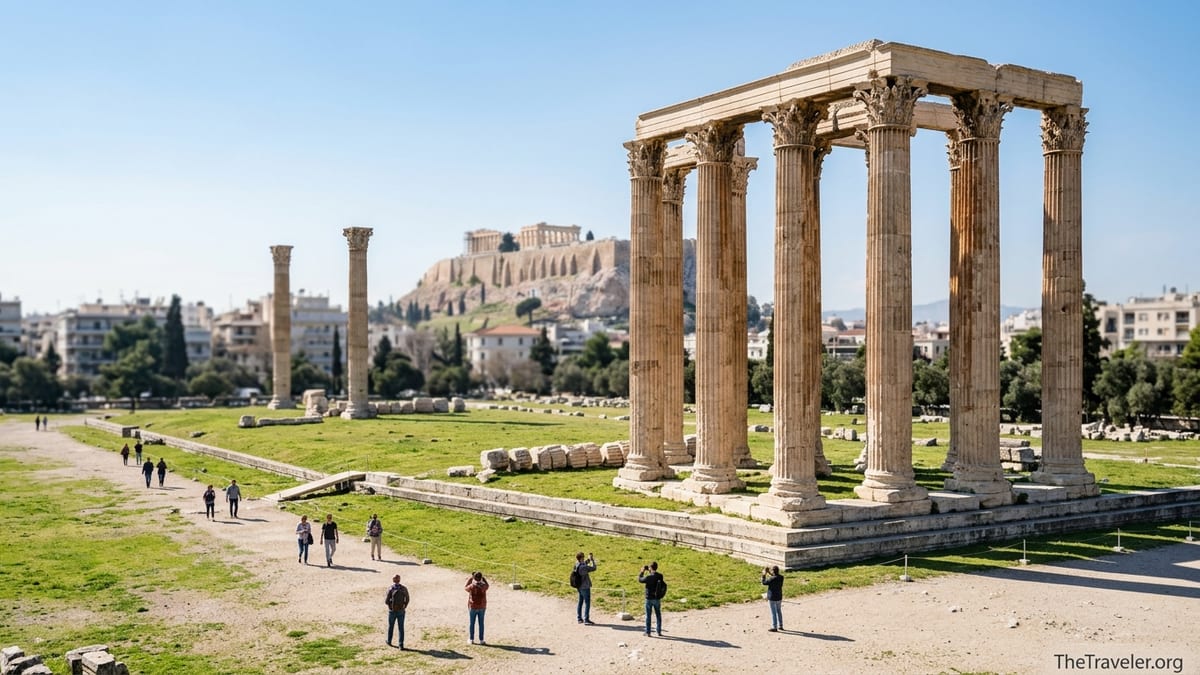
Visitors to the Temple of Olympian Zeus in Athens encounter a relatively compact, open area defined by the remaining columns and low stone foundations. Of the original 104 Corinthian columns, only 15 remain standing, with one dramatic column lying sideways on the ground, its drum sections clearly visible. The scene is striking, especially in late afternoon light when the Parthenon is visible on the Acropolis behind the columns. Many travelers spend 30 to 45 minutes walking the perimeter, taking photographs and reading the on-site information panels.
At Olympia, the Temple of Zeus is more ruinous. The columns collapsed in earthquakes centuries ago, and most lie in massive segments where they fell. The temple footprint is still clear, and the toppled drums help visitors visualize its original scale, but you are largely walking through foundations and scattered architectural blocks. The real impact comes from the setting: the temple is one of many structures within a large archaeological park that includes the stadium where the Olympic races were held, the Temple of Hera, and training areas like the palaestra. Most travelers spend at least two to three hours in the sanctuary itself, often followed by another hour or more in the excellent Archaeological Museum of Olympia, where you see the sculpted pediments and metopes that once decorated the Temple of Zeus.
In practice, the Athens site works well as a short stop between other central attractions. You might, for example, visit the Acropolis in the morning, have lunch in Plaka, then walk ten minutes down Amalias Avenue to the Olympieion, taking in Hadrian’s Arch on the way. Olympia, by contrast, is typically the main focus of your day. Travelers who make the journey usually visit both the archaeological site and the museum, sometimes combining them with a stop at nearby Katakolo port or the beaches of the western Peloponnese.
Tickets, Prices and Practicalities
For most travelers, ticketing is where confusion really matters. The Temple of Olympian Zeus in Athens is managed as a standalone archaeological site. As of mid 2026, the standard adult ticket costs around 20 euros in high season, with a reduced price in the winter months. In the past, the site was included in a popular multi-site combination ticket with the Acropolis and several other ancient sites in Athens, but that combined option has been discontinued. Visitors now typically buy a dedicated ticket for the Temple of Olympian Zeus, either online through the official Greek heritage ticketing platform or at the small on-site kiosk.
At Olympia, the situation is slightly different. The archaeological site of Olympia and the Archaeological Museum of Olympia are usually covered by a combined ticket, which is priced higher than the single-site ticket in Athens but includes both the sanctuary and museum. Prices can change seasonally and are occasionally adjusted by the Ministry of Culture, so it is best to treat any numbers you see as approximate. Many visitors first encounter these prices through organized tours departing from Athens, Nafplio or cruise ships docking at Katakolo, where the entry fee is bundled into the overall excursion cost.
Opening hours also differ. The Temple of Olympian Zeus in Athens generally keeps shorter hours in winter, usually closing mid-afternoon, and longer hours in summer that align with other central archaeological sites. Olympia follows a similar seasonal pattern but remains open later on long summer days, with last entry typically about half an hour before closing time. In both cases, schedules can change for holidays, heat waves or strikes, so it is wise to check the current hours a week or two before you travel and avoid relying on an old guidebook.
In practical planning terms, budget at least 30 minutes for the Athens site if you are short on time, or an hour if you enjoy taking photographs and reading the panels. At Olympia, count on half a day for the archaeological site and museum, plus travel time. Travelers who rush through Olympia in under two hours often report feeling they missed much of what makes the place special.
How Travelers Typically Experience Each Temple
Because the Temple of Olympian Zeus in Athens is so central, most visitors fit it into a broader city itinerary rather than traveling specifically for it. A common pattern for first-time visitors is to buy an Acropolis ticket, tour the Parthenon and surrounding slopes in the morning, explore the Acropolis Museum around midday, then walk down to the Olympieion in the afternoon. Others visit the site at golden hour to photograph the columns against the sunset, sometimes in combination with a viewpoint on Areopagus Hill. Some travelers decide not to pay for entry at all and simply view the columns through the fence from outside, particularly if they are on a tight budget.
At Olympia, the opposite tends to be true: travelers make a deliberate journey to visit. One typical real-world example is a couple driving from Athens to the Ionian coast who plan a one-night stop in the town of Ancient Olympia. They arrive in the afternoon, walk the modern town’s main street, and spend the evening at a taverna. The next morning they visit the archaeological site when it opens, walk through the stadium and temples, then continue to the museum before checking out of their hotel. Another common scenario involves cruise passengers docking at Katakolo. They join a half-day coach tour where the guide leads them through the sanctuary, focusing on the Temple of Zeus and the stadium start line, then returns them to the ship by mid-afternoon.
Expectations also differ. In Athens, some travelers express mild disappointment when they discover only a cluster of columns remains, especially if they had imagined a nearly complete temple. The site is still impressive, but the experience can feel brief compared with the Acropolis. At Olympia, the ruins are more fragmentary, yet the emotional impact often comes from the setting and the connection with the Olympic Games. Standing at the starting line of the ancient stadium after walking past the fallen columns of the Temple of Zeus creates a strong sense of place that many visitors remember long after they leave.
Which Temple Do People Usually Mean When They Say “Temple of Zeus”?
In everyday travel planning, when someone casually mentions the “Temple of Zeus” without specifying a town, they almost always mean the Temple of Olympian Zeus in Athens. This is the site that appears most often in Athens city passes, walking tours, rooftop bar views and quick-stop itineraries. If a friend posts a sunset photo of towering columns with the Acropolis in the background, that is the Athens temple.
Confusion tends to arise in two specific situations. The first is when travelers research the Olympic Games and assume that the temple they are reading about must be in Athens because their flight lands there. They may not realize that Olympia is a separate region until they start looking at transport times and see four or five hour driving estimates. The second is when online ticketing sites and blogs use generic titles like “Temple of Zeus tickets” or “Visit the Temple of Olympian Zeus” and mix images from Athens and Olympia in the same article. Someone skimming on a phone might see a picture of the stadium at Olympia next to a price list that actually applies to the Athens site.
A simple rule of thumb helps: if a tour description mentions walking distance from Syntagma Square, the Acropolis, Plaka or the Athens Metro, it is the Temple of Olympian Zeus in Athens. If you see references to the archaeological site and museum, the ancient stadium and a long drive from Athens or a departure from Katakolo port, it relates to the Temple of Zeus at Olympia. When in doubt, look for the place name “Athens” or “Ancient Olympia” in the fine print and, if necessary, ask the tour operator or hotel to confirm.
Planning Your Trip: Should You Visit One or Both?
If you are spending only two or three days in Athens, visiting the Temple of Olympian Zeus in the city is straightforward and usually worthwhile, especially if you enjoy photography or are interested in Roman-era Athens. The site is relatively small, the ticket price is manageable for most visitors, and you can easily combine it with the Acropolis, the Acropolis Museum, the Panathenaic Stadium and a walk through the National Garden without extra travel planning. For many first-time visitors, that is enough Zeus-related history for one trip.
Olympia requires more commitment. It becomes an attractive option if you have at least one extra night to spare in mainland Greece or if you are particularly fascinated by the history of the Olympic Games. Travelers driving a loop through the Peloponnese often include Olympia alongside destinations like Nafplio, Mycenae and the Mani peninsula. In that context, the Temple of Zeus at Olympia is part of a broader journey through rural landscapes, traditional villages and coastal towns rather than a single, isolated attraction.
Both sites can be combined in one longer trip. For example, a traveler on a ten-day itinerary might spend three days in Athens, including a visit to the Temple of Olympian Zeus, then rent a car and drive along the northern Peloponnese coast to Olympia for an overnight stay. After exploring the sanctuary and museum, they might continue to Delphi or back to Athens via other Peloponnese sites. In that scenario, seeing both temples offers an interesting contrast: one embedded in a modern capital city, the other in a relatively quiet valley where the Games began.
The Takeaway
Although both monuments honor the same god, the Temple of Olympian Zeus in Athens and the Temple of Zeus at Olympia offer very different experiences. The Athens temple is an easily accessible cluster of colossal Corinthian columns in the middle of the city, ideal for a short, impactful visit tied into a broader exploration of the Acropolis and surrounding neighborhoods. The Olympia temple is more ruinous but sits at the heart of a sprawling sanctuary that tells the full story of the ancient Olympic Games, rewarded most when you devote at least half a day and additional travel time.
When travelers talk about the “Temple of Zeus,” they almost always mean the Athens site unless they explicitly mention Olympia, the Olympic Games or a Peloponnese road trip. Keeping that distinction clear when you search for tickets, hotels and tours will help you avoid mix-ups, like booking a nonrefundable excursion to Olympia when you only have a weekend in Athens. With a bit of planning and awareness of the differences, you can choose the temple experience that best fits your time, interests and budget, or build an itinerary that lets you appreciate both faces of Zeus in Greece.
FAQ
Q1. Which temple is in Athens, the Temple of Olympian Zeus or the Temple of Zeus at Olympia?
The Temple of Olympian Zeus is in central Athens, near the Acropolis and Hadrian’s Arch, while the Temple of Zeus at Olympia is in the Peloponnese at Ancient Olympia.
Q2. When people say “Temple of Zeus tickets” for Athens, which site do they usually mean?
They almost always mean the Temple of Olympian Zeus in Athens, because it is the Zeus temple that appears in standard Athens itineraries and central walking tours.
Q3. How far is Olympia from Athens if I want to visit the Temple of Zeus there?
By road, Olympia is roughly 300 kilometers from Athens. Driving usually takes around four to five hours each way, so it works best as a day trip by coach tour or, ideally, an overnight stay.
Q4. Can I easily walk to the Temple of Olympian Zeus in Athens from the main tourist areas?
Yes. The site is a short walk from Syntagma Square, Plaka and the Acropolis area. Many visitors include it in a loop that also passes the National Garden and the Panathenaic Stadium.
Q5. Is there a combined ticket that covers the Temple of Olympian Zeus and other Athens sites?
There used to be a combination ticket that included several Athens sites along with the Acropolis, but it has been discontinued. You now buy a separate ticket for the Temple of Olympian Zeus.
Q6. Do I need a separate ticket for the Temple of Zeus at Olympia and its museum?
In most cases, you buy a combined ticket that includes both the archaeological site of Olympia, with the Temple of Zeus, and the Archaeological Museum of Olympia on the same day.
Q7. How much time should I plan for each temple?
Plan 30 to 60 minutes for the Temple of Olympian Zeus in Athens, depending on your interest. For Olympia, allow at least two to three hours for the site and museum, plus travel time.
Q8. Which temple is better if I am mainly interested in the Olympic Games?
If your focus is the Olympic Games, prioritize the Temple of Zeus at Olympia. It stands in the sanctuary where the Games originated, right next to the ancient stadium and training areas.
Q9. Is it worth entering the Temple of Olympian Zeus in Athens if I can see the columns from outside?
Many budget travelers are satisfied viewing it from the fence, but going inside lets you walk among the columns, read information panels and photograph the site without visual obstructions.
Q10. Can I realistically visit both temples on a short trip to Greece?
On a very short trip of two or three days, it is best to focus on the Athens temple. To visit both, plan a longer itinerary that includes at least one night in the Peloponnese near Ancient Olympia.