


More news on this day
A powerful Thanksgiving nor’easter sweeping up the U.S. East Coast on Thursday, November 26, 2026, brought flooding, power cuts and widespread transport disruption at the peak of the holiday rush, and forced New York City to postpone the 100th Macy’s Thanksgiving Day Parade to Saturday for the first time in the event’s history.
Get the latest news straight to your inbox!
Storm track, official warnings and early impacts
Forecasters began flagging the coastal storm at the start of Thanksgiving week, but National Weather Service briefings on Wednesday, November 25, highlighted a rapidly deepening low tracking from the Southeast toward the Mid Atlantic, with an unusually strong onshore flow aimed at New Jersey, Delaware and the New York Bight. Offices including Mount Holly, New Jersey, issued coastal flood warnings, wind advisories and storm and gale warnings for bays, inlets and nearshore Atlantic waters from Virginia north into New England, noting the risk of moderate to locally major coastal flooding around the Thursday high tide cycles.
By Thursday morning, the nor’easter was delivering periods of heavy rain and embedded thunderstorms from coastal Virginia through New York City, with the strongest winds along exposed capes and barrier islands. Observations and local media reports indicated frequent gusts in the 40 to 55 mile per hour range along sections of the New Jersey and Long Island coasts, with a few higher readings on headlands and bridges. Combined with astronomical high tides, those winds pushed water into back bays and tidal rivers, inundating low-lying streets in parts of Atlantic and Cape May counties, sections of the New York metropolitan shoreline and other vulnerable communities along the Mid Atlantic seaboard.
Hydrologists and emergency managers warned that water could remain trapped in some back-bay systems for more than one tide cycle, particularly in New Jersey where the governor’s office cited expectations of “multiple rounds of tidal flooding” from Wednesday through Friday. In response, authorities temporarily closed or restricted access on a number of shore-adjacent parkways and causeways during peak tides, adding to journey times for residents and visitors attempting to reach coastal hotels, vacation rentals and second homes over the holiday period.
Power outages and knock-on effects for key travel hubs
The combination of saturated ground and strong winds brought down trees and power lines across a broad swath of the country as the coastal storm overlapped with a separate winter system in the Midwest. By Thursday afternoon, tracking services and federal briefings indicated that roughly 1 million electricity customers nationwide had lost power at some point during the day, with the largest concentrations in the Mid Atlantic and Northeast along the nor’easter’s path and in parts of the Upper Midwest affected by snow and ice. Utilities reported progress restoring service through the day but cautioned that some outages near the hardest-hit coastal communities could extend into Friday as crews waited for water to recede and winds to ease.
Critical infrastructure generally remained operational, but the storm created localized issues for travelers. A number of hospitals, rail facilities and at least one major airport reported brief power interruptions before backup generation or grid supply was restored. Terminal buildings remained open, but some passengers encountered temporarily darkened concourses, closed retail units and minor delays while systems were checked. In coastal neighborhoods, traffic signals failed in pockets, complicating already slow road movements in heavy rain and ponding.
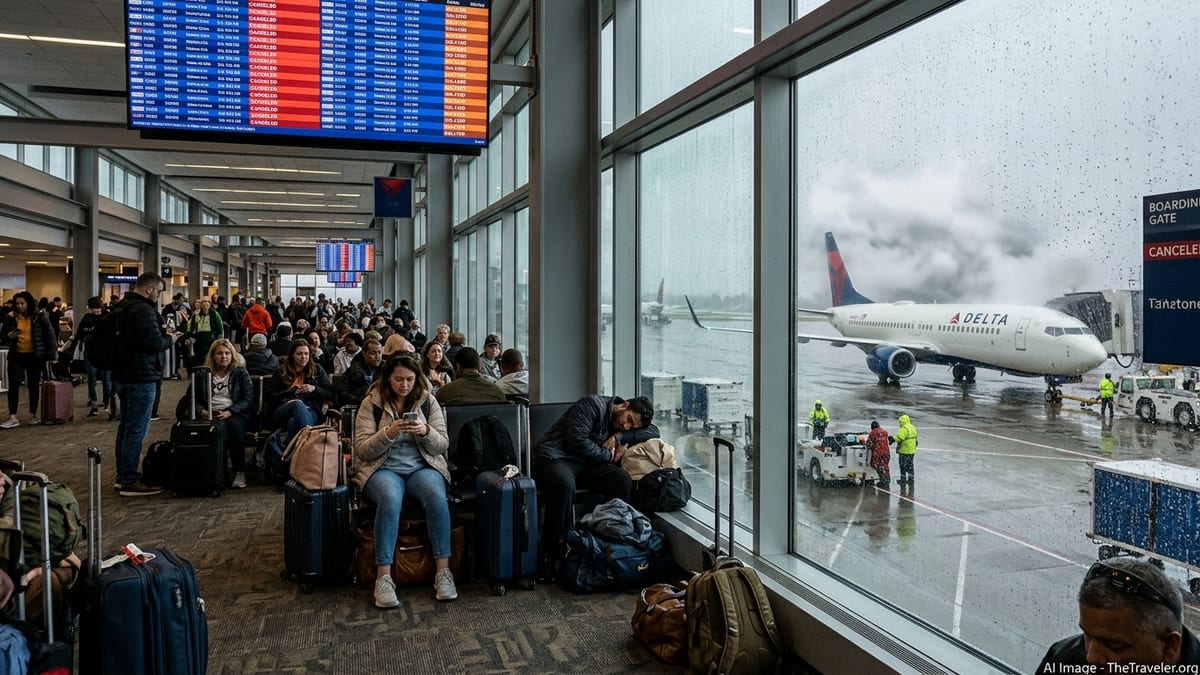
Aviation data on Thursday evening showed that the nor’easter hit during an already crowded Thanksgiving travel period. Flight tracking service snapshots indicated that more than 2,000 flights to, from or within the United States were delayed and over 400 were canceled by early evening, with the highest disruption at airports along the Interstate 95 corridor, including New York’s John F. Kennedy, LaGuardia and Newark, as well as Boston Logan, Philadelphia, Washington National and Baltimore/Washington. At these hubs, low cloud ceilings, heavy rain, wind shear and standing water on runways prompted the Federal Aviation Administration to implement ground delay programs and, at times, ground stops for arrivals into the New York area.
Those flow restrictions reduced the number of aircraft that could land or depart each hour and led airlines to trim schedules, especially short-haul and regional flights, to keep operations stable. Because most large U.S. carriers operate tightly timed hub-and-spoke networks over Thanksgiving, delays and cancellations in the Northeast quickly cascaded across the system. Passengers at inland airports, including some where the weather remained largely benign, experienced late departures and missed connections as aircraft and crews failed to arrive on time from earlier legs routed through the storm-affected corridor.
Rail, roads and urban transit under holiday strain
The nor’easter arrived on a day when U.S. rail and road networks were already heavily loaded. Amtrak and regional commuter rail operators on the Northeast Corridor had warned earlier in the week that they would be monitoring tidal sections of track, particularly in New Jersey and along parts of the Connecticut shoreline. As water levels rose on Thursday, some services were subject to speed restrictions to limit spray on electrical equipment, and dispatchers held or rerouted a small number of trains around localized flooding or debris. Operators advised riders to expect slower journeys rather than mass cancellations, and by late afternoon there were no indications of a full corridor shutdown attributable solely to the storm.
Urban transit systems around New York City reported scattered flooding at low-lying subway and commuter rail stations, along with delays where fallen trees or branches obstructed tracks on outer suburban lines. Transit agencies used social media and service alert feeds to signal temporary line suspensions and diversions, encouraging travelers heading to airports or intercity stations to allow additional time and to check status shortly before departure. Beyond New York, cities including Philadelphia and Boston also dealt with weather-related slowdowns on bus and trolley routes, although core subway networks generally remained in service.
On the highways, heavy rain, poor visibility and areas of flash flooding hampered road travel for much of Thanksgiving Day from Virginia to southern New England. State transportation departments and highway patrols repeatedly urged drivers not to attempt to cross flooded underpasses or shore roads where waves and surge were overtopping barriers. Several coastal bridges and causeways, particularly in New Jersey and along exposed sections of the Delmarva Peninsula, were closed to high-profile vehicles during peak wind periods, forcing detours for buses, RVs and trucks.
Freight movements were also affected. Some Mid Atlantic and Northeast states already had seasonal holiday restrictions on oversize loads in place, and regulators maintained or tightened those limits where forecasts pointed to the strongest winds and heaviest rain. That reduced the number of slow-moving, wide vehicles on key corridors while conditions were at their worst, but also introduced additional delays for time-sensitive freight flows running along Interstate 95 and connecting east-west routes.
Macy’s Thanksgiving Day Parade: historic postponement and visitor implications
The most high-profile cultural effect of the nor’easter has been the unprecedented postponement of the Macy’s Thanksgiving Day Parade. On Wednesday evening, November 25, Macy’s and New York City officials confirmed that the 100th edition of the parade, originally scheduled for Thursday morning, would be moved to Saturday, November 28, 2026. In coordinated statements, the city, Macy’s and broadcast partners said the decision followed detailed consultations with forecasters and safety authorities, who warned of sustained rain and the potential for damaging gusts along the Manhattan route during the usual start time.
Organizers stressed that safety considerations for both participants and spectators, as well as the risks to the famous giant balloons in Manhattan’s street canyons during strong crosswinds, were driving the change. City notices and broadcaster advisories now list a revised step-off time of 8:30 a.m. Eastern on Saturday. The event will still use the established route on Manhattan’s West Side and through Midtown, subject to updated street-closure plans and security arrangements that will extend the intensive Thanksgiving parade footprint deeper into the weekend than usual.
Macy’s has confirmed that it is working to reassemble as much of the planned lineup as possible, but has cautioned that not every marching band or featured performer will be able to adjust. School and community bands that traveled from other states for a long-planned Thursday appearance now face additional hotel and meal costs if they stay through Saturday, and some have indicated that at least part of their groups will return home as scheduled. Parade organizers and city officials have encouraged visitors hoping to see specific acts to monitor updated schedules and local advisories in the coming days in case of last-minute changes to the running order or guest list.
For the wider tourism economy, the shift to Saturday has produced a compressed and more complex pattern of demand. Hotels in Midtown and other parade-view neighborhoods have reported an uptick in guests seeking to extend stays by one or two nights so that families can still attend the live event. At the same time, airlines serving the three major New York airports are processing additional change requests from passengers wishing to push return flights to Sunday or later, on top of rebookings already triggered by the nor’easter’s weather disruption. Travelers with fixed itineraries, particularly those booked on sold-out weekend departures, are likely to leave without experiencing the centennial parade they had built their trip around.
How this Thanksgiving travel week compares and what travelers should do next
Preliminary Transportation Security Administration figures for Tuesday and Wednesday suggested that passenger screening volumes were broadly in line with, or slightly below, the record numbers seen over Thanksgiving week in 2025, pointing to very high aircraft load factors even before the storm’s arrival. With relatively few empty seats available, airlines have limited capacity to re-accommodate passengers from canceled flights, which in practice means that many disrupted travelers are being offered options later in the weekend rather than same-day alternatives.
The weather has also hit after a period of operational strain in U.S. aviation. In the days before Thanksgiving, several large carriers reported brief technology issues involving reservation or dispatch systems, prompting temporary ground holds and schedule adjustments that were largely resolved before Wednesday night. However, those incidents reduced operational buffers, leaving airlines more exposed to the kind of cascading knock-on delays that develop when severe weather forces rapid changes to flight plans, crew pairings and aircraft routings.
Looking ahead, meteorological guidance from the National Weather Service and local forecast offices indicates that the coastal low will continue to track northeast into Atlantic Canada through Thursday night and Friday, with rain and strong winds gradually easing from south to north along the Mid Atlantic and New England coasts. Residual showers, elevated river levels and lingering coastal flooding are expected in some areas into Friday, November 27, particularly near tidal rivers and back bays that experienced multiple high-tide cycles under onshore flow. High pressure is forecast to build into the northeastern United States by Saturday, with drier and calmer conditions currently expected for the rescheduled parade window.
For travelers, the immediate focus is on recovery operations through the remainder of the holiday period. Airlines serving major East Coast hubs have issued weather waivers for a defined list of airports and travel dates, generally allowing at least one change to a later flight without change fees. The precise rules, including any waivers of fare differences, vary by carrier and fare type, and some waivers are limited to rebookings through a fixed date or specific city pairs. Where flights are canceled outright, U.S. regulations entitle passengers to a refund if they choose not to travel, although rebooking options may remain constrained through the weekend.
Passengers still planning to travel on Friday or Saturday should closely monitor airline and rail apps, text alerts and airport status boards for last-minute schedule changes, and factor in additional time to reach terminals where localized flooding or debris may still affect access roads. Those intending to attend the rescheduled Macy’s Thanksgiving Day Parade should verify the latest information from city authorities on street closures, recommended arrival times and security screening, and be prepared for large but potentially more compressed crowds as visitors, New Yorkers and late-arriving out-of-town performers converge on Manhattan for a rare Saturday morning edition of the century-old event.