


More news on this day
Thanksgiving air travel across the United States is facing significant disruption, with more than 14,000 flights delayed today as storms sweep both coasts and airlines work through the effects of recent technology outages during one of the busiest travel periods of the year.
Get the latest news straight to your inbox!
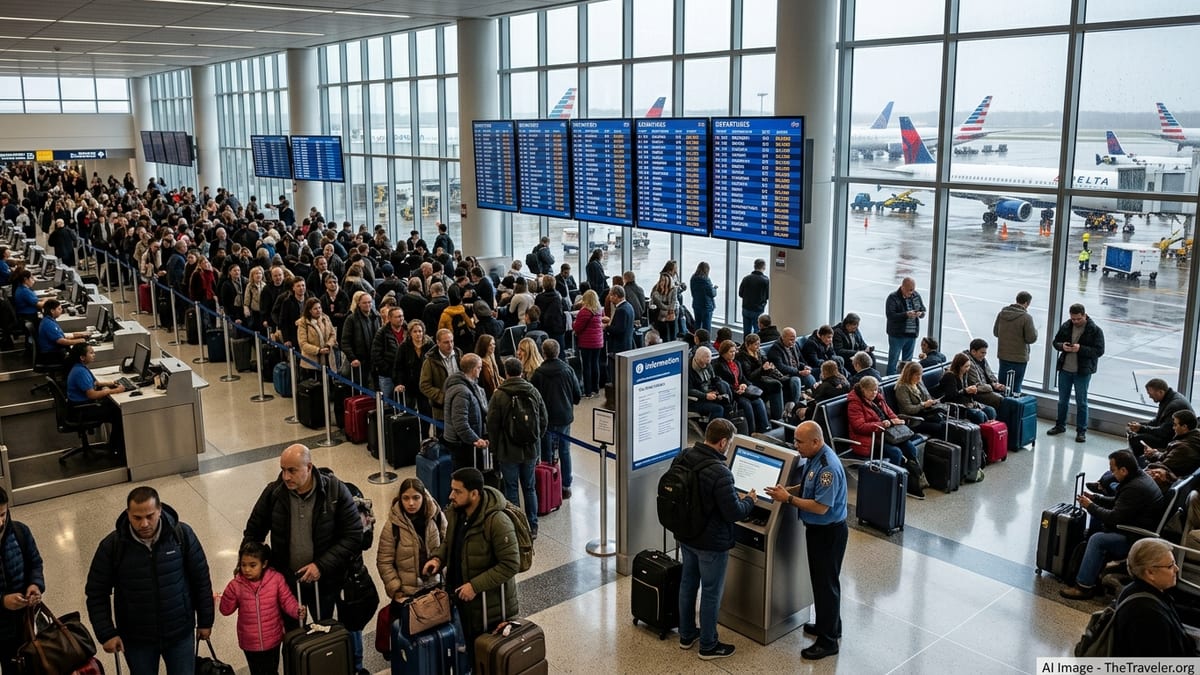
More than 14,000 delays as Thanksgiving Day begins
By late morning on Thursday 26 November 2026, live operational data showed roughly 15,000 U.S. flights running late, with the disruption figure surpassing 14,000 delays earlier in the day. The tallies, compiled from Federal Aviation Administration programs and airline status feeds, cover both domestic and international services touching U.S. airports. While cancellation numbers remained comparatively lower, the sheer volume of delayed departures and arrivals meant long queues at gates and knock-on impacts across airline networks.
Independent trackers monitoring Thanksgiving operations reported that today’s delay count is among the highest single-day totals so far this holiday week. A live Thanksgiving travel update published early Thursday afternoon listed 14,947 delayed flights across U.S. airports, with the number still climbing as afternoon departures ramped up. The same snapshot showed hundreds of cancellations, particularly at hubs dealing with runway constraints or heavy precipitation.
The disruption comes against the backdrop of what federal officials had forecast as a record or near-record Thanksgiving period. The Federal Aviation Administration projected more than 417,000 flights over the nine-day holiday window, while airline industry forecasts pointed to tens of millions of passengers taking to the skies. Even a modest increase in delay percentages therefore translates into many thousands of affected journeys on the holiday itself.
Weather, runway closures and recent outages combine
Several overlapping factors are driving today’s spike in delays. A powerful storm system is affecting large portions of the country, bringing heavy rain, strong winds and flooding to the East Coast and winter weather to sections of the Midwest. Forecasters had warned that this nor’easter-style system could disrupt travel from Virginia through New York on Thanksgiving Day, and by Thursday morning local time, that expectation was borne out in the form of low clouds, wind restrictions and aircraft de-icing at multiple airports.
On the opposite coast, additional weather systems have contributed to low visibility and congestion at major West Coast airports, which flight-tracking services show among the most delay-prone this morning. Live delay maps highlighted clusters of late departures at hubs such as Los Angeles and San Francisco, where volume is high and even minor weather-related flow restrictions quickly cascade into gate and taxiway backups.
In Florida, a runway incident has added a localized bottleneck. On Wednesday night, 25 November, a FedEx aircraft overran a runway at Miami International Airport. Officials temporarily closed all but one runway while safety checks and recovery work were carried out, just as pre-Thanksgiving departures were peaking. Although only one runway remained out of service by early Thursday, the earlier capacity reduction forced airlines to build in schedule gaps and contributed to multi-hour delays for some flights. That disruption came on top of a week that already included technical outages at United Airlines and Delta Air Lines, each of which led to hundreds of delayed flights as carriers reset their operations.
Heavy demand magnifies the impact at major hubs
This year’s holiday crunch is magnified by high passenger volumes. The Transportation Security Administration said it expected to screen around 17.6 million passengers between Tuesday and the Monday after Thanksgiving, and early-week checkpoint numbers confirmed that airports were already seeing crowds comparable to or higher than 2025. Airlines for America, an industry group, forecast nearly 29 million air travelers between 20 and 30 November, underscoring how tightly scheduled this period is for carriers.
The load is especially visible at the country’s largest hubs, where weather-related restrictions and knock-on effects from earlier glitches converge. In South Florida, local monitoring earlier this week recorded more than 130 delayed flights in a single day at both Miami International and Fort Lauderdale–Hollywood International, ahead of today’s runway-related issues in Miami. On the East Coast, New York’s major airports are handling high winds and low ceilings while also processing full holiday loads, creating longer-than-usual taxi times and arrival holds even for flights that ultimately depart close to schedule.
National statistics from recent holiday seasons show how quickly such conditions can translate into widespread disruption. An analysis of more than a million federal flight records from November and December 2025 found that roughly one in four flights arrived late during the Thanksgiving and Christmas periods, with late-arriving aircraft accounting for a substantial share of total delay minutes. Today’s figures suggest a similar pattern, with delays clustering at already-congested hubs and then spreading to downline cities as aircraft and crews fall out of position.
How today compares with past Thanksgiving travel
While the raw number of more than 14,000 delayed flights sounds dramatic, it reflects both high demand and a pattern familiar from recent Thanksgiving weeks. Historic data for the last five Thanksgiving periods shows disruption levels that, averaged over the whole holiday window, are only slightly higher than at other times of year, even if individual days can be significantly worse. From 2021 through 2025, about 6.5 percent of U.S. domestic flights from the Friday before Thanksgiving to the Tuesday after were heavily disrupted, a rate broadly in line with surrounding weeks.
The daily pattern within that window is more uneven. Previous years’ Department of Transportation data indicate that the Sunday after Thanksgiving is consistently the most delay-prone day, with nearly a third of flights arriving 15 or more minutes late in some years. By contrast, Thanksgiving Day itself tends to be quieter as many travelers aim to arrive earlier in the week. What makes 2026 stand out so far is that an already busy Thursday is being hit simultaneously by a major coastal storm, lingering airline technology issues from earlier in the week and local events such as the Miami runway overrun.
Federal consumer reports underline that weather is only one piece of the puzzle. In recent on-time performance summaries, air carrier issues such as maintenance, crew availability and aircraft rotations were responsible for a significant share of delays, while extreme weather directly accounted for a smaller proportion of total delay minutes. Today’s operational picture appears consistent with that pattern: severe weather has triggered flow-control measures and de-icing, but many of the resulting late departures arise from aircraft and crew knocked off their original schedules rather than from immediate safety risks.
What travelers are experiencing and what to expect next
For passengers, the cumulative effect of these factors is visible in long lines at check-in and security, congested boarding areas and increased use of rebooking counters and airline apps. Early-morning local news reports from several U.S. cities on Thursday showed travelers facing delays of an hour or more at airports as varied as South Florida’s coastal gateways and major Midwest hubs, with some departures held for even longer while weather or runway constraints eased. Social media posts and forum discussions from travelers departing on Thanksgiving morning also point to moderate but rising departure delays at mid-size airports.
Looking ahead, the biggest pressure points are likely still to come. Forecasts for the remainder of Thanksgiving week suggest that once the current storm complex moves through the Northeast and Mid-Atlantic, weather impacts should gradually lessen across much of the country. However, even in calmer conditions, historical records show that the Sunday after Thanksgiving remains the most challenging day for punctuality almost every year, simply because aircraft and airports are operating at or near capacity. With federal and airline forecasts both calling for very heavy traffic on Sunday 29 November 2026, travelers should be prepared for further significant delays even if Thursday’s storms subside.
Officials and operational experts reiterate that some unpredictability is inevitable around a holiday of this scale, but that passengers can reduce their exposure to disruption by planning around known high-risk periods and staying informed. For those yet to travel, that means checking real-time airport status tools that aggregate FAA ground stops and delay programs, monitoring airline apps closely for gate and timing changes, and building extra time into connections wherever possible. Travelers already affected by today’s disruptions are being advised to work directly with their airlines’ official channels for rebooking, and to keep receipts if they incur out-of-pocket expenses that might later be eligible for reimbursement under carrier policies.