


The first time you round the curve of Sandown Bay and see Yaverland’s sweep of sand running into the white chalk of Culver Down, you understand why cameras come out almost on instinct. This short but spectacular stretch of Isle of Wight coastline concentrates many of the island’s most photogenic features into a walkable arc: dinosaur‑rich cliffs, big skies over the English Channel, a vast tidal beach and a headland that seems designed for wide, cinematic frames. For coastal travelers and photographers, Yaverland is the place where a simple stroll often turns into an impromptu photo shoot.
The Allure of Yaverland’s Curve of Coastline
Yaverland sits at the northeastern end of Sandown Bay on the Isle of Wight, just beyond the busier seafront of Sandown itself. Here the promenade gives way to a more open, elemental landscape: a deep sandy beach, gently shelving sea and a backdrop of cliffs that grow steadily taller as you walk toward the white chalk bulk of Culver Down. The bay forms part of an 8‑plus mile sweep of coast between Culver Down and Luccombe, but Yaverland’s section feels particularly intimate and approachable, especially for travelers with cameras slung over their shoulders rather than hiking rucksacks.
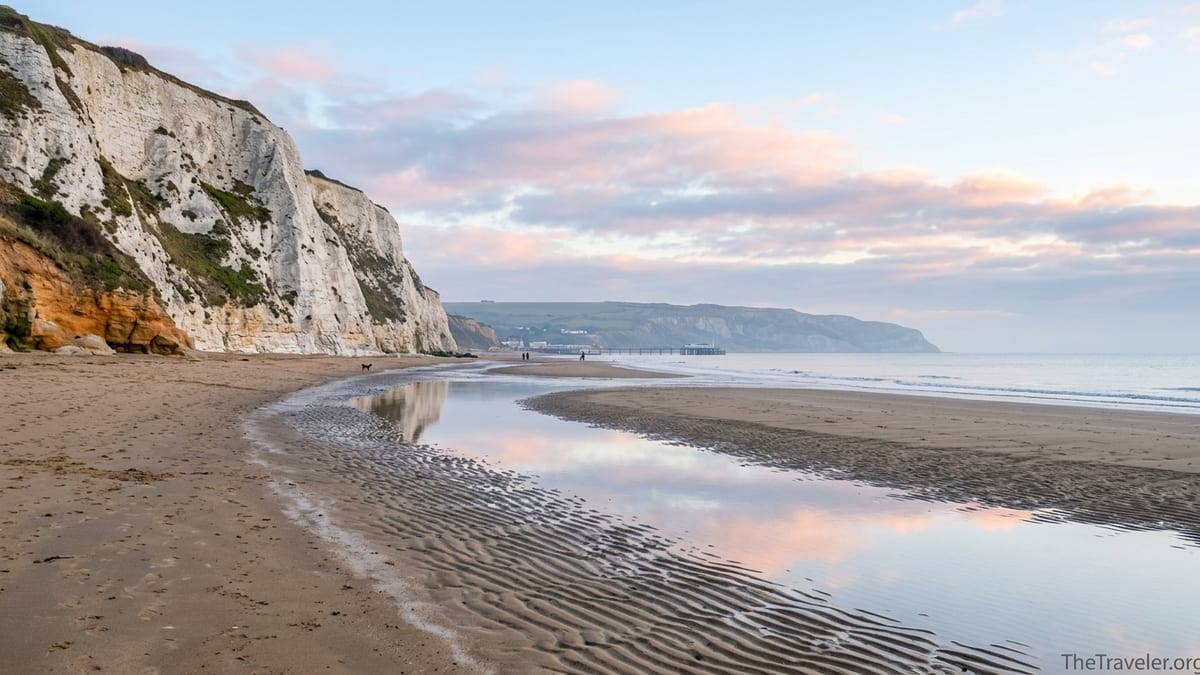
What travelers photograph again and again is the relationship between beach, cliff and sky. At lower tides wide bands of firm sand reflect the weather above like a muted mirror, catching streaks of pink at sunrise or dramatic grey clouds ahead of a passing front. At high tide, waves press closer to the seawall and groynes near the Sandown end, adding foreground texture for anyone framing Culver Cliff in the distance. Even a simple walk from the Yaverland car park towards Sandown Pier can easily yield a dozen distinct compositions without ever leaving the shoreline.
The practicalities also help explain the constant stream of images from this spot. Yaverland has a large seafront car park right behind the beach, a seasonal café‑and‑kiosk cluster and public toilets, so visitors can step out of the car and be photographing within a minute. On busy summer days families set up windbreaks and beach tents toward the Sandown side, while those seeking emptier frames gravitate east, where the cliffs rise and the crowds thin. Whatever your style of travel photography, the scene feels ready to shoot without demanding a long or difficult approach.
From Low‑Tide Textures to Fossil‑Rich Cliffs
The changing tide at Yaverland creates some of the most photographable textures on the Isle of Wight. Around mid to low tide, the water retreats to reveal a broad apron of hard, compacted sand that is easy to walk on and kind to tripods. Shallow tidal rills snaking back to the sea make leading lines across the frame, while occasional patches of exposed pebbles provide contrast against the uniform sand. After windy days, blown sand leaves ripples and ridges that catch side‑light at sunrise and late afternoon, giving even smartphone images a surprising sense of depth.
Close to the Yaverland end, the cliffs start as warm orange and red sandstone before transitioning toward the white chalk as you approach Culver Down. This colour shift is one reason photographers rarely put their cameras away on the short coastal path heading east. The cliffs are part of the island’s celebrated dinosaur coast, and guided fossil walks often begin near Yaverland’s slipway or by the Dinosaur Isle museum in Sandown. Travelers may not capture dinosaur bones in their photos, but the knowledge that the strata beside them once held iguanodon footprints or prehistoric plant life adds a quiet drama to every shot of the eroding rock face.
Safety is part of the visual story here. Recent shoreline management reports and local signage remind visitors about the possibility of cliff falls and landslips along this soft coastline, and you can often see fresh scars of pale rock where a section has given way. Photographers are strongly advised to keep clear of the base of the cliffs, especially after rain, and to use a longer lens rather than creeping closer for a dramatic angle. The result is often better composed images anyway, with more of the sky and surf included for context, while staying comfortably outside any fenced‑off or signed hazard zones.
Chasing Light: Sunrises, Storm Fronts and Golden Hour
Part of what makes Yaverland endlessly photogenic is its orientation. The bay faces broadly east, which gives it some of the island’s best sunrise light. On calm mornings in late spring and summer, photographers gather quietly on the sand or along the seawall long before cafés open, framing the sun as it lifts above the line of the English Channel. Even simple timelapse clips of dawn over Sandown Bay, widely shared by locals, show how quickly the palette shifts from deep blue to peach and gold across the water.
Because the cliffs run roughly north to south at this point, they catch side‑light beautifully in early and late hours. In autumn, when the sun rises a little further south, the chalk of Culver Down glows softly while the foreground sand stays cool in tone. By late afternoon, the situation reverses: the headland may fall partly into shadow while the sand nearest the camera catches long warm shafts of light. Travelers walking from Sandown toward Yaverland around this time often find themselves stopping every few metres as new compositions appear with the changing angle of the sun.
Not every photographic moment at Yaverland comes with blue skies. The bay is exposed enough that incoming weather fronts are clearly visible, giving photographers a generous warning when interesting clouds are on their way. Heavy grey banks rolling in from the Channel, shafts of rain over distant shipping lanes and sudden shafts of sunlight breaking through gaps in the cloud can all turn an ordinary seafront stroll into an atmospheric shoot. Many of the most shared local images show waves slamming into the Culver Parade seawall in Sandown during winter storms, the headland of Culver Down looming behind under brooding skies.
The Iconic Viewpoints: From Beach to Culver Down
For many travelers, the definitive Yaverland photograph is taken from the beach just north of the car park, looking south along the curve of Sandown Bay toward the pier and beyond to Shanklin’s distant cliffs. From this angle the bay’s classic concordant coastline is obvious: a long, even ribbon of sand fronting a line of low urban development that quickly gives way to cliffs further south. The groynes nearest Sandown make easy foreground anchors, while small fishing boats moored just off the beach or paddleboarders hugging the surfline provide human scale without dominating the frame.
Walk a little further east, staying either on the firm sand at low tide or on the coastal path above, and the perspective changes. From here Culver Cliff rears up ahead, its chalk face cutting abruptly into the sea. Photographers often turn back toward Yaverland and Sandown from midway along this stretch, framing the beach, town and downs in a single sweeping arc. On busy days you may capture a mix of dog walkers, kite flyers and fossil hunters spread out below, highlighting how much activity fits comfortably into this relatively modest bay.
For the widest panoramas, many travelers head up onto Culver Down itself. A minor road climbs steeply from the outskirts of Sandown to a National Trust car park on the chalk ridge, where visitors can step out beside a downland pub, the Yarborough Monument and a lattice of footpaths. From the cliff‑edge path here, views swing from Bembridge and its harbour on one side to the full curve of Sandown Bay on the other. On clear days you can make out the tower blocks of Portsmouth and the outline of the mainland coast beyond the Solent, which lends an extra sense of scale when photographed with a longer lens.
Walking Routes That Reward Patient Photographers
Although you can gather plenty of strong images within a few hundred metres of the Yaverland car park, the real photographic payoff comes when you slow down and walk. One classic half‑day route follows the Isle of Wight Coastal Path from Yaverland up onto Culver Down and onward to the beaches at Bembridge. The climb may feel short, but it is steep, and many photographers pause frequently to catch their breath and tweak compositions as the view behind them widens with every zigzag in the path.
Near the top of the climb, the first reward is a high‑angle shot straight back down to Yaverland Beach, the beach huts and parked cars reduced to colourful streaks against the sand. A little further along, the coastal battery remnants and the edge of the down provide rugged foreground interest for shots sweeping back over Sandown, Lake and Shanklin. Some travelers complete the full circular walk, dropping down to Whitecliff Bay and looping back inland, while others simply linger on the ridge, choosing different outcrops and grassy knolls to set up tripods for a series of overlapping panoramas.
For a gentler alternative, visitors often stay low, ambling along the seawall from Sandown’s Canoe Lake area to Yaverland and back. This there‑and‑back route, popular with families and runners, offers subtle shifts in viewpoint as you move. From under Sandown Pier you can frame the ironwork structure itself against Culver Down, then, twenty minutes later, reverse the angle from Yaverland, showing the pier as a tiny silhouette against the sweep of the bay. Because the route is mostly paved and relatively flat, it works well for travelers carrying heavier camera gear or pushing strollers.
Seasonal Moods: Summer Crowds, Winter Solitude
The character of Yaverland’s coastal views shifts markedly with the seasons, which is one reason repeat visitors keep photographing the same scenes without getting bored. In high summer, school holidays bring families and day‑trippers in large numbers. Colourful beach tents, lines of deckchairs near Sandown, kayaks dragged above the tideline and ice‑cream queues at the Yaverland kiosk all add splashes of human colour for lifestyle‑oriented photographers. Late in the afternoon, as the heat eases, you may capture impromptu games of cricket on the sand or stand‑up paddleboarders cutting slow lines across the bay’s calmer water.
In shoulder seasons such as April, May, September and October, the beach often feels more spacious while still benefiting from relatively mild weather. Temperatures are comfortable enough for long walks, yet crowds are thin enough that you can photograph reflective scenes of near‑empty sand with only a few dog walkers in the distance. On brighter days, pastel tones dominate: soft blue skies, pale beige sand and white flecks of surf. For many travel photographers aiming for a tranquil mood, these months offer the ideal balance between atmosphere and solitude.
Winter transforms Yaverland again. Prevailing winds whip waves higher and throw spray over the Culver Parade seawall near Sandown, a favourite subject for local photographers in heavy waterproofs. The top of Culver Down can feel exposed and wild, but on crisp clear days the air clarity is exceptional, allowing detailed shots of passing ferries in the Solent and, occasionally, snow‑dusted hills on the mainland. Short daylight hours mean golden light arrives mid‑afternoon, so photographers can capture long‑shadowed shots across the bay without having to wait until evening.
Practical Tips: Getting the Best Shots Safely
For travelers planning a dedicated photography outing, a bit of timing and preparation makes a big difference. Checking local tide tables before you arrive helps determine whether you will be shooting expansive wet sand or a more confined, high‑tide shoreline. Many landscape photographers aim for a falling tide around sunrise, which often leaves reflective sand and small pools without completely emptying the bay. Weather forecasts are equally important in this exposed location; clear skies might deliver a clean pastel sunrise, while broken cloud can create more dramatic light but also sudden showers.
Footwear and clothing choices directly influence how freely you can move through the landscape. The approach from the Yaverland car park to the sand is simple, but exploring towards the cliffs or climbing up onto Culver Down involves uneven paths, steep gradients and, after rain, slick mud and chalk. Sturdy trainers or light hiking shoes with good grip are usually sufficient in dry conditions, while winter walkers appreciate waterproof boots and a windproof layer. Remember that even in summer, breezes on the downland ridge can feel significantly cooler than temperatures in the sheltered town streets below.
Photographers should also respect ongoing coastal erosion and any official diversions to sections of the coastal path. Reports in recent years note localised landslips along parts of the Isle of Wight Coastal Path, and signage sometimes directs walkers inland around affected zones. The safest practice is to obey these diversions and avoid walking directly beneath crumbling cliff faces or venturing beyond safety railings for a unique selfie. Using zoom lenses or cropping in post‑processing usually provides all the drama you need without risking equipment or personal safety.
Travel Logistics and On‑the‑Ground Details
Reaching Yaverland is straightforward for most visitors to the Isle of Wight. Sandown, the nearest town, sits on the island’s southeast coast and is linked by regular island bus services to Ryde, Newport and other main hubs. From Sandown, Yaverland is either a short bus ride, a couple of minutes by taxi, or a pleasant 20‑ to 30‑minute walk along the seafront, depending on where you start. Drivers usually approach from the Sandown side and follow signs to the beach, where the main car park sits directly behind the sand with pay‑and‑display machines and marked bays for cars and campervans.
Facilities are focused around this car park area. Public toilets and a seasonal café or beach shop provide basic refreshments and shelter, and a slipway leads directly down to the beach. Accessibility for visitors with limited mobility can be good at the Sandown end, where the promenade offers level access and occasional ramps to the sand, though the foreshore becomes more challenging closer to the cliffs where the surface is uneven and strewn with pebbles. Wheelchair users sometimes prefer to enjoy the view from the paved seafront or from accessible points further along Sandown’s promenade.
Accommodation options range from traditional seaside guesthouses and small hotels in Sandown to self‑catering cottages in the surrounding countryside. Many photographers base themselves in Sandown or Shanklin for a few nights, using Yaverland as the sunrise location before exploring other photogenic spots across the island, such as Compton Bay, Tennyson Down or Ventnor’s terraced streets. Because the Isle of Wight is compact, it is entirely possible to shoot dawn at Yaverland, spend midday in the island’s interior and return to the same bay for an evening walk, all in a single unhurried day.
FAQ
Q1. Where exactly is Yaverland, and how does it relate to Sandown?
Yaverland sits at the northeastern tip of Sandown Bay on the Isle of Wight, just beyond Sandown’s main seafront. It feels like a quieter extension of the resort, with its own car park and beach access, but you can easily walk there from Sandown along the promenade in around 20 to 30 minutes.
Q2. What makes Yaverland such a popular place for coastal photography?
Yaverland combines several photogenic features in a compact area: a wide sandy beach, colourful sandstone and white chalk cliffs, the prominent headland of Culver Down and an open view across the English Channel. Its east‑facing orientation gives excellent sunrises, while the curving line of Sandown Bay creates natural leading lines for landscape compositions.
Q3. Is the coastal path between Yaverland and Culver Down suitable for all fitness levels?
The stretch of coastal path from Yaverland up onto Culver Down includes a short but steep climb, with some uneven and occasionally muddy sections. Most reasonably fit walkers manage it without difficulty, taking breaks to enjoy the views, but visitors with mobility issues or heart or breathing conditions may prefer to access the top via the road and National Trust car park instead.
Q4. When is the best time of day to photograph Yaverland and Sandown Bay?
The most rewarding times are typically sunrise and the hours around late afternoon and early evening. At sunrise, the sun appears over the sea, casting soft light across the beach and cliffs. Later in the day, low‑angled light from the west can produce long shadows on the sand and gentle side‑lighting on Culver Down, while also being more comfortable for walkers in cooler months.
Q5. Are there any safety concerns photographers should be aware of?
Yes. The cliffs along this stretch of coast are subject to ongoing erosion and occasional landslips. Visitors should avoid standing directly beneath overhangs, respect any fenced‑off areas or warning signs and follow diversions to the coastal path if sections are temporarily closed. On the downland ridge, keep a sensible distance from the cliff edge, especially in strong winds or poor visibility.
Q6. Do I need specialist camera equipment to capture good images at Yaverland?
No specialist gear is necessary. Many travelers achieve striking images using modern smartphones, especially around sunrise and sunset. However, a basic interchangeable‑lens camera with a wide‑angle lens for sweeping views and a short telephoto for isolating details, plus a lightweight tripod for low‑light conditions, will give more creative flexibility without adding excessive bulk on walks.
Q7. Is Yaverland Beach suitable for families who also want to relax between photo sessions?
Yaverland is popular with families thanks to its gently shelving sand, generally calm waters within the bay and convenient facilities such as parking, toilets and seasonal refreshments. Many visiting photographers travel with partners or children who spend time paddling, building sandcastles or exploring rock pools, while the photographer ducks away for a few minutes at a time to capture changing light or interesting cloud formations.
Q8. Can I reach Yaverland by public transport if I don’t have a car on the island?
Yes. Regular bus services link Sandown with other parts of the Isle of Wight, including Ryde and Newport. From Sandown town centre or the railway station, it is an easy walk or short local bus or taxi ride to Yaverland. The seafront route is particularly pleasant, allowing you to scout photographic angles as you go.
Q9. Are there other viewpoints nearby worth combining with Yaverland in one day?
Several. Culver Down above Yaverland is an obvious partner location, offering high‑level panoramas over Sandown Bay and Bembridge. Brading Down, a short drive inland, provides another elevated vantage point looking back towards Sandown and Culver Down. Many travelers also continue along the coast to Shanklin or, on a separate day, explore contrasting west‑coast locations such as Compton Bay.
Q10. What kind of weather should I hope for when planning a photography trip to Yaverland?
Clear mornings with scattered cloud often produce the most appealing images, with colour in the sky and soft light on the cliffs. That said, Yaverland is also striking in more dramatic conditions, such as when storm fronts approach from the Channel or winter sunlight breaks through gaps in heavy cloud. For safety and comfort, it is sensible to avoid high winds on the cliff edge and to dress for quickly changing coastal weather.