


Few European cities are as closely tied to their waterfront as Thessaloniki. The seafront promenade runs in an almost unbroken line from the port to the modern Concert Hall, giving visitors a five kilometre stage for strolling, people watching, running, cycling and some of the most vivid sunsets in Greece. This guide walks you step by step along Thessaloniki’s waterfront, highlighting the key landmarks, best viewpoints, café stops and practical tips so you can experience the city like a local.
Get the latest updates straight to your inbox!
Getting Oriented: Old Promenade, Nea Paralia and Overall Route
Thessaloniki’s waterfront is effectively one long walk, but locals divide it mentally into two main stretches. The older, more urban section runs along Nikis Avenue from the port and Aristotelous Square to the White Tower. Here the promenade is narrow, framed by neoclassical and mid twentieth century façades, and busy with cafés, bars and apartments. East of the White Tower, the atmosphere shifts. The redesigned Nea Paralia, completed in the last decade, opens into a broader, greener, more contemporary waterfront that continues for roughly 3.5 kilometres to the Thessaloniki Concert Hall.
In total, walking from the port to the Concert Hall is around five kilometres. A relaxed one way stroll with stops for photos and a drink usually takes 1.5 to 2 hours, depending on how often you pause. Many visitors choose to walk only the core section between the White Tower and the Umbrellas sculpture, which is approximately 1.5 kilometres and easy to cover in 20 to 30 minutes. Surfaces are flat and paved, so it is suitable for most fitness levels and for strollers.
The promenade follows the curve of the Thermaic Gulf, and the mountains of Pieria and Olympus often form a hazy backdrop across the water on clear days. Because the coastline faces broadly southwest, the sun sets directly over the gulf for much of the year. That orientation is what turns an ordinary evening walk into a memorable ritual, with locals timing their stroll to “catch the colours” as the sun sinks behind the water.
To make navigation simple, think of the route in three segments: the historic urban waterfront from the port to the White Tower, the landmark cluster around the White Tower and Alexander the Great statue, and the contemporary parkland and artworks of Nea Paralia leading to the Concert Hall.
Starting Point: From Aristotelous Square to the White Tower
A classic way to start the walk is at Aristotelous Square, Thessaloniki’s grand central plaza that opens directly onto the sea. From the square, step onto the sea side of Nikis Avenue and begin walking east. This first stretch is the most urban, with a relatively narrow pedestrian zone between the buildings and the water, and low railings rather than a broad park. Cafés and bars line the ground floors, with locals sipping freddo espresso and cold beer while watching the promenade life pass by.
The atmosphere here is busy and sociable rather than tranquil. You are likely to pass groups of students from the nearby universities, office workers on their way home and street musicians playing Greek pop covers. On weekends, food stalls sometimes appear near the port selling roasted corn and koulouri bread rings, an inexpensive snack you can eat while you walk. A takeaway coffee on Nikis Avenue is typically around 2 to 3 euros, slightly more if you sit down with table service.
As you continue toward the White Tower, look back occasionally for one of the most iconic views of Thessaloniki: the sightlines from the promenade toward Aristotelous Square with its curved, white neoclassical façades. The traffic of Nikis Avenue runs just inland, but because you are on the water side you mostly hear the murmur rather than the full city noise. This section can be windy in winter and quite hot in summer afternoons because there is little shade, so a hat or light jacket depending on the season is useful.
The White Tower soon appears ahead, its cylindrical stone form marking the transition between the old promenade and the newer, greener waterfront. Just before you reach it, the promenade widens and the feel of the walk changes from narrow city edge to open public space.
The White Tower and Alexander the Great: History Meets Everyday Life
The White Tower is Thessaloniki’s emblem and an essential stop on any waterfront walk. Built during the Ottoman period and later used as a prison, it now houses a museum about the city’s history. If you have time, consider climbing the spiral ramp inside. The rooftop terrace offers a 360 degree view over the bay, the old town and the inland hills. The short ascent and visit typically take 45 to 60 minutes, and entry is modestly priced compared with major Western European monuments, making it an accessible detour.
Outside, the small park around the tower is usually dotted with street vendors selling ice cream, roasted chestnuts in winter and sesame bread rings year round. Families meet here, teenagers gather on the low walls with takeaway drinks, and visiting groups pose for photos with the tower in the background. It is one of the best places to feel how tightly everyday life in Thessaloniki is woven to its seafront.
A short walk east from the White Tower, the promenade opens further and you come to the equestrian statue of Alexander the Great, mounted on his rearing horse, facing the gulf. This statue, set slightly closer to the sea than the main path, is a popular photo stop. The space around it is open and paved, which makes it a natural gathering point for skateboarders, street performers and occasional small events or rallies.
Between the White Tower and the Alexander statue, you begin to notice more cyclists and runners using the dedicated lanes that thread through Nea Paralia. The mood shifts again from compact, urban stroll to a more spacious, recreational waterfront. From here onward, the sea is always at your right shoulder if you walk east, and the city’s long ribbon of apartment blocks stands inland to your left.
Nea Paralia and the Umbrellas: Art, Parks and Sunset Views
Beyond the Alexander the Great statue lies Nea Paralia, the modern waterfront park system that has transformed Thessaloniki’s relationship with the sea. This stretch, extending several kilometres to the Concert Hall, is designed as a sequence of themed gardens and open spaces. You will pass the Garden of Alexander, small playgrounds, tree shaded lawns and low wooden decks that jut over the water. Benches are frequent, and locals use them for reading, chatting or simply watching the steady flow of people and boats.
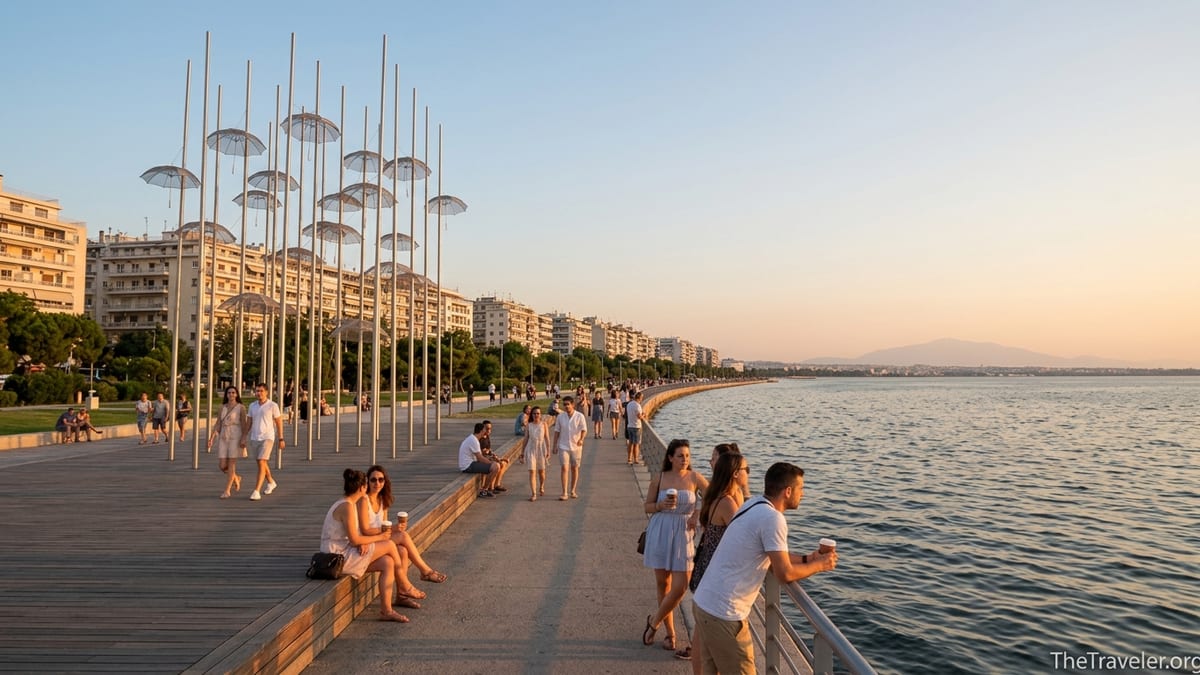
One of the absolute highlights is the Umbrellas sculpture by George Zongolopoulos, a forest of tall, stainless steel poles supporting open umbrellas, set on a large wooden platform above the water. This has become one of Thessaloniki’s most photographed spots. In late afternoon, couples, friends and solo travellers sit on the edge of the deck with their feet dangling above the waves, waiting for the sky to turn orange and pink. On summer evenings it can be quite busy, but the platform is large enough that you can usually find a place to sit.
Roughly halfway along Nea Paralia you pass the Makedonia Palace hotel, one of the city’s landmark buildings. Its ground floor café and terrace face the water and are a convenient, if somewhat upscale, place to pause for a drink or light meal. Prices here are higher than at simple kiosks, but the setting and shade can make it worthwhile, particularly in the heat of the day. A coffee on the terrace might cost 4 to 5 euros, compared with 2 to 3 euros from a basic kiosk or takeaway café nearby.
As you continue east toward the Concert Hall, the parkland widens and becomes somewhat quieter. Locals walk their dogs, children cycle along the flat paths, and you are more likely to hear the sound of waves and conversation than city traffic. If you time your walk for the hour before sunset, the low sun often creates striking reflections on the water and silhouettes of people along the promenade. On certain evenings, the sky over the Thermaic Gulf shifts to deep red or purple, a colour display that has earned Thessaloniki a reputation for some of Greece’s most dramatic urban sunsets.
Cafés, Bars and Food Stops Along the Waterfront
Part of the charm of Thessaloniki’s promenade is how easy it is to punctuate your walk with coffee, drinks or a quick snack. In the old promenade section around Nikis Avenue, every block offers a mix of sit down cafés, pastry shops and casual bars. Places range from long established patisseries serving bougatsa pastries filled with cream or cheese, to modern espresso bars offering specialty coffee and brunch plates. Expect to pay around 3 to 4 euros for a freddo cappuccino at a sit down café in this area, and slightly less if you order to go.
Closer to the White Tower and along the early part of Nea Paralia, several seasonal kiosks and small stands sell coffee, soft drinks, bottled water and packaged snacks. These are useful if you do not want to leave the path to search for a café inland. A small bottle of water is typically under 1 euro, and a simple sandwich or packaged snack might cost 2 to 4 euros. Many visitors pick up a takeaway coffee and a koulouri from a bakery a few streets back, then bring them to the promenade to eat on a bench facing the sea.
Further east in Nea Paralia, the cafés are more dispersed but still present. The ground floor café of Makedonia Palace offers seafront seating in a hotel environment, while around the Concert Hall complex, there is a modern café and bar with large glass windows and, in some buildings, rooftop terraces. These are particularly pleasant for an evening drink after your walk, when the lights of the city begin to reflect on the water.
If you are interested in a panoramic overview of the whole waterfront after your walk, you can also consider visiting the café in the OTE Tower, slightly inland near the city centre. Its rotating floor completes a circle roughly every hour, allowing you to watch the waterfront line, the upper town and the port gradually come into view while you sip a drink. It is not directly on the promenade but offers a useful way to understand the route you have just walked.
Cycling, Running and Active Ways to Enjoy the Promenade
The Thessaloniki waterfront is not only for strolling. The flat terrain and distance make it a practical space for everyday exercise. Runners are a common sight from early morning until late evening, but the most popular times are sunrise and the hour before sunset, when temperatures are milder and the light softer. A relaxed run from the White Tower to the Concert Hall and back covers roughly seven kilometres, a comfortable distance for many recreational runners.
Cycling is also well integrated into Nea Paralia’s design. There is a designated cycle lane for most of the route east of the White Tower, usually marked in a different colour from the main pedestrian path. Local bike rental shops in the city centre and near the waterfront offer hourly and daily rentals, often starting from around 5 to 7 euros per hour for a standard city bike. Some hotels also provide bicycles to guests. Because families with children and pedestrians can occasionally drift into the bike lane, a bell and moderate speed are important for safety.
If you prefer a slower pace, simply using the promenade as an extended outdoor gym is common. You will see groups doing yoga or stretching on the grassy areas, people practising calisthenics on low walls and informal boot camp sessions in the wider squares. Several of the themed gardens within Nea Paralia have basic outdoor fitness equipment. These are free to use and are most comfortable during spring and autumn when temperatures are neither too hot nor too cold.
For those travelling with children, the presence of multiple playgrounds along Nea Paralia makes it easy to break up the walk. Small climbing frames, swings and slides sit just a few metres from the main path, always with clear sightlines to the water. Parents often sit on nearby benches with takeaway coffee while children play, turning the walk into a series of short, manageable segments rather than one long route.
Best Time to Go: Seasons, Time of Day and Crowd Patterns
Thessaloniki has a temperate climate with warm to hot summers and mild winters. For walking the waterfront, spring and autumn are generally the most comfortable seasons. From April to early June and from late September through November, daytime temperatures are usually pleasant for outdoor activity, and the sun is not as intense as in midsummer. These periods also tend to be less crowded with visitors, so you will share the promenade mainly with residents.
In July and August, daytime temperatures can rise well above 30 degrees Celsius, making midday walks along the largely unshaded sections strenuous. If you visit in high summer, aim for early morning before 10:00 or early evening after 18:30. Locals often time their waterfront outings for just before sunset, when the temperature has dropped slightly and the breeze from the gulf is strongest. This is also when the sky colours are at their best, but be prepared for more people, especially around the White Tower and the Umbrellas sculpture.
Winter walks along the promenade have a different but appealing character. From December to February, temperatures are cooler and the air clearer, which can make the distant outline of Mount Olympus more visible on the horizon. Rain is more likely in these months, and strong northerly winds can make the waterfront feel significantly colder than inland streets. A windproof jacket, scarf and gloves will make even a brisk winter walk along the sea pleasant.
As for days of the week, evenings from Friday to Sunday are the busiest, particularly around the cafés of Nikis Avenue and near the White Tower. If you prefer quieter atmosphere and more space for photography or running, aim for weekday mornings. Early Sunday mornings can be especially tranquil, with very light traffic and only a scattering of joggers and dog walkers along the water.
Practical Tips: Safety, Transport and Extending the Walk
Thessaloniki’s waterfront promenade is generally considered safe and well used, particularly between early morning and late evening. Families with children, students and older residents all share the path, which gives it a lived in feel rather than a purely tourist space. Basic precautions apply as in any city: keep an eye on your belongings in crowded spots around the White Tower, especially if you pause to watch the sunset or street performances.
Footwear is important. The route is entirely paved, but sections near the water can be uneven or slippery after rain. Lightweight trainers or comfortable walking shoes are preferable to sandals if you plan to cover the full distance from the port to the Concert Hall. In summer, bring a hat, sunglasses and sunscreen. There are some trees and shaded areas in Nea Paralia, but long stretches are exposed, particularly near midday.
Public buses run parallel to much of the waterfront, which is helpful if you prefer to walk only one way. For example, you might walk from the White Tower to the Concert Hall and then take a bus back toward the city centre from a stop on the inland main avenue. Taxis are also easy to find along the main roads just inland from the promenade, and rides between the Concert Hall area and Aristotelous Square are usually short and moderately priced compared with other European cities.
If you want to extend your walk, consider combining the waterfront with nearby districts. From the port end of the promenade, it is a short walk inland to the Ladadika quarter, known for its tavernas and bars in restored warehouses. From the White Tower, you can head uphill into the museum corridor that includes the Archaeological Museum and the Museum of Byzantine Culture. For a contrasting perspective, visit the uphill old town of Ano Poli later in your trip to look back down at the same waterfront you have walked.
The Takeaway
Walking Thessaloniki’s waterfront is one of the simplest and most rewarding experiences the city offers. In a single route, you move from historic stone tower and dense urban façades to contemporary parkland, public art and open views of the Thermaic Gulf. Whether you cover only the stretch between the White Tower and the Umbrellas or complete the full five kilometre line to the Concert Hall, the promenade introduces you to the rhythms of local life as much as to the city’s landmarks.
The practical advantages are clear. The route is flat, accessible and filled with opportunities to pause for coffee, snacks or photographs. It works as an early morning run, a family friendly afternoon stroll or a romantic sunset walk. With a bit of planning around time of day and season, you can avoid the hottest hours of summer, enjoy quieter moments in spring or autumn and even experience the sharp, clear light of winter days.
For many visitors, the image that stays with them after leaving Thessaloniki is not a single monument but the memory of walking by the sea, watching the sky change colour, and feeling that the city lives with its back doors open to the water. Treat the waterfront not just as a path between attractions but as an attraction in its own right, and you will understand why locals return to it again and again.
FAQ
Q1. How long does it take to walk from the White Tower to the Umbrellas sculpture?
Most visitors take about 20 to 30 minutes to walk the roughly 1.5 kilometre stretch between the White Tower and the Umbrellas, allowing time for brief photo stops.
Q2. Is the Thessaloniki waterfront walk suitable for children and strollers?
Yes. The entire promenade is flat and paved, with several playgrounds along Nea Paralia and plenty of benches, making it very family and stroller friendly.
Q3. Can I cycle the whole waterfront from the port to the Concert Hall?
You can cycle most of the route, especially through Nea Paralia where there is a dedicated bike lane, but you should slow down in the busier sections near the White Tower and port.
Q4. What is the best time of day to see the sunset from the promenade?
The hour before sunset is ideal. Arrive a little early to find a spot near the Umbrellas sculpture or the area around the White Tower for the best colours over the gulf.
Q5. Are there toilets along the Thessaloniki waterfront?
Public toilets are limited, but you can usually use facilities in cafés and bars if you purchase a drink, especially around Nikis Avenue, the White Tower and the Concert Hall.
Q6. Do I need to worry about strong winds on the promenade?
On some autumn and winter days the waterfront can be quite windy, making it feel colder than inland streets, so a windproof jacket is useful in cooler months.
Q7. Is the waterfront safe to walk at night?
The promenade is usually busy and well used until late evening, especially around the White Tower and Nea Paralia. Normal city precautions with valuables are still recommended.
Q8. Can I buy food and drinks directly on the promenade?
Yes. There are numerous cafés, kiosks and stands selling coffee, soft drinks, snacks and ice cream, particularly around Nikis Avenue, the White Tower and parts of Nea Paralia.
Q9. How do I get back to the city centre after walking to the Concert Hall?
You can return by bus from the main avenue just inland from the Concert Hall area or take a taxi, which usually reaches Aristotelous Square in around 10 to 15 minutes depending on traffic.
Q10. Is it worth visiting the White Tower museum during the waterfront walk?
Many visitors find it worthwhile. The museum provides a concise history of Thessaloniki, and the rooftop terrace offers some of the best panoramic views over the bay and city.