


Choosing between Athens and Thessaloniki for a first trip to Greece is less about which city is “better” and more about which one fits the way you actually like to travel. Both offer ancient history, walkable neighborhoods, strong coffee culture and lively nights, but the feel on the ground is very different. This guide looks at how Athens and Thessaloniki compare in real life, from prices and food to beaches, transport, day trips and sample itineraries, so you can confidently pick the city that should come first on your Greek list.
Get the latest updates straight to your inbox!
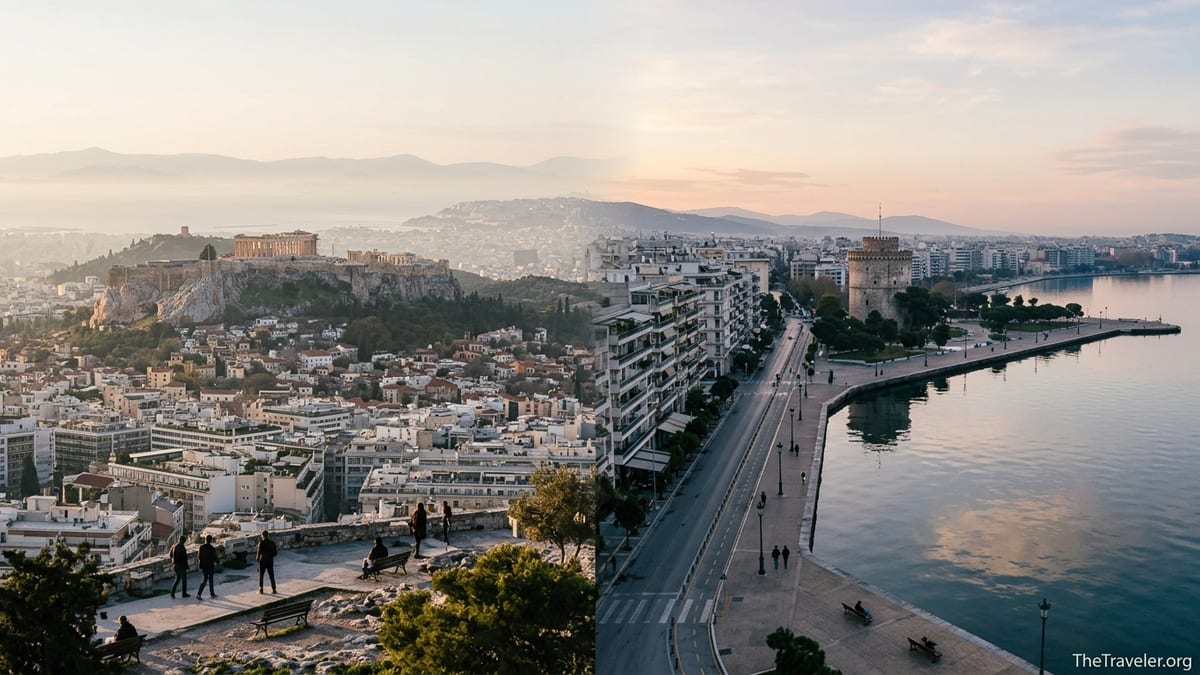
First Impressions: Atmosphere and Urban Vibe
Most travelers will feel Athens before they see it. Landing at Athens International Airport and riding the metro into the center, the city quickly announces itself as a loud, layered capital of more than three million people. Around Syntagma Square and Monastiraki you get traffic noise, street protests some evenings, and clusters of visitors heading for the Acropolis. It can feel chaotic on arrival, especially in high season, but if you enjoy big-city energy, open squares filled with people until late and a sense that “everything happens here,” Athens delivers from the first hour.
Thessaloniki by contrast is smaller and feels immediately looser and more local. From its compact airport you reach the center in about 25 to 35 minutes by bus or taxi, and you step into a city oriented along the sea rather than around ancient ruins. Aristotelous Square, the main plaza opening to the Thermaic Gulf, usually has kids on scooters, groups of students, and locals walking dogs along the promenade. Even in summer it is busy, but the pace is more relaxed, with a strong café culture and a cooler, more lived-in edge thanks to its large student population.
In practical terms, first timers who want that unmistakable “I am in Greece” postcard moment under the Acropolis will probably feel an instant connection with Athens. Travelers who prefer a less touristic, more everyday Greek city where they can slide into local routines at bakeries and neighborhood bars often find Thessaloniki an easier first landing.
History and Sights: Ruins vs Layers
Athens is the obvious choice if your priority is classical history. The Acropolis, the Parthenon, the Ancient Agora, the Temple of Olympian Zeus and the Acropolis Museum are all concentrated within a walkable area. A typical first morning might involve buying a combined archaeological ticket, walking up to the Acropolis for opening time to avoid crowds, then descending through the southern slope to the Acropolis Museum for lunch at the rooftop restaurant with a view back to the Parthenon. Even with only two days you can comfortably fit in the main monuments plus a walk through Plaka and a sunset drink on a rooftop bar.
Thessaloniki’s history is more layered than monumental. You do not get a single defining ruin like the Acropolis, but you do walk through Roman, Byzantine, Ottoman and modern streets often in the space of a few blocks. The Rotunda, Arch of Galerius, Roman Forum and the city’s Byzantine walls and churches are all scattered through the center and upper town. An afternoon could see you moving from the Roman forum to the 7th century church of Agia Sophia, then up to the Ano Poli district for views from the old walls over the sea and the port cranes.
For a first trip focused on ticking off world famous ruins, Athens is hard to beat. If you are more interested in how different historical eras sit on top of one another and shape daily life, Thessaloniki rewards slow wandering and repeat café stops between smaller, often less crowded sites.
Food, Coffee and Nightlife
Greece takes food seriously, and both cities have strong culinary scenes, but they feel different. Thessaloniki is often called Greece’s food capital, and once you spend an evening in the Ladadika district or the Modiano and Kapani market area, it is easy to see why. You can have a sit down meal at a meze taverna with grilled octopus, bougiourdi baked feta with peppers and local wine for a price that is generally a bit lower than in central Athens. Street food is excellent too: koulouri sesame bread from corner bakeries, bougatsa pastry with cream or cheese in morning cafés, and late night gyros on streets around Kamara where students crowd inexpensive souvlaki places.
Athens has greater range at the top end. Around Syntagma, Kolonaki and Koukaki you find inventive bistros and fine dining that mix traditional flavors with modern techniques. It is easy to spend on a tasting menu or a view heavy dinner near the Acropolis, but you also find casual spots in Psiri or Exarchia where a couple can share plates of fried zucchini, grilled meats and a carafe of house wine for a modest bill. For coffee, Athens has several specialty roasters and third wave cafés in Koukaki, Pangrati and around the university zones, while Thessaloniki’s strength is more its all day cafés and patisseries where people linger for hours over frappé and sweets.
Nightlife is strong in both cities, but the feel differs. Athens offers variety, from rooftop cocktail bars with direct Acropolis views in Monastiraki to live rebetiko music tavernas in Psiri and late bars in Gazi. A typical evening might start with a sunset drink overlooking the lit Acropolis, continue with meze in a small lane in Plaka, then move to a bar in Psiri that stays open well past midnight. Thessaloniki’s nights concentrate around Ladadika, Valaoritou and the seafront. Many places combine café, bar and snack bar in one, and streets can stay busy with locals and students until very late, especially from Thursday to Saturday, often at slightly lower prices for drinks and cover charges.
Costs, Accommodation and Practicalities
For most visitors, Thessaloniki is a little cheaper overall. Accommodation in central areas like Aristotelous Square, Ladadika or the streets just behind the seafront often comes in under similar quality rooms in central Athens. A mid range hotel in Athens around Plaka or Monastiraki typically charges noticeably more in high season than a comparable hotel near Thessaloniki’s waterfront. Budget travelers will also find that casual meals, coffees and taxis are usually a bit more affordable in Thessaloniki, though the difference is not dramatic and can fluctuate with demand.
In Athens, the most convenient neighborhoods for first timers are Plaka, Monastiraki, Syntagma and Koukaki. Staying there means you can walk to the Acropolis, the main museums and major metro lines. The trade off is higher room rates and more tourist focused restaurants on certain streets. Slightly more residential districts like Pangrati or Mets can give you lower rates and a local feel while still being within a reasonable walk or short taxi ride of the historic center. In Thessaloniki the city is more compact, so staying anywhere between the port and the White Tower keeps you in easy walking distance of key sights, bars and markets.
Getting around both cities is straightforward for visitors. Athens has a metro system linking the airport, port of Piraeus and major central areas, along with trams to the southern coastal neighborhoods and extensive buses. In Thessaloniki, you rely more on buses, taxis and walking, as the metro is still limited while new lines are being completed. For many travelers this is not a major issue since the waterfront and historic streets are dense and pedestrian friendly.
Beaches, Water and Green Space
If you imagine combining city sightseeing with easy swims, the difference between the two cities matters. Athens has the advantage of quick access to the Athenian Riviera. From Syntagma or Monastiraki you can take a tram or bus south to coastal neighborhoods like Paleo Faliro, Alimos and Glyfada, where you find organized beach clubs and free stretches of coastline. Further along in Vouliagmeni you reach clearer water, rocky coves and more upscale beach bars. Many visitors split a day between the Acropolis in the morning and a late afternoon swim followed by a seafood dinner by the sea.
Thessaloniki’s city waterfront is a long promenade rather than a central swimming beach. Locals and visitors stroll, cycle and sit on benches facing the gulf, and it is a beautiful place at sunset, with the White Tower on one side and the port cranes on the other. For actual swimming, you need to travel out of the city to nearby beaches. Many locals take buses or drive to the first finger of Halkidiki, about an hour to ninety minutes away depending on the beach, where you find pine framed coves and long sandy stretches with clear water. That makes beach days more of a separate excursion than a quick afternoon dip.
When it comes to green space, neither city is packed with large parks in the center, but Athens has the National Garden behind the Parliament building and the wooded hill of Lycabettus with its panoramic views. Thessaloniki has smaller parks along the seafront and in Ano Poli, where walking the old walls gives you sweeping views without leaving the city.
Transport Links and Day Trips
Both cities work as bases for wider exploration, but in different ways. Athens has clear advantages for classic day trips. From central Athens you can join organized tours or drive yourself to Delphi in the mountains, the ancient theater of Epidaurus, the seaside town of Nafplio, or Cape Sounion and the Temple of Poseidon. These trips are well established, with pick ups from central hotels and a steady flow of English speaking guides. From the port of Piraeus and nearby smaller ports, you also have frequent ferries to islands in the Saronic Gulf and beyond, making short island hops realistic even on a tight schedule.
Thessaloniki is better placed for northern Greece. From here, popular day or overnight trips include the monasteries of Meteora, the royal tombs at Vergina, wine routes in Naoussa and the beaches of Halkidiki. Many of these are easier as guided excursions or with a rental car, as public transport connections can be slower and less regular than routes out of Athens. Ferries from Thessaloniki’s port have connections to some Aegean islands and occasionally to places like the Sporades, though schedules and routes vary by season and year, and are generally less frequent than Piraeus services.
Travel between Athens and Thessaloniki is also straightforward. Domestic flights run frequently and usually take under an hour of air time. Intercity trains connect the two in roughly five hours depending on service type, with schedules adjusted periodically as infrastructure works continue on the main line. Buses offer another option and can be competitive on price. Most first time visitors with limited days tend to pick one city and fly there directly if possible, rather than splitting a short trip between both.
First Time Itineraries: Who Should Pick Which City
Athens is the stronger choice if this is your first visit to Greece, you have limited time, and you do not know when you will return. A realistic three day first time itinerary might look like this: on day one, arrive, check into a central hotel near Syntagma or Plaka, then walk through the old streets of Plaka and Anafiotika up to viewpoints of the Acropolis, finishing with dinner at a traditional taverna. On day two, spend the morning at the Acropolis and Acropolis Museum, then explore Monastiraki’s flea market and Psiri’s bars in the evening. On day three, either visit the National Archaeological Museum and Lycabettus Hill or take a guided afternoon trip to Cape Sounion for sunset over the Temple of Poseidon.
Thessaloniki works best for travelers who either have been to Athens before or are less driven by bucket list sights. A three day Thessaloniki plan could start with arrival and a slow afternoon walk along the seafront from the port to the White Tower, then dinner in Ladadika. The second day might involve exploring the Roman Forum, visiting the Rotunda and Arch of Galerius, then climbing to Ano Poli for sunset views and a simple meal in a family run taverna. On the third day, you could take a trip to nearby beaches or a wine region, or simply spend more time in the markets around Modiano and Kapani sampling local products and sweets.
For a longer overall trip to Greece, many travelers choose to start in Athens for three or four days, continue to an island or the Peloponnese, and then end in Thessaloniki before flying out. Others reverse the order for a softer landing, beginning with quieter Thessaloniki to adjust to the country and finish in Athens for a last blast of big city and ancient sites.
The Takeaway
If you are trying to decide where to go first, the simplest question to ask yourself is: do I want my first image of Greece to be the Acropolis or the sea? If you picture standing on a pedestrian street with the Parthenon glowing above you at night, Athens should probably be your first stop. It remains the country’s cultural and political heart, with enough world class sights, food and nightlife to fill several days even if you never leave the city limits.
If instead you imagine sitting on a waterfront bench, watching locals stroll a long promenade and students fill late night bars around a historic port, Thessaloniki might suit you more. It offers strong food, authentic everyday pace, and good access to northern mountains and beaches. Many visitors who start there feel they have discovered a more understated, less touristed gateway to Greece.
For most first time travelers with only a week or less in Greece, Athens is still the more logical first choice, especially if this might be a once in a lifetime visit. But if you plan to return, or if you prefer a slightly more local and less monument driven experience, there is a strong argument for letting Thessaloniki be the city that quietly hooks you on Greece from the very beginning.
FAQ
Q1. Is Athens or Thessaloniki better for a very short trip of 2 to 3 days?
Athens is usually better for a very short first trip, because the main ancient sites, central neighborhoods and airport connections are so concentrated that you can see headline highlights quickly. Thessaloniki is wonderful but rewards slower wandering and does not offer a single landmark on the scale of the Acropolis.
Q2. Which city is generally cheaper, Athens or Thessaloniki?
On average Thessaloniki is a bit cheaper for accommodation, casual dining and nightlife, especially around student areas and local neighborhoods. Central Athens can feel pricier, particularly in Plaka and around the Acropolis, though you can still find good value in residential districts like Pangrati or Koukaki.
Q3. Where should I stay in Athens for a first visit?
For a first time stay, most visitors choose Plaka, Monastiraki, Syntagma or Koukaki so they can walk easily to the Acropolis, Acropolis Museum and major metro lines. These neighborhoods balance access to sights, plenty of restaurants and reasonably straightforward airport transfers.
Q4. Where should I stay in Thessaloniki for a first visit?
In Thessaloniki, staying between the port and the White Tower works well. Areas around Aristotelous Square, Ladadika and the streets just behind the seafront put you in walking distance of markets, major monuments, bars and cafes without needing constant taxis.
Q5. Which city has better nightlife?
Both cities have strong nightlife but with different styles. Athens offers a wider range including rooftop cocktail bars with Acropolis views, late night clubs and live music venues across several districts. Thessaloniki’s nightlife is more concentrated along the seafront and in Ladadika and Valaoritou, with a dense mix of bars, cafes and music spots that feel very local and student heavy.
Q6. Is either city better for families with children?
Families often find both cities manageable, but Athens offers more obvious kid friendly sights like the Acropolis, larger archaeological sites and several museums with interactive exhibits. Thessaloniki can feel less hectic in the center and the seafront promenade is ideal for strollers and bikes, so it may appeal to families who prefer a calmer urban environment.
Q7. Can I combine beaches easily with my city stay?
In Athens you can reach beaches in the southern suburbs like Alimos, Glyfada or Vouliagmeni by tram, bus or taxi, making a half day swim very realistic. In Thessaloniki, the waterfront is lovely for walking but you usually need to travel out of town, for example toward Halkidiki, turning beach time into more of a day trip.
Q8. Which city is better for day trips without a car?
Athens has more established day trips that are easy without a car, including organized tours to Delphi, Epidaurus, Nafplio and Cape Sounion, plus frequent ferries to nearby islands. Thessaloniki is better for northern destinations, but many options like Meteora or some Halkidiki beaches are simpler with a tour or rental car than by regular public transport.
Q9. Is it worth visiting both cities on the same trip?
Visiting both makes sense if you have at least 10 to 14 days in Greece and enjoy cities. Many travelers do three or four days in Athens, move on to islands or the Peloponnese, then spend two or three days in Thessaloniki before flying home. With only a week or less, it is usually better to choose one base to avoid losing time to travel days.
Q10. Which city should I choose if I plan to return to Greece?
If you are confident you will come back, you could start with Thessaloniki for a more relaxed, local introduction and save Athens and its blockbuster sights for a dedicated future trip. If you are unsure whether you will return, it makes more sense to begin with Athens so you experience the Acropolis and the classic highlights at least once.