


More news on this day
Togo has introduced a drastic 98 percent reduction in market-entry fees for airlines seeking to launch operations in the country, a move designed to accelerate the development of Lomé as a strategic aviation hub for West Africa and to complement wider regional efforts to bring air travel costs down.
Get the latest news straight to your inbox!
A Historic Cut in Airline Installation Costs
Publicly available information from the Togolese government indicates that the country has reduced financial charges for new airlines entering its market by 98 percent, covering a range of fees associated with establishing operations in Togo. The measure is presented as a cornerstone of a wider policy to make the country markedly more attractive to passenger and cargo carriers looking for a base or additional routes in West Africa.
Details published on the official Togo government portal describe the decision as a substantial overhaul of the financial framework for airline installation, aimed at easing access to the market and encouraging more operators to choose Lomé as a primary or secondary hub. Reports point out that the reduction affects the up-front cost burden that often deters smaller or regional airlines from opening new routes into emerging markets.
Information released by the National Civil Aviation Agency (ANAC) underscores that the reform is intended to stimulate competition and route development rather than offer short-term promotional incentives. By nearly eliminating installation charges, Togo is positioning itself as one of the least costly entry points for airlines in the region, a notable shift in a market where various taxes and fees have historically weighed heavily on carriers.
According to sector-focused coverage, the announcement was highlighted on the sidelines of a high-level regional aviation meeting in Lomé, signaling that the reform is meant to resonate not only domestically but also across West Africa’s air transport community.
Lomé’s Ambition to Become a West African Aviation Gateway
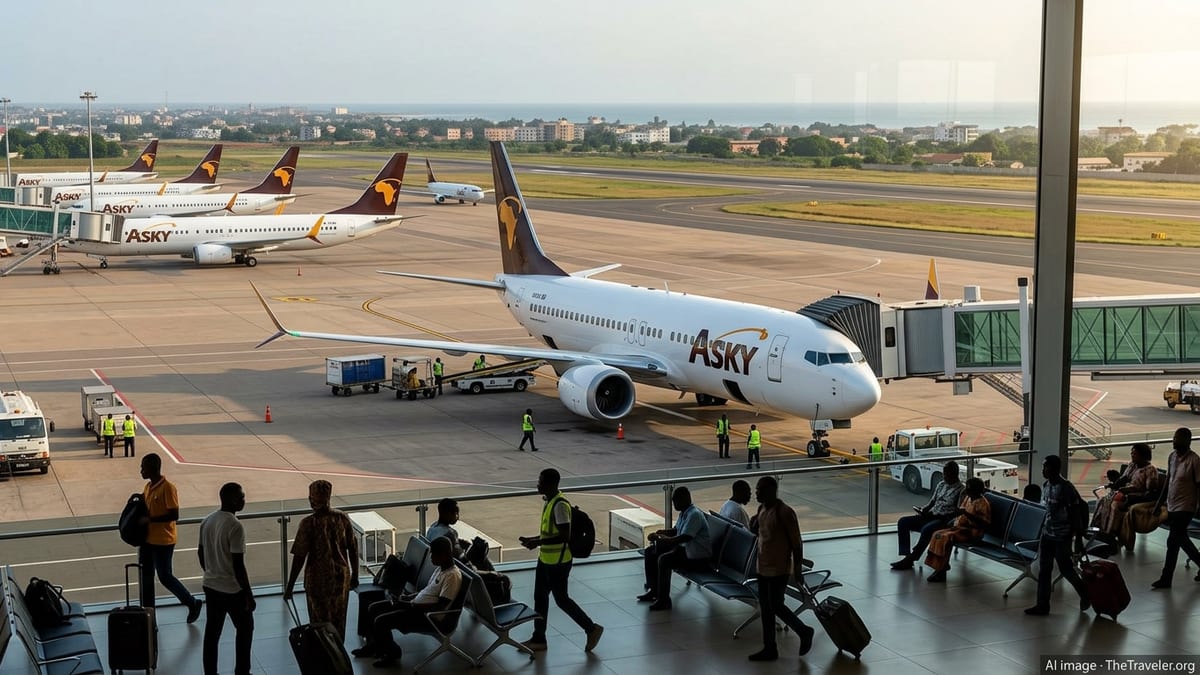
Lomé’s main gateway, Gnassingbé Eyadéma International Airport, already serves as a hub for ASKY Airlines and plays a growing role in connecting West Africa with Europe, the Middle East and other parts of the continent. Background documentation on Togo’s transport strategy shows that the government has long targeted logistics and air connectivity as pillars of a national development roadmap, with ambitions to turn the capital into a multimodal hub for passengers and cargo.
Investment promotion material produced for international investors highlights Togo’s central coastal location, including direct overland access to landlocked neighbors such as Burkina Faso and Niger. In this context, air connectivity through Lomé is seen as a natural complement to port and road corridors that already channel regional trade flows through the country.
Analysts following West African aviation note that a more competitive cost structure at Lomé’s airport could strengthen its position relative to rival hubs such as Accra, Abidjan and Lagos, especially for transfer traffic. Lower airline entry costs may enable additional regional carriers to schedule Lomé as a connecting point, expanding frequencies and destination choices for travelers who now often face high fares and limited direct options within West Africa.
The new pricing environment may also appeal to long-haul operators assessing secondary hubs in Africa for future expansion. While decisions on new intercontinental routes depend on multiple factors, including demand and fleet availability, a sharp cut in up-front charges can improve the business case for testing new services into Lomé.
Going Beyond ECOWAS-Wide Airfare Reforms
The 98 percent reduction in airline installation fees in Togo comes as West Africa advances a broader regional agenda to bring down air transport costs. Documents from the Economic Community of West African States (ECOWAS) describe a Supplementary Act on aviation charges, taxes and fees that requires member states, from 1 January 2026, to abolish certain air transport taxes and cut selected passenger and security charges by 25 percent.
Recent ECOWAS communiqués outline economic simulations indicating that the removal of non-transport taxes and a quarter reduction in key charges could stimulate traffic by more than one million additional passengers a year across domestic, regional and international markets. These projections are tied to expectations of lower average ticket prices, stronger airline balance sheets and deeper regional integration.
Coverage of the Togolese reform stresses that the national measure goes further than the minimum cuts envisaged at ECOWAS level. While the regional framework focuses primarily on recurring taxes and passenger-related charges, Togo’s decision targets the one-off but often prohibitive costs airlines face when first entering a market. By tackling this specific barrier, Lomé is effectively layering an additional incentive on top of the upcoming regional charge reductions.
Observers of West African policy coordination suggest that Togo’s move could serve as a demonstration case within ECOWAS, illustrating how individual states might adopt complementary national initiatives alongside common regional rules to accelerate the impact on connectivity and affordability.
Implications for Airlines, Passengers and the Wider Economy
For airlines, the near-elimination of installation fees in Togo translates into lower initial capital outlays when evaluating new routes or basing aircraft in Lomé. This can be particularly significant for regional and start-up carriers operating with thinner margins and limited access to financing. Lower entry costs may allow these operators to allocate more resources to marketing, network development and fleet deployment.
In practical terms, a more airline-friendly cost structure could support increased frequencies on existing routes, the launch of new intra-African links and potentially the expansion of cargo services using Lomé as a consolidation point. Industry experience in other regions suggests that when airport and state charges fall, carriers often test additional capacity, especially on underserved regional city pairs.
For passengers, any pass-through of cost savings into fares could improve access to air travel in a region where ticket prices are widely regarded as high relative to average incomes. ECOWAS documents and regional press commentaries have repeatedly underlined how taxes and charges contribute to expensive air tickets in West Africa. If Togo’s move succeeds in attracting more competition and capacity to Lomé, travelers may benefit from more routing options, shorter journey times and, over time, more competitive pricing.
Beyond aviation, the reform is aligned with Togo’s objective of using transport as a driver of trade, tourism and services growth. Easier airline entry may help position Lomé as a venue for regional conferences, a transit point for business travelers and a gateway for leisure visitors connecting to coastal and inland destinations. Increased traffic flows through the capital’s airport could stimulate investment in hospitality, logistics, maintenance and training, deepening the wider economic footprint of the aviation sector.
Lomé’s Role in Africa’s Single Air Transport Market
Togo’s decision is also consistent with continental initiatives such as the Single African Air Transport Market, which seeks to liberalize air services and gradually remove non-physical barriers across Africa. Policy documents and country yearbooks on Togo describe the aviation sector as central to the national strategy of reinforcing the country’s role as a logistics and services hub in support of regional integration.
By sharply reducing the financial hurdle for airlines to enter its market, Togo is signaling that it intends to be among the more proactive supporters of liberalization in practice, not only on paper. The combination of national reforms and alignment with ECOWAS and African Union frameworks could help Lomé gain visibility among carriers designing pan-African networks and choosing where to base connecting operations.
Regional stakeholders will be watching how quickly the new fee regime translates into concrete announcements of new routes or airlines entering the Togolese market. The effectiveness of the reform is likely to be measured not only by the number of additional operators, but also by the breadth of new connections created between West African capitals and beyond.
As West Africa prepares for the entry into force of ECOWAS-wide aviation charge reductions in 2026, Togo’s early and more radical step on airline installation costs positions Lomé as an important test case for how targeted financial reforms can accelerate progress toward a more affordable and better-connected regional air transport system.
Official Togo government announcement on airline installation fees
ANAC Togo information on the new financial framework for airlines