


More news on this day
A commuter rail journey north of London turned deadly on Friday evening when two passenger trains collided near Bedford, killing a train driver and injuring 89 people on one of Britain’s busiest intercity corridors.
Get the latest news straight to your inbox!
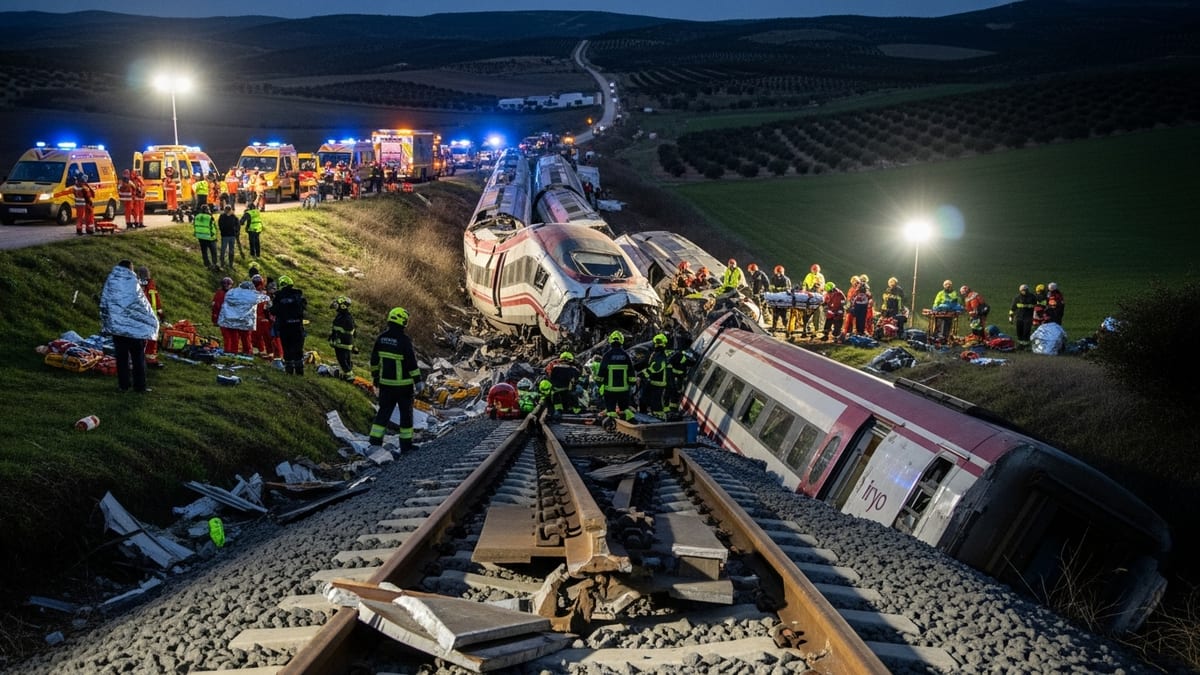
Collision Near Bedford on Busy London Corridor
Publicly available information indicates that the crash occurred at around 5:15 p.m. local time on Friday 19 June 2026, on the main line between Bedford and Luton. The route carries frequent services into London St Pancras, linking the capital with towns in the East Midlands and connections to Luton Airport.
Reports describe a southbound Luton Airport Express service striking the rear of another East Midlands Railway train that was also heading towards London. The impact took place a few miles south of Bedford, close to the village of Elstow, in an area of multiple tracks and high traffic density.
Ambulance services reported that one person died at the scene and 89 people suffered injuries of varying severity. Rail union statements and regional media coverage identify the person killed as the driver of one of the trains, who was in the leading cab at the moment of impact.
Images from the scene published by news outlets show one train partially overriding the rear of the other, with visible damage to the leading and trailing carriages but both formations remaining upright on the tracks. Emergency lighting and evacuation chutes were deployed as passengers were led away to safety.
Casualties, Emergency Response and Passenger Accounts
Data released by the East of England Ambulance Service and reported by several outlets indicate that among the 89 injured, 11 people sustained very serious injuries, 22 were classified as seriously hurt and 56 suffered minor wounds. Many of those on board were traveling during the evening peak, either commuting or heading to and from flights via Luton Airport.
Passengers described being thrown from their seats, with some accounts carried by broadcasters comparing the sensation to a powerful explosion. Several people reported broken glass, fallen luggage and a chaotic scramble to reach doors and emergency exits in the darkened carriages.
Emergency services deployed a large-scale response that included multiple ambulances, specialist hazardous incident teams and at least one air ambulance. The incident was treated as a major emergency, with triage areas established beside the railway to assess and prioritize casualties before transfer to hospitals around the region.
Publicly available information from regional authorities indicates that many passengers with minor injuries were treated at the scene and released, while hospitals in Bedfordshire and neighboring counties received those with more serious trauma. Rail and local officials have acknowledged the scale of the emergency response and the challenges of accessing the site along the railway embankment.
Impact on Rail Services Through Bedford and Luton
The collision brought one of England’s key north–south rail arteries to a standstill. East Midlands Railway suspended services into and out of London St Pancras for the rest of Friday evening, while National Rail issued warnings of severe disruption between London, Bedford and Leicester.
Trains already in motion were held at stations along the route, with some services turned back short of their destinations. Passengers reported extended delays at hubs including Luton, Wellingborough and Kettering as operators worked to clear the line and organize alternative transport.
Replacement road services were deployed on sections of the corridor, but capacity constraints and evening traffic meant many travelers faced journeys lasting several hours longer than planned. Rail industry statements suggest that full restoration of services is expected to take time, given the need for on-site investigations and track inspections before damaged rolling stock can be removed.
The disruption is particularly significant for Luton Airport, which relies heavily on rail links from London St Pancras via dedicated airport express services. Travelers were advised to allow additional time and to check for latest service changes before heading to the airport or attempting longer distance journeys on the affected line.
Early Focus on Safety Systems and Signaling
Specialist investigators from the Rail Accident Investigation Branch have been deployed to the crash site to begin a detailed examination of the circumstances leading to the collision. According to published coverage, the inquiry is expected to focus on signaling systems, train protection technology and operating practices on this intensively used stretch of railway.
Early media reports, which have not yet been formally corroborated by investigators, suggest that one of the trains may have been stopped on the line due to a technical fault shortly before being struck from behind. Some coverage has referred to communication between the stopped train and maintenance staff, raising questions about how information was shared and what protections were in place during the incident.
Britain’s rail network is generally regarded as having a strong safety record, with systems designed to prevent high speed rear end collisions on main lines. The Bedford crash is therefore attracting close scrutiny from safety experts, rail worker representatives and passenger groups, all of whom are calling for a thorough examination of how multiple layers of protection appear to have failed.
Investigators are expected to analyze data from on board recorders, trackside signaling logs and radio communications, as well as conducting detailed inspections of braking systems and cab controls. Their findings will likely inform recommendations that could affect operating rules, staff training and future investment in train control technology.
Wider Questions for UK Rail Reliability and Resilience
For travelers, the Bedford collision raises broader concerns about resilience and reliability on a corridor that plays a central role in the United Kingdom’s passenger rail network. The line carries intercity services linking London with the East Midlands, as well as commuter and airport traffic that has grown steadily over the last decade.
Passenger groups and transport commentators are already highlighting the combination of high traffic volumes, infrastructure maintenance needs and periodic engineering works that place pressure on scheduling and operations. The fact that the crash occurred on a busy Friday evening, with trains crowded and the network close to capacity, is likely to feature in ongoing assessments of risk.
While major train collisions remain rare compared with the overall number of journeys made each day, the fatality of a driver and the high tally of injuries near Bedford have reinforced calls for continual upgrades to safety systems and contingency planning. Travel industry observers note that clear communication, robust emergency procedures and timely restoration of services are all critical to maintaining public confidence in rail travel following a high profile incident.
As recovery and investigation work continues over the coming days, travelers using the Bedford and Luton corridor are being advised to check revised timetables and prepare for potential delays. Analysts suggest that future recommendations resulting from the inquiry are likely to shape not only safety protocols on this specific route, but also wider policy debates about investment and modernization across the UK rail network.