


More news on this day
Around 2,000 passengers were stranded overnight at Hong Kong International Airport after Typhoon Noul swept through the city over the weekend, forcing widespread flight cancellations and leaving travelers sleeping in departure halls as airlines struggled to restart operations.
Get the latest news straight to your inbox!
Flights Canceled as Typhoon Signals Halt Operations
Published coverage indicates that Typhoon Noul triggered some of Hong Kong’s highest tropical cyclone alerts late Saturday into early Sunday, bringing strong winds and intense rain across the territory. As conditions deteriorated, airlines progressively canceled services and suspended most overnight operations at Hong Kong International Airport, one of Asia’s busiest aviation hubs.
According to publicly available information from airport authorities and news outlets, about 350 flights were canceled on Sunday alone, with many more delayed or rescheduled as crews and aircraft were repositioned. The disruption affected both regional and long-haul routes, impacting connections across East Asia, Europe, North America and Australia.
Airport advisories show that Hong Kong’s three-runway system was held in reserve to operate through the night once weather conditions improved, in an attempt to clear the mounting backlog. However, the speed and intensity of the storm’s arrival meant thousands of passengers had already been checked in or in transit when operations were curtailed, leaving many with few immediate options but to wait inside the terminal.
Reports from local media describe prolonged queues at airline counters as passengers tried to secure new itineraries. With phone hotlines and online channels overwhelmed, many travelers were advised to remain at the airport and monitor departure boards for rolling updates as Typhoon Noul moved away from the city.
Passengers Sleep in Terminals as Transport Links Falter
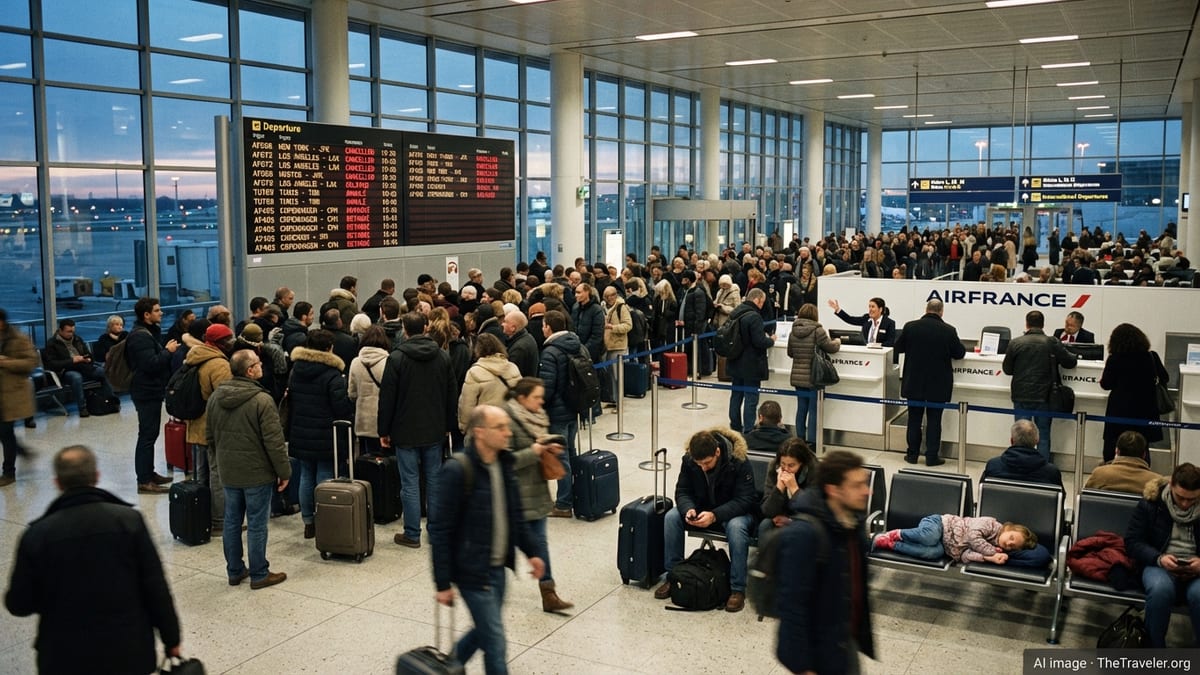
Hong Kong International Airport’s cavernous departure halls were transformed into makeshift waiting areas overnight, with around 2,000 passengers staying inside the terminal, based on figures cited in regional press coverage. Photographs and video shared by news outlets show travelers resting on benches, leaning against luggage trolleys and lying on the floor as they waited for clarity on new departure times.
Publicly available reports indicate that the situation was worsened by the temporary suspension or reduction of transport links between the airport and the urban area. Services on the Airport Express rail line and some bus routes were curtailed during the height of the storm, while cross-boundary connections such as the Hong Kong–Zhuhai–Macau Bridge were also affected. That left many travelers unable to easily leave the airport to seek accommodation elsewhere, even if hotel rooms were available.
Local coverage notes that some passengers caught in transit from other destinations found themselves effectively stuck in limbo. With onward flights postponed and ground connections disrupted, travelers with limited local knowledge or language skills were particularly reliant on airport announcements and airline staff for guidance.
Throughout the night, seating areas near check-in and boarding gates remained crowded as families, business travelers and tourists waited side by side. Many resorted to using jackets, scarves and carry-on bags as makeshift pillows and blankets, underscoring the suddenness with which normal operations had ground to a halt.
Rising Hotel Prices and Strain on Passenger Services
One of the main complaints highlighted in regional newspaper coverage was the jump in hotel prices near the airport and on Lantau Island as Typhoon Noul approached. Some travelers reported that room rates climbed into the range of roughly HK$2,000 to HK$3,000 per night, putting them out of reach for budget-conscious passengers, students and backpackers.
These cost increases came at a time when demand for last-minute accommodation surged, as travelers tried to avoid spending the night in the terminal. With many hotels reportedly nearing capacity and transportation to more distant districts constrained by the weather, a significant number of passengers chose or were forced to stay in the airport despite the discomfort.
Public information from the Airport Authority indicates that contingency measures were activated, including the distribution of meal vouchers for some affected travelers and the deployment of additional staff in key areas of the terminal. News reports describe airport and airline personnel assisting with rebooking, queue management and basic welfare needs, though the sheer volume of disrupted itineraries meant many passengers faced lengthy waits.
Observers noted that food and beverage outlets inside the restricted area remained busy well into the night, as stranded travelers sought hot meals and a place to sit. Limited power outlets for charging devices and crowded restrooms added to the strain, particularly for those traveling with children or elderly relatives.
Gradual Recovery as Typhoon Noul Moves Inland
By Sunday afternoon and into Monday morning, publicly available information shows that Typhoon Noul had weakened as it moved further inland over southern China, allowing Hong Kong’s weather signals to be lowered. This paved the way for airlines and the airport operator to begin restoring more regular service, although flight schedules remained heavily disrupted.
Statements posted by Hong Kong International Airport indicate that around 670 flights were expected to operate the day after the storm, with three runways available to handle traffic and nighttime movements used where necessary. Airlines worked to clear the backlog by adding extra services, upgauging aircraft where possible and consolidating passengers from multiple canceled flights onto new departures.
Despite these efforts, some travelers were still waiting for seats more than 24 hours after their original flights, according to follow-up coverage by local media. Limited aircraft availability, crew duty-time restrictions and knock-on delays at other regional hubs all contributed to a recovery phase that extended into the new week.
Travel industry analysts quoted in various reports noted that Hong Kong’s aviation sector has extensive experience handling typhoon-related disruptions, with established playbooks for rescheduling flights and supporting stranded passengers. Even so, the scale of cancellations linked to Noul served as a reminder that extreme weather can still bring one of Asia’s most sophisticated airports close to capacity.
Implications for Travelers During Typhoon Season
The disruption caused by Typhoon Noul highlights the particular vulnerabilities of air travel in southern China and the wider South China Sea region during the summer and early autumn months. Tropical systems that skirt or strike the Pearl River Delta can quickly prompt high-level storm signals, leading to rapid shutdowns of air, sea and land transport.
Travel commentators observing the situation point out that Hong Kong’s well-developed warning system provides advance notice of approaching storms, but that passengers with tight connections or fixed itineraries can still find themselves unexpectedly stranded when conditions worsen faster than forecast. The experience of the roughly 2,000 people who slept in the airport over the weekend underscores the importance of flexible planning during typhoon season.
Publicly available advice from airlines and travel agencies typically recommends that passengers monitor weather bulletins closely, ensure contact details are up to date in booking records and leave extra buffer time for critical journeys. Travel insurance with disruption coverage is also frequently cited as a useful safeguard, particularly for long-haul or multi-stop trips through major hubs such as Hong Kong.
For Hong Kong International Airport, Typhoon Noul adds to a long record of weather-related challenges that have shaped operational procedures and contingency planning. While the rapid resumption of services drew some praise from observers, the sight of thousands of travelers bedding down in departure halls is likely to fuel further discussion about how airports, hotels and transport providers can better coordinate to support passengers caught out by severe storms.