


More news on this day
Major UAE carriers Emirates, Etihad Airways, Air Arabia and flydubai are extending flight suspensions and adjusting schedules on key Gulf routes as an escalating conflict in the region disrupts airspace and triggers rolling delays and cancellations.
Get the latest news straight to your inbox!
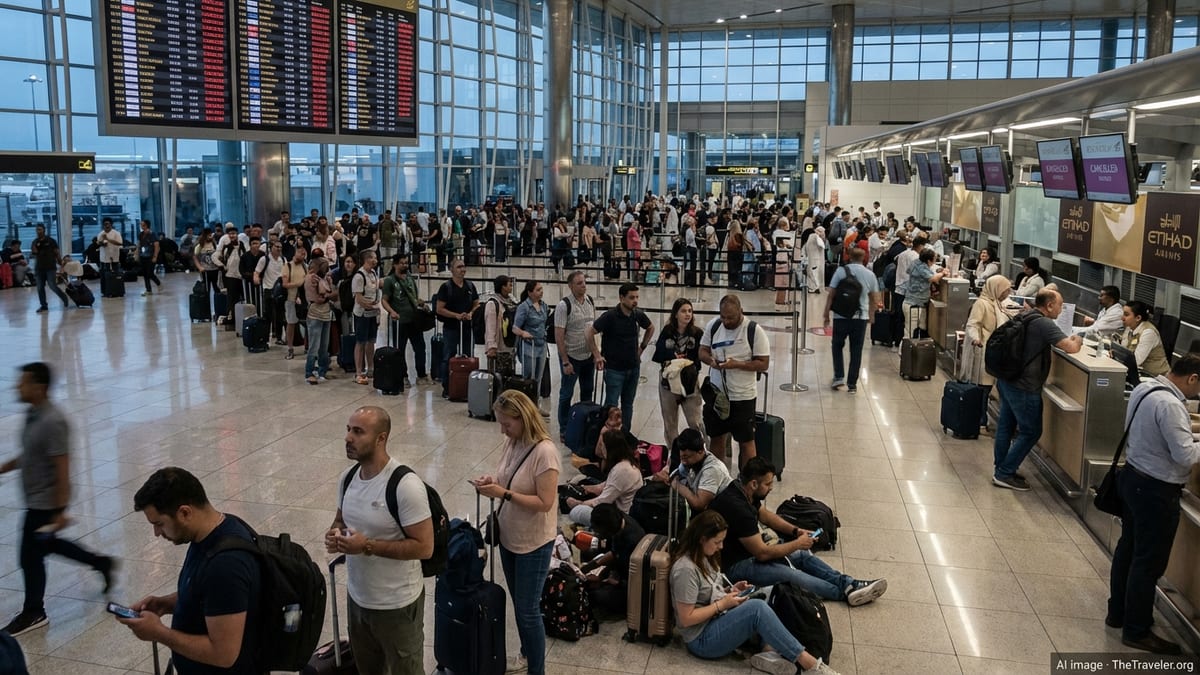
Services to Kuwait and Bahrain remain most affected
Publicly available information shows that flights between the UAE and Kuwait and Bahrain continue to face the heaviest disruption. Several UAE outlets report that Emirates, Etihad, Air Arabia and flydubai have all suspended or reduced services on these short-haul routes as tensions in the Gulf intensify.
According to recent coverage, Emirates has cancelled multiple rotations between Dubai and Kuwait, following an earlier phase of temporary suspensions. Flight-tracking data and airline updates indicate that paired outbound and inbound services on selected days have been removed from schedules, with customers rebooked on later departures or offered refunds and travel vouchers.
Etihad Airways has also widened its cancellations. Reports indicate that flights EY653 and EY654 between Abu Dhabi’s Zayed International Airport and Kuwait City have been cancelled across several days, alongside Bahrain services EY647 and EY648, which are shown as halted at least through Thursday, July 23. Travel advisories stress that further changes remain possible at short notice as the situation evolves.
Low-cost carriers are facing similar constraints. Air Arabia has reduced frequencies on Sharjah to Kuwait and certain Saudi Arabian routes, while flydubai has cancelled selected services to Kuwait and Bahrain, including codeshare flights operated in partnership with Emirates. Operational updates on airline channels continue to flag those destinations as particularly vulnerable to new disruptions.
US–Iran tensions reshape Gulf air corridors
The latest wave of disruption is closely tied to renewed hostilities involving the United States and Iran, which have shifted risk assessments across parts of the Gulf. Aviation media and regional outlets describe a network under strain, with airlines reconfiguring routings to avoid higher-risk airspace and in some cases pausing flying altogether on the shortest Gulf sectors.
Analysts note that while the UAE’s major hubs in Dubai and Abu Dhabi remain open, airlines are relying on more restricted corridors, longer routings and schedule trimming to keep long-haul and key regional services operating. This has created pinch points on high-frequency shuttle routes such as UAE to Kuwait and Bahrain, where small adjustments in airspace availability can result in multiple daily cancellations.
Capacity data compiled by aviation tracking platforms shows that Emirates, Etihad, Air Arabia and flydubai collectively remain well below their planned growth trajectory for 2026 on certain Gulf sectors. Airline-specific recovery indices published earlier in the year already pointed to a fragile balance between demand and operational constraints, a situation now complicated further by the conflict-triggered airspace changes.
Industry commentary suggests that operators are prioritising longer-haul and strategically important markets, such as Europe, North America and major Asian gateways, while allowing more volatility on shorter Gulf routes that can be restored quickly once conditions improve.
Airports in the UAE largely stable but schedules fluid
Despite the regional turbulence, Dubai International and Abu Dhabi’s Zayed International Airport are reported to be operating normally, with no blanket restrictions on arrivals or departures. Coverage from UAE-based outlets describes terminals that are busy but functioning, with most disruption concentrated on specific destinations rather than across entire networks.
At the same time, timetables remain fluid. Airlines have issued a series of rolling schedule updates over recent days, adjusting departure times, consolidating flights and, in some cases, downgrading aircraft types to match revised demand and slot availability. These changes often appear only a day or two in advance, reflecting the rapidly changing security and airspace picture.
Passengers on affected routes are being moved onto alternative services where feasible, while some connections require re-routing through other Gulf or regional hubs. Travel advisories regularly urge customers not to proceed to the airport until they have checked the latest status of their flight through official airline channels or airport information boards.
Reports also indicate that ground operations teams are contending with tight turnaround times as aircraft and crews are reassigned. This can lead to knock-on delays even on routes that are not directly impacted by airspace closures, particularly during peak morning and late-evening departure banks.
What passengers flying today should expect
For travellers flying on July 23, publicly available schedules suggest that services between the UAE and Kuwait and Bahrain remain the most likely to face cancellations or significant delays. Etihad’s Bahrain rotations for the day are listed as cancelled, while multiple Kuwait flights on Emirates, Etihad, Air Arabia and flydubai have been removed or marked as disrupted in recent updates.
On other routes, especially medium and long-haul services, operations appear broadly stable but subject to last-minute timetable changes. Longer routings around sensitive airspace can add extra flight time, and aircraft that arrive late in the UAE may depart behind schedule on their next sectors, impacting onward connections.
Travel guidance published over the past week consistently advises passengers to allow extra time at the airport, stay alert for schedule notifications, and consider flexible travel plans. Those with non-essential trips to the most affected Gulf destinations are being encouraged, where possible, to explore alternative dates or routings until the situation stabilises.
Airlines are also reminding customers that rebooking options and fare rules vary by ticket type, meaning that some travellers may face change fees or fare differences if they adjust their plans. Many carriers, however, are offering more lenient waivers on flights that are directly cancelled as a result of the conflict.
Outlook for regional connectivity in the coming days
Short-term expectations among aviation observers point to continued volatility on Gulf shuttle routes while the conflict persists. Published forecasts and airline advisories indicate that suspensions on some Kuwait and Bahrain services have already been extended into the coming days, suggesting that a rapid return to full schedules is unlikely.
Nevertheless, the core long-haul networks of Emirates and Etihad, and the broader regional webs of Air Arabia and flydubai, remain largely intact. Carriers are signalling a preference for targeted, route-specific adjustments rather than sweeping cuts, allowing them to maintain the UAE’s role as a key connecting hub between Europe, Asia and Africa.
Market analysts expect further schedule fine-tuning as airlines respond to evolving airspace guidance, insurance considerations and passenger demand. Any de-escalation in regional tensions could enable a gradual restoration of suspended Gulf flights, though operators may move cautiously given the potential for renewed flare-ups.
For now, travellers planning to fly to or through the UAE are being advised, in publicly available guidance, to monitor their bookings closely, remain flexible with timings and routings, and anticipate that short-notice adjustments on certain Gulf sectors will remain a feature of the market in the days ahead.