


More news on this day
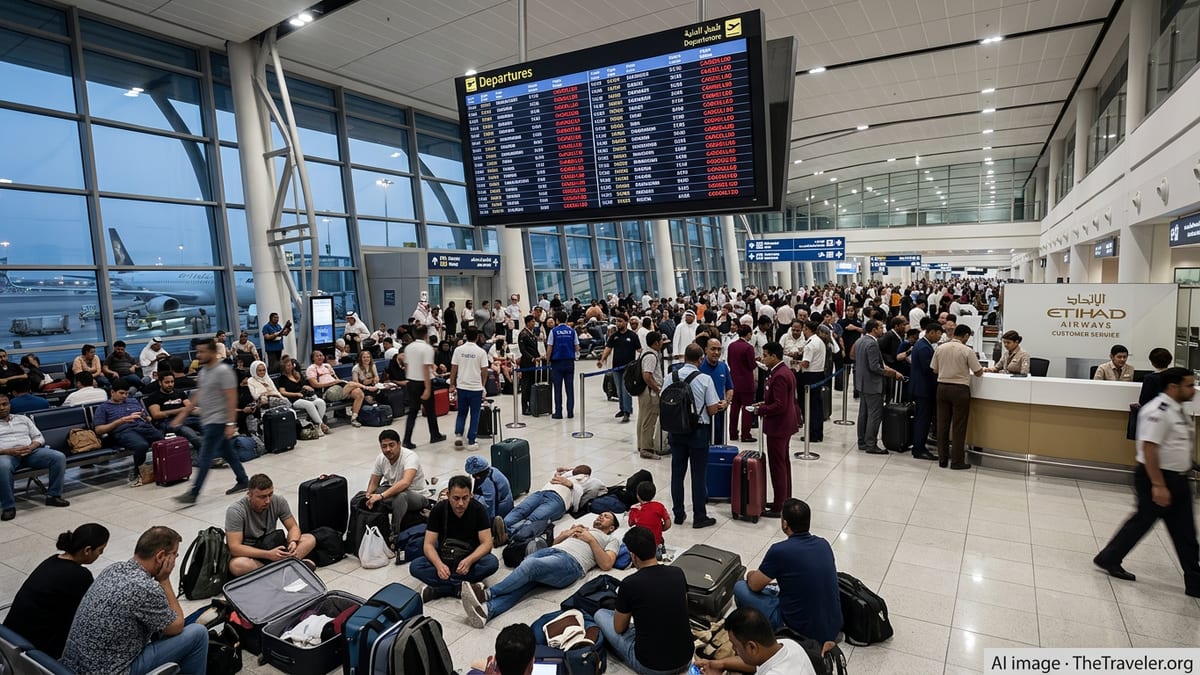
Passengers flying out of the UAE on September 23 are encountering scattered delays, isolated cancellations and evolving international schedules, as regional tensions and airspace restrictions continue to reshape flight operations from Dubai, Abu Dhabi and Sharjah.
Get the latest news straight to your inbox!
Rolling disruptions across Dubai, Abu Dhabi and Sharjah
Publicly available airport and airline information on September 23 shows multiple flights to and from the UAE delayed or cancelled, affecting services operated by Emirates, Etihad Airways, flydubai, Air Arabia and several foreign carriers. Coverage in local media indicates that Dubai International Airport, Dubai World Central, Zayed International Airport in Abu Dhabi and Sharjah International Airport have each reported disruption on selected services rather than across-the-board shutdowns.
Reports from Dubai list cancellations including certain Emirates arrivals from regional hubs and flydubai departures to Gulf destinations, alongside lengthy delays on routes to India, Iran and Oman. Flight status boards have shown some services to Kozhikode, Delhi and Kochi running several hours behind schedule, while select rotations to Tehran, Muscat and Riyadh have also been affected.
In Abu Dhabi, departure data from Zayed International Airport on September 23 continues to show a high volume of early morning flights operating, but with individual services adjusted or rerouted. Etihad Airways and partner airlines are still running extensive networks to Europe, Asia and Africa, although some departures are operating off their originally published times as schedules are fine-tuned in response to airspace constraints.
Sharjah International Airport has also recorded cancellations and delays on Air Arabia services and other regional operators. Recent updates highlight disrupted flights on certain Gulf and South Asian routes, underscoring that travellers across all three major UAE hubs can encounter last minute changes even where the wider airport operation appears normal.
Regional tensions and airspace restrictions reshape routings
Recent Gulf-based coverage links the latest pattern of UAE flight disruption to renewed tensions involving the United States and Iran, which have prompted carriers to avoid or limit use of higher risk airspace. Aviation-focused reports indicate that since early September a number of airlines serving Dubai and Abu Dhabi have adopted longer routings around sensitive areas, adding flying time and placing pressure on connection banks at busy hubs.
Passenger rights organisations tracking on-time performance report that on some days in mid September more than one hundred flights arriving and departing across Dubai and Abu Dhabi have operated late, with a smaller number of outright cancellations. The same analyses describe these as rolling delays rather than a single event, arising from a mixture of operational constraints, crew scheduling limits and the knock-on effects of diversions around restricted airspace.
Coverage in UAE media notes that, despite these complications, Dubai International Airport and Zayed International Airport have generally remained fully open, with the majority of flights still operating. The picture for travellers is described as mixed: many services depart broadly on time, while others, particularly on certain regional routes, encounter significant schedule changes at short notice.
Industry briefings on the wider Middle East suggest that airports in neighbouring states are facing similar issues, with airlines warning that routings, flight times and even operating days may continue to change as risk assessments are updated. For passengers originating in the UAE, this means that onward connections through third-country hubs can be affected even when the initial departure from Dubai, Abu Dhabi or Sharjah leaves on schedule.
International airlines extend Middle East suspensions
Alongside operational delays at UAE hubs, several international carriers have recently adjusted or extended suspensions on certain Middle East routes. Travel reporting from the region notes that airlines such as British Airways, KLM, Air Canada, Finnair and Wizz Air have revised their schedules in response to ongoing security concerns and changes in demand.
According to this coverage, Wizz Air services from mainland Europe to Amman are paused until late September, while flights to Dubai and Abu Dhabi are on hold until at least late October. Finnair is reported to be suspending its flights to the UAE and Qatar for the coming winter season, and British Airways has pushed back the planned restart of some Dubai services from late October to early November.
These international schedule changes do not close UAE airports, but they reduce the range of non-Gulf carriers currently operating into the country. Passengers who normally rely on European or North American airlines for direct services to Dubai or Abu Dhabi may find that options are temporarily limited and that rebooking often involves travel on Gulf-based carriers or alternative routings.
Travel industry commentary stresses that these decisions are being reviewed on an ongoing basis and can change with relatively short notice. Prospective travellers are therefore being encouraged to treat provisional restart dates as subject to revision until tickets are actually placed on sale and operating schedules stabilise.
UAE carriers adjust summer schedules but keep most flights running
While short-term disruption has dominated recent headlines, longer term schedule filings show that UAE airlines continue to operate the bulk of their planned networks, with targeted frequency changes rather than wholesale cuts. Specialist timetable analyses of Etihad Airways’ northern summer 2026 season indicate that, between mid June and late October, the Abu Dhabi-based carrier is operating around 96 per cent of its previously planned flights and roughly 97 per cent of its planned seat capacity.
Within that framework, Etihad has adjusted frequencies on a range of routes. Recent data shows increases on services from Abu Dhabi to Amman, Amsterdam, Bangkok and Denpasar, as well as additional flights to Frankfurt and other European cities during peak weeks. At the same time, frequencies have been trimmed on some routes to Casablanca, Copenhagen, Johannesburg, Melbourne, Milan, Munich, Rome, Seoul, Sydney and Taipei as the airline balances demand, aircraft availability and operational resilience.
Earlier network updates also highlight aircraft changes and seasonal variations. On routes such as Abu Dhabi to Lisbon and Nice, Etihad has shifted between widebody and narrowbody aircraft and adjusted the number of weekly flights during different parts of the summer. Services between Abu Dhabi and London Heathrow continue to operate multiple times per day, though some A380 frequencies have been replaced by smaller aircraft during certain months.
For passengers, these strategic schedule changes mean that, even beyond today’s short-notice delays and cancellations, flight times and frequencies for late 2026 may differ from what was loaded into booking systems many months ago. Travellers holding tickets booked well in advance are being advised by travel agents and consumer advocates to review their itineraries periodically and watch for notification of timetable changes.
What travellers from the UAE should expect in the coming weeks
Travel and aviation reports agree that, for now, airports in Dubai, Abu Dhabi and Sharjah remain open and busy, with the majority of flights departing as planned. However, the combination of geopolitical tension, evolving airspace restrictions and rolling schedule adjustments means that passengers should be prepared for conditions that are less predictable than usual, especially for multi-leg journeys.
Local coverage notes that UAE-based airlines continue to recommend that passengers arrive at the airport well ahead of departure, with some carriers advising check-in as early as four hours before flight time. Online check-in and dedicated mobile apps are being emphasised as key tools for receiving real-time notifications of delays, gate changes or rebooking options, particularly on days when disruption is more widespread.
Consumer rights material points out that, depending on the origin, destination and operating carrier, travellers may be entitled to assistance such as meals, accommodation and rebooking when delays or cancellations occur. However, the exact level of support varies between jurisdictions and airlines, and passengers are being encouraged to review the conditions of carriage and any applicable regional regulations before travel.
Analysts following the situation suggest that, unless there is a major escalation in regional tensions, the current pattern of scattered delays, selective cancellations and incremental schedule changes is more likely than a complete shutdown of UAE air links. Even so, with schedules and airspace usage under constant review, anyone flying from the UAE in the near term is being urged to treat their itinerary as subject to change until they are comfortably in the air.