


More news on this day
Travelers flying between the United Arab Emirates and Kuwait are facing fresh disruption as Emirates, Etihad Airways and Air Arabia cancel or adjust services in response to ongoing restrictions at Kuwait International Airport and heightened regional tensions.
Get the latest news straight to your inbox!
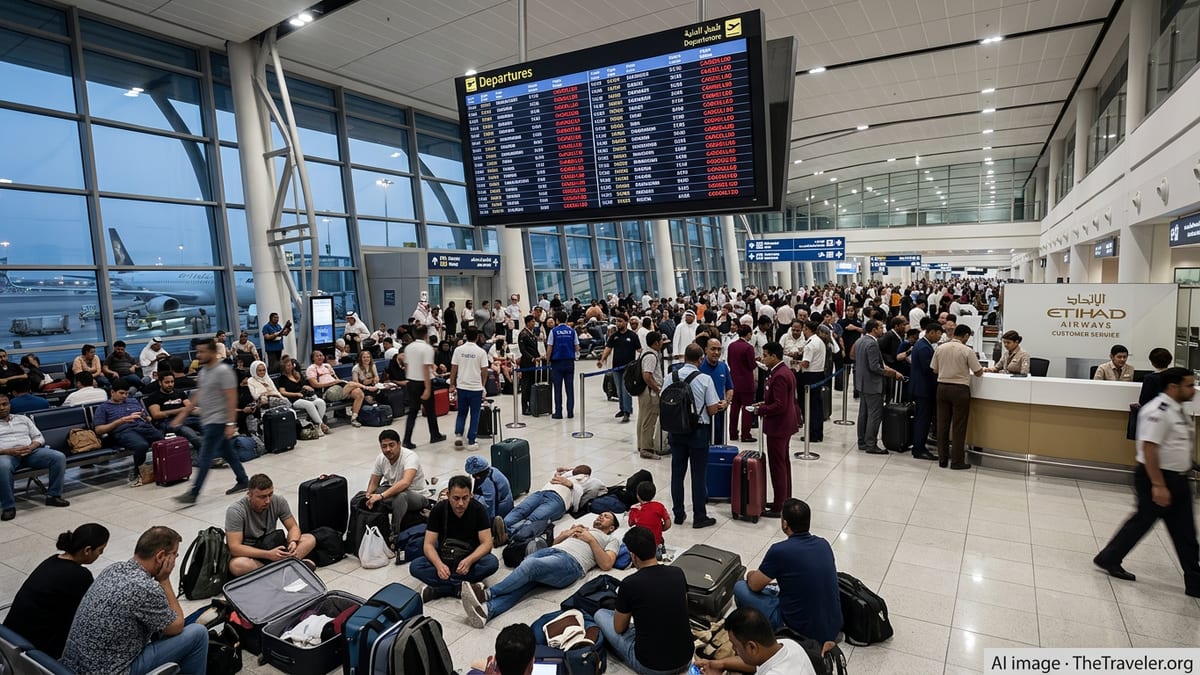
Suspended operations at Kuwait International ripple across Gulf carriers
Publicly available information from regional media and aviation trackers indicates that Kuwait International Airport has been operating under tight restrictions for much of 2026, following a series of drone and rocket incidents linked to the wider Iran–US confrontation. Periodic suspensions of air traffic, combined with infrastructure damage and security reviews, have severely limited the number of arrivals and departures airlines can operate into the country.
These constraints have translated directly into cancellations on high‑frequency routes from the UAE, particularly Dubai–Kuwait, Abu Dhabi–Kuwait and Sharjah–Kuwait. Schedules that were rebuilt in early summer as Kuwait signalled a phased reopening have since been cut back again as the situation on the ground remained unstable.
For passengers, the impact has been most visible in last‑minute schedule changes and extended connection times. Travelers report receiving notifications that Kuwait sectors have been removed from their itineraries even while longer‑haul legs to and from Dubai or Abu Dhabi remain in place, effectively stranding the Kuwait portion of their journey.
Aviation advisories focused on the Middle East describe Kuwait’s capacity as “severely constrained,” with carriers from neighbouring states instructed to reduce frequencies, consolidate flights or temporarily suspend certain rotations as authorities review airspace risk and airport readiness.
Emirates trims Dubai–Kuwait services amid restricted airspace
Emirates, which normally operates one of the densest schedules between Dubai International Airport and Kuwait City, has been among the most affected. Recent Gulf-focused coverage notes that the airline has cancelled multiple rotations on the Dubai–Kuwait route after air traffic at Kuwait International was temporarily halted during the latest escalation in regional tensions.
In several cases highlighted by passenger accounts and booking‑system snapshots, Dubai–Kuwait segments have been removed while long‑haul flights into Dubai continue as planned. This pattern suggests that Emirates is prioritising network integrity on key intercontinental routes while scaling back short‑haul sectors that depend on Kuwait’s limited operating windows.
General disruption guidance on the airline’s support pages reinforces that customers whose flights are cancelled are typically rebooked on the next available service or offered alternative routing where possible. However, where Kuwait is the origin or final destination and the airport remains under restrictions, options to reroute via nearby Gulf hubs can be limited, leading to extended wait times before seats become available.
Travel industry analysts point out that Emirates has experience managing large‑scale disruption in the region, but Kuwait’s proximity to active conflict zones and the sensitivity of overflight corridors mean the airline must respond rapidly to shifting risk assessments, sometimes resulting in late‑breaking schedule changes that are challenging for passengers to predict.
Etihad adjusts network after recent Gulf disruptions
Etihad Airways, based in Abu Dhabi, has also been reshaping parts of its Gulf network in response to the same set of regional constraints. Recent reports on the carrier’s operations describe how Etihad has already cancelled selected services on other short‑haul Gulf routes when neighbouring airports faced temporary closure, underscoring how quickly security developments can affect flight schedules across the region.
While Abu Dhabi–Kuwait is a smaller market than Dubai–Kuwait, the route forms part of Etihad’s broader connectivity strategy linking South and Southeast Asia, Europe and North America through its hub. Any reduction in Kuwait capacity therefore has knock‑on effects for transfer passengers who use Abu Dhabi as a gateway rather than a final destination.
Etihad’s public travel‑updates pages emphasise that passengers should monitor flight status closely and keep contact details in their bookings up to date so that they can receive SMS or email alerts if flights are delayed, rerouted or cancelled. The airline’s handling policies for disrupted trips generally include complimentary rebooking on the next available service or refunds where no suitable alternatives exist, though actual options depend on how long Kuwait International remains under operational restrictions at any given time.
Industry observers note that the carrier is simultaneously rolling out new routes and increasing frequencies elsewhere in its network, a sign that the current Gulf‑specific constraints are being treated as a targeted operational challenge rather than a system‑wide retreat.
Air Arabia pares Sharjah–Kuwait links and watches demand
Low‑cost carrier Air Arabia, which operates from Sharjah and Abu Dhabi, has likewise been forced to modify its Kuwait schedule. Flight‑tracking services and airport timetables show that while Sharjah continues to handle strong summer traffic, the number of services touching Kuwait has fluctuated as the security picture has changed.
The airline has recently focused growth on other regional destinations, including new services into Syria and additional frequencies across its wider Middle East network. Aviation analysts interpret this strategy as a partial pivot away from markets such as Kuwait where operational uncertainty remains relatively high, and toward routes where demand is robust and airspace is more predictable.
Passengers with Kuwait itineraries on Air Arabia report receiving cancellation notices well in advance of travel in some cases, suggesting the carrier is proactively thinning its schedule when guidance about Kuwait’s operating limits is available early. However, sudden closures or fresh security alerts can still trigger short‑notice changes when flights are already on sale, especially during the busy summer travel period.
Sharjah International Airport has forecast handling millions of passengers over July and August, and the shifting Kuwait programme is seen by local observers as one piece of a broader effort to protect on‑time performance by concentrating capacity on routes less exposed to conflict‑related disruption.
What travelers between UAE and Kuwait should expect now
For travelers planning journeys between the UAE and Kuwait in the coming weeks, the overarching message from airline advisories and regional reporting is to expect an unpredictable environment. Schedules are being loaded based on the latest information about Kuwait’s airspace and airport capabilities, but changes can occur quickly if security assessments are updated or if new incidents are reported.
Passengers are being encouraged, through airline websites and social‑media updates, to check their flight status frequently rather than relying solely on original booking confirmations. Many carriers recommend registering for real‑time notifications and allowing extra time in travel plans in case of missed connections or the need to overnight at a hub while awaiting a replacement service.
Travel experts also advise that customers consider flexible booking options, such as tickets that permit date changes or refunds, when planning trips involving Kuwait during this period. In some cases, rerouting via alternative regional hubs may be possible, but capacity on those routes is finite and can sell out quickly when Kuwait‑bound flights are cut.
While there are signs that authorities in Kuwait intend to continue a phased return to normal operations, the combination of regional tensions and infrastructure recovery means that airlines like Emirates, Etihad and Air Arabia are likely to keep making short‑term adjustments. For now, anyone travelling between the UAE and Kuwait is being urged by publicly available guidance to treat any itinerary as subject to change and to stay alert to updates right up to the day of departure.