


More news on this day
Travel through key Gulf hubs is facing fresh disruption as Etihad Airways, Air Arabia, flydubai and Qatar Airways cancel or adjust select services across the region, prompting UAE-bound and transit passengers to review itineraries and monitor flight status closely.
Get the latest news straight to your inbox!
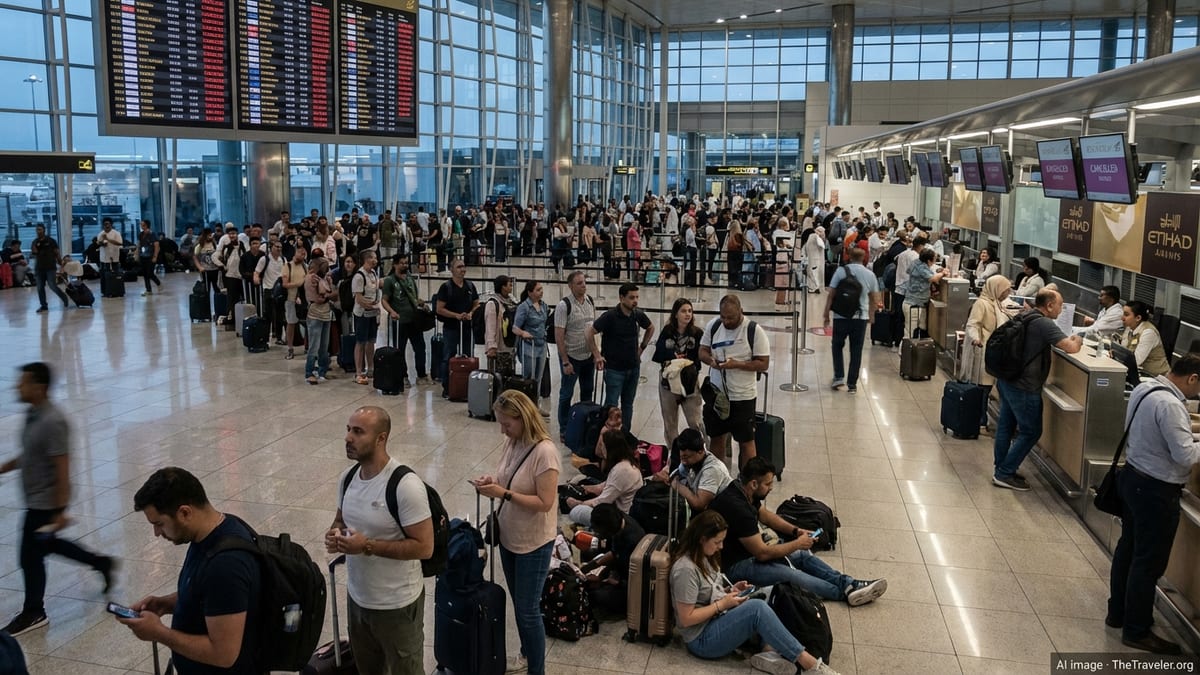
Targeted cancellations hit Kuwait, Bahrain and nearby routes
Recent updates from airline advisories and regional media show that the sharpest impact is being felt on short-haul Gulf sectors, particularly services linking the United Arab Emirates with Kuwait and Bahrain. A series of operational notices in late July reported that Etihad Airways, Emirates and Air Arabia had cancelled multiple flights between Abu Dhabi, Dubai, Sharjah and Kuwait City over several consecutive days, citing the evolving situation in the region and associated airspace constraints.
Coverage in Gulf-based outlets indicates that Etihad has extended the cancellation of flights EY653 and EY654 between Abu Dhabi’s Zayed International Airport and Kuwait International Airport over different periods in July, while also suspending certain rotations to Bahrain. Similar patterns are reported for Air Arabia and flydubai, which have pulled individual services on Kuwait and Bahrain routes, leading to reduced frequency and, in some cases, day-of-travel cancellations.
Separate reports highlight that Qatar Airways has temporarily suspended passenger flights on selected Gulf routes including Bahrain, Erbil and Kuwait on specific dates, with the pauses currently indicated to run until at least the end of July 2026. These adjustments come on top of earlier cuts to some Dubai and Riyadh services by various international carriers, reinforcing the sense of a fragmented regional schedule rather than a uniform shutdown.
Despite the cancellations on particular sectors, publicly available data suggests that most long-haul traffic to and from the UAE continues to operate, albeit with schedule changes and occasional rerouting to avoid sensitive airspace. This mixed picture is creating a complex planning environment for travellers relying on Gulf hubs for connections across Europe, Asia and Africa.
Security advisories and airspace warnings shape airline decisions
The targeted flight cancellations are unfolding against a backdrop of elevated security advisories and conflict-zone guidance affecting Gulf airspace. Travel coverage in the UAE notes that authorities in countries such as the United States, United Kingdom, Canada and Australia have recently renewed warnings about the unpredictability of the security situation in parts of the Middle East, highlighting the potential for rapid changes to airline operations.
In parallel, industry-focused reporting on regulatory bulletins describes how European aviation safety bodies have advised carriers to exercise caution or avoid certain portions of airspace over the UAE, Bahrain, Kuwait and Qatar within specified timeframes. These notices, while not mandating blanket closures, have encouraged airlines to reassess routing and scheduling on short regional hops where alternative flight paths may be limited or operationally inefficient.
Analysts cited in open-source commentary suggest that airlines such as Etihad, Air Arabia, flydubai and Qatar Airways are weighing multiple factors when deciding whether to cancel or consolidate Gulf routes. These include risk assessments, crew and aircraft positioning, airport capacity and the ability to re-accommodate passengers via other hubs or partner airlines. Short segments to Kuwait, Bahrain or nearby cities can be particularly vulnerable to disruption when turnaround times are tight or when onward connections depend on punctual arrivals.
The result is a patchwork of frequent timetable updates, where flights may appear as scheduled only to be cancelled or retimed closer to departure. This environment places a premium on real-time information, and recent articles consistently advise passengers to verify status directly with their carrier before heading to the airport.
Impact on passengers: rebooking, refunds and connection risks
For travellers, the most immediate effect of the latest Gulf cancellations is uncertainty around departure and arrival times, especially for those using Abu Dhabi, Dubai, Sharjah or Doha as transit points. Consumer-rights explainers and aviation advisory pages report that passengers booked on affected Kuwait and Bahrain services with Etihad, Emirates, Air Arabia or flydubai have been offered options such as free date changes, rerouting where seats are available, or refunds in line with each airline’s policies.
Disruption on short regional legs can quickly cascade into missed long-haul flights. Travel industry guidance notes that a cancelled feeder flight from Kuwait City or Manama into Dubai, Abu Dhabi or Doha can jeopardise onward journeys to Europe, North America or Asia if same-day alternatives are limited. Where tickets are issued on a single itinerary, airlines typically take responsibility for rebooking, but separately booked connections may leave passengers with fewer protections and higher out-of-pocket costs.
Online travel advisories and airline notices consistently recommend that affected passengers avoid travelling to the airport without confirmation that their specific flight is operating. In earlier phases of the current disruption cycle, carriers operating from the UAE urged travellers not to appear at terminals solely on the basis of historical schedules or third-party booking confirmations, as same-day operational decisions could override earlier plans.
Industry commentators also highlight the importance of monitoring email, SMS and airline apps for last-minute updates. Some carriers have been using digital channels to issue travel waivers, allowing date or destination changes without standard penalties during defined windows. This has been particularly relevant on routes touching Kuwait and Bahrain, where schedules have shifted repeatedly in response to changing conditions.
How Etihad, Air Arabia, flydubai and Qatar Airways are adjusting networks
While the current focus is on cancellations, the broader strategy of major Gulf carriers appears to centre on fine-tuning networks rather than imposing sweeping long-term cuts. Earlier in 2026, Qatar Airways announced a phased restoration of services to the UAE, including daily flights to Dubai and Sharjah, as part of a wider expansion of its global schedule. That broader growth trajectory remains in place, even as the airline temporarily suspends or reduces some regional frequencies in response to the latest tensions.
Similarly, UAE-based airlines have spent much of the past year gradually rebuilding capacity after earlier periods of airspace closure and large-scale disruption. Commentary from aviation analysts and regional business outlets describes how Etihad, Emirates, flydubai and Air Arabia have steadily increased long-haul and high-demand regional operations, using smaller tactical cuts on shorter sectors as a way to manage risk and keep the wider network resilient.
Operational updates suggest that airlines are also adjusting flight timings and routings to navigate around areas covered by conflict-zone bulletins. In some cases, this has meant slightly longer flight times or altered departure waves from Gulf hubs, designed to maintain banked connections while avoiding sensitive airspace. For passengers, these changes may not always be visible beyond minor schedule tweaks, but they form part of the same risk-management framework that is driving cancellations on a subset of Gulf routes.
At the same time, international carriers operating into the region are revising their own strategies. Reports from Europe and North America describe how some airlines have scaled back Dubai or Riyadh operations or shifted capacity to alternative hubs, which can indirectly affect connection options for travellers booked on Gulf carriers. This web of adjustments underscores how developments in Kuwait, Bahrain and neighbouring states can reverberate across global networks.
What travellers should do now
With the situation in the Gulf region still fluid, publicly available guidance from airlines, airports and travel experts converges on a few practical steps for anyone flying with Etihad, Air Arabia, flydubai or Qatar Airways in the coming days. Passengers are urged to check their flight status repeatedly in the 24 hours before departure, using official airline channels rather than relying solely on third-party booking platforms or historical timetables.
Travellers starting their journey in Kuwait, Bahrain or other nearby points served by short-haul Gulf flights may wish to allow extra time for potential disruption, including the possibility of overnight stays if connections are missed. Those with critical onward itineraries are being encouraged in some advisory pieces to keep backup routing options in mind, particularly during periods identified as higher risk in security or airspace bulletins.
For future bookings, travel specialists suggest paying close attention to fare rules, change fees and refund conditions on Gulf itineraries. Flexible tickets or itineraries issued on a single carrier or alliance can offer additional protection if cancellations continue or expand. Many Gulf carriers have, at various points this year, introduced temporary flexibility policies for travel during defined windows, and similar measures could reappear if disruptions persist.
Although the latest wave of cancellations has raised understandable concern, the broader pattern across UAE and Qatari carriers still points to largely intact long-haul operations and selective cuts on shorter regional routes. For now, the key for travellers is to stay informed, remain flexible where possible and build in contingency time when planning journeys that depend on Gulf hubs.