


UAE and Thailand have emerged as leading bases for digital nomads in Asia, but they offer very different environments from a connectivity and work-setup perspective. This briefing compares both destinations strictly on digital nomad practicality: internet quality and reliability, availability of workspaces, business services, and day-to-day work conditions for location-independent professionals.
Overall Suitability for Digital Nomads
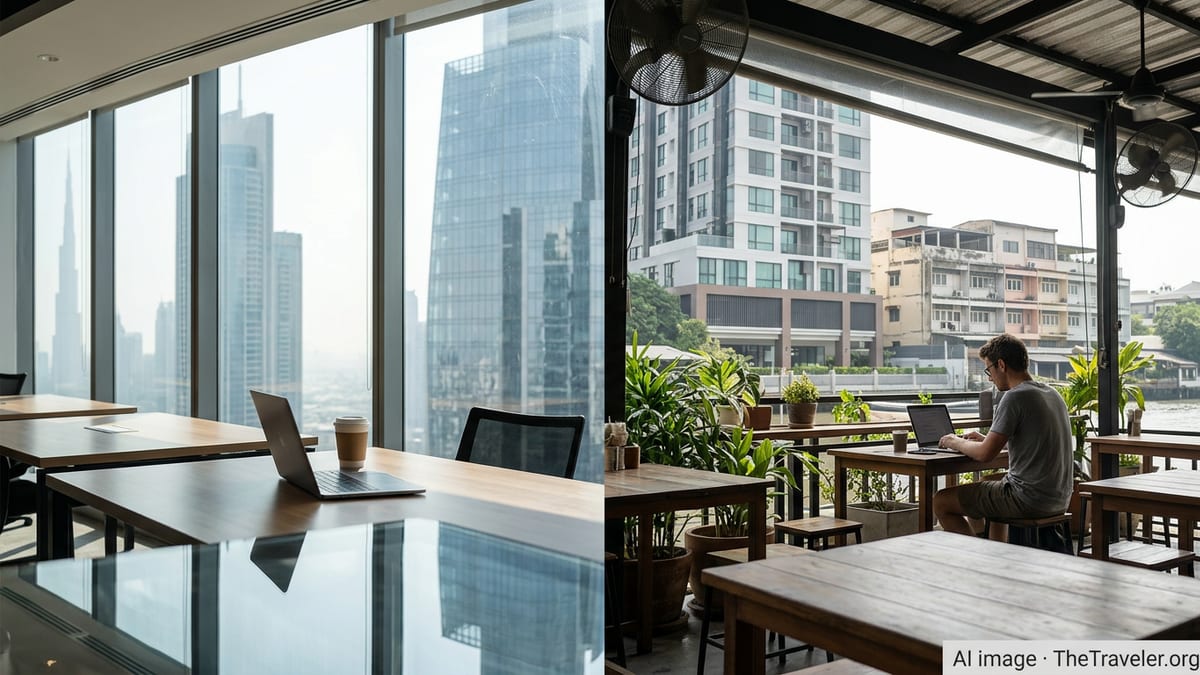
Both UAE and Thailand rank among the stronger global options for remote professionals, but they occupy different positions in the digital nomad landscape. UAE is positioned as a premium, infrastructure-first hub anchored by cities such as Dubai and Abu Dhabi, with some of the fastest mobile and fixed broadband speeds in the world and highly developed service infrastructure. Thailand is a mature, high-volume digital nomad destination with strong but less extreme connectivity, more informal work setups, and a wide spread of viable locations beyond the capital.
For digital nomads whose work is bandwidth-critical or enterprise-facing, UAE offers near top-tier reliability, extremely high mobile speeds, and professional-grade coworking spaces closely aligned with corporate standards. Thailand is highly workable for most online jobs, but performance levels are more variable between cities and neighborhoods and can be impacted by local infrastructure and power grid robustness.
In practice, UAE suits digital nomads prioritizing maximum technical reliability and professional business environment, often at higher operating costs. Thailand suits digital nomads who are comfortable managing some variability in infrastructure in exchange for a more flexible, informal working ecosystem and broader choice of environments.
Internet Speed, Quality, and Reliability
UAE is consistently ranked at or near the top globally for internet performance. Recent global speed indexes place UAE in the top three countries worldwide for fixed broadband, with typical median fixed broadband speeds reported in the 250 to 350 Mbps range and mobile median download speeds above 400 Mbps, with some recent quarters closer to or above 500 Mbps. These are national medians, meaning most connected locations in major cities meet or exceed speeds that are more than double global averages.
Within UAE, large cities such as Dubai and Abu Dhabi achieve significantly higher speeds than the national median. Recent local measurements for Dubai, for example, indicate average fixed broadband download speeds around or above 120 Mbps across providers, with premium packages and central business districts commonly offering several hundred Mbps to multi-gigabit fiber. Mobile networks are heavily 5G-enabled, with real-world consumer speeds often in the high double to low triple-digit Mbps range in central areas, and expanding coverage along major highways and secondary cities.
Thailand delivers solid but less extreme performance. Global comparisons usually place Thailand in the upper-middle tier worldwide for fixed broadband, with national median speeds broadly in the 100 to 200 Mbps range, and mobile speeds often in the 40 to 80 Mbps band in large cities. On the ground, digital nomads in Bangkok, Chiang Mai, Phuket and similar urban centers frequently report fiber-to-home packages in the 300 to 1000 Mbps range, often over-provisioned relative to nominal speed, but these experiences can vary by neighborhood and time of day.
Reliability profiles differ. In UAE, power and last-mile connectivity are highly stable in major cities, and unplanned outages are relatively rare in central business and residential districts. In Thailand, fiber quality is generally good in cities but more exposed to occasional local disruptions, neighborhood-level outages, or weather-related issues. For most remote jobs, Thailand’s performance is entirely adequate, but mission-critical, real-time workflows may experience more frequent minor interruptions compared with UAE.
Coworking Spaces and Remote Work Infrastructure
Coworking infrastructure in UAE has expanded rapidly. Dubai and Abu Dhabi host a dense network of coworking operators, from global brands to locally established business centers. These spaces often resemble corporate serviced offices, with structured membership plans, dedicated desks and private offices, and business support services such as reception, mail handling, and meeting room access. Internet in coworking venues is typically business-grade fiber with redundant links or at least enterprise routing and Wi-Fi systems.
Smaller emirates such as Sharjah, Ras Al Khaimah, and Ajman also offer emerging coworking options, though the variety is more limited than in Dubai. Many UAE coworking spaces sit within mixed-use developments or free zones, creating a professional ecosystem of startups, investors, and service providers, which can be advantageous for digital entrepreneurs looking for partnerships or clients.
Thailand’s coworking ecosystem is broader in geographic spread and more diverse in style. Bangkok features a full range of spaces from corporate-style offices in Grade A towers to more casual hubs geared toward freelancers and early-stage founders. Chiang Mai, Phuket, Koh Phangan and other regional centers have a high density of coworking and co-living spaces explicitly targeting digital nomads, typically with relaxed membership policies, day passes, and strong community programming such as skill shares and informal networking events.
However, quality and predictability can vary more in Thailand. While many urban coworking venues maintain solid connectivity and ergonomic workstations, others are small, café-adjacent spaces with more limited meeting facilities or less robust climate control and noise management. Digital nomads who require confidential calls, advanced AV meeting rooms, or guaranteed quiet may find UAE coworking spaces more consistently aligned with corporate standards, while Thailand offers more variety but requires more careful selection.
Work Environments Outside Formal Offices
For digital nomads who rely on public or semi-public work environments such as cafés, hotel lounges, and serviced apartments, the two countries present distinct patterns. In UAE’s large cities, many cafés and hotel lobbies provide reliable Wi-Fi, but the environment often prioritizes short visits, meetings, or social use more than extended laptop work. Some venues may limit power outlet access or discourage long working sessions without high ongoing consumption, particularly at peak hours.
Residential broadband in UAE’s urban apartments is typically strong, but installation and account setup are linked to formal contracts and can involve fixed-term arrangements. Many digital nomads therefore rely on serviced apartments or co-living spaces that bundle high-speed internet. Mobile tethering is practical given strong 5G, but data packages with higher caps or “unlimited” plans can be relatively expensive compared with regional peers, which may impact heavy users of video conferencing or large data transfers.
Thailand’s café and informal workspace culture is more structurally aligned with digital nomad use. Major cities and nomad centers have numerous cafés, cowork cafés, and casual restaurants with power sockets, relatively permissive laptop policies, and fiber-backed Wi-Fi. It is common for remote workers to spend several hours per day in such venues with only moderate spend expectations. However, the environment can be noisier and less predictable in terms of seating ergonomics and bandwidth sharing during peak occupancy.
Residential internet access in Thai cities is usually affordable and widely available, with short or flexible contracts in some buildings. Many rentals targeting foreigners and nomads are pre-wired with fiber connections included in the rent. Mobile tethering using Thai 4G and 5G networks is generally workable in urban and many semi-urban locations, but performance can degrade in dense environments or during peak usage hours and may be inconsistent on islands or remote areas.
Digital Services, Payments, and Everyday Work Practicalities
Digital payments and online services are well developed in both countries, but the balance of tools and common practices differs and can affect digital nomad workflows. In UAE, contactless payments, banking apps, and merchant terminals are widespread in major cities. Card-based transactions are the default in many settings, with strong support for international cards. This reduces friction for remote workers who are paid internationally and rely on cross-border banking, although full integration often requires local accounts that can demand residency documentation.
Thailand has made rapid progress in digital payments through local QR payment schemes and mobile wallets, which are widely used by residents and smaller vendors. Digital nomads can benefit from cashless transactions in most urban contexts, but usage often depends on holding a local bank account or wallet, which can be more complicated for short-stay foreigners. International cards are accepted in medium to large businesses and coworking spaces, though smaller operators may remain cash or local-QR centric.
Cloud services, online government portals, and delivery platforms are strongly established in UAE’s major cities, contributing to a frictionless working environment for tasks such as receiving equipment, filing documents, or coordinating client meetings. Thailand offers similarly convenient delivery and ride-hailing platforms in cities, but coverage and reliability fall off more sharply in secondary towns and islands, which some digital nomads may prefer for lifestyle reasons but which introduce small operational frictions.
Remote work communications, including access to mainstream platforms for messaging, VoIP, and videoconferencing, are broadly available in both destinations. UAE historically restricted some VoIP and calling apps at the network level, though the practical situation can evolve over time. Digital nomads who rely on specific non-enterprise calling tools should verify their functionality in UAE before committing to a long stay. Thailand generally imposes fewer restrictions on mainstream communication platforms.
Safety, Stability, and Operational Continuity
Operational continuity is a critical factor for digital nomads, particularly those with time-zone sensitive work or contractual service obligations. UAE offers a very high level of physical security, predictable urban infrastructure, and low exposure to extreme weather events in core cities, which collectively minimize unplanned disruptions. Building standards, fire safety regulations, and backup systems in modern offices and coworking spaces are relatively strong, and core business districts are designed for continuous operation.
Thailand, while broadly safe and accustomed to large volumes of foreign residents, faces a different risk profile. Seasonal weather, including heavy rain and flooding in some regions, can temporarily affect mobility and local infrastructure. Power cuts are not widespread in major central districts but can occur more frequently than in UAE, particularly in older buildings or peripheral neighborhoods. For many digital nomads, these events are infrequent and manageable, but those managing mission-critical service levels should factor them into risk planning.
Both countries maintain robust telecommunications backbones with international connectivity through submarine cables and regional exchange points, but UAE currently positions itself as a regional data and cloud services hub. This status translates into competitive data center presence, enterprise-grade hosting options, and relatively low latency links to Europe, Africa, and wider Asia, benefiting digital nomads running performance-sensitive services or managing servers and applications deployed close to Gulf-region users.
Thailand is well integrated into regional networks in Southeast Asia and maintains adequate international connectivity for most remote work uses. Latency to North America and Europe is higher than from some alternative hubs but is generally acceptable for video conferencing, cloud collaboration, and software development workflows, provided that local last-mile connections are stable.
The Takeaway
From a strictly work-focused, digital nomad perspective, UAE and Thailand both qualify as viable long-stay bases, but they serve different profiles. UAE offers superior headline connectivity, highly reliable infrastructure, professional-grade coworking spaces, and a business environment aligned with corporate expectations. This combination is attractive for digital nomads with enterprise clients, bandwidth-intensive workloads, or minimal tolerance for service interruptions, and who are prepared for higher overall operating costs and more formal work settings.
Thailand, by contrast, offers strong but more variable connectivity, an extensive ecosystem of nomad-oriented coworking and co-living spaces, and a wide geographic range of workable locations. It is particularly suited to freelancers, independent contractors, and remote employees whose work can accommodate occasional minor disruptions and who value flexible, informal work environments and community-driven spaces over highly standardized office infrastructure.
Decision-grade differentiation comes down primarily to risk tolerance and professional positioning. Those requiring maximal stability, predictable enterprise infrastructure, and rapid access to business services will likely find UAE the safer operational base. Those prioritizing a flexible, community-centric digital nomad environment with sufficient but not top-tier infrastructure will often find Thailand more aligned with their working style.
FAQ
Q1. Which country offers faster internet overall for digital nomads, UAE or Thailand?
UAE generally offers significantly faster and more consistent internet speeds, both fixed and mobile, often ranking among the top countries globally. Thailand’s speeds are sufficient for most remote work, especially in major cities, but are typically lower and more variable.
Q2. Is working from cafés and informal spaces easier in UAE or Thailand?
Thailand is generally more accommodating for long laptop sessions in cafés and informal venues, with many businesses expecting digital nomad patrons. In UAE, working long hours from cafés is possible but less embedded in the culture, and expectations around spending and time limits can be stricter.
Q3. Where are coworking spaces more plentiful for digital nomads?
Both countries have extensive coworking options in major cities, but Thailand offers a wider geographic spread into secondary cities and islands popular with digital nomads. UAE’s coworking network is denser and more corporate in style in cities like Dubai and Abu Dhabi.
Q4. Which destination is better for bandwidth-intensive work such as video production or large data transfers?
UAE is generally better suited to bandwidth-intensive work, thanks to higher typical upload and download speeds and highly reliable infrastructure. Thailand can support such work in many urban locations, but performance and reliability are more variable.
Q5. How reliable is mobile internet for tethering in each country?
Mobile tethering is highly reliable in UAE’s major cities, with widespread 5G coverage and high speeds, though data plans can be relatively costly. In Thailand, 4G and 5G tethering works well in cities and many towns, but speeds can fluctuate more and coverage drops in remote or island areas.
Q6. Are communication tools and VoIP services equally accessible in UAE and Thailand?
Thailand generally permits mainstream communication and VoIP tools without significant restriction. UAE has historically restricted some consumer VoIP services, so digital nomads who rely on specific calling apps should verify their accessibility before settling.
Q7. Which country offers a more professional office-style environment for remote work?
UAE typically offers more standardized, corporate-style coworking and serviced office environments, especially in Dubai and Abu Dhabi. Thailand has some similar spaces in Bangkok, but many nomad hubs favor more casual, community-oriented setups.
Q8. How do digital payment systems affect daily work logistics in each country?
In UAE, card and app-based payments are widely accepted, especially in larger businesses and coworking spaces, simplifying expenses for those with international cards. Thailand’s digital payments are highly advanced but more focused on local QR and wallet systems, which may require local accounts that are not always straightforward for short-term visitors.
Q9. Which destination is less prone to infrastructure disruptions that could impact work?
UAE’s core cities experience very few power or connectivity disruptions, offering high operational continuity. Thailand is generally reliable in major centers but has a higher risk of local outages, weather-related disruptions, or neighborhood-level issues.
Q10. For a first-time digital nomad, which country is easier to adapt to from a work-setup perspective?
Thailand may feel easier for first-time digital nomads who value flexible, informal setups and abundant nomad-focused spaces. UAE can be more straightforward for those already used to corporate-grade offices and who prioritize formal infrastructure and predictable work environments.