


Somewhere between a crowded furgon minibus leaving Shkodër at sunrise and a windblown ridge above Valbonë, I realised I was not just collecting memories. I was quietly gathering the raw ingredients for a story. By the time I had looped from the Albanian Alps in the north to the turquoise coves near Ksamil in the south, my SD cards were full and my shoulders ached under my pack. What I did not know then was that those chaotic, handheld clips would turn photos into engaging videos that now does more to explain Albania than any social media carousel ever could.
Why Albania Was The Perfect Place To Learn Storytelling
I did not choose Albania because I thought it would make a perfect film set. I chose it because, on paper, it looked like a dream for a low budget backpacking trip. Hostels in Tirana and Shkodër were advertising dorm beds for about 10 to 15 euros a night, guesthouses in the Alps with home cooked dinners cost only slightly more, and intercity buses rarely went above the price of a coffee in Western Europe. On the ground, I discovered something less obvious: the country’s compact size and dramatic contrasts made it ideal for learning how to tell a travel story in pictures.
Within a single week I moved from the Ottoman era alleys of Gjirokastër to the modern cafe culture of Tirana, and then to stone farmhouses along the Theth to Valbonë trail where electricity still flickered during evening storms. Those shifts gave my eventual documentary a natural three act structure: city, mountains, sea. Albania’s current tourism boom also added energy. Cafes in Tirana buzzed with Italian, Polish, and British voices, and my clips from the capital now serve as a visual shorthand for a country that finds itself suddenly on the world’s travel radar.
Equally important was how approachable everything felt as a solo traveller carrying a camera. In Tirana’s New Bazaar vendors laughed when I asked permission to film, and in Shkodër the staff at my hostel were used to travellers heading north with GoPros and mirrorless cameras. Language barriers existed, especially in remote valleys, but smiles and a few Albanian phrases went a long way. That relaxed atmosphere helped me to keep shooting even when I felt self conscious, which is exactly what you need if you hope to turn a trip into a film.
Planning The Trip Like A Filmmaker, Not Just A Backpacker
My itinerary started like any other backpacking route. I sketched a loop on a notepad: Tirana, Shkodër, Koman Lake, Valbonë, Theth, back to Shkodër, then south to Berat, Gjirokastër, Sarandë, and the beaches around Ksamil. Only later did I realise that this loop could be structured visually as an ascent from sea level to the high pass between Valbonë and Theth, then a descent back to the Ionian coast. That “up and down” arc would eventually become the backbone of my mini documentary.
In practical terms, I booked my first three nights and then left the rest open. In Tirana, I stayed at a central hostel where other travellers were already swapping notes about the Theth to Valbonë hike and the Koman Lake ferry. One German backpacker showed me their phone footage from the ferry: plastic chairs, mist rising off the reservoir, and locals loading sacks of potatoes at tiny jetties. Those clips were beautiful but chaotic. I noted in my journal: “If you film this, think about wide establishing shots and close ups of faces, not just the scenery.” When I reached Koman a few days later, that line changed how I used my camera.
I also began to schedule “filming windows” into each travel day. Instead of turning my camera on for every pretty view, I would focus on key transitions: boarding a furgon in Shkodër at dawn, the moment the Koman ferry horn echoed off the cliffs, the first glimpse of Valbonë’s jagged skyline, a grandmother in Theth pouring thick Turkish style coffee. This made me a calmer traveller. I could enjoy many experiences without seeing them only through the lens, knowing I was collecting enough material at meaningful moments to build a story later.
Capturing The Journey: Shooting With Editing In Mind
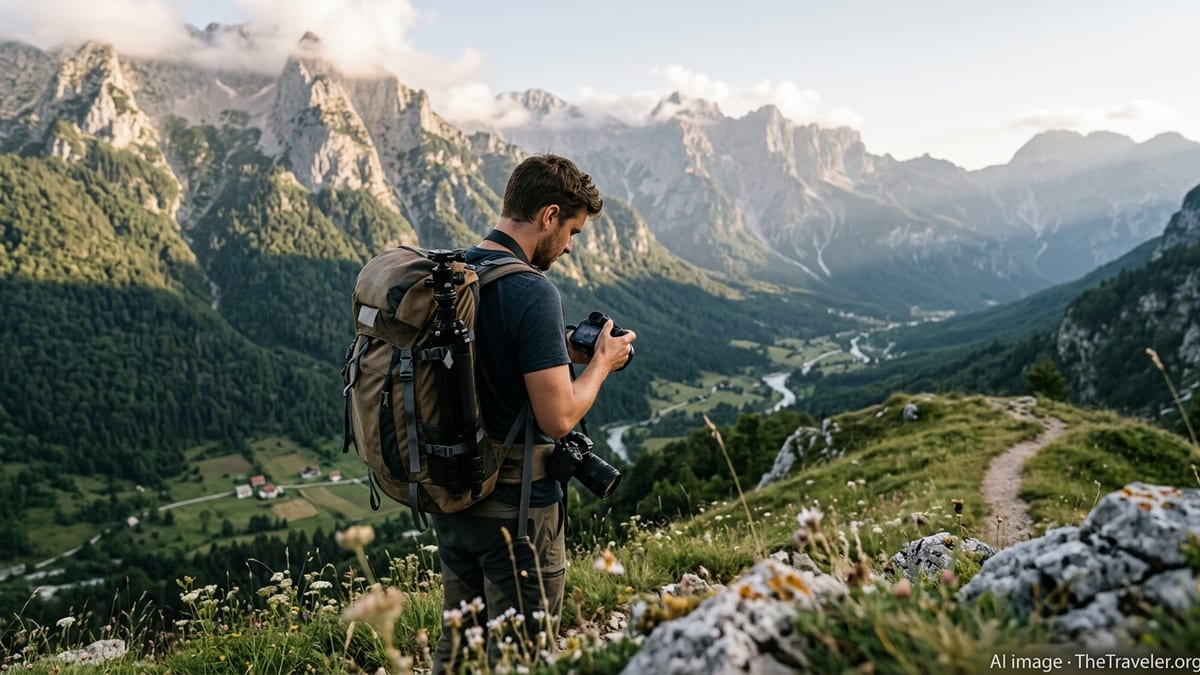
On the trail from Valbonë to Theth, my pack felt heavier because of the camera gear, but my future self in the editing room was very grateful. I kept my kit light: a mirrorless camera with a 24 to 70 mm lens, a compact travel tripod strapped to the side of my bag, a small action camera clipped to my shoulder strap for hands free walking shots, and a phone for spontaneous clips when digging out the main camera felt impossible. Later, when piecing together the footage, I even experimented with tools that can create professional videos from image sequences to fill small storytelling gaps between clips and smooth transitions naturally.I tried to shoot sequences rather than isolated scenes. For example, leaving Shkodër, I filmed a close up of my bus ticket, a medium shot of travellers loading backpacks underneath the bus, and a wide shot of the vehicle pulling away from the curb with the Rozafa Castle hill in the background. In Theth, I recorded the process of a guesthouse dinner: vegetables sizzling in a pan, bread coming out of a wood fired oven, the host announcing the dishes around a communal table. Later, those short clips linked together to create mini narratives that gave the documentary rhythm and context.
Sound mattered more than I expected. In Tirana, I captured street noise outside Skanderbeg Square, the call to prayer overlapping with pop music from a nearby bar. On Koman Lake, I recorded the low rumble of the ferry engine and the slap of waves against the hull. Even if much of that audio now sits quietly underneath music in the final cut, it gave the edit texture. My rule became simple: when you film, record at least five extra seconds of “nothing” at the start and end of each clip to capture clean ambient sound.
I also learned to film “in and out” of scenes. At the Blue Eye of Theth, a freezing spring where hikers dip their toes, I did not just point the camera at the water. I started with my boots crunching on gravel, panned slowly to reveal the turquoise pool, then ended with my red face as I pulled my feet out of the icy water. That tiny narrative, shot in less than a minute, later fit neatly into the broader story of the hike and showed my own vulnerability in a way that a static landscape shot never could.
Finding The Story In Hundreds Of Clips
Back home, importing my footage from Albania into my laptop felt overwhelming. I had days where I had shot over 90 short clips. The first step was brutally simple: I organised the files by date and location, then watched everything at double speed, adding a colour label to any clip that sparked a reaction. A child riding a bicycle through a puddle in Shkodër at golden hour, a shepherd crossing a gravel road near Valbonë, a busker playing an accordion in Gjirokastër’s stone bazaar. Those red labelled clips became my “essentials” bin.
Only after this emotional curation did I ask the harder question: what is this documentary really about? It could have been a generic guide to Albania’s highlights, but the footage told me a different story. Again and again, the camera lingered on shared tables, bus conversations, and small acts of kindness. A cafe owner in Berat who refused to let me pay for coffee because I was travelling alone, a Koman ferry passenger adjusting my tripod so it would not fall over in the breeze, a young couple in Sarandë explaining why they had left London to move back to Albania. The pattern was clear: this was a story about encounters more than landscapes.
With that theme in mind, I wrote a single page outline. Act one: arriving slightly nervous in Tirana and Shkodër, getting my bearings. Act two: tested by the hike and logistics in the north, learning to rely on strangers. Act three: recovering on the southern coast, reflecting on what I had learned about Albania and about myself. Only after that outline existed did I create a new project in my editing software and start building the film, one small timeline at a time.
Building The Mini Documentary In The Edit
I edited the film on a mid range laptop using accessible software that many travellers already have, though any modern editing program would work. The first days were about structure, not polish. I dropped my key clips onto the timeline in rough order and created three sequences: “Northbound,” “The Pass,” and “Southbound.” A four minute sequence from Tirana to Valbonë. A five minute sequence focused on the Koman ferry and the hike itself. A final five minutes that drifted slowly along the Riviera and circled back to Tirana’s streets.
A surprising amount of work went into transitions. In reality, my bus from Shkodër to Tirana took about two hours and cost only a few euros. On screen, that needed to compress into a few seconds without confusing viewers. So I used what editors call match cuts. A shot of the bus door closing in Shkodër cut directly to a bus door opening in Tirana. The white noise of the engine carried over both shots, smoothing the jump in time and space. I repeated similar transitions elsewhere: boots on gravel in Theth dissolving into flip flops on sand in Ksamil, mountains reflected in a puddle replaced by clouds reflected in the sea.
Music raised another set of decisions. Albania has a rich musical heritage, but licensing popular tracks was beyond the scope of a small, personal project. I instead looked for royalty free tracks that echoed what I had heard on the ground: a slow, string based piece under dawn scenes in the Alps, something with a subtle Balkan rhythm for Tirana’s markets, and quieter ambient pieces for bus rides. I deliberately left some sections without music entirely, especially where human voices mattered more than atmosphere, such as a grandmother in Theth explaining through my hostel host’s translation why she loved her valley.
For colour, I aimed for restrained consistency. In Shkodër, the sky had a soft haze that could make footage look flat; on the coast, midday sun created harsh contrasts. Rather than chasing a flashy, stylised grade, I nudged exposure and contrast until landscapes resembled what I remembered. Slightly muting saturation kept the patchwork of red roofs in Berat, the emerald fields near Valbonë, and the neon cafe signs in Tirana from competing with each other. When shots from different cameras sat back to back, I matched their white balance so viewers could focus on the story, not the technology behind it.
Weaving In People, Place, And Context
One of the challenges of turning travel clips into a documentary is avoiding the trap of anonymous beauty. Albania’s mountains and beaches are spectacular, but what brought them to life on screen were the people who defined each place. Early in the edit, I realised I had filmed plenty of landscapes but not enough faces. To fix that, I combed through my B roll for every moment where someone interacted with me or the camera.
In Shkodër, that meant including a short exchange with a bike rental owner who marked the location of the lake on a paper map and joked about my pronunciation of “faleminderit.” In Theth, it was a silent shot of a farmer leading two cows down the stone lane at dusk, glancing at my camera with a half smile. On the Koman ferry, I cut in a few seconds of a fellow backpacker from Spain teaching a group of local teenagers how to say “selfie stick” in English. Each moment lasted only a breath or two, but together they grounded the film in lived experience instead of postcard views.
Context also mattered. Albania’s tourism sector has grown quickly, with millions of international visitors in recent years, and locals had mixed feelings about that boom. In Gjirokastër, I filmed a shopkeeper explaining in halting English how rising visitor numbers had been good for business but had also pushed up rents in the old town. On a quiet pebbled beach north of Himarë, an older man pointed at a row of new guesthouses and shrugged, suggesting with a few words and hand gestures that things had changed fast. Rather than turning those conversations into heavy commentary, I used them as gentle reminders that travellers are walking through someone else’s home.
Voiceover allowed me to connect those dots. I recorded narration in my bedroom under a blanket to dampen echoes, reading from a lightly scripted text that I had written after finishing the first rough cut. Instead of describing everything viewers could already see, I focused on emotions: the nervous excitement of negotiating my first furgon ride, the quiet exhaustion reaching the pass between Valbonë and Theth, the bittersweet feeling of leaving Ksamil’s beaches knowing that tourism might change them quickly. That narration threaded the visual chapters together and made the film less about checklists and more about a personal arc.
Practical Lessons For Travellers Who Want To Film Their Own Story
Looking back, the documentary feels inevitable. In reality, it was held together by a handful of simple habits that any traveller can adopt, even with just a phone camera. The first was to think in pairs: always capture a wide shot to establish a scene and at least one detail shot to give it texture. In Berat, for example, I filmed a sweeping view of the hillside houses and then zoomed in on a single window where laundry fluttered in the wind. That pair told a complete micro story in under ten seconds.
The second habit was restraint. Albania is visually rich, and it was tempting to record constantly, especially on the Theth to Valbonë trail where every bend in the path revealed another postcard view. But some of my favourite sequences came from moments where I filmed one deliberate shot and then put the camera away. A slow pan across the stone bridge in Theth at dawn, mist hanging in the valley, turned out far more powerful than the dozens of quick clips I grabbed later that morning in harsher light.
Third, I learned to note key phrases from conversations in my phone’s notes app immediately after they happened. On a bus from Sarandë to Tirana, a university student told me, “We grew up thinking of the sea as somewhere to leave from, not to stay beside.” I did not record his face, but that sentence ended up in the documentary as a voiceover line while the camera lingers on a departing ferry. Without the note, that nuance would have been lost.
Finally, I accepted that a mini documentary is not a comprehensive guide. My film does not mention popular stops like the Llogara Pass viewpoint or every historic site in Tirana. Instead, it lingers on specific threads that mattered to me: hospitality, movement, and changing landscapes. That focus allowed the piece to feel intentional rather than scattered, and it took the pressure off filming every monument or meal. For other travellers, the central theme might be food, architecture, or nightlife, but the principle is the same. Choose a lens through which to view the country, and let that lens guide what you shoot.
The Takeaway
When I boarded my flight home from Tirana, my only certainty was that I had seen a version of Albania that deserved more than a fast disappearing stream of social media posts. I wanted a way to remember not only the cobalt water of Koman Lake or the limestone peaks above Valbonë, but also the quiet bus rides, the jokes told over raki in small kitchens, and the feeling of learning to navigate a place that was new to me.
Turning my travel clips into a mini documentary became that way. The project stretched long after the backpack went back into the closet. Over a few winter evenings, I relived the journey, cut away what did not serve the story, and stitched together a record of how the country and its people had made me feel at a particular moment in time. The finished film is modest, certainly not a festival contender, but it has already done something valuable. It has sparked conversations with friends who had barely heard of Theth or Shkodër and encouraged a few to consider Albania for their own travels.
For anyone walking similar streets or trails soon, the cameras we already carry in our pockets are more than enough to begin. With a bit of intention, some simple on the road habits, and patience in the edit, a pile of scattered clips can become a story that outlasts the fading tan lines from Ksamil’s beaches. The country is changing quickly, and so are we. A small, honest film is one way of marking where the two intersect.
FAQ
Q1. Do I need professional camera gear to make a mini documentary while backpacking in Albania?
You do not. A recent smartphone with decent low light performance is enough if you are thoughtful about composition, steady shots, and capturing clear sound. Many travellers combine a phone with a small action camera or compact mirrorless body, but the storytelling choices matter more than the equipment.
Q2. Is it safe to film openly in Albanian cities and villages?
In most places it feels comfortable and safe to film, especially in busy public areas like Tirana’s central squares, Shkodër’s pedestrian streets, or Sarandë’s seafront promenade. In smaller villages, it is courteous to ask before pointing a camera directly at people or private homes. A friendly greeting and simple request usually go a long way.
Q3. How much daily budget should I plan for if I want to travel and film for a couple of weeks?
Budget travellers can often get by on roughly 30 to 50 euros per day, covering hostel or guesthouse stays, local transport such as buses and furgons, and simple meals. Filmmaking itself does not have to add much cost unless you choose to upgrade storage cards, batteries, or specific activities for the sake of your project.
Q4. Are hostels and guesthouses okay with travellers filming on their properties?
In most popular backpacker hubs like Tirana, Shkodër, and coastal towns, staff are accustomed to guests taking photos and video. It is polite to ask before filming other guests or staff, especially in dorm rooms or at shared dinners. Many owners are proud to showcase their places and will even help you find good viewpoints.
Q5. What is the best season to backpack and film in Albania?
Late spring and early autumn often strike a good balance. Around May or late September you can expect milder temperatures for hiking in the Alps and fewer crowds on southern beaches compared with peak summer, while still enjoying long daylight hours for filming.
Q6. How do I deal with power and data storage while moving around so much?
Carrying at least one sizeable power bank and multiple memory cards helps. Most hostels and guesthouses provide enough outlets to charge overnight, though in very remote valleys the supply can occasionally be unstable. Back up important clips to a small external drive or cloud service whenever you stay somewhere with reliable internet.
Q7. Can I fly a drone to capture aerial shots for my documentary?
Drone regulations can change, so it is important to check current rules before you fly. In general, you should avoid restricted areas, respect people’s privacy, and follow any local guidance from park authorities or accommodation hosts, especially in national parks and densely populated areas where drones may not be welcome.
Q8. How long should a travel mini documentary be to keep people engaged?
Many viewers respond well to pieces in the 8 to 20 minute range. That is long enough to develop a sense of place and a personal arc, but short enough to watch in one sitting. Focus on telling a clear story rather than hitting a specific time mark.
Q9. Do I need permission from people who appear briefly in the background of my clips?
Candid shots of crowds in public spaces are generally considered acceptable, but it is respectful to ask permission if a person is the clear subject of a close up or identifiable portrait. When in doubt, a quick gesture toward your camera and a smile will usually make intentions clear.
Q10. How can I share my finished Albania mini documentary with others?
Many travellers upload their films to popular video platforms, embed them on personal blogs, or screen them at local travel meetups. Before sharing, consider whether any sensitive locations, private moments, or children’s faces should be blurred or omitted to respect the people and places that made your journey possible.