


More news on this day
A technology outage affecting United Airlines’ internal computer systems led to widespread delays at Houston’s George Bush Intercontinental Airport on Saturday, stranding passengers in terminals and on aircraft as the carrier worked to restore normal operations at its largest Texas hub.
Get the latest news straight to your inbox!
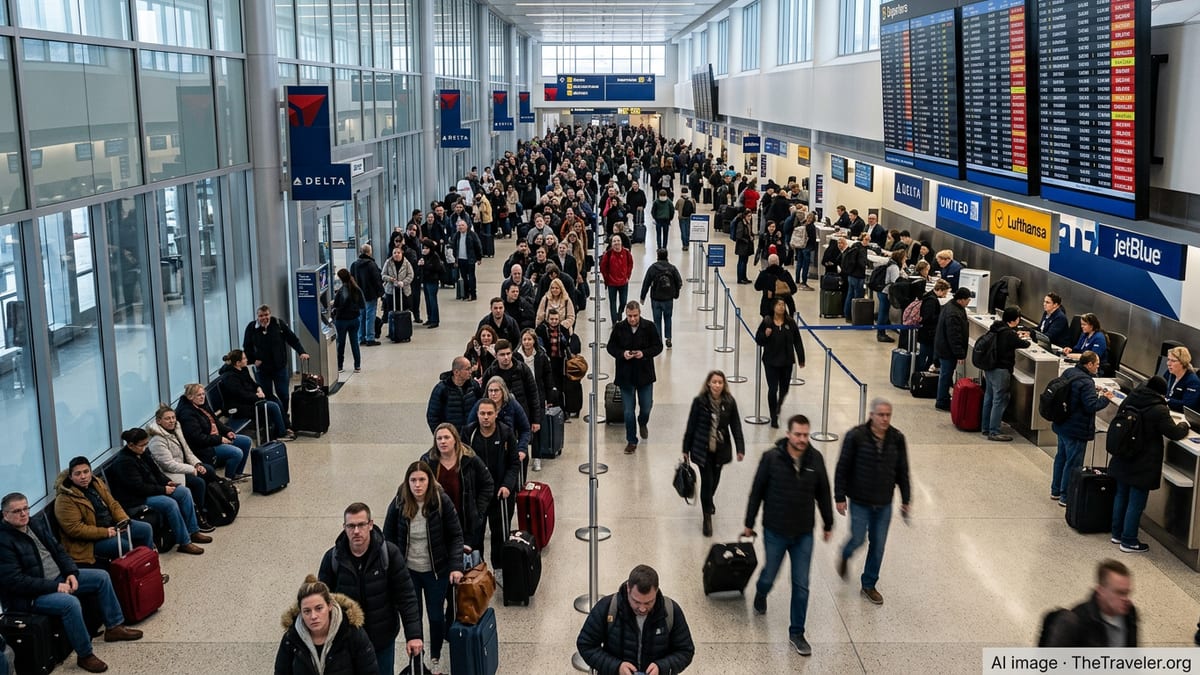
Outage hits United operations at key Houston hub
Reports from passengers and aviation watchers on Saturday indicated that a system disruption at United affected flights throughout the airline’s network, with a particularly visible impact at Houston’s George Bush Intercontinental Airport, a major connecting hub. Travelers described long lines at check in and boarding areas, with some flights unable to complete boarding or push back from gates while the outage persisted.
Publicly available flight tracking data showed clusters of departure delays building through the day at IAH, even as some flights continued to operate. The pattern suggested that while the outage did not halt all United operations, it slowed the pace of departures and arrivals enough to create bottlenecks at gates and on taxiways.
Information posted by federal aviation authorities showed IAH operating with limited capacity as delays mounted, advising travelers to check directly with airlines for the status of individual flights. The advisory language pointed to delays but not a full closure of the airport, highlighting the targeted nature of the disruption.
The situation draws renewed attention to the vulnerability of large hub operations to technology interruptions, especially at airports like Houston where one airline controls a high share of traffic and connections.
System reboot leads to ground stops and gate gridlock
Accounts shared publicly by passengers indicated that a reboot of United’s internal systems led to temporary ground stops in parts of the network, including Houston. Several travelers reported sitting at gates after boarding had begun, only to be told that the flight could not depart until computer tools used by flight crews and dispatchers were fully restored.
At IAH, those pauses quickly translated into crowded taxiways and gate areas. Some arriving flights reportedly waited on the tarmac for extended periods because gates remained occupied by aircraft whose departures had been delayed by the outage. That effect is common during technology interruptions, when even a short ground stop can cause a backlog that takes hours to clear.
Travelers also described difficulties checking in and printing boarding passes at airport kiosks, with some agents resorting to manual workarounds while systems were unavailable or slowly restarting. In several cases, passengers reported that check in was temporarily halted altogether until computer access returned.
These types of failures can ripple quickly through a tightly scheduled hub operation. Once flights miss their assigned departure windows, crews risk reaching duty time limits, aircraft rotations fall out of position, and onward connections for passengers begin to misalign, further complicating recovery efforts.
Technology at the heart of modern airline operations
While specific technical details of Saturday’s outage were not immediately clear from public reports, United relies on an interconnected set of systems to manage flight planning, crew scheduling, aircraft weight and balance, and real time operational control. Industry coverage of previous disruptions at the airline has highlighted the role of its legacy Unimatic system, which feeds data to other tools used by dispatchers and crews.
When those systems malfunction, airlines can lose access to critical information such as aircraft performance calculations and crew assignments. Aviation analysts note that without accurate weight and balance figures or validated flight plans, departures must be held for safety reasons even when weather and airport conditions are otherwise favorable.
The Houston disruption fits a broader pattern of high profile technology incidents across global aviation in recent years, in which software glitches, data center problems or issues at third party providers have led to mass delays and cancellations. Each episode underscores how dependent airlines have become on complex digital infrastructures that must function with near perfect reliability.
Carriers have responded by investing in redundancy, cloud migrations and backup manual procedures, but occasional outages continue to expose the fragility of these systems and the difficulty of fully eliminating single points of failure.
Impact on passengers and ongoing recovery efforts
For travelers at IAH, the most immediate effects on Saturday were extended waits and uncertainty around departure times. Passengers described arriving at the airport to find growing queues at ticket counters and security checkpoints, as disrupted check in processes slowed the flow of people through the terminal.
Inside the concourses, packed gate areas and rolling delay announcements created a challenging environment for those with tight connections. Some travelers reported missed onward flights and same day rebookings, while others faced longer layovers as United worked within available aircraft and crew resources to reassemble its schedule from Houston.
Publicly accessible operational boards suggested that, as the day progressed, more United flights at IAH began to depart, indicating that key systems were coming back online and that the airline was moving into recovery mode. However, residual delays typically continue for many hours after a major disruption as aircraft and crews are repositioned and stranded passengers are accommodated.
Travel advisors often recommend that in situations like Saturday’s outage, passengers monitor their flight status frequently through airline apps or airport displays, remain prepared for gate or schedule changes, and proactively request assistance with rebooking if it becomes clear that connections will be missed. Those steps can be especially important at connecting hubs such as Houston, where disruptions can cascade across multiple legs of a trip.
Questions about resilience as summer travel continues
The incident at IAH arrives during the busy summer travel period in the United States, when airline schedules are already stretched by high demand, limited spare aircraft and tight staffing in critical roles. In this environment, even short lived technology problems can have outsized consequences for on time performance and customer experience.
Industry observers have noted that United, like many large carriers, has been investing in technology upgrades and new terminal infrastructure in Houston, positioning the airport as a key gateway for domestic and international travel. Events such as Saturday’s outage may renew debate over how quickly legacy systems can be modernized and how much redundancy is needed to protect major hubs from future disruptions.
For now, publicly available information indicates that operations at IAH are recovering, but with lingering delays. Travelers scheduled to pass through Houston in the coming hours are likely to feel some continued effects as United works to stabilize its schedule, reposition aircraft and crews, and clear the backlog of displaced passengers created during the outage window.
The episode serves as a reminder that for all the advances in fleet and airport facilities, the reliability of behind the scenes technology remains central to the smooth functioning of modern air travel, particularly at large connecting hubs such as Houston’s George Bush Intercontinental Airport.