


More news on this day
The United States has renewed its warning against travel to parts of the Middle East following fresh Iran-linked attacks and threats that have again placed Saudi Arabia and neighboring Gulf states under the spotlight, prompting renewed scrutiny of aviation routes, energy corridors and the safety of foreign visitors.
Get the latest news straight to your inbox!
Heightened Concern After New Attacks Target Saudi Arabia
Recent reporting on the ongoing conflict between Iran and the United States describes a new phase of hostilities in which Iranian forces and allied groups have intensified strikes across the Gulf, including targets in and around Saudi Arabia. Open-source analysis of the fighting indicates that drone and missile attacks have repeatedly been directed at military installations, oil facilities and key infrastructure, raising concern that civilian areas and foreign nationals could be exposed to collateral risk.
Accounts of the 2026 wave of Iranian strikes on Arab countries describe Saudi Arabia as one of the hardest-hit states, with dozens of missiles and hundreds of drones launched at sites across the kingdom since the war began earlier this year. Infrastructure in Riyadh and the eastern energy-producing provinces has been singled out, while air-defense alerts and sporadic damage reports have become part of daily life in some regions.
In the latest incidents, regional media and specialist outlets monitoring maritime and airspace security have pointed to renewed Iranian attacks on Gulf states following another round of United States strikes on Iranian military facilities. Analysts note that each spike in cross-border fire has tended to trigger parallel updates to Western travel advisories, as governments reassess whether commercial routes, ports and tourist hubs can be considered reasonably secure.
Although many of the strikes are understood to have focused on military and economic targets, the complexity of modern drone and missile operations and the density of urban development in the Gulf mean that miscalculation or malfunction could have serious consequences for civilian travelers, particularly in areas close to airports, energy installations and major highways.
US Travel Advisories Emphasize Iran-Linked Terror and Conflict Risks
Publicly available State Department advisories continue to assign some of the highest warning levels anywhere in the world to Iran and several conflict-affected states in the broader Middle East. Iran remains under a “do not travel” alert, citing a combination of terrorism, armed conflict, civil unrest, the risk of kidnapping and a well-documented pattern of arbitrary detention involving foreign citizens, including people with dual nationality.
For key Gulf partners such as Saudi Arabia, Bahrain and the United Arab Emirates, the official US guidance in recent months has settled at “reconsider travel,” reflecting a persistent risk of Iranian missile and drone activity alongside broader terrorism concerns. Updated notices highlight the danger of potential targeting of American interests and critical infrastructure, and point to the possibility of sudden degradation in commercial air connectivity if hostilities flare.
In Saudi Arabia’s case, the advisory language draws attention to the risk of drone and missile attacks linked to Iran and its network of allied groups, as well as to past episodes of cross-border fire and strikes on oil facilities. Travelers are urged to be prepared for air-raid warnings, localized curfews, and rapid changes in security postures that can affect both domestic movement and outbound flights, especially from airports in the Gulf and the kingdom’s eastern region.
Similar wording appears in advisories for Bahrain and the United Arab Emirates, both of which have hosted United States military assets and have been mentioned in reports about potential Iranian targeting scenarios. In each case, the State Department notes that attacks may occur with little or no warning and that locations attracting foreign visitors, including shopping centers, transportation hubs and areas associated with Western or allied governments, are viewed as potential targets.
Aviation Routes, Energy Corridors and Regional Mobility Under Strain
The renewed US travel warning comes against a broader backdrop of international concern about the safety of airspace and shipping lanes across the Middle East. European aviation regulators and other flight-safety bodies have already advised airlines to avoid or exercise extreme caution over parts of Iran and Iraq, and to review routing decisions for several neighboring states in response to the risk of long-range missile launches and anti-aircraft activity.
Energy corridors are under similar strain. Recent reporting has documented incidents around the Strait of Hormuz and the Bab el-Mandeb, two maritime chokepoints critical to global oil and goods shipments. Vessels have been seized or attacked in separate episodes linked to Iran or allied factions in Yemen, spurring insurers and shipping companies to reassess risk premiums and routing patterns through the Red Sea and Arabian Gulf.
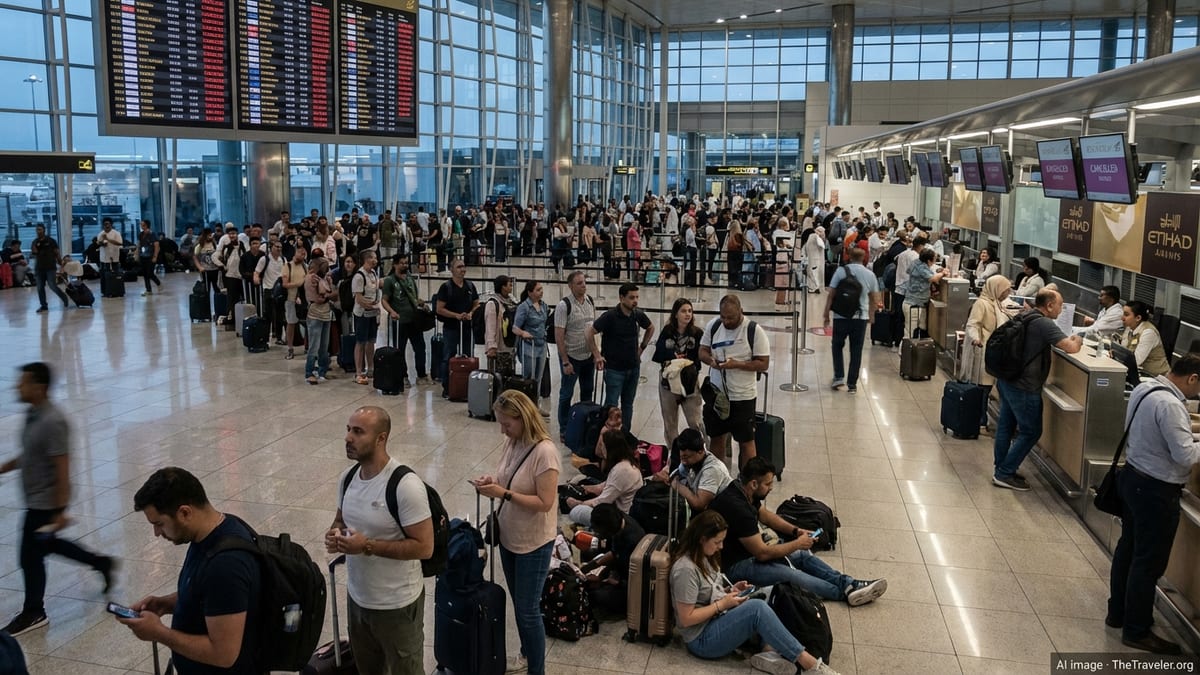
For travelers, these dynamics translate into a more fragile operating environment. Airlines have periodically suspended or rerouted flights, while sudden closures of airspace or key causeways have disrupted overland links between Gulf states. Travel-industry briefings circulated in June highlighted the possibility of short-notice cancellations and the difficulty of arranging rapid departures from affected countries if diplomatic tensions escalate quickly.
Even in Gulf cities that remain open to tourism and business, the possibility of air-defense alerts, temporary lockdowns or indirect effects from strikes on energy infrastructure can introduce unpredictability that complicates itineraries, conferences and large-scale events.
Regional and International Responses Shape the Risk Landscape
Governments within the region have responded in varying ways to the evolving security picture. Some European foreign ministries, monitoring the same pattern of Iranian strikes and United States counterattacks, have advised citizens to avoid nonessential travel to parts of the Gulf or to remain ready to leave at short notice. Others have recently eased earlier blanket warnings after a brief period of reduced tensions, while still acknowledging the potential for renewed confrontation.
These differences in national guidance reflect not only diverging threat assessments but also varying levels of exposure to regional trade, energy dependence and existing diaspora communities. For travelers, the result is a patchwork of advice that can be difficult to reconcile, particularly when some governments emphasize the threat from Iran-linked armed groups while others frame the main hazard as broader instability in the wake of United States military operations.
The latest cycle of Iranian activity targeting Saudi Arabia and other Gulf states has also fed into wider debates about the legal designation of Iranian organizations as terrorist entities. Moves by some Western capitals to list components of Iran’s security apparatus as terrorist groups have been framed as a response to both regional attacks and attempts at foreign interference, but they also carry implications for sanctions, aviation cooperation and security screening procedures affecting travelers.
Within international aviation and maritime circles, these developments are feeding into scenario planning for further disruptions. Contingency measures range from expanded no-fly zones and diversions around sensitive areas to additional naval patrols tasked with safeguarding shipping against missile or drone strikes launched from Iranian territory or by aligned factions elsewhere in the region.
What the Renewed Warning Means for US Travelers
The renewed United States warning about travel to the Middle East is not a blanket ban on movement but a strong signal that the regional security situation remains unstable and that risks tied to Iran and its allied groups are elevated. Public guidance emphasizes that conditions can deteriorate quickly, and that what appears calm on one day can be affected by long-range attacks or sudden diplomatic escalations the next.
Travelers who continue to plan or undertake trips to Saudi Arabia and nearby states are being encouraged, through advisory language and industry briefings, to remain in close contact with airlines and tour operators, monitor local media for airspace or border closures, and maintain contingency plans for sheltering in place if outbound routes are temporarily cut off. Companies with staff in the region are reviewing evacuation and remote-working policies in light of the renewed alerts.
Experts in risk consultancy note that urban centers such as Riyadh, Jeddah, Manama, Doha, Abu Dhabi and Dubai still function as major commercial hubs, and that many visits proceed without incident. However, the combination of Iran-linked missile and drone activity, the elevated threat of terrorism, and the possibility of broader conflict escalation underpin the latest US decision to reiterate its cautionary stance.
For now, the overall message embedded in the updated US travel posture is that the Middle East’s interconnected air routes, ports and energy facilities remain deeply exposed to the fallout of the Iran conflict, and that leisure and business travelers alike should weigh that reality carefully when considering trips to Saudi Arabia and the wider region.