


Üsküdar is one of Istanbul’s most atmospheric waterfront districts, and its busy ferry piers are where daily commuter life and Bosphorus sightseeing collide. From here you can glide across the water to Eminönü’s spice-scented streets, Karaköy’s cafés, Beşiktaş’s markets or Kadıköy’s bar-lined back alleys while watching tankers, fishing boats and palaces slide by. This guide explains how to use Üsküdar’s ferries as both a practical transport hub and a front-row seat on the Bosphorus, with clear advice on routes, piers, Istanbulkart, sunset timing, Kadıköy connections and when it makes sense to choose the Marmaray instead.
Get the latest updates straight to your inbox!
Understanding Üsküdar’s Waterfront and Piers
Üsküdar’s shoreline is compact and easy to navigate, but there are several adjacent piers serving different routes, which can be confusing at first glance. When you exit the main Üsküdar Square facing the water, you will see a row of low, historic-looking ferry buildings lined up along the promenade. The central municipal Şehir Hatları pier handles core inner-city lines such as Üsküdar – Eminönü and Üsküdar – Karaköy, while nearby private operators run fast boats and some sea-bus services. Walking from the metro or Marmaray station to any of these piers usually takes no more than three to five minutes.
The key thing to know is that each pier is signposted by its primary destination rather than by number. For example, you will see clear signage for "Üsküdar – Eminönü" or "Üsküdar – Beşiktaş" on the pier façade and above the turnstiles. Inside, large electronic boards list the next departures and platforms. On busy weekday evenings, locals queue in long, orderly lines on the promenade in front of each pier, but even then the boarding process is efficient and quick, with ferries absorbing hundreds of passengers in a few minutes.
Orientation is easiest if you use the Maiden’s Tower as your mental anchor. Standing with the tower offshore on your right, the main inner-city piers for Eminönü and Karaköy are directly in front of you, while additional piers stretch northwest toward the Galata Bridge and Bosphorus. A short stroll south along the waterfront, away from the bridge, brings you to smaller boat landings serving more local or seasonal services. If in doubt, staff in orange or navy vests are usually happy to confirm you are at the correct pier for your route.
Inside most Şehir Hatları terminals you will find basic facilities: a ticket office window (useful if you need help with Istanbulkart), small kiosks selling tea, simit and snacks, and basic restrooms. Toilets may require payment with cash or Istanbulkart, so keeping a small balance on your card can be useful even if you mostly pay transit fares with contactless bank cards.
Key Routes from Üsküdar: Where the Ferries Can Take You
Üsküdar’s ferries form one of the most scenic cross-Bosphorus commuter corridors in the city. For many visitors the most useful route is Üsküdar – Eminönü, which connects directly to the T1 tram toward Sultanahmet and the Grand Bazaar. This short 10 to 15 minute crossing offers postcard views of the Süleymaniye Mosque and Galata Tower as you approach the Golden Horn. Departures run frequently during the day under the city’s inner-line schedule, typically every 15 to 20 minutes in peak hours, and slightly less often late in the evening.
Another essential line is Üsküdar – Karaköy, ideal if you are staying in Galata, Tophane or Cihangir. The journey is similarly short but gives a slightly different angle on the skyline. On this route, you will pass closer to the Galata Bridge and the mouth of the Golden Horn, watching fishing rods line the bridge above you as ferries, tourist boats and tankers crisscross below. Many travelers like to arrive from the Asian side via Üsküdar – Karaköy in the morning, wander uphill to the Galata Tower and Istiklal Avenue, then return to Üsküdar by ferry after sunset for a glowing view of the mosques.
For reaching the European side’s residential and nightlife hub of Beşiktaş, you can use the Üsküdar – Beşiktaş route, which typically runs from early morning until late night. This line is particularly popular with locals commuting between Üsküdar’s neighborhoods and Beşiktaş’s universities and offices. The crossing gives you a sweeping mid-Bosphorus panorama, with Dolmabahçe Palace, the Bosphorus Bridge and the Asian hillside neighborhoods of Kuzguncuk and Beylerbeyi in view depending on your exact path.
Seasonally, there are also longer Bosphorus routes and tourist-oriented loops that originate on the European side but stop at Üsküdar or nearby piers as part of their itinerary. For example, many of the classic Bosphorus tours that depart from Eminönü or Kabataş include short calls at Asian-side piers such as Üsküdar or Beylerbeyi as they progress toward Anadolu Kavağı. If you are staying in Üsküdar, this means you can often board a longer scenic cruise without crossing to the European side first, though schedules vary by season and are worth checking a day or two in advance at the pier.
Istanbulkart, Tickets and Paying for the Ferry
Üsküdar’s ferries are fully integrated into Istanbul’s public transport system, so you pay using the same Istanbulkart contactless smart card that works on the metro, tram, buses and Marmaray. You can buy an anonymous Istanbulkart from yellow or blue vending machines near the Üsküdar metro and Marmaray entrances or right beside the ferry terminals. Machines typically accept Turkish lira banknotes and sometimes cards, but not foreign currency, so it is wise to withdraw or exchange a small amount of cash on arrival.
As of late 2025 and 2026, a standard inner-city transit ride for visitors using a regular Istanbulkart is usually priced in the range that a short ferry crossing will cost roughly the same as a metro or tram ride, typically only a few dozen lira. Fares are adjusted periodically by the city, so instead of memorizing exact numbers, budget the equivalent of just a few euros or dollars per crossing for planning purposes. When you tap in at the turnstile, the current fare is deducted automatically, and if you transfer to another metro, tram or ferry within a set time window, a reduced transfer fare generally applies to your second and third rides.
If you are traveling as a couple or small group, you can often use a single anonymous Istanbulkart to tap each person through the turnstiles one after the other, as long as you maintain enough balance for multiple fares. This is common practice on ferries and trams, but note that some premium lines like Marmaray calculate distance-based refunds per card and are technically intended for individual use, so sharing one card there can be less economical. For a short stay focused on central ferries and trams, however, a single shared card usually works well.
For travelers who prefer not to deal with a separate transit card, many ferry turnstiles in Üsküdar now accept contactless credit or debit cards and digital wallets like Apple Pay or Google Pay. You simply tap your bank card on the reader as if it were an Istanbulkart and pay a slightly higher single fare. This is convenient for a spontaneous sunset crossing when your Istanbulkart is empty, but if you plan to use public transport several times a day for more than a day or two, loading credit on an Istanbulkart still tends to be the more economical option.
Best Bosphorus Views and the Perfect Sunset Ride
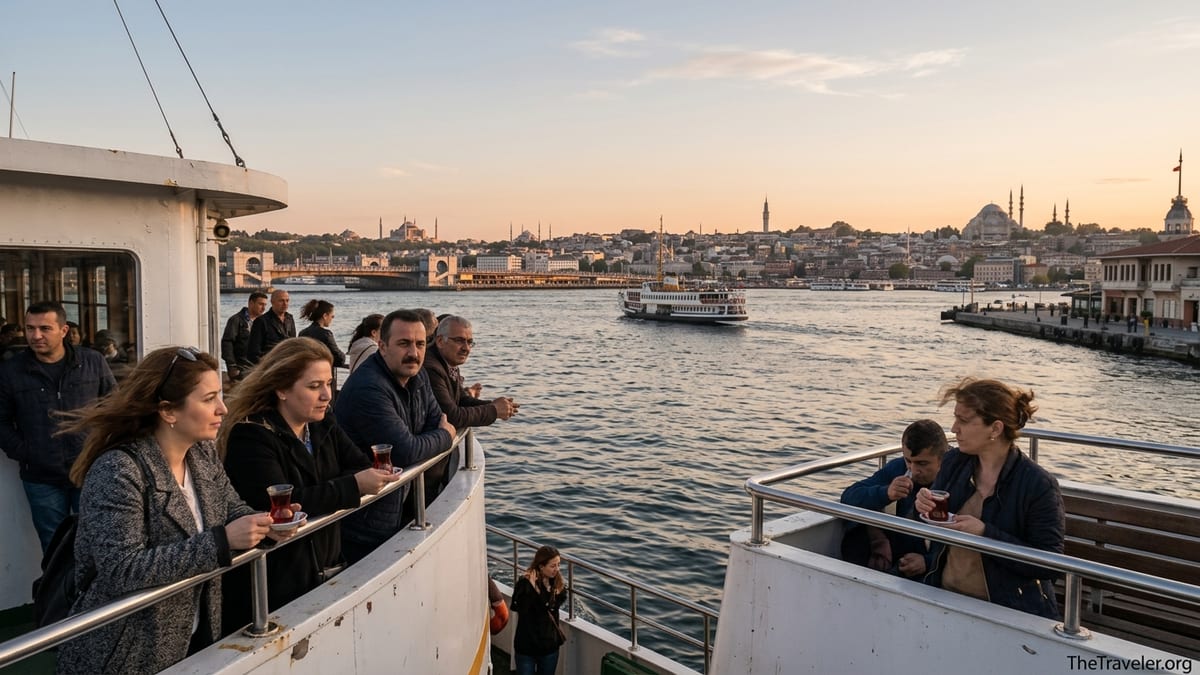
From Üsküdar, every route across the Bosphorus gives a different angle on Istanbul’s skyline, so choosing the “best” view depends on what you want to photograph. For classic silhouettes of the Blue Mosque and Hagia Sophia, aim for the Üsküdar – Eminönü ferry and sit on the left-hand side when departing Üsküdar. As the boat crosses, you will see the domes and minarets stack up behind the Galata Bridge, especially atmospheric in the golden hour just before sunset.
If you want sweeping views under the Bosphorus Bridge and along the mid-Bosphorus coastline, opt for Üsküdar – Beşiktaş or a longer Bosphorus line that stops near Üsküdar. Sitting on the open deck at the rear lets you watch the Asian hills recede while palaces and waterside mansions slide into view on the European side. On clear days, in late afternoon, the light reflects off the water and illuminates the facades of Dolmabahçe Palace and the hillside neighborhoods behind Beşiktaş, making this a favorite route for photographers.
Sunset timing matters. In summer, when daylight stretches well into the evening, a departure around 19:30 to 20:30 often captures the sky turning orange behind the historic peninsula. In winter, with earlier sunsets, early evening commuter ferries between 17:00 and 18:00 can be spectacular, with low sun, long shadows and often more dramatic skies. Because ferry rides are short, you may want to cross from Üsküdar to Eminönü just before sunset for the skyline shot, then linger on the European side for blue-hour photos from the Galata Bridge or Karaköy waterfront.
Even if you are not focused on photography, consider making at least one crossing from Üsküdar after dark. Nighttime ferries reveal a different city, with mosque domes picked out in spotlights, office blocks glowing in Levent and boats leaving shimmering trails of light across the Bosphorus. In cooler months, the enclosed lower deck is heated and has big windows, so you can sip a glass of hot tea from the onboard kiosk while the city lights flicker by outside.
Üsküdar to Kadıköy: Asian-Side Connections and Nightlife
While many visitors head straight across to the European side, the connection between Üsküdar and Kadıköy is one of the most useful intra-Asian routes, linking two of Istanbul’s liveliest districts. Ferries between these two hubs are frequent in peak times and generally run into the late evening, though first and last departures depend on the season. The journey typically takes under 20 minutes and passes close to the Maiden’s Tower, giving another iconic vantage point on this small islet lighthouse.
Practically, the Üsküdar – Kadıköy ferry is ideal if you are staying in Üsküdar but want to explore Kadıköy’s bar streets, such as Kadife Sokak, or its food market around the main square. You can leave Üsküdar on an early evening ferry, enjoy dinner in Kadıköy’s meyhane-style taverns or modern restaurants, then return by ferry or by metro on the M4 line from Kadıköy to Ayrılık Çeşmesi and transfer to the Marmaray back to Üsküdar. This combination of ferry out and train back is a very local way to move between the neighborhoods.
For island day trips, Üsküdar’s connection to Kadıköy is also practical because most large ferries to the Princes’ Islands depart from either Kadıköy or nearby Bostancı. A typical itinerary might involve a mid-morning Üsküdar – Kadıköy ferry, continuing from Kadıköy to Büyükada, then returning in the evening to Kadıköy and crossing back to Üsküdar at sunset. Since all of these rides can be paid with Istanbulkart, it feels like one integrated system rather than a set of separate tickets.
At busy times, especially on weekends in spring and summer, both Üsküdar and Kadıköy piers can be crowded with locals heading to the islands or along the Bosphorus. Leave a little extra time to find the right pier and queue. If you see a long line outside the main Kadıköy islands pier but only a small group waiting at the Üsküdar – Kadıköy pier, it can sometimes be faster to cross to Üsküdar first and then change to another ferry, rather than waiting for the next direct boat from Kadıköy.
Ferry vs Marmaray: Which Should You Choose from Üsküdar?
Üsküdar is uniquely positioned with both a major ferry hub and one of the busiest Marmaray stations directly inland. The Marmaray is a modern commuter rail tunnel running under the Bosphorus, linking Üsküdar with Sirkeci, Yenikapı and beyond on the European side, as well as many stations along the Asian shoreline. From a purely practical standpoint, Marmaray is usually faster than the ferry for longer cross-city journeys, especially if you are headed to neighborhoods not directly on the water.
For example, if you are going from Üsküdar to the Fatih district near Aksaray or to suburbs such as Bakırköy or Küçükçekmece, it generally makes sense to take the Marmaray from Üsküdar to Yenikapı or beyond, then transfer to the metro or bus. The trip under the Bosphorus itself takes only a couple of minutes. By contrast, making multiple ferry transfers via Eminönü and then continuing overland would be slower and involve more walking with luggage.
On the other hand, if your destination is the historic peninsula around Eminönü and Sultanahmet, the ferry remains the more enjoyable and often equally efficient choice. Instead of taking Marmaray to Sirkeci, then walking or transferring, you can board the Üsküdar – Eminönü ferry and arrive directly at the foot of the Galata Bridge. From there it is only a short tram ride or 15-minute uphill walk to key sights. Many travelers settle on a simple rule: use the ferry when your endpoint is near the water and you are not in a rush, and choose Marmaray or the metro when you need speed or are going deep into the city.
Pricing also plays a role. Marmaray fares are distance-based, with the system charging a higher amount at entry and refunding part of it at exit depending on how far you traveled. This means short undersea hops from Üsküdar to Sirkeci can be similar in price to a ferry ride, but longer Marmaray journeys out to Florya or Gebze become more expensive. For a visitor with a limited number of days in Istanbul, it often makes sense to treat Marmaray as a backbone for one or two long cross-city excursions, and use the Üsküdar ferries for everyday travel and sightseeing.
Practical Tips: Timing, Seasons and Comfort Onboard
For most of the year, ferries from Üsküdar start early in the morning, often around 06:00 or 07:00 for major routes, and continue until late in the evening, with the last departures commonly between 22:00 and 23:00 depending on the line and season. A weekday morning ride before 08:30 will be full of commuters, and while this can be a fascinating cultural experience, it also means less space on the open deck. If you prefer a quieter crossing with room for photos, late-morning and mid-afternoon departures are usually more relaxed.
In summer, the upper open decks can become very popular, especially at sunset. If you want a coveted seat on the rail, arrive 10 to 15 minutes before departure, especially on the Eminönü and Beşiktaş routes. In winter, focus on the enclosed lower deck, where big windows still offer good views and overhead heaters keep the interior warm. Light rain does not disrupt service, but dense fog, strong winds or rare snowstorms can lead to delays or cancellations on some routes. In those cases, Marmaray and the metro are usually less affected backup options.
Onboard, expect a modest but pleasant level of comfort. Almost all municipal ferries have a small tea counter or café serving çay (black tea), instant coffee, packaged juice, simit and simple sandwiches at prices comparable to what you would pay in a local café. Many locals buy a glass of tea and stand at the rail, resting the glass on the metal ledge while chatting or simply staring at the water. The combination of sea breeze, tea and scenery is a quintessential Istanbul ritual that costs very little yet feels special.
If you are sensitive to motion, choose a seat on the lower, enclosed deck toward the middle of the boat where movement is least noticeable. The Bosphorus can be choppy on windy days, especially on longer routes, but the short inner-city crossings from Üsküdar rarely cause serious discomfort. There are no seat reservations; you can move freely between decks during the ride as long as you keep clear of the gangways when docking.
The Takeaway
Using Üsküdar’s ferries is not just a way to get from point A to point B, but one of the most rewarding experiences you can have in Istanbul. In a single day you might cross to Eminönü for the markets, glide to Karaköy for coffee, sail to Kadıköy for dinner, then return to Üsküdar under a sky full of minarets and bridge lights. With a single Istanbulkart in your pocket, the system feels intuitive and flexible, and the cost of each crossing remains modest compared with taxis or rideshares.
Choosing between ferry and Marmaray becomes less of a technical decision and more about your priorities. When you crave speed and efficiency across large distances, the undersea tunnel wins. When you want salt air, skylines and the romance of the Bosphorus, the ferries from Üsküdar are unbeatable. Build your days around at least a couple of crossings, plan a dedicated sunset ride, and treat the piers not just as transit points but as living public spaces where Istanbul gathers, pauses and watches its own spectacular waterfront.
FAQ
Q1. Do I need an Istanbulkart to use the ferries from Üsküdar?
While you can often tap in with a contactless bank card, using an Istanbulkart is usually cheaper and more flexible, especially if you plan several rides per day and want to take advantage of reduced transfer fares between ferries, trams and the metro.
Q2. How often do ferries run between Üsküdar and Eminönü or Karaköy?
Frequency varies by season and time of day, but on most weekdays you can expect a ferry every 15 to 30 minutes on the main Üsküdar – Eminönü and Üsküdar – Karaköy routes, with slightly longer gaps early in the morning and late at night.
Q3. Which side of the ferry should I sit on for the best views of the historic peninsula?
If you are departing from Üsküdar toward Eminönü, sit on the left-hand side of the boat to see the full skyline of the historic peninsula, including the mosques and the Galata Bridge, as you approach the Golden Horn.
Q4. Is the Marmaray faster than the ferry from Üsküdar to the European side?
For longer journeys beyond the waterfront, such as reaching Yenikapı, Bakırköy or further west, Marmaray is generally faster. For short hops to areas directly along the shore like Eminönü, the ferry is often comparable in time and much more scenic.
Q5. Can I use one Istanbulkart for my whole family on the ferries?
On inner-city ferries it is common for families to tap the same anonymous Istanbulkart several times at the turnstile, once per person. Just ensure you keep enough balance for multiple fares, and remember that some distance-based systems like Marmaray calculate partial refunds per card.
Q6. What is the best time of day to take a scenic ferry ride from Üsküdar?
The hour before sunset usually offers the most beautiful light and colors, especially on clear days. A late-afternoon or early-evening crossing toward Eminönü or Beşiktaş will give you warm, golden views of the skyline and bridges.
Q7. Are ferries from Üsküdar affected by bad weather?
Light rain rarely disrupts service, but heavy fog, strong winds or storms can lead to delays or occasional cancellations on some routes. In such cases, underground options like Marmaray and the metro are typically more reliable alternatives.
Q8. How close are the Üsküdar ferry piers to the metro and Marmaray stations?
The walk from Üsküdar’s ferry piers to the Marmaray and M5 metro stations is usually around three to five minutes through the main square, making it easy to combine ferry crossings with underground lines in a single journey.
Q9. Do ferries from Üsküdar operate late at night?
Many core routes, such as those to Eminönü, Karaköy and Beşiktaş, run into the late evening, often until around 22:00 or 23:00, though exact last departure times vary by line and season, so it is wise to check the schedule posted at the pier.
Q10. Can I reach the Princes’ Islands directly from Üsküdar?
Most regular ferries to the Princes’ Islands depart from Kadıköy or Bostancı rather than Üsküdar, so the usual approach is to take a short Üsküdar – Kadıköy ferry first, then transfer to an islands ferry heading to Büyükada or the other islands.