


Utuado sits at the heart of Puerto Rico’s Central Mountains, where Taíno heritage sites, misty coffee farms, river canyons and rural guesthouses are all within an hour’s drive of each other. That compact geography tempts travelers to pack everything into a single, hyperactive day. In reality, Utuado rewards a slower, framework-based plan that adapts to mountain weather, early tour departures and how your body feels after hours in rivers and canyons.
Get the latest updates straight to your inbox!
How Utuado Fits Into a Puerto Rico Trip
From San Juan, Utuado is usually a 1.5 to 2 hour drive via PR‑22 and PR‑10 into the island’s interior, long enough that most travelers treat it as at least an overnight stop instead of a day trip tacked onto the beach. Tourism authorities highlight Utuado as a gateway to the Central Mountains, with marquee sites like Caguana Indigenous Ceremonial Park, Tanamá River caves, coffee estates and the pale rock walls of Cañón Blanco. Those same routes also link easily to Adjuntas, Jayuya and Río Abajo State Forest, so Utuado often anchors a wider mountain loop.
Because many visitors combine Utuado with San Juan, Rincón or Ponce, drive days can eat several hours if you are not careful. For example, driving from Old San Juan to a rural cabin near the Tanamá can take almost as long as flying from New York to Puerto Rico. Folding heavy activities like a Tanamá cave‑tubing tour into the same calendar day as a long transfer rarely feels relaxing, especially with early start times. Treat the day you arrive or leave as a lighter "transition" day rather than the centerpiece of your Utuado experience.
Weather is another structural factor. Local outfitters and government guides consistently warn that rivers like the Tanamá and Caonillas respond quickly to rain. Tours may be shortened, shifted to calmer sections or cancelled outright. If you build your entire one‑day visit around one river experience with no backup, a stormy front can unravel your plans. A better approach is to think in themes, not fixed hours, and keep at least one dry‑land option ready for each day.
Understand Utuado’s Core Experiences
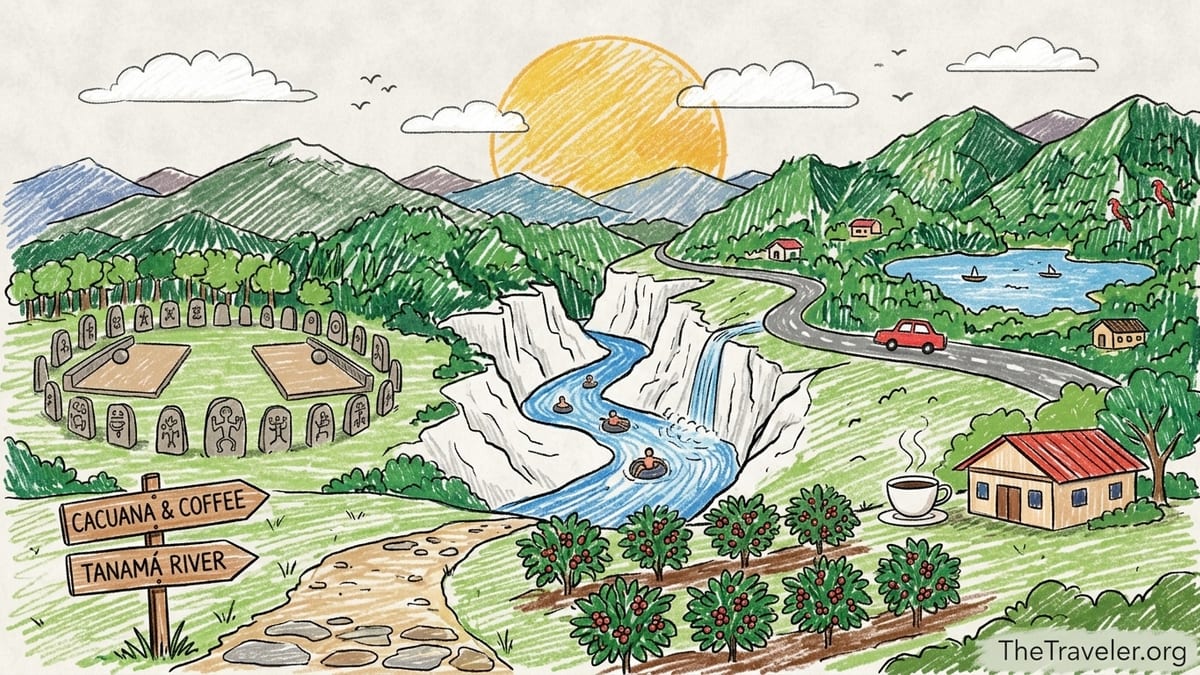
Official destination coverage and local operators tend to cluster Utuado experiences into a few repeat themes: Taíno heritage at Caguana and nearby petroglyph sites, coffee culture at fincas such as Café Gran Batey, river adventure in the Tanamá corridor, Cañón Blanco and neighboring Caonillas River pools, and the wider forest and lake landscapes around Río Abajo and Dos Bocas. Planning becomes easier if you decide which of these themes defines each travel day instead of trying to sample all of them every time you stop the car.
On the cultural side, Caguana Indigenous Ceremonial Park, in the Caguana barrio of Utuado, preserves multiple stone ball courts ringed by carved petroglyphs that date back centuries before Spanish colonization. Entry has usually been a modest fee per person, and the site can be explored in one to two unrushed hours, with time to read interpretive panels and walk the grassy fields. Coffee farms north and south of town, some highlighted in recent tourism guides, often pair a short plantation walk and basic explanation of harvesting with tastings of locally roasted beans, making them a natural pairing with Caguana on a low‑intensity cultural day.
Adventure days concentrate around the Tanamá River and the Caonillas corridor. Operators like Tanamá River Adventures advertise guided eco tours that may include cave tubing, short rappels, river hiking and time in caverns. Travelers on recent seasons’ tours describe outings lasting most of a day, with meeting times often in the early morning and a mix of floating, walking and scrambling on wet rock. Around Caonillas, guides such as Nativos Eco Tours focus on Cañón Blanco, where pale rock walls carved by the river form pools, flumes and natural "sofas" for swimming and photos. Many itineraries weave in Taíno petroglyph stations along the river as part of a combined nature and heritage experience.
A third cluster revolves around forests and lakes. Río Abajo State Forest, accessible within a short drive of Utuado’s rural communities, protects karst hills, caves and part of the recovery habitat for the critically endangered Puerto Rican parrot. Hikers and birders can spend half a day on signed trails or on guided cave walks that may include bat colonies and underground chambers. To the north, reservoirs such as Lago Caonillas and Lago Dos Bocas provide mountain‑rimmed water views, with recent public investment going into docks, small passenger boats and lakeside infrastructure. Combined with rural guesthouses like hillside villas or coffee‑farm lodgings featured by the national tourism board, these settings lend themselves to slower "lake time" afternoons and long meals instead of athletics.
Should You Move Lodging While in Utuado?
Because Utuado’s main experiences are scattered along PR‑10, PR‑111 and smaller rural roads, it is tempting to book different cabins for each theme: one closer to Caguana and coffee, another near Tanamá or Cañón Blanco, maybe a third by a lake. In practice, shifting accommodation within the municipality often creates more hassle than benefit. Driving from the town plaza to Caguana, Tanamá staging areas or the Cañón Blanco access roads usually falls within 30 to 45 minutes in normal traffic. That drive time is similar to unpacking and packing, checking in and out, and re‑stocking groceries in a new rental.
For stays of one or two nights, most travelers are better off choosing a single base that suits their main theme and tolerating some driving. For example, a family focusing on Tanamá cave tubing and Cañón Blanco swimming could book a house near PR‑10 north of town, gaining relatively straightforward access to both river corridors and still driving into the plaza for dinner. A history‑and‑coffee traveler might reverse the logic, choosing a guesthouse nearer to town and Caguana and accepting slightly longer morning drives on adventure days, or even capping activities at short river viewpoints instead of full tours.
Changing lodging becomes more reasonable when you extend to three nights or add adjacent municipalities such as Adjuntas, Jayuya or Ciales. In those cases, you might use one base in Utuado for one or two nights and then a second base deeper into the Central Mountains. A sample pattern would be two nights in a coffee hacienda property in Utuado that includes lake views and access to the Tanamá, followed by one or two nights near Jayuya for coffee museums and high‑elevation viewpoints. Even then, it is usually best to switch just once rather than hop daily between similar rural cabins.
Building Weather Flexibility Into Your Plan
River‑based activities are Utuado’s main wild card. Local guides, visitor comments and safety advisories all emphasize that heavy rain upstream can raise water levels and currents in the Tanamá or Caonillas quickly. That risk is highest in the rainy season and around tropical systems but can appear after any strong mountain storm. Operators may cancel or modify tours accordingly, and independent hikers have reported arriving at Cañón Blanco only to find conditions too swift for safe swimming. In that context, a rigid itinerary that hinges on a single scheduled tour will always feel fragile.
An effective framework is to pair each river day with a "dry" backup theme that uses the same starting point. If you have only one full day in Utuado and hope to do cave tubing, book the Tanamá eco tour, but also know your options if the river is unsafe: Caguana, Utuado’s plaza and church, a coffee tasting and short scenic drives on PR‑10 and PR‑123 can easily fill a day without getting wet. For longer stays, you can float river activities toward whichever day has the most favorable short‑term forecast while keeping culture or forest hikes ready for cloudy or showery periods.
Weather flexibility also means resisting the urge to stack demanding activities on back‑to‑back mornings. A full‑day Tanamá trip with cave sections, hiking and cold water will leave many visitors pleasantly tired. Scheduling a dawn departure for Cañón Blanco the very next day, plus an evening drive to another city, can turn any weather disruption into a logistical tangle. Leaving at least one lighter block after big exertions makes it easier to shuffle days if rain forces operators to shift your slot.
How Much Activity Is Sensible on Consecutive Days?
Central Mountain landscapes invite ambitious plans, but elevation, humidity and uneven terrain can add fatigue more quickly than visitors expect. A typical Tanamá day with a mainstream operator can involve multiple hours in life jackets, walking in knee‑deep water over rocks, scrambling up muddy banks and possibly short rappels or climbs. Similarly, guided Cañón Blanco experiences from local eco companies describe several hours of hiking along the Caonillas River, wading across channels, swimming in deep pools and exploring petroglyph stations. Even fit adventure travelers may feel it in their legs and shoulders the next morning.
As a planning baseline, combining one high‑output river day with one moderate day and one gentler day tends to work better than scheduling two intense outings back to back. For instance, if you book Tanamá river caves on Day 2 of a three‑day stay, you might place Cañón Blanco on Day 1 at an easy pace and keep Day 3 for Caguana, a coffee farm visit and lake viewpoints by car. That way, if the Tanamá day moves because of water conditions, you can still maintain a sensible exertion pattern instead of landing both long sessions on the same day.
Families with children, older adults and travelers unaccustomed to rocky riverbeds should be especially conservative. For them, a single half‑day at Cañón Blanco with lots of swimming and photos, plus a farm tour and a leisurely restaurant lunch, may already provide plenty of stimulation for one day. Swapping a rugged Río Abajo cave hike for a flat stroll on forest roads or a short bird‑watching session with binoculars can preserve energy while still delivering the feeling of being deep in the Central Mountains.
One, Two and Three Day Frameworks
For a single full day in Utuado, it helps to choose one primary theme and one contingency. One common pattern is "Taíno heritage and coffee," built around Caguana and a coffee finca such as Café Gran Batey or another estate promoted in current mountain itineraries. That day demands relatively little physical effort and is resilient to rain, since paved access roads and indoor tasting rooms remain usable. An alternative one‑day focus is a "Tanamá adventure" or "Cañón Blanco and mountain scenery" theme, where you commit to a guided river experience, but map out cultural or roadside viewpoints if conditions force cancellation.
With two days, you can deliberately separate culture and agriculture from more demanding outdoor activities. One framework places Caguana, the town plaza, a coffee farm visit and a lakeside drive around Caonillas or Dos Bocas on Day 1. Day 2 becomes your primary river block, anchored by either a Tanamá cave‑tubing or river‑hiking tour, or a half‑day guided Cañón Blanco outing with Nativos Eco Tours or similar operators. If river conditions look questionable, you can swap days or reshape the second day into a Río Abajo forest hike followed by relaxed time at your lodging.
Three days unlock a much slower tempo. You might devote one theme day to Taíno sites and coffee, another to the Tanamá, and a third to Cañón Blanco and nearby mountain drives, or substitute Río Abajo State Forest for one of the rivers if you prefer land‑based hiking. Some travelers use the extra time to add horseback riding at a rural ranch between Utuado and Jayuya, linger over long lunches in countryside restaurants and schedule nothing more than a lakeside picnic for an afternoon. With three days, you can also plan a non‑driving morning when you simply walk down from your guesthouse to the river or sit on the porch watching fog burn off the ridges.
Sample Day Themes and Real‑World Choices
A culture‑first day could start at Caguana Indigenous Ceremonial Park mid‑morning, after driving up PR‑111 from town. You might spend ninety minutes walking the ball courts, reading about Taíno cosmology and viewing carved stone monoliths. From there, a short drive takes you to a coffee farm for a pre‑booked tour where staff explain how beans move from shrub to roaster, and you taste a cup brewed from beans grown on the surrounding slopes. Lunch might be at a local restaurant in Utuado’s center serving arroz con habichuelas and pernil, followed by a relaxed stroll around the plaza and perhaps a short sunset drive up PR‑123 for mountain vistas.
A Tanamá adventure day, using a company such as Tanamá River Adventures, typically starts early, with check‑in at their rural base. Guides outfit participants with helmets, life jackets and dry bags before leading them to cave entrances and river sections. Over several hours, you might float through dim caverns, listen to bats overhead, squeeze through narrow passages and walk along carved rock ledges. That pace leaves time in the late afternoon for a simple dinner near town or cooking at your cabin, but not much else. It would be ambitious to schedule another strenuous hike that same day, which is why the framework approach leaves evenings open.
A Cañón Blanco and scenery day could revolve around a guided trip with a local eco‑tour company that knows current access points, parking arrangements and safe swimming zones along the Caonillas River. A typical outing might last three to four hours, with stops at named pools and rock formations, opportunities to see petroglyphs carved into boulders and ample time for photos in the canyon’s pale rock corridor. After rinsing off, you could continue driving along PR‑10 for scenic overlooks or detour to a roadside stand for fresh churros or local fruit, then return to your lodging before dark. If heavy rain makes the canyon inadvisable, that same day could pivot to a forest trail in Río Abajo and a visit to a lake overlook.
Which Base Makes Sense for Different Traveler Types?
First‑time visitors to Puerto Rico who include Utuado in a broader island trip usually benefit from a base within a short drive of the town center. Staying near PR‑10 or PR‑111 keeps you flexible. From there, you can reach Caguana, coffee farms, Tanamá tour bases and Cañón Blanco trailheads by car in under an hour in most cases. That centrality matters if forecasts shift and you need to substitute a Taíno and coffee day for an adventure day at the last minute. It also simplifies grocery runs, pharmacy visits and restaurant dinners after long hours outside.
Adventure travelers who know they want early‑morning Tanamá or Cañón Blanco departures might instead prioritize proximity to their chosen operator. Some tours meet in rural barrios outside town, and guides often ask guests to arrive at specific times to fit daylight and river levels. In reviews and forum discussions, participants mention pre‑dawn alarms from San Juan to make those check‑ins. By staying in Utuado the night before, ideally within thirty to forty minutes of the meeting point, you reduce pre‑tour stress, especially if mountain fog or roadworks slow traffic.
Families and travelers seeking a slow mountain escape often lean toward full‑house rentals or small haciendas visible in national tourism listings. Properties on coffee plantations or near small lakes combine kid‑friendly open space with simple access to rivers for short swims rather than intense expeditions. For them, it may make sense to skip a full‑scale Tanamá rappel day entirely in favor of shallow river play, a gentle farm tour and a scenic drive. Meanwhile, serious history and coffee travelers may focus lodging near Caguana and coffee corridors, using a rental car to make one well‑chosen foray into either the Tanamá or Cañón Blanco on the day conditions look best.
The Takeaway
Planning Utuado as a framework rather than a checklist transforms the experience. Instead of racing between Caguana, coffee farms, Tanamá caverns, Cañón Blanco, Río Abajo and lakes in a single blur, you assign each day a guiding theme and accept that mountain weather and energy levels will refine the details. That might mean a one‑day visit devoted entirely to Taíno heritage and coffee, a two‑day stay that cleanly separates culture from river adventure, or a three‑day immersion with time for forests, lakes and slow meals.
The constants across all versions are flexibility and respect for the landscape. Rivers are not reliable anchors on stormy days, early tour starts shape your previous night’s lodging, and back‑to‑back strenuous outings can diminish rather than amplify the joy of being in the Central Mountains. By grounding plans in Utuado’s real visitor offerings and allowing room for substitution, you gain the freedom to savor fog on the ridges, the smell of drying coffee and the quiet of petroglyph‑lined rivers without constantly watching the clock.
FAQ
Q1. Is one day in Utuado enough to experience the area?
One full day is enough to focus on a single theme such as Taíno heritage plus coffee or one major river adventure, but not to sample everything without rushing.
Q2. How early do Tanamá River adventure tours usually start?
Many Tanamá eco tours ask guests to meet in the morning, often by mid‑morning at the latest, so staying in or near Utuado the night before is more comfortable than driving from the coast.
Q3. Do I need a guide for Cañón Blanco?
Local hikers sometimes go independently, but using a certified guide or company is strongly recommended because of water level changes, access issues, private land and the need to respect petroglyph sites.
Q4. What is the best season to visit Utuado for river activities?
Dryer months generally offer more stable river conditions, but mountain weather can change quickly year‑round, so it is wise to keep a backup plan and confirm with operators shortly before your tour.
Q5. How many nights should I stay in Utuado?
Two nights allow a balanced mix of culture and adventure without rushing. Three nights give enough time for a river day, a Cañón Blanco or forest day and a slower heritage and coffee day.
Q6. Is it worth changing accommodation within Utuado to be closer to each activity?
For most trips of one to three nights, staying in a single, well‑located base makes more sense, since drives to Caguana, Tanamá or Cañón Blanco are typically under an hour.
Q7. Can families with children enjoy Utuado without intense adventure tours?
Yes. Families often combine Caguana, an easy coffee farm visit, shallow river play in safer spots, lakeside viewpoints and relaxed time in a rural rental without undertaking technical river expeditions.
Q8. How do I plan around bad weather in the Central Mountains?
Assign each day a primary theme and a dry‑land backup. For example, if river levels are unsafe, pivot from Tanamá or Cañón Blanco to Caguana, coffee farms, town walks or short forest drives.
Q9. Is Utuado a good base for exploring other Central Mountain towns?
Yes. Utuado connects reasonably well by road to Adjuntas, Jayuya and Ciales, so you can visit additional coffee farms, waterfalls or viewpoints as day trips from a single base.
Q10. Do I need a rental car to follow this flexible Utuado framework?
In practice, yes. A rental car gives you the freedom to shift between Taíno sites, coffee farms, river trailheads and lakes at short notice as weather and energy levels change.