


More news on this day
Value Group plans to use the 27th Annual GHI Conference at Olympia London from 1 to 3 December 2026 to present its “Global Oversight, Local Action” approach to airline disruption management, detailing how its RUBIK technology ecosystem, 24/7 Operations Control Center and global supplier network are intended to give airlines and ground handlers a shared framework for recovering passengers during irregular operations.
Get the latest news straight to your inbox!
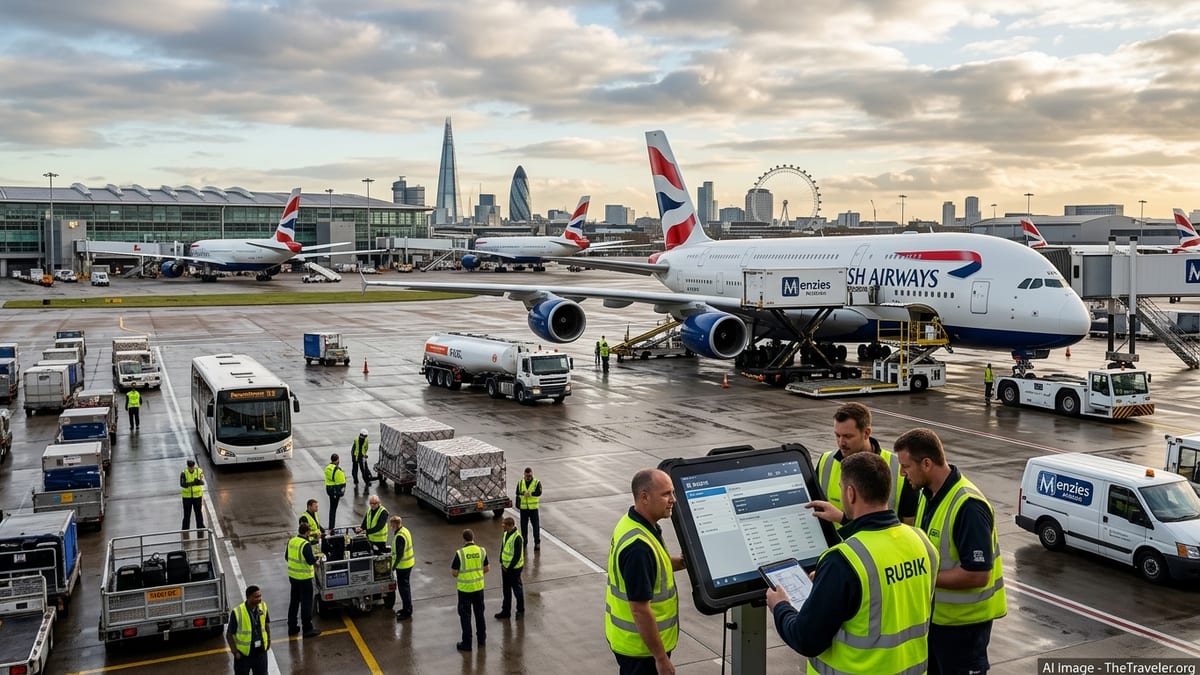
GHI London 2026 Confirms Focus on Ground Operations and Disruption
The 27th Annual GHI Conference is scheduled to take place at Olympia London from 1 to 3 December 2026, with organisers describing it as their flagship global meeting for the ground handling community. The event website lists London’s Olympia exhibition centre as the venue and confirms the three-day programme of conference sessions, exhibition stands and pre-arranged one-to-one business meetings between airlines, ground handlers, airports and technology suppliers.
According to conference information, the 2025 edition hosted around 1,100 stakeholders and more than 100 airline carriers, and the London event is again framed as a place where operational decision makers and front-line implementers will meet. Topics advertised for 2026 include digitisation of ground processes, ramp safety, workforce resilience and changing passenger expectations, providing a context in which disruption management tools and processes sit alongside broader operational concerns rather than as an isolated specialty.
GHI’s published materials emphasise the structured meeting format, with a dedicated one-to-one meetings programme intended to match airlines, handling companies and service providers. For companies involved in irregular operations management, including Value Group, this setup offers a route to discuss specific airport stations, commercial structures and technical integrations in detail rather than limiting conversations to general product overviews delivered from the exhibition floor.
Inside the “Global Oversight, Local Action” Disruption Model
Value Group describes itself in recent corporate and investor materials as a specialist in managing passengers affected by disruption events and in supporting airlines and rail operators with passenger care obligations. In a statement distributed via Business Wire on 24 November 2026 and republished by international newswires, the company set out its “Global Oversight, Local Action” framework as the basis for its participation at GHI London 2026. Under this model, central governance, data visibility and supplier management are combined with local execution by ground handlers and airport-based teams.
The company’s communications state that the model relies on three elements operating together: the RUBIK digital ecosystem, a vetted global supplier network and a 24/7 Operations Control Center. RUBIK is positioned as the core technology layer, automating tasks such as activating disruption events, grouping and assessing affected passengers, allocating hotel rooms and ground transport, coordinating with local suppliers and sending notifications or vouchers to travellers. The Operations Control Center is described as monitoring network-wide events at all hours, including weekends and overnight periods, while the supplier network covers accommodation, transport and related passenger services in multiple countries.
Value Group says that combining these layers is intended to move airlines away from a station-by-station, largely manual recovery model. Instead of each airport improvising during a weather event or technical failure, the company argues that a single disruption management framework can define policy centrally, identify capacity ahead of time and then instruct local teams on execution. In its public statements, Value Group links this approach to clearer accountability, with each step of the recovery process recorded and visible to airline operations and customer care teams, rather than scattered across emails, phone calls and separate local systems.
RUBIK Ecosystem, Supplier Network and 24/7 Operations Control Center
RUBIK, which Value Group has introduced over several years, is described in product materials and trade media as a modular ecosystem rather than a single monolithic application. Configurations such as RUBIK Enterprise and RUBIK Plug and Play are designed to connect with airline passenger service systems and flight operations tools at different levels of integration. When an airline chooses the higher-integration model, passengers affected by disruption can receive messages containing a personalised link that leads them to a dedicated portal showing rebooking, hotel and, where available, transport options selected according to the airline’s policy.
For carriers or handling partners that do not require deep system integration, Value Group promotes lighter-touch configurations intended to be deployed more quickly at a station or regional level. Across both, the emphasis in recent technical descriptions is on using a single platform to track available hotel capacity, contractual conditions, passenger eligibility rules and any constraints such as immigration requirements or local curfews. The company states that this consolidated view allows both the Operations Control Center and local teams to understand which options can be offered in real time and to avoid overcommitting limited inventory during large disruption events.
The 24/7 Operations Control Center, highlighted in Value Group’s latest press materials, is presented as both a monitoring and escalation hub. According to the company, staff at this centre track foreseeable risks such as incoming storms or large-scale air traffic control restrictions and can trigger early activation of disruption scenarios in RUBIK. They can also pre-alert hotels, coach operators and other partners where the supplier network indicates likely pressure on capacity. When an airline has limited or no own staff at a station, the centre may support contracted ground handlers by guiding them through agreed procedures, authorising exceptions where required and providing a point of contact for airline network operations and customer care teams.
Ground Handlers as Strategic Partners in IROPS
In an interview distributed by aviation trade outlet AirPro News on 24 November 2026, Value Group’s Co-CEOs underlined that ground handlers sit “where disruption becomes real,” in front of passengers at the airport. While airlines typically retain responsibility for setting compensation policies and bearing the cost of care, the executives noted that handlers are often the ones who must arrange hotels, transport and meal options at short notice, particularly at outstations where the operating carrier has no permanent staff presence.
Within the “Global Oversight, Local Action” framework, Value Group presents handlers not only as service providers but as strategic partners that can help deliver a consistent recovery model across an airline’s network. The company says that when handlers use RUBIK and associated tools, they are working within the same disruption management environment seen by the airline’s central teams. Information such as remaining hotel capacity, the status of coach bookings, voucher issuance and special-assistance flags for passengers with reduced mobility is intended to be shared across this environment rather than maintained separately in local spreadsheets or manual logs.
For ground handling companies, Value Group argues that participation in structured disruption management models could influence commercial discussions. Trade press coverage and conference materials indicate that handlers increasingly seek to differentiate themselves on service quality and the ability to reduce operational complexity for airline customers. Demonstrating reliable participation in an integrated IROPS framework may, in that context, be presented as a way to add value beyond basic check-in and boarding services. However, any such positioning depends on detailed agreements regarding responsibilities, performance indicators and how handler systems interface with platforms like RUBIK, and those specifics are expected to be a key topic in meetings at GHI London 2026.
Balancing Automation, Human Support and Passenger Experience
Across its recent statements, Value Group has stressed that its strategy is not to fully automate disruption management but to use technology to prioritise human attention where it is most needed. RUBIK supports what the company calls “digital self-handling” for passengers able to navigate their own recovery journey, such as solo travellers comfortable with online tools. These passengers may be able to accept a rebooking, select hotel options from a curated list or arrange ground transport using automated flows without queuing at a service desk.
At the same time, Value Group describes several channels for passengers who require or prefer personal assistance. Its Operations Control Center staff, ground handler agents and a service branded RUBIK GO are cited in marketing and media materials as being available to manage complex cases and vulnerable travellers, including families, elderly passengers or those with reduced mobility. Recent coverage in European business and aviation publications has noted that the company operates in-person assistance teams at certain major hubs, although the precise list of airports where such teams are permanently based is not set out in the latest global announcements.
Industry discussion around disruption management in 2024 and 2025 has increasingly framed passenger handling during irregular operations as a significant driver of satisfaction and repeat bookings, rather than solely a regulatory obligation. Value Group’s public messaging aligns with that shift, suggesting that airlines are interested not only in the direct costs of hotels and transport but also in the long-term impact of how disruption is communicated and resolved. However, concrete evidence of those impacts remains largely specific to individual carriers and markets, and Value Group’s own statements focus primarily on operational efficiency, visibility and the ability to tailor recovery options according to an airline’s existing policies.
What Airlines, Handlers and Travellers Should Watch After GHI London
As of late November 2026, Value Group has framed its appearance at GHI London 2026 as an opportunity to present its integrated IROPS model, showcase the current capabilities of RUBIK and hold meetings with existing and potential partners. Neither the company’s Business Wire release nor trade media interviews specify new product launches timed to the conference, and no major airline-specific deployment announcements linked directly to the event had been published at the time of writing. Any significant new contracts, station roll-outs or system integrations that result from discussions in London are expected to be announced separately following the conclusion of commercial negotiations.
For airline and ground handling attendees, a practical next step after the conference will be to compare Value Group’s integrated framework with their own disruption response structures. Key questions highlighted in pre-event materials include whether passenger care responsibilities are clearly defined between departments and suppliers, how much real-time visibility network operations teams have into station-level responses, and whether current IT landscapes can support the integration levels required by platforms such as RUBIK. Carriers operating complex networks with many outstations and shared handlers may need to consider pilot implementations at specific airports before deciding on any wider deployment.
Travellers are unlikely to see immediate visible changes as a direct result of GHI London 2026. Even if airlines or handlers decide at the conference to adopt or expand integrated disruption management tools, actual implementation typically requires technical integration work, staff training and updates to internal procedures. Passengers facing disruption in late 2026 and into 2027 should therefore continue to rely on their airline’s published channels for rebooking, accommodation and information, checking official communications for each journey. Over the medium term, if more carriers move toward coordinated disruption frameworks, travellers may gradually encounter more consistent communication and an increased use of digital self-service options, but the timing and extent of that shift will vary by airline, route network and local airport arrangements.