


More news on this day
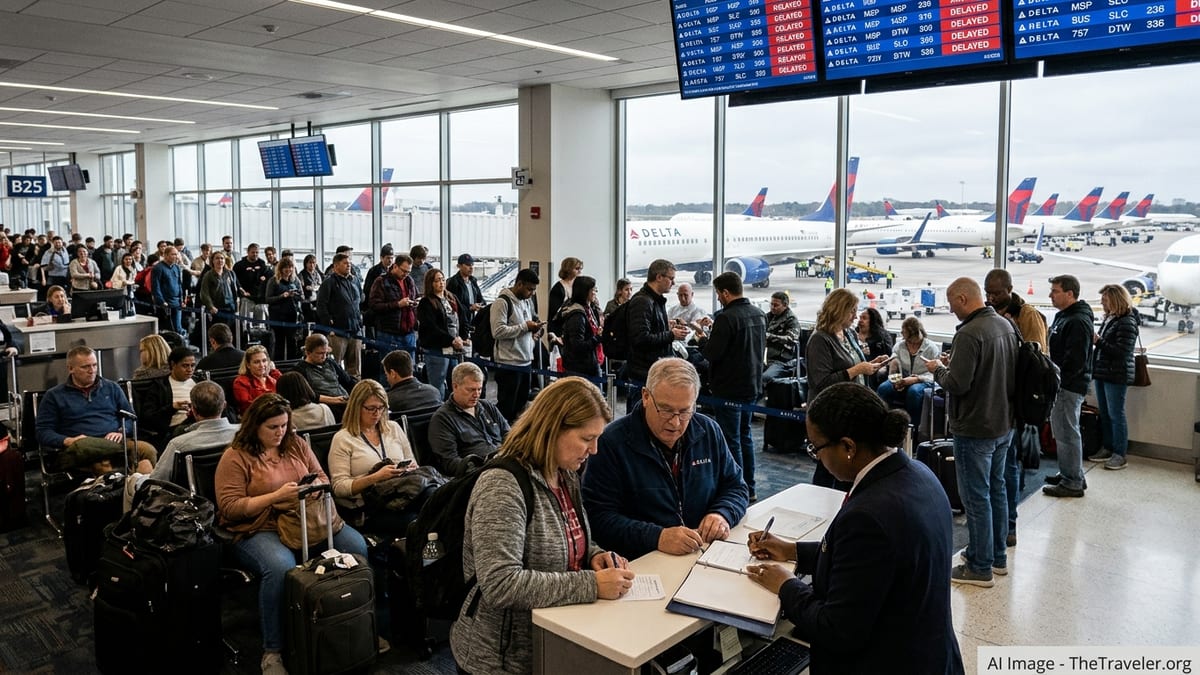
Delta Air Lines has restored its automated weight and balance system after a nationwide outage on Sunday, November 22, that triggered hundreds of delays and some cancellations across its network, heightening concerns about the fragility of U.S. air travel infrastructure just as Thanksgiving passenger volumes reach near‑record levels.
Get the latest news straight to your inbox!
What happened to Delta’s automated weight and balance system
Delta confirmed on Sunday, November 22, that its automated system for calculating aircraft weight and balance failed for several hours, affecting departures across the United States. The system, used to determine how passengers, baggage and cargo are distributed on each aircraft, feeds data to flight crews and ground teams before pushback. When it went offline, Delta said operations teams reverted to manual workarounds while engineers worked to restore automation.
According to statements from the airline and the Federal Aviation Administration, the outage was significant enough that the FAA briefly issued a ground stop for Delta flights bound for Atlanta, the carrier’s primary hub, before shifting to a ground delay program later in the morning. Flight-tracking data compiled on Sunday afternoon showed that Delta-operated flights were departing late across much of the network, not only in Atlanta but also at major domestic airports where the airline maintains a strong presence.
By Sunday evening, Delta and local media in Atlanta reported that the automated system was back online and that operations were stabilizing. The airline said approximately 70% of the delays and cancellations reported for its flights that day were directly linked to the automation issue, with the remainder attributed to adverse weather and air traffic control programs in the Northeast. Delta has not publicly detailed the root technical cause of the failure beyond describing it as a problem with its weight and balance automation.
Scale of the disruption and where it was felt
Data from monitoring site FlightAware and local airport reports indicate that Delta experienced more than 1,000 delayed flights on Sunday, November 22, including departures and arrivals. At Hartsfield–Jackson Atlanta International Airport alone, flight-tracking data showed roughly 1,250 delays affecting all carriers by early evening, with Delta representing a substantial share given its hub dominance there. Other Delta focus cities, including Detroit, Minneapolis–St. Paul and Salt Lake City, also saw elevated numbers of late departures.
Reports from Detroit, Dallas–Fort Worth and other large airports cited dozens of Delta delays and a small number of cancellations, reinforcing that the issue was network-wide rather than limited to a single station. Because the problem originated in a core automation tool, it affected a variety of aircraft types and routes, from regional connections to transcontinental services. However, the impact was uneven. Many flights still operated, some only modestly late, while others faced multi-hour setbacks as staff completed manual calculations and paperwork.
On Monday, November 23, Delta and Atlanta airport officials said operations had largely normalized, although some travelers continued to experience residual knock-on delays. Posts from passengers and crew suggested that in a few cases dispatchers were still clearing aircraft using manual processes while systems were monitored, leading to longer-than-usual turnaround times at certain gates. There is currently no indication from airline or regulatory sources that the outage continued as a full-scale network disruption beyond Monday.
Why a weight and balance failure is so disruptive
Airlines treat weight and balance calculations as a critical safety function. Every departure requires a precise assessment of the aircraft’s total weight and how that weight is distributed relative to the center of gravity. These figures determine performance data such as takeoff speeds and required runway length. In normal circumstances, carriers use automated systems that ingest passenger counts, baggage loads, cargo and fuel data to produce standardized load sheets for each flight.
When that automation fails, dispatchers and station staff must shift to manual procedures that are slower and more labor-intensive. For a large network airline such as Delta, which can operate more than 4,000 flights per day at peak periods, relying on manual workarounds can quickly create bottlenecks even if each individual calculation only takes a few extra minutes. The challenges are amplified at hubs like Atlanta, where tightly timed arrival and departure banks are built around connecting traffic. Delays to early bank flights can ripple throughout the day, affecting aircraft and crews scheduled to operate later services.
The recent Delta incident followed other technology-related air travel disruptions this month, including an FAA ground stop earlier in November and a separate system outage at United Airlines tied to its own weight and balance tools. Regulators and industry analysts have pointed out that while such failures remain relatively rare compared with the total number of flights, they highlight the dependence of modern airline operations on complex, centralized software. For travelers, that dependence can translate into sudden, widespread disruption when a single component fails, even without severe weather.
Thanksgiving 2026 travel volumes and what this means for passengers
The automation outage hit just as U.S. Thanksgiving travel was ramping up. Forecasts from AAA indicate that about 81.5 million people are expected to travel at least 50 miles from home between Tuesday, November 24, and Monday, November 30, 2026. Nearly 6 million of those travelers are projected to fly, representing a little over 7% of the total holiday travel volume and keeping air demand close to last year’s near-record levels.
Separate figures based on Federal Aviation Administration schedules suggest that airlines are planning roughly 417,000 flights across the nine-day holiday window from November 23 through December 1. That would make this one of the busiest Thanksgiving periods for air traffic in more than a decade. At the same time, travel booking services report that average domestic roundtrip fares for Thanksgiving are significantly higher than in 2025, reflecting both strong demand and increased operating costs for airlines.
In that context, the Delta glitch has raised passenger concerns about whether the system can handle both heavy traffic and the possibility of further technology problems. For now, there is no indication from federal authorities of any structural constraint on holiday operations beyond the usual weather and congestion challenges. The FAA has reiterated that the Delta disruption was confined to the airline’s own systems and that its nationwide traffic management infrastructure remains fully functional. Nonetheless, the proximity of the incident to the peak travel window has led many passengers to pad connection times or shift flights to less busy days where possible.
How Delta and other stakeholders are responding
Delta has issued public apologies to affected customers and emphasized that safety was never compromised during the outage. The carrier said its teams train regularly to perform manual weight and balance procedures, which are a standard fallback across the industry when automation is unavailable. The airline has not announced any structural schedule reductions in response to the event, and current booking systems show its Thanksgiving-period timetable operating broadly as planned.
Passengers whose flights were significantly delayed or canceled as a result of the automation failure are being rebooked subject to seat availability, consistent with normal irregular operations policies. U.S. Department of Transportation rules do not require airlines to provide compensation for most delays that stem from internal technical issues, but carriers typically offer refunds to customers who choose not to travel when their flight is canceled. Travelers affected on Sunday and Monday are being advised to check their ticket conditions and Delta’s customer service commitments for options that may include refunds, meal vouchers at the airline’s discretion or hotel accommodation when overnight stays are required.
At the system level, Delta has indicated that it is reviewing the incident in coordination with its technology providers, although it has not publicly committed to any specific infrastructure changes. Recent federal air travel consumer reports show that major U.S. airlines, including Delta, have overall on-time performance above 80% in typical months, but they also document how irregular operations can spike during severe weather and system outages. Regulators use those data to monitor patterns and to inform any future policy discussions on airline accountability for technology failures.
Practical advice for travelers heading into the holiday rush
With the weight and balance system now restored but Thanksgiving traffic building, travelers are being urged to plan for crowded airports and the possibility of residual disruptions, whether from weather or localized technical issues. Transportation authorities recommend that passengers check their flight status frequently on the airline’s app or website on the day of travel, rather than relying solely on information from third-party booking platforms. Same-day schedule changes can still occur, particularly around hub airports managing tight connections and heavy inbound traffic.
Industry and airport guidance also points to a few practical steps that can reduce the impact of unexpected delays. Flying earlier in the day can provide more rebooking options if something goes wrong, as can allowing extra time between connections rather than scheduling the shortest possible layover. Packing essential medications, chargers and a change of clothes in carry-on bags rather than checked luggage can make extended waits in terminals or overnight misconnects more manageable if they occur.
For the coming days, travelers booked on Delta do not currently face any special restrictions or waivers related to the automation outage, beyond the airline’s standard irregular operations policies. However, given the tight conditions in the U.S. air travel system at holiday peaks, passengers on all carriers are advised to monitor weather forecasts along their route, verify gate and departure time information close to real time, and build extra margin into their plans if making important family, event or cruise connections after arrival.