


Few places in Oslo divide opinion quite like Vigeland Sculpture Park, the open-air gallery of more than 200 human figures that spills across the lawns of Frogner Park. For some visitors, it becomes the defining memory of their time in Norway’s capital. For others, it is an odd hour-long detour they would not rush back to. If you are weighing up whether this free attraction deserves a place on your itinerary, it helps to know what travelers actually encounter among the granite plinths and manicured lawns.
Get the latest updates straight to your inbox!
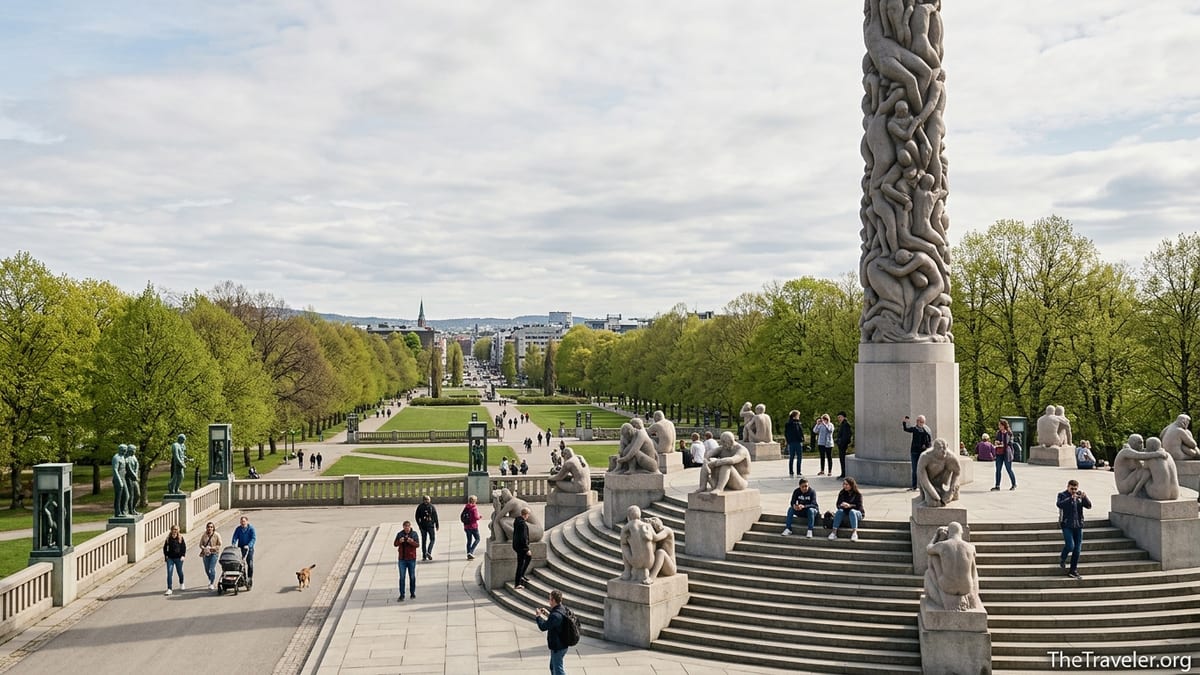
What Vigeland Sculpture Park Actually Is
Despite what guidebooks often call it, “Vigeland Sculpture Park” is not a separate, fenced-off attraction, but the central sculpture installation inside Frogner Park, Oslo’s largest urban green space. Local authorities describe Frognerparken as a popular everyday park for residents, with the Vigeland installation at its heart. The statues and monumental structures you see in most photos are grouped along a central axis of bridges, terraces and lawns that cut through this larger public park.
The works are all by one artist, Gustav Vigeland, created mainly in the first half of the 20th century. Travel and city guides commonly highlight that more than 200 sculptures in bronze, granite and wrought iron depict the “circle of life,” from infancy to old age, in a highly physical, sometimes unsettling way. Many visitors are surprised by how concentrated the art feels. Within a relatively compact area, you move from a bridge lined with bronze figures to a vast fountain and then to the famous Monolith, a single column carved with 121 intertwined human bodies rising above a stepped platform.
Because the park is integrated into the city rather than set on a remote site, it does not feel like entering a formal museum. There are no turnstiles, and there is no admission fee. On a summer afternoon, you are just as likely to see local residents walking dogs, children on scooters and groups picnicking on the grass as you are to see tour groups clustering around the Angry Boy statue for photos. That mix of everyday life and grand art is a big part of the experience for many travelers.
For practical orientation, most visitors arrive via tram or bus to stops near the main gate on Kirkeveien or by walking from nearby neighborhoods. From the central gate, you follow a straight promenade across the bridge and up a gentle rise to the Monolith terrace. Even if you only have an hour, you can comfortably see the main sculptures without rushing, which is one reason cruise passengers and day-trippers often add it to a tight Oslo schedule.
Why Many Travelers Say It Is Absolutely Worth It
When you read recent trip reports and reviews, a clear pattern emerges: many travelers consider Vigeland the highlight of their stay in Oslo. One American visitor, writing decades after his first trip, still remembered the park as the single most memorable place he saw in Norway. On travel forums today, locals replying to “what should I see with one day in Oslo” threads routinely put Frogner Park and the Vigeland sculptures at the very top of their lists, sometimes above the opera house or newer waterfront museums.
Several factors drive that enthusiasm. First, the park is free and open at all hours, which matters in a city where admission to major museums and attractions can easily run the equivalent of 15 to 25 US dollars per person. For budget-conscious travelers or families, being able to spend a couple of rich, absorbing hours without paying entry is a major plus. Combined with Oslo’s efficient public transport, it becomes a very low-friction outing: a 15-minute tram ride from the center, a slow wander among the sculptures, then back into town for dinner.
Second, for visitors who enjoy art and photography, the park is unusually rewarding. The figures are full of movement and emotion, and the open-air setting means varying natural light across the seasons. Travel bloggers and local guides often mention that the park looks different in snow, low winter sun, spring blossom or the long evening light of July. Photographers appreciate the chance to capture silhouettes of the Monolith against the sky, close-ups of weathered bronze skin on the bridge figures, or candid scenes of locals and tourists interacting with the works.
Third, many people value the window the park opens onto Norwegian life. Because Frogner Park is a local green space as much as a tourist draw, you see everyday Oslo rhythms: office workers jogging after work, families grilling on summer evenings, teens sunbathing on the lawns. For travelers who want to move beyond the harborfront and museums, that slice of ordinary city life, framed by a major cultural landmark, can be more memorable than another indoor gallery.
The Parts Visitors Talk About Most
Among the entire installation, a few elements consistently show up in traveler comments and social media posts. The first is the bridge lined with bronze figures. As you cross, sculptures on either side depict people in dynamic poses: a man juggling children, couples embracing, a figure hurling a child outward. They are easy to walk around and photograph from different angles, and you can get close enough to see details like the patina patterns on the bronze.
The second, and most iconic, is the Monolith. Set atop a stepped stone terrace, this towering column of carved human bodies is visible from much of the park. Visitors often describe mixed reactions on arrival: some find it awe-inspiring, others slightly disturbing. In practice, it becomes a natural gathering point. Many travelers sit on the steps, rest with a coffee picked up from a kiosk near the entrance, or simply watch the ebb and flow of tour groups and locals moving past.
The third is the Angry Boy (Sinnataggen), a small bronze sculpture of a toddler mid-tantrum on the bridge. Despite its modest size, it has become a minor celebrity. Travelers routinely hunt it down for photos, and some notice the shiny patches where people have touched the figure’s hand or foot for luck. For families traveling with young children, the sculpture’s exaggerated frustration often becomes an in-joke and a favorite snapshot from the day.
Aside from these, the fountain area is another focal point. The central bowl supported by muscular figures is surrounded by bronze trees whose branches conceal small human forms. Visitors often walk around it several times, noticing new details as water, light and shadow shift. In summer, children sometimes play near the spray, and the sound of the water softens traffic noise from nearby streets, which contributes to the feeling of being in a green oasis despite the central location.
Common Criticisms and Mixed Reactions
Not everyone comes away convinced that Vigeland Sculpture Park lives up to its reputation. Some travelers, especially those who are less interested in sculpture or public art, report that the visit felt underwhelming after glossy photos and superlative-laden descriptions in brochures. A typical reaction might be seeing the Monolith, walking the length of the bridge and then feeling there was not much else to do unless you wanted a picnic or a long stroll.
Others take issue with the sculptures themselves. A widely circulated opinion piece in an international newspaper described the park as unsettling rather than playful, faulting the figures for what the writer saw as a stiff, almost propagandistic view of the human body. Similar comments appear occasionally in traveler reviews, where people say they found some of the depictions of children or family dynamics odd or uncomfortable. The very intensity that some visitors love is off-putting for those who prefer lighter or more impressionistic art.
A different set of criticisms focus on time and logistics. For cruise passengers who only have a few hours in Oslo, getting to Frogner can feel like a detour from the waterfront cluster of attractions. Even though public transport is efficient, you still need to budget at least an hour and a half to travel there, walk through the main axis and return. Travelers squeezing the city into a single day sometimes say they wish they had spent that time along the harbor, at the Viking Ship Museum’s successors, or exploring neighborhoods like Grünerløkka instead.
Finally, while the park is free, some visitors arrive expecting a more curated museum experience, with extensive signage or guides embedded throughout the grounds. Apart from a few information boards and occasional guided walks organized by local institutions, interpretation is relatively minimal on site. If you prefer stories and context with your art, you may want to read up beforehand or consider combining the park with the nearby Vigeland Museum, which provides more background on the artist’s life and process.
Practical Experience: Crowds, Seasons and Safety
One of the biggest advantages of Vigeland Sculpture Park is that it can absorb crowds without feeling overwhelmed. City and tourism sources estimate that Frogner Park sees between one and two million visitors annually, making it one of Norway’s most visited attractions, yet its scale, with long lawns and wide paths, means you can usually find breathing room even on busy summer days. You may have to wait a minute for a clear shot of the Angry Boy, but you can easily step a few meters away and find a quiet bench under the trees.
Season and time of day change the mood dramatically. In June and July, long daylight hours keep the park accessible well into the evening, and locals often treat it as an extended living room: barbecues, frisbee games and groups sitting on blankets late into the night. In shoulder seasons like April or September, you are more likely to share the space with joggers, dog walkers and a thinner spread of tourists, which can make the sculptures feel more contemplative. In winter, snow can pile on pedestals and steps, turning the figures into stark silhouettes. Several travelers report that a quick tram ride to the park on a clear winter afternoon gave them some of their best photos of Oslo, even if they only stayed 45 minutes because of the cold.
From a safety perspective, most visitors describe the park as feeling very safe during daylight and early evening hours. Families with children use the playgrounds in the wider Frogner area, and local runners and dog walkers keep steady foot traffic through the main paths. Standard city awareness is still sensible, of course, especially after dark, but there is no particular reputation for petty crime that would set the park apart from other central Oslo green spaces.
Weather is the main practical challenge. Oslo’s climate can be unpredictable, and much of the park experience involves being outdoors for at least an hour. Travelers who arrive without appropriate clothing sometimes cut their visit short. Light rain is common even in summer, so packing a waterproof jacket and comfortable shoes can make the difference between rushing quickly past the sculptures and enjoying a leisurely circuit with time to stop and reflect.
How to Fit the Park into a Real Itinerary
For many travelers, the decision about whether Vigeland Sculpture Park is “worth it” is really a question of how it fits with everything else you want to do in Oslo. Because the park is free and open around the clock, it is flexible: you can visit first thing in the morning before museums open, stop by in the late afternoon after a day indoors, or even detour there on your way between neighborhoods if you like walking.
One practical example: a short-stay visitor arriving on an overnight ferry or cruise ship with a day in port might start at the waterfront, exploring the opera house and new Munch museum, then take a tram from the center to Frogner in the mid-afternoon. After an hour or two among the sculptures, they could stroll through the surrounding residential streets and catch another tram back into town for dinner at a food hall or along Aker Brygge. In that scenario, the park becomes an airy, low-cost break between more structured, ticketed experiences.
Longer-stay travelers often weave the park into a slower day of neighborhood exploration. You might pair a morning coffee and pastry at a local bakery near Majorstuen with a walk through Frogner Park, then cross town to the Bygdøy peninsula for maritime and folk museums. Families might combine a play session at Frogner’s playgrounds and swimming facilities with a picnic near the sculptures, giving children room to run between art stops rather than expecting them to behave in hushed galleries all day.
Guided tours are another option some visitors use to get more out of the park. Oslo-based bike tour companies, for example, include Vigeland as a stop on city loops, allowing you to reach the park via quiet streets and paths you might not find on your own. Small-group walking tours sometimes focus specifically on the sculptures, delving into themes and symbolism in more depth than most individuals would uncover unaided. For travelers who are unsure they would “get it” on their own, joining such a tour for a couple of hours can tilt the experience decisively into the “worth it” column.
Who Will Appreciate It Most (and Who Might Skip)
Travelers who respond most strongly to Vigeland Sculpture Park tend to share a few traits. They have at least a passing interest in art or design, enjoy walking outdoors, and appreciate people-watching as much as formal sightseeing. If you like places where you can wander without a fixed route, pause on a bench to take in a scene, and read as much or as little context as you like, the park is probably a good match for you.
It is also a strong choice if you are balancing a higher-cost Oslo trip with some free experiences. After paying for museum tickets, meals and possibly a fjord cruise, spending a few unhurried hours in a scenic, sculpture-filled park can feel like a welcome relief to the budget. Solo travelers, in particular, often note that wandering Vigeland on their own, with time to think and photograph, was more satisfying than some of the more heavily programmed activities in the city.
On the other hand, if you know that sculpture leaves you cold, or if you are squeezing Oslo into a tight half-day, the park might fall into the “nice if you have time” category rather than being essential. Visitors focused on very young children sometimes report that, beyond the chance to run on the grass, the art does not hold their kids’ attention for long, especially in colder or wet weather. In heavy rain or mid-winter darkness, an hour at an indoor museum or a cozy café might well feel like a better use of limited time.
The park may also be a lower priority for travelers on very short winter visits where daylight is scarce, and every hour outdoors in the cold needs to feel special. In that context, choosing a single panoramic viewpoint, a guided city tour that passes major sights in one sweep, or an indoor cultural experience could deliver more concentrated value than a standalone tram ride to Frogner solely for the sculptures.
The Takeaway
So is Vigeland Sculpture Park worth visiting? For many travelers, the answer is a clear yes. The combination of monumental, emotionally charged sculpture, a spacious city park setting and the absence of an entry fee makes it one of Oslo’s most distinctive experiences. When you factor in how easy it is to reach by public transport and how flexibly it can be slotted into a day of sightseeing, it is understandable that locals and visitors alike so often recommend it.
At the same time, the park is not a universal must-see. If you have only a few hours in the city, are indifferent to sculpture, or dislike being outdoors in cooler or unpredictable weather, your limited time might be better spent elsewhere. The emotional tone of the art, which some find profound and others unsettling, also means it pays to look at a few images beforehand and reflect on whether it appeals to you.
Ultimately, Vigeland Sculpture Park is best viewed not as a box to tick, but as an opportunity: a rare chance to wander among a vast body of work by a single artist in a living urban park that locals use every day. If that blend of culture and daily life appeals, then setting aside an hour or two to walk the bridge, climb the Monolith terrace and watch Oslo unfold around you will almost certainly feel worthwhile.
FAQ
Q1. Is there an entrance fee for Vigeland Sculpture Park?
The sculpture installation within Frogner Park is free to enter, and the surrounding park is a public space open to everyone at no cost.
Q2. How much time do I need to visit the park?
Most travelers spend between one and two hours walking the main axis, taking photos and pausing at the Monolith terrace, though you can stay longer if you plan a picnic or extended stroll.
Q3. What is the best time of day to visit?
Mornings and late afternoons tend to be quieter, with softer light that many photographers prefer. Midday in summer is busier but lively, with more locals using the lawns.
Q4. How do I get there from central Oslo?
Trams and buses from the city center stop near the main gates of Frogner Park, and the ride typically takes around 15 minutes, followed by a short walk into the sculpture area.
Q5. Is the park suitable for children?
Yes, many families visit with children who enjoy the open lawns and playgrounds in Frogner Park, though interest in the sculptures themselves can vary depending on age and attention span.
Q6. Can I visit the park in winter?
Yes, the park is open year-round. In winter you should dress warmly and be prepared for snow or ice, but the sculptures and views can be especially striking in clear, cold light.
Q7. Are there guided tours available?
Several local companies and guides offer walking or bike tours that include Vigeland, and some focus specifically on the sculptures to provide more artistic and historical context.
Q8. Is the park accessible for visitors with limited mobility?
The main paths are broad and relatively level, and many areas can be reached with wheelchairs or strollers, though some parts of the Monolith terrace involve steps.
Q9. Are there facilities like toilets and cafés nearby?
Within and around Frogner Park you will find seasonal kiosks, nearby cafés and public toilets, though their opening hours can vary by season and time of day.
Q10. Is Vigeland Sculpture Park safe to visit alone?
Most visitors describe the park as feeling safe during daylight and early evening, with regular foot traffic from both tourists and locals, though normal city awareness is always advisable.