


More news on this day
Virgin Australia passengers flying through Adelaide, Brisbane, Melbourne and Sydney are facing rolling disruption as Australian Services Union members escalate protected industrial action in a pay and conditions dispute that has already triggered walkouts and is set to continue into the peak holiday period.
Get the latest news straight to your inbox!
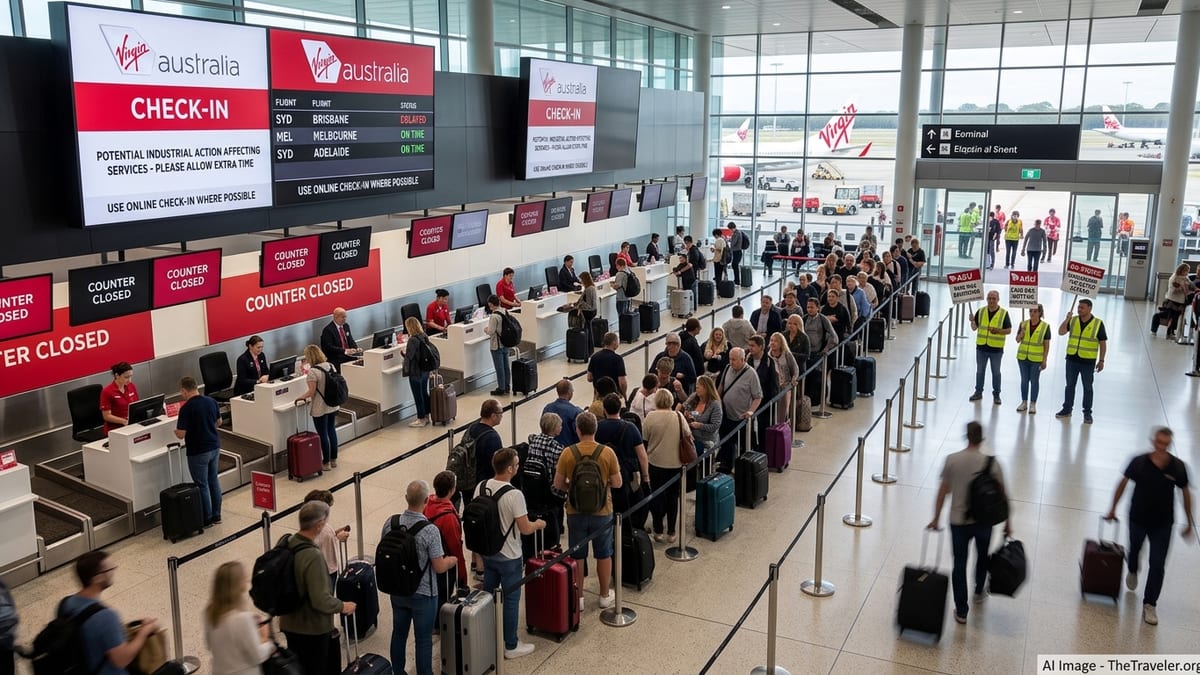
What has happened so far at Virgin Australia’s major airports
Protected industrial action by Virgin Australia airport workers represented by the Australian Services Union has moved from limited work bans to short, sharp walkouts at key hubs. After an initial phase this month in which staff withdrew premium services such as priority boarding and some ancillary fees, ASU members have now staged coordinated one-hour stoppages at Adelaide, Brisbane, Melbourne and Sydney airports, timed to coincide with busy morning and evening peaks on selected days in November 2026.
The Fair Work Commission authorised a protected action ballot for ASU-represented Virgin Australia guest services and airport workers in October. Following a strong vote in favour, the union notified the airline and regulators of its plan to conduct legally protected stoppages and targeted service bans while bargaining for a new enterprise agreement. The latest walkouts have seen check-in and gate staff leave their posts and gather outside terminal buildings, while Virgin Australia managers and non-union personnel have been brought in to keep flights operating where possible.
According to union statements and local media reports, the number of workers involved in each stoppage has been modest, but the impact has been magnified by the strategic timing and concentration at choke points in the check-in and boarding process. At times, passengers have encountered long queues at check-in and bag drop, slower boarding and, in some cases, minor delays to departures when staffing at gates and baggage belts was reduced.
The core of the dispute: pay rises, conditions and cost of living
The ASU says the dispute centres on the value of Virgin Australia’s current pay offer, the structure of rosters and protections for existing conditions for some of the airline’s lowest paid employees. Public material from the union indicates that Virgin has proposed wage increases over three years that, depending on classification, would equate to total rises in the high-teens to high-twenties in percentage terms. The ASU argues that, even at the upper end, the offer does not keep pace with cumulative cost-of-living pressures and is tied to trade-offs in conditions that workers are unwilling to accept.
Union officials have highlighted that many airport guest services workers experienced wage freezes or below-inflation increases in the years following Virgin Australia’s administration and restructuring during the pandemic. They say members are now struggling to meet basic costs such as rent and transport in Australia’s major cities and want an agreement that not only lifts base pay but also limits excessive use of part-time and casual rosters, guarantees minimum hours and protects penalty rates and other entitlements.
Virgin Australia has not publicly detailed its full offer line by line but has said it is bargaining in good faith and wants to deliver sustainable increases that reflect the company’s financial position and the need to remain competitive in a market where airfares are already under scrutiny. The airline maintains that it has contingency plans in place to minimise disruption to customers during industrial action, including reassigning managers and rescheduling some duties, while continuing to encourage the ASU to return to the Fair Work Commission for conciliation if talks stall further.
Parallel cabin crew dispute adds pressure to Virgin operations
The airport workers’ stoppages are unfolding alongside a separate but related dispute involving Virgin Australia cabin crew, represented by the Transport Workers Union. Cabin crew have voted in favour of their own protected industrial action over rosters, rest breaks, duty limits and pay. While their dispute is covered by a different enterprise agreement to that of ground and customer service staff, any escalation by cabin crew, combined with the existing airport stoppages, would add to the operational complexity facing the airline during a period of high demand.
Crew representatives say they are seeking tighter safeguards against long duty days, better recovery time between shifts and a pay structure that reflects increased workloads on fuller flights and ongoing pressure to perform non-flying tasks, such as cleaning cabins between sectors. Earlier this year, Virgin Australia trimmed parts of its schedule in response to staffing constraints, acknowledging challenges in recruiting and retaining cabin crew in a tight labour market. Union materials argue that without improvements to pay and conditions, the airline will struggle to build a stable workforce and maintain reliable on-time performance.
So far, cabin crew action has largely remained at the stage of preparing ballots, issuing notices and applying tactical work bans rather than long-duration strikes. However, the existence of two active bargaining disputes at the same airline, involving frontline staff in the cabin and on the ground, underscores the wider tension between airlines’ post-pandemic cost control and workers’ expectations as travel demand and company revenues recover.
Impact on passengers and Virgin Australia’s response
For travellers, the most immediate effect of the ASU-led strikes has been uncertainty around queuing times and the risk of short delays on days when walkouts are scheduled. To mitigate this, Virgin Australia has issued commercial policies for travel on strike-affected dates, allowing eligible customers to change flights without standard change fees, subject to availability, if they are booked to fly to or from Adelaide, Brisbane, Melbourne or Sydney during notified stoppage windows. These waivers have been communicated through the airline’s agent information channels and customer alerts.
Virgin has advised guests to arrive at the airport earlier than usual on days with planned action, particularly during morning and late afternoon peaks, and to monitor flight status via the airline’s website or app. While most flights have continued to operate, some services have experienced knock-on delays where check-in and boarding took longer or where aircraft could not be turned around as quickly as planned. At times, the airline has redeployed back-office staff and managers with appropriate accreditation to cover essential ground roles, including assisting at bag drop, boarding gates and customer service desks.
Consumer advice from advocacy groups and travel agents has focused on practical steps rather than alarm. Passengers are being encouraged to use online and mobile check-in wherever possible, travel with carry-on baggage only when feasible, and keep contact details up to date in their bookings so any schedule changes or gate moves are communicated promptly. Travellers with tight connections, special assistance needs or group bookings are being told to build in extra buffer time on strike days and to consider proactive rebooking if their itineraries are flexible.
What happens next and what travellers should watch for
The ASU has signalled that it intends to continue and potentially escalate protected industrial action if no agreement is reached, making clear that short, targeted stoppages and service bans are likely to remain its primary tactics in the near term. Union representatives say they will provide advance notice of each new phase of action, as required under Australian workplace law, giving Virgin Australia and passengers time to plan. At the same time, the union has repeatedly stated that it is prepared to suspend industrial action if the airline returns to the bargaining table with what it considers a materially improved offer.
For its part, Virgin Australia will be weighing the operational and reputational costs of ongoing disruption against the longer-term financial implications of a larger wage settlement. The airline has indicated that it will keep publishing strike-related travel policies when needed, outlining options for fee-free changes or rebooking windows tied to specific dates and airports. These policies are typically updated shortly after new notifications of industrial action are received, so passengers booked several weeks ahead should check closer to departure whether their travel falls within any revised arrangements.
Travellers planning to fly with Virgin Australia through late November and into the southern summer holidays should pay particular attention to pre-flight communications. It is advisable to re-check flight status on the day of departure, arrive at the airport earlier than usual if industrial action is scheduled at the origin or destination, and review the latest guidance on change and refund flexibility. While there is no confirmed end date for the dispute, both the ASU and Virgin Australia remain engaged in the enterprise bargaining framework overseen by the Fair Work Commission, meaning a negotiated settlement or commission-assisted resolution remains the most likely pathway to restoring routine operations.