


More news on this day
Delta Air Lines suffered a major technology outage on Sunday 22 November 2026 when its automated weight and balance system malfunctioned, triggering hours of delays at its Atlanta hub and across the United States at the start of the busy Thanksgiving travel period.
Get the latest news straight to your inbox!
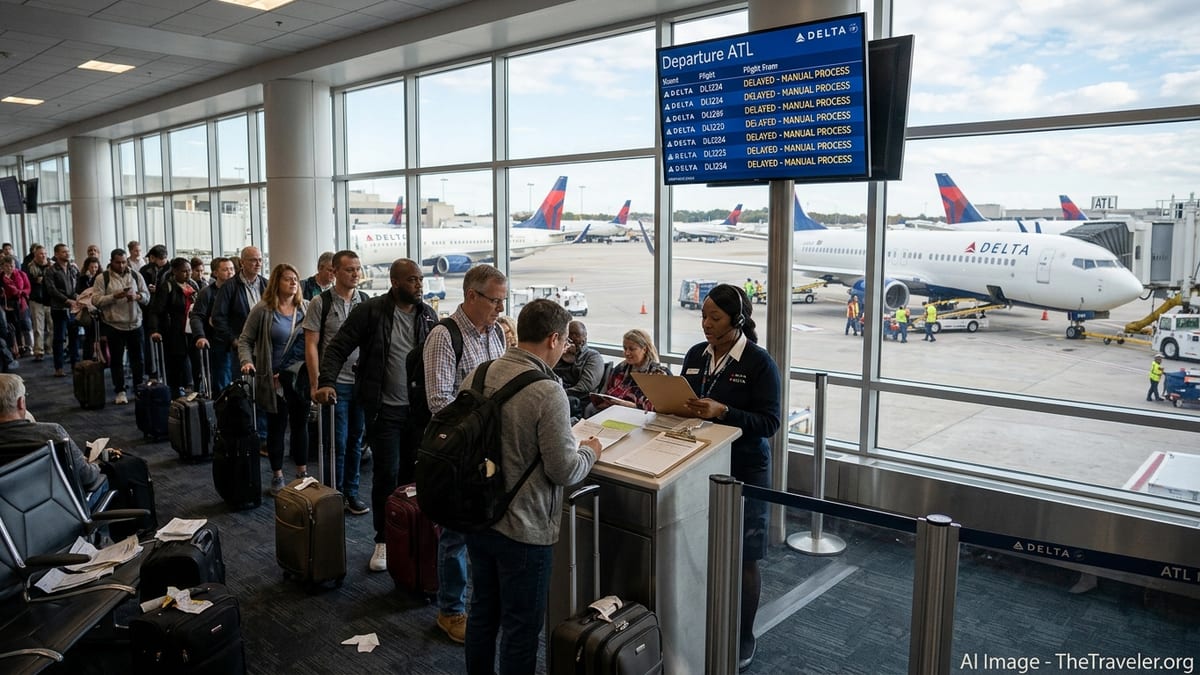
What happened to Delta’s weight and balance automation
According to statements from Delta and the Federal Aviation Administration (FAA), the airline’s automation for calculating departing aircraft weight and balance failed on the morning of Sunday 22 November. The problem affected flights into and out of Hartsfield–Jackson Atlanta International Airport and quickly spread across Delta’s network as departures were held while staff reverted to manual procedures.
Weight and balance calculations determine how passengers, baggage, cargo and fuel are distributed on each aircraft and are a core safety requirement for every commercial flight. When the system outage occurred, Delta instructed its operations teams and dispatchers to complete these calculations by hand, a process they are trained to perform but which takes considerably longer than the automated workflow used in normal operations.
The FAA confirmed publicly that Delta was working to resolve an issue with its own automation and that the problem was not related to any FAA air traffic control systems. Earlier in November, a separate fault in the FAA’s network resulted in the longest nationwide ground stop for U.S. airspace in 25 years, but officials stressed that Sunday’s disruption was confined to Delta’s systems.
Scale of the disruption at Atlanta and across the network
As the outage unfolded, Atlanta, Delta’s largest hub and the world’s busiest passenger airport, became the focal point of the delays. Flight-tracking data from FlightAware showed that by Sunday afternoon around half of all Delta-operated flights were arriving or departing late. By Sunday evening, some tallies put the proportion of delayed Delta flights closer to three-fifths of the daily schedule, or roughly 2,000 flights, including services that did not touch Atlanta but were operated by aircraft and crews originally routed through the hub.
Separate estimates and carrier figures vary slightly, but they all point to more than 1,600 to just over 2,000 Delta flights delayed on 22 November. Delta later said that around 70 percent of its delays and cancellations that day were directly tied to the automation issue, with the remainder caused by weather and routine operational factors. The concentration of late operations at Atlanta also affected other airlines using the airport, as gate availability, ramp congestion and airfield throughput were constrained during peak periods.
For several hours on Sunday morning, departures to Atlanta were restricted under a formal ground delay program. That traffic management step, implemented in coordination with the FAA, limited the rate at which flights bound for Atlanta could take off from other airports in order to prevent gridlock on the ground once they arrived. Passengers already on board aircraft reported extended waits at gates and on taxiways while flight crews waited for manually prepared weight and balance paperwork before receiving clearance to depart.
How long the outage lasted and when systems were restored
Delta has not publicly detailed the precise technical cause of the failure, but the airline said on Sunday evening that the automation for departing flight weight and balance calculations had been restored. Local television reports from Atlanta cited Delta representatives on 22 November confirming that the system was again functioning, with the carrier shifting its focus to resolving the backlog of delayed flights and repositioning aircraft and crews.
Operational data and traveler reports suggest that while the core technology issue was resolved by late Sunday, its effects continued into Monday 23 November. Some passengers reported residual delays while aircraft and crews were realigned and while some flights still waited on manual weight and balance clearances. Airport officials and Delta executives described Monday’s operation as stabilizing, with performance at Atlanta steadily improving as the day progressed.
By Tuesday 24 November, most sources indicated that Delta’s flight schedule was largely back to normal, although individual travelers could still encounter localized knock-on delays typical after a major disruption. The airline has not reported any continuing problems with the weight and balance system since then, and there have been no related safety incidents linked to the outage.
Context: recent technology failures before Thanksgiving
The Delta outage arrived at a particularly sensitive moment for U.S. aviation. Thanksgiving week in 2026 is forecast to be one of the busiest holiday travel periods in more than a decade, with federal figures showing hundreds of thousands of commercial flights scheduled nationwide between 23 November and 1 December. Airlines have been operating near full capacity on many routes, leaving limited slack to absorb large-scale disruptions.
Sunday’s events also followed two other high-profile technology problems affecting U.S. air travel within the same month. Earlier in November, an FAA network malfunction triggered the most extensive nationwide ground stop in roughly 25 years, halting departures around the country for more than four hours before controllers gradually resumed traffic. Days later, United Airlines experienced its own system outage involving technology used for flight dispatch, delaying large numbers of departures while the carrier worked to restore normal operations.
Those earlier incidents and the Delta outage are different in their technical details and in which systems were affected, but together they have highlighted the aviation industry’s dependence on complex, interlocking IT infrastructure for everything from flight planning and crew scheduling to passenger check-in. For travelers, they underscore how faults in a single critical application can quickly cascade across an entire route network, particularly when they occur at a megahub such as Atlanta or during peak travel seasons.
What travelers experienced and what to do if you were affected
For passengers flying with Delta on 22 November, the most immediate impact was time. Many travelers reported gate holds stretching to an hour or more as crews waited for manually prepared weight and balance calculations, followed by additional time in departure queues once aircraft pushed back. Some early-morning flights sat on the ground for several hours before either taking off or, in a limited number of cases, being cancelled when they would have exceeded crew duty limits or missed available arrival slots at connecting hubs.
Because the weight and balance system outage primarily affected departures, many inbound flights to Atlanta and other Delta hubs continued to arrive, which put added pressure on gate space and baggage handling. Some connecting passengers missed onward flights that did manage to depart, while others found that their checked luggage did not travel on the same aircraft once operations restarted. Travelers reported long lines at customer service desks as they sought rebooking options and advice on compensation or goodwill gestures.
Delta has not issued a broad, public compensation policy specific to this outage, but its standard customer commitments apply. In practice, affected travelers are being rebooked on the next available flights and, where required by local regulations or company policy, may be offered meal vouchers or hotel accommodation when delays extend overnight. Passengers whose plans were significantly disrupted are generally advised to retain documentation of delays, cancellations and any out-of-pocket expenses and to contact Delta directly through its website, mobile app or reservations centers to discuss refunds or credits, especially if their flights were cancelled or delayed by several hours.
What this means for upcoming travel and how to prepare
With the immediate technical issue resolved and Delta’s operations at Atlanta described as stable in the days since, the airline is running its published schedule heading into the core Thanksgiving travel dates. However, major disruptions of this kind often have lingering effects in the form of displaced aircraft and uneven crew availability, particularly at smaller spoke airports that depend on a limited number of daily departures.
Travelers booked on Delta in the coming days are unlikely to see direct delays from the weight and balance system failure itself, but they should continue to monitor flight status closely. Checking departure and arrival times in the airline’s app or on airport information screens before leaving for the airport remains important, especially when making tight connections. For those who were traveling on 22 or 23 November, it may also be worth confirming baggage delivery and any changes to seat assignments or itineraries that customer service agents made while operations were disrupted.
More broadly, the series of recent technology issues affecting the FAA, United Airlines and Delta has prompted renewed discussion among regulators, airlines and airport operators about system redundancy, testing and contingency planning. For now, though, the key practical takeaway for travelers is to build extra margin into their journeys during peak periods, to keep contact details updated with airlines so that disruption alerts are received quickly, and to have a backup plan in mind if a critical system outage unexpectedly slows air traffic again.