


I thought I knew what to expect from an underground cemetery. I pictured damp stone, a quick look at a few skulls and a shiver of morbid curiosity before heading back into the Neapolitan sun. Walking through the Catacombs of San Gennaro and San Gaudioso in Naples turned out to be something entirely different: a layered journey through faith, art and the living neighborhood of Rione Sanità that stayed with me long after I surfaced.
Get the latest updates straight to your inbox!
First Descent: Stepping Into the Hill of San Gennaro
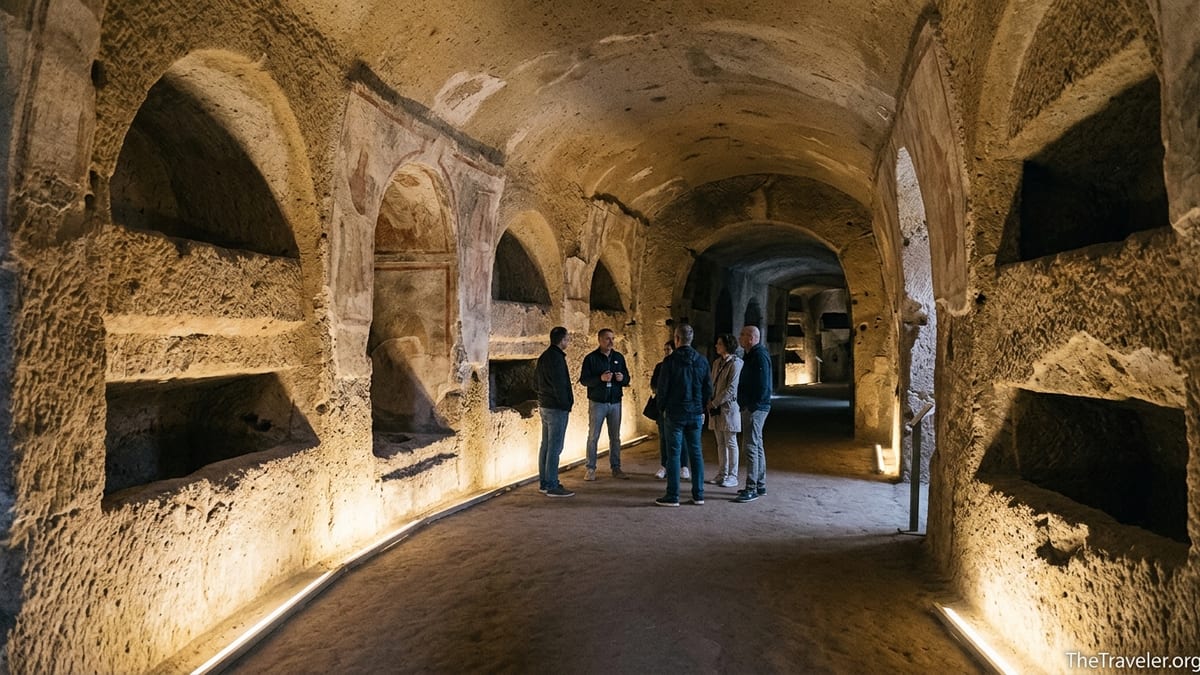
The entrance to the Catacombs of San Gennaro sits high above central Naples, on the slope of Capodimonte, beside the Basilica dell’Incoronata Madre del Buon Consiglio. From the street, it looks more like the gateway to a quiet sanctuary than to an underground city of the dead. I joined a small group just before a mid-morning tour; a young local guide in a simple blue jacket checked our pre-booked tickets, handed us a quick safety briefing, and reminded us that we were entering both an archaeological site and a place that many Neapolitans still consider sacred.
From the first steps down, the air turned cooler and drier, with that dusty, almost chalk-like smell of volcanic tuff. This honey-colored rock is what much of Naples rests on, and it is soft enough to carve yet strong enough to hold a city. Within a few seconds, the noise of motorbikes, church bells and bus brakes from the street above faded to a muffled memory, replaced by the soft echo of footsteps and the guide’s voice bouncing off stone.
The catacombs unfold in terraces and corridors rather than the narrow tunnels I had imagined. The guide explained that what we were seeing began as a small hypogeum, probably the tomb of a wealthy family in the 2nd century AD, and later expanded when the remains of Saint Agrippinus, an early bishop and patron of Naples, were moved here. Over centuries, bishops, martyrs and ordinary Christians were all buried in this porous hillside, until the site became a sprawling underground complex layered with history.
Standing in the so-called “basilica of the bishops,” a large chamber with a low ceiling and side niches, I could still make out painted crosses and stylized flowers. Nothing looked pristine. Colors were faded, edges chipped, yet that patina of age made the space feel more intimate, like a family album that has been thumbed through for generations.
Where Saints Sleep: Faces, Frescoes and Early Faith
It is easy to forget, amid the sheer visual drama, that the Catacombs of San Gennaro were once a living place of worship. As we moved deeper into the complex, the guide stopped beside arcosolia, arched recesses carved into the walls that had once held the bodies of the dead. Some were simple, bare hollows. Others were decorated with fragments of frescoes and mosaics that quietly told the story of early Christian Naples.
One fresco, hardly larger than a dinner plate, showed a figure with arms outstretched in prayer, flanked by doves and vines. Another, more famous, portrayed San Gennaro himself. The guide explained that after the remains of the city’s patron saint were moved here around late antiquity, the catacombs became an important pilgrimage site. Today, devotion to San Gennaro is more often associated with his blood miracle at the cathedral in the historic center, but up here, beneath the earth, you understand that his story is carved into the city’s very bedrock.
Our group paused where thick pillars were left uncarved to support the vaulted ceiling. Some bore traces of geometric paint, like ancient guardrails between the living and the dead. Children in the group instinctively reached for the stone, and parents gently pulled their hands back when the guide reminded us not to touch. The only modern interventions were subtle: discreet LEDs tucked into ledges, small non-glare panels explaining the layout, and the occasional elevator and handrail installed as part of a broader accessibility effort that has made parts of the site reachable even for visitors with reduced mobility.
What surprised me most was the sense of space. Instead of claustrophobic corridors, much of San Gennaro opens into wide chambers where you can stand comfortably without stooping. In one hall the guide switched off the main lights for a moment, leaving only low emergency strips on. The darkness was soft rather than absolute, and the silence settled like a protective cloak. It was a reminder that people once came here not only to bury their dead, but to gather, pray and wait together in times when persecution or plague reached the streets above.
From Patron Saint to Present Day: How the Catacombs Came Back to Life
For centuries, the catacombs were more or less abandoned, used occasionally as shelter during wartime, or simply forgotten. Their modern story is as compelling as their ancient one. In the early 2000s, a group of young people from Rione Sanità, a neighborhood long associated with poverty and social exclusion, began working with local clergy and heritage experts to reclaim the catacombs as both a cultural asset and a source of dignified employment.
Today, many of the guides at San Gennaro and San Gaudioso are from the immediate area. One of them spoke frankly about growing up when the catacombs were little more than a rumor under the hill, a ghostly presence mentioned by grandparents. Now, he and his colleagues welcome visitors from all over the world, and ticket revenue helps fund community projects, from after-school programs to small-scale renovations of crumbling courtyards in Rione Sanità.
Concrete details surface in small ways. The combined ticket that covers both San Gennaro and San Gaudioso typically costs just under 15 euros per adult and remains valid for a year, encouraging visitors to spend more than a single rushed morning underground. On busy weekends, additional English-language tours are scheduled, while shoulder seasons such as early spring and late autumn often mean smaller groups and more time for questions.
This community-based model changes the feeling of a visit. It never becomes a theme park or a macabre spectacle. The guides insist on respectful behavior, ask visitors to keep voices low, and regularly explain how the project has created sustainable local jobs. You leave with the impression that your entrance fee is not only paying for light bulbs and conservation work, but for a gradual reweaving of social fabric in a neighborhood that tourism once largely bypassed.
Crossing to San Gaudioso: The Other Soul of Underground Naples
Later that same day, I walked down into Rione Sanità itself to visit the Catacombs of San Gaudioso. Unlike San Gennaro, whose entrance sits near a park-like plateau, San Gaudioso hides in plain sight beneath the Basilica di Santa Maria della Sanità, a luminous, pastel-colored church that anchors one of the liveliest squares in the district. Scooters weaved past plastic crates of oranges and crates of mussels, kids played football under washing lines, and then, suddenly, you step inside the echoing baroque interior and find a discreet sign pointing toward the catacombs.
The descent here feels more abrupt. A tight stone staircase leads under the main altar, and the atmosphere shifts quickly from gilded chapels to dark tuff corridors. The site is older than the baroque church above, dating back to between the 4th and 5th centuries AD, when Gaudiosus, a North African bishop fleeing the Vandal invasions, arrived in Naples and was eventually buried here. Over centuries, this underground cemetery expanded and morphed, absorbing new burial customs and artistic tastes.
If San Gennaro feels like a vast, calm underworld basilica, San Gaudioso is more intimate, almost theatrical. The ceilings are lower, the passages narrower, and you are never far from a reminder that for 17th-century Neapolitan nobles, visibility in death was almost as important as it was in life. This is where the visit becomes unforgettable for reasons that have little to do with skulls and everything to do with how a society imagines status beyond the grave.
In one hallway, the guide’s flashlight illuminated a row of frescoed torsos painted directly on the wall: a judge in robes, a knight in armor, a lady in an elaborate dress. Above each painted body, set into the stone like punctuation marks, were real human skulls. The rest of the skeleton was depicted in pigment; only the head remained bone. It was a startling fusion of portraiture and anatomy, at once eerie and strangely dignified.
Skulls, Frescoes and Neapolitan Irony
The story behind these half-painted, half-skeletal nobles speaks volumes about baroque Naples. During the 1600s, members of the aristocracy and clergy commissioned special burials at San Gaudioso. Their bodies went through a macabre but socially accepted process of decomposition, overseen by religious custodians in narrow niches. When the bones were finally clean, the skulls were set into the walls, and an artist, Giovanni Balducci, was tasked with painting the remainder of the figure, complete with clothing and the instruments of their profession.
The result is a corridor that reads like a gallery of professional identities: you can pick out doctors, soldiers, judges and prelati, each represented by the objects or garments that signaled their rank in life. The guide explained that Balducci, a respected painter, refused payment for his work on the condition that he, too, could be buried among this elite. In death, his self-portrait now watches over visitors, a painted artist’s body crowned with his own skull, slipping quietly into the hierarchy he once depicted.
There is humor in this darkness. It is said that Neapolitan comedian Totò found inspiration here for his famous poem on the equality of death, a satire that imagines nobles and commoners sharing the same narrow grave and discovering that titles carry little weight underground. Standing in front of these frescoes, you sense why. No matter how elaborate the painted robes, the skulls above them are almost identical. The catacombs become a kind of moral theater, where the vanity of worldly status is gently mocked by stone and time.
Elsewhere in San Gaudioso, early Christian symbols persist: fish, anchors, doves and simple crosses, reminders that this place long predated its baroque makeover. In a small chamber off the main route, glowing under preservative lighting, were mosaics that could easily be overlooked, their tesserae chipped and irregular. The guide pointed out how the designs stitched together Roman decorative traditions and early Christian iconography, evidence of a city that never severed its past but kept layering new meanings on old stones.
Rione Sanità Above: Life Over Layers of the Dead
What amplifies the emotion of visiting both catacombs in a single day is the constant interplay between the worlds above and below. Rione Sanità is one of Naples’ most densely populated districts, and its residents live literally on top of centuries of burials. Stepping out of San Gaudioso into the piazza, I was struck by the noise and color: a fruit seller shouting prices for late-season peaches, a grandmother scolding a toddler for straying too close to the curb, a group of teens loitering near a mural that reimagined San Gennaro in street-art colors.
This neighborhood has been through difficult decades, with unemployment and organized crime casting long shadows. Yet in recent years it has become a symbol of grassroots renewal. Cultural associations organize “Sacred Mile” walks linking the catacombs, churches and historic palazzi. Small bed-and-breakfasts have opened in renovated apartments, their owners happy to explain which trattoria still serves generous plates of pasta e patate con provola for around 10 or 12 euros, and which bakery fries dough at dawn for fresh graffe, Neapolitan donuts dusted in sugar.
Walking from San Gaudioso up towards San Gennaro, I passed the ornate staircases of Palazzo dello Spagnolo and Palazzo Sanfelice, 18th-century apartment buildings whose curved ramps once allowed horse-drawn carriages to reach inner courtyards. Today, everyday residents hang their laundry along these same balustrades, and visiting them is free; you simply walk in, nod respectfully to whomever is sitting near the entrance, and tilt your gaze up to admire stucco angels and peeling pastel walls.
The contrast is constant: coffins beneath, scooters above; saints in frescoes, teenagers with earbuds; baroque basilicas that host community theater in the evenings; tombs whose income supports local study halls. It is this tight weave between archaeology and daily life that makes the experience of the catacombs feel less like an isolated attraction and more like a thread in a much larger urban story.
Practical Tips for Visiting Both Catacombs in One Day
From a logistical point of view, combining San Gennaro and San Gaudioso in a single day is straightforward but benefits from a bit of planning. Most visitors start with San Gennaro in the late morning, when the light is gentle on the hill of Capodimonte and group sizes are manageable. Guided tours are mandatory at both sites and usually last around one hour each, with English, Italian and sometimes additional languages scheduled throughout the day depending on demand.
Booking online ahead of time is strongly recommended, especially between April and October and on weekends year-round. While exact prices can change, expect a regular adult ticket for the catacombs to be comfortably under 20 euros, with discounts for students and children and a combined option that includes both San Gennaro and San Gaudioso. The combined ticket generally remains valid for a full year, which is helpful if rain or fatigue prompts you to split the visits across multiple days.
Reaching the sites from central Naples is easier than their underground setting suggests. Many visitors take the metro to Museo station near the National Archaeological Museum, then a short taxi ride or bus up to the Capodimonte area for San Gennaro. From there, it is a downhill walk of about 15 to 20 minutes to San Gaudioso through Rione Sanità, or a quick ride on a local bus if steep streets are an issue. Good walking shoes are essential; pathways inside the catacombs are generally even and fitted with non-slip surfaces, but some sections still involve low ceilings, steps and slightly uneven ground.
Photography rules vary a little depending on the area and the current conservation guidelines. In general, flash is not allowed, and in some chambers, photography may be restricted altogether to protect fragile frescoes. It is worth asking your guide at the start of the tour what is permitted on that particular day. Even without photos, the visual impact is strong enough that you are unlikely to forget the details.
The Takeaway
Emerging from San Gaudioso into the late afternoon glare, I realized how profoundly these two visits had reframed my sense of Naples. The city is often caricatured as noisy, chaotic, all surface energy and street food. The catacombs reveal a deeper tempo: generations who worried about salvation, who buried their dead with painstaking care, who painted their hopes and hierarchies on underground walls and then left them to time.
What makes walking through the Catacombs of San Gennaro and San Gaudioso unforgettable is not just the proximity to human remains or the age of the frescoes. It is the continuity between then and now. Early Christian worship spaces become war shelters, then community projects run by local youth. A baroque cult of noble burials ends up inspiring a 20th-century comedian’s meditation on equality. Ticket counters support after-school homework clubs. Underground corridors carved in the 2nd and 5th centuries shape the 21st-century identity of a neighborhood that is determined to define itself by culture rather than headlines.
If you have time for only one underground experience in Naples, either San Gennaro or San Gaudioso would reward you. But walking both in a single day, connected by the steep streets and busy squares of Rione Sanità, gives you something rarer: a sense that the city’s past is not sealed off behind glass, but breathing under your feet, asking you to listen closely in the half-light and carry its stories back into the sun.
FAQ
Q1. Do I need a guided tour to visit the Catacombs of San Gennaro and San Gaudioso?
Yes. Both sites can only be visited on guided tours organized by the official operators, which helps protect the fragile environments and provides essential context.
Q2. How long should I plan for visiting both catacombs in one day?
Each guided visit lasts about one hour. Allow at least three to four hours total to include walking or transport between the sites and a short break in Rione Sanità.
Q3. Are the catacombs suitable for children or sensitive visitors?
The visits focus on history and art rather than horror, and many families bring children, but there are human remains and dimly lit spaces, so very sensitive visitors should consider this.
Q4. What should I wear inside the catacombs?
Wear comfortable closed shoes with good grip and bring a light layer, as temperatures underground are cooler than at street level even in summer.
Q5. Can people with limited mobility visit the catacombs?
Some areas, especially at San Gennaro, have been adapted with ramps and handrails, but there are still stairs and uneven sections, so accessibility is partial rather than complete.
Q6. Is photography allowed during the tours?
Non-flash photography is typically allowed in many areas, but some chambers may have restrictions for conservation reasons, so always follow your guide’s instructions on the day.
Q7. Do I need separate tickets for San Gennaro and San Gaudioso?
You can buy a combined ticket that covers both catacombs and usually remains valid for many months, or purchase separate tickets if you plan to visit only one site.
Q8. What is the best time of day to visit to avoid crowds?
Early morning or late afternoon tours outside peak holiday periods tend to be quieter, while mid-day and weekends, especially in spring and summer, are usually busier.
Q9. Are there places to eat or rest nearby after the visits?
Yes. Rione Sanità is full of small cafés, bakeries and trattorias where you can sit down for an espresso, pastry or simple meal between or after the tours.
Q10. Is visiting the catacombs safe given their location in Rione Sanità?
During normal daytime hours, visiting with the official tours is considered safe, and many travelers walk between the sites, staying on main streets and being mindful as in any busy city.