


More news on this day
Escalating tensions in West Asia have begun to significantly disrupt operations at Chennai International Airport, with reports indicating that at least 20 international flights have been delayed and services on the busy Chennai–Colombo sector have been cancelled or curtailed, stranding hundreds of passengers on both sides of the Palk Strait.
Get the latest news straight to your inbox!
Flight delays ripple through Chennai’s international network
According to regional aviation updates and local media coverage from Chennai, a wave of schedule disruptions linked to the evolving security situation in parts of West Asia has pushed airlines to rework routings and timings for services operating through Indian airspace. This has translated into extended waits at Chennai International Airport, where roughly 20 international departures and arrivals have faced delays ranging from one to several hours.
Operational data shared in public domain indicates that flights serving destinations in the Gulf and wider Middle East have been the most affected, as carriers adapt to route restrictions, airspace caution zones and longer flight times. Aircraft arriving late from disrupted sectors are in turn departing late from Chennai, creating a knock-on effect for onward connections and ground handling schedules.
Recent incidents of prolonged delays on Chennai services to Abu Dhabi and London, previously attributed to late inbound aircraft and tight rotation windows, underline how quickly congestion can build up when even a few long-haul flights are pushed off their slots. Observers note that the latest West Asia tensions are adding another layer of complexity to an airport that already operates close to capacity during peak hours.
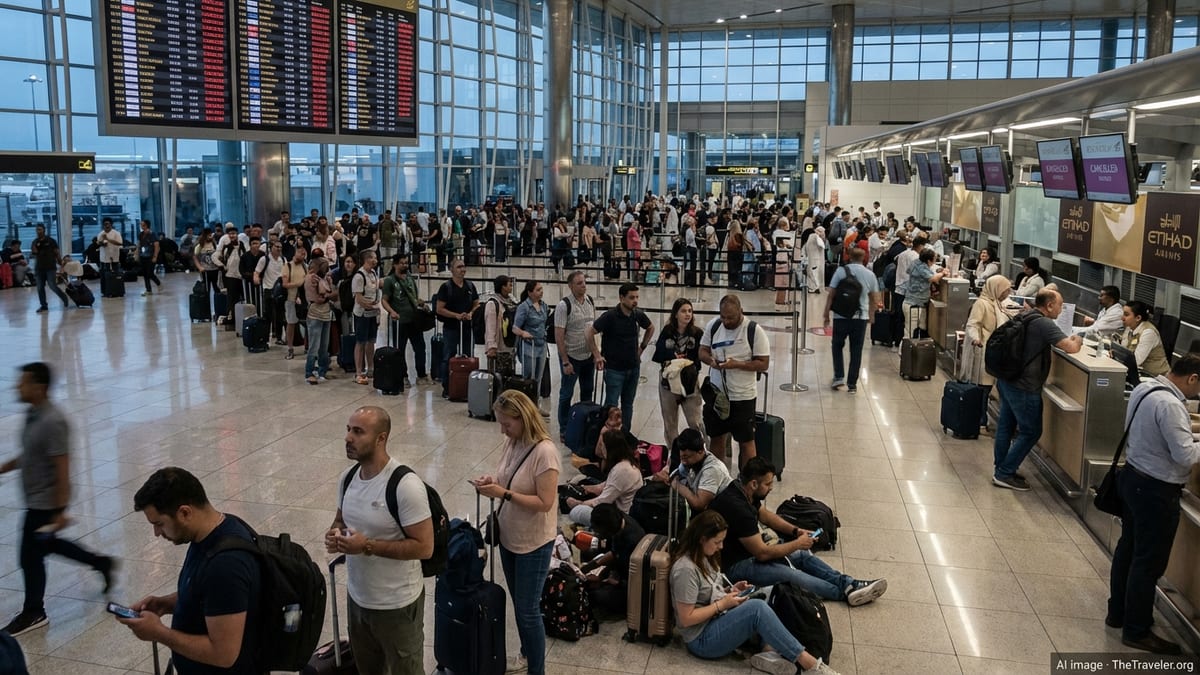
Passengers have reported crowded departure halls and long queues at immigration and security as delayed flights bunch together on the departure boards. Publicly available information shows that some travellers attempting to connect via Gulf hubs to Europe, North America and Africa have been forced to rebook or accept extended layovers due to the compounded delays.
Colombo sector cancellations hit a key short-haul corridor
The traditionally busy air corridor between Chennai and Colombo has been particularly exposed, as the broader regional disruption intersects with airline-specific schedule changes. SriLankan Airlines has already announced a series of cancellations and reductions on Middle East routes from Colombo in response to heightened tensions, and regional reports indicate further adjustments where services interface with South Indian gateways.
Chennai–Colombo flights, which typically carry a mix of business travellers, medical tourists, migrant workers and short-break leisure passengers, are an important short-haul link within South Asia. The suspension or trimming of these services has narrowed options for travellers who often rely on multiple daily departures to manage tight itineraries or same-day returns.
Public schedules show that select Chennai–Colombo rotations have been taken off-line or merged with other services to relieve operational pressure, with airlines prioritising long-haul and higher-yield routes in the face of airspace uncertainties. This has reduced seat availability on remaining flights and pushed some travellers to seek connections through alternative Indian cities such as Bengaluru, Kochi or Mumbai.
Travel agents in the region, drawing on airline circulars and notifications, have cautioned passengers holding tickets on Chennai–Colombo routes to closely monitor their bookings, as day-of-travel cancellations remain possible while the West Asia situation continues to evolve.
West Asia airspace constraints reshape routings
Government briefings and aviation industry analyses over recent months describe a steady pattern of disruption in parts of West Asia, with closures and restrictions affecting key en route corridors used by Indian and foreign carriers. The Ministry of Civil Aviation has previously detailed hundreds of cancellations and diversions on India-linked routes as airlines adjusted to changing risk assessments in the region.
Carriers operating to and from Chennai have joined this wider recalibration, in many cases adding extra flight time to skirt sensitive airspace, altering departure waves to align with newly available corridors, or consolidating services where demand no longer supports the cost of longer routings. Each of these measures reduces schedule resilience and increases the likelihood that a localised delay in one region will be felt hours later at a hub such as Chennai.
Aviation analysts note that the Chennai network is especially reliant on Middle East and West Asia traffic flows, both for point-to-point journeys and as feeders to long-haul flights operated by Gulf and European airlines. Any sustained instability across these airspace segments therefore has a disproportionate impact on the airport’s ability to operate a predictable timetable.
Publicly available tracking data also shows that aircraft operating between South India and destinations in Europe or North America via the Gulf are at times spending additional time in the air, raising fuel costs and narrowing schedule buffers. Airlines have responded by building in longer ground times or trimming frequencies, both of which reduce the number of daily movements feasible through congested terminals like Chennai.
Passenger experience strained by rolling disruptions
For passengers, the convergence of regional tensions and local capacity constraints has translated into longer waits, missed connections and a surge in last-minute itinerary changes. Social media posts and first-hand accounts from recent weeks describe travellers waiting onboard aircraft for extended periods, queuing for rebooking counters late into the night, and struggling to secure alternative seats on already busy flights.
Anecdotal reports from Chennai highlight bottlenecks at check-in, security and baggage belts when multiple delayed flights are processed in quick succession. The airport’s infrastructure, which has been repeatedly criticised by frequent flyers for limited seating, crowded corridors and constrained landside access, has come under renewed pressure as delays turn single peak periods into prolonged rushes.
Consumer forums and online travel communities indicate that some affected passengers on the Chennai–Colombo route have opted to reroute via other Indian cities or even travel by a combination of domestic flights and ferries or surface transport where feasible. Others have reported challenges securing timely refunds or free date changes on lower-fare tickets, especially when disruptions are framed as safety-driven operational decisions rather than outright cancellations days in advance.
Travel advisers recommend that flyers passing through Chennai build in additional connection time, avoid tight same-day onward links through Gulf hubs where possible, and remain attentive to airline notifications, as rolling knock-on delays may continue even on days when the West Asia security picture appears comparatively stable.
Airlines and regulators weigh next steps
Indian aviation regulators and the Ministry of Civil Aviation have indicated in earlier public statements that they are monitoring the situation in West Asia and its impact on international routes. Industry watchers expect that further schedule adjustments remain likely if tension levels rise again or if additional airspace control measures are introduced by states in the region.
Airlines serving Chennai are meanwhile engaged in an ongoing balancing act between safety, cost and connectivity. Public timetable changes in recent months show patterns of temporary route suspensions, reduced weekly frequencies and equipment swaps on select international sectors, as carriers attempt to preserve financially critical connections while absorbing the operational impact of longer routings and uncertain overflight permissions.
Airport-focused commentators in India argue that the current disruption underscores the need for more resilient infrastructure, including additional contact stands, expanded terminal capacity and more flexible slot management at key gateways such as Chennai. They highlight that while the trigger for the present delays lies far away in West Asia, the severity of local impact is shaped by how much spare capacity airports can deploy when global networks are stressed.
For now, travellers using Chennai International Airport, particularly on Middle East and Colombo routes, face a period of heightened uncertainty. Schedules remain subject to late changes, and the prospect of further disruptions will likely persist as long as the security environment in parts of West Asia continues to affect the wider international aviation system.