


More news on this day
Heightened tensions in West Asia are rippling across South Asian air corridors, disrupting operations at Chennai International Airport, where around 20 international services have been delayed and flights on the busy Colombo route have been cancelled, according to published coverage and airline advisories.
Get the latest news straight to your inbox!
West Asia volatility reverberates in South Asian skies
Publicly available information shows that continuing instability in parts of West Asia has forced airlines to adjust routings, rethink overflight plans and, in some cases, suspend services altogether. India’s Ministry of Civil Aviation has previously acknowledged that hundreds of international flights have been affected in recent months as carriers navigate restricted or sensitive airspace over the region.
These broader constraints are now being felt directly in South India. Chennai, a key international gateway on the country’s east coast, relies heavily on westbound corridors that connect it to hubs in the Gulf, Europe and North America. When airspace along these paths becomes more complex or constrained, delays and cancellations can quickly cascade through the schedule.
Reports from aviation outlets and regional media indicate that the latest escalation has had a disproportionate impact on services linking South Asia with the Gulf and beyond. Aircraft and crew stranded out of position, longer diversion routes and tighter operational buffers around certain airspace zones are cumulatively slowing down the system.
While safety regulators describe these adjustments as precautionary, the net effect for travellers is tangible: longer journeys, missed connections and uncertainty at departure gates from Chennai to Colombo and other regional hubs.
Chennai airport sees wave of international delays
At Chennai International Airport, the knock-on effects have translated into a fresh wave of disruptions on already busy mid-year travel days. Airport movement data and local reports point to roughly 20 international services experiencing extended delays, with waiting times stretching well beyond scheduled departure slots.
These are in addition to earlier weather and operational disruptions at the airport in recent weeks, when rain, wind and localised incidents had already tested the resilience of the timetable. The latest hold-ups tied to West Asia tensions are compounding those pressures, especially during early morning and late-night international banks when multiple widebody departures are scheduled within short windows.
Airlines serving Chennai’s westbound network are understood to be padding flight times, reworking crew rosters and occasionally consolidating services where demand and aircraft availability allow. Such measures can help maintain overall safety margins but leave passengers facing revised departure boards, last-minute gate changes and, in some cases, involuntary rebookings.
Travellers connecting through Chennai onto long-haul flights are particularly exposed. Any delay departing the city can jeopardise onward links in Gulf and European hubs, prompting carriers to proactively shift passengers to later services rather than risk misconnected itineraries.
Colombo connection hit as airlines pull back
The Chennai to Colombo corridor, traditionally one of the region’s busiest short-haul international routes, has emerged as an early casualty of the latest turbulence. Airline notices and regional coverage indicate that services on this sector have been cancelled as operators reassess the viability of certain rotations amid tightening constraints linked to West Asia.
The impact is felt on both sides of the Palk Strait. From Chennai, passengers bound for Sri Lanka lose a direct, sub-hour hop that has long supported tourism, family visits and business travel. From Colombo, the suspension of Chennai services disrupts a popular feeder link into India’s wider domestic network, reducing options for travellers heading onward to other South Indian cities.
Airlines are steering affected passengers toward alternative routings where possible, often via other Indian or regional hubs that retain more stable schedules. However, such detours can add several hours to journeys that, under normal conditions, involve less than an hour in the air.
For Sri Lanka’s aviation sector, the latest cancellations come on top of an already challenging environment marked by earlier cuts to Middle East operations and fluctuating demand. Industry observers note that every lost regional frequency not only affects point-to-point passengers but also undermines Colombo’s role as a connector between South Asia and wider Asia Pacific markets.
Stranded travellers, longer journeys and rising costs
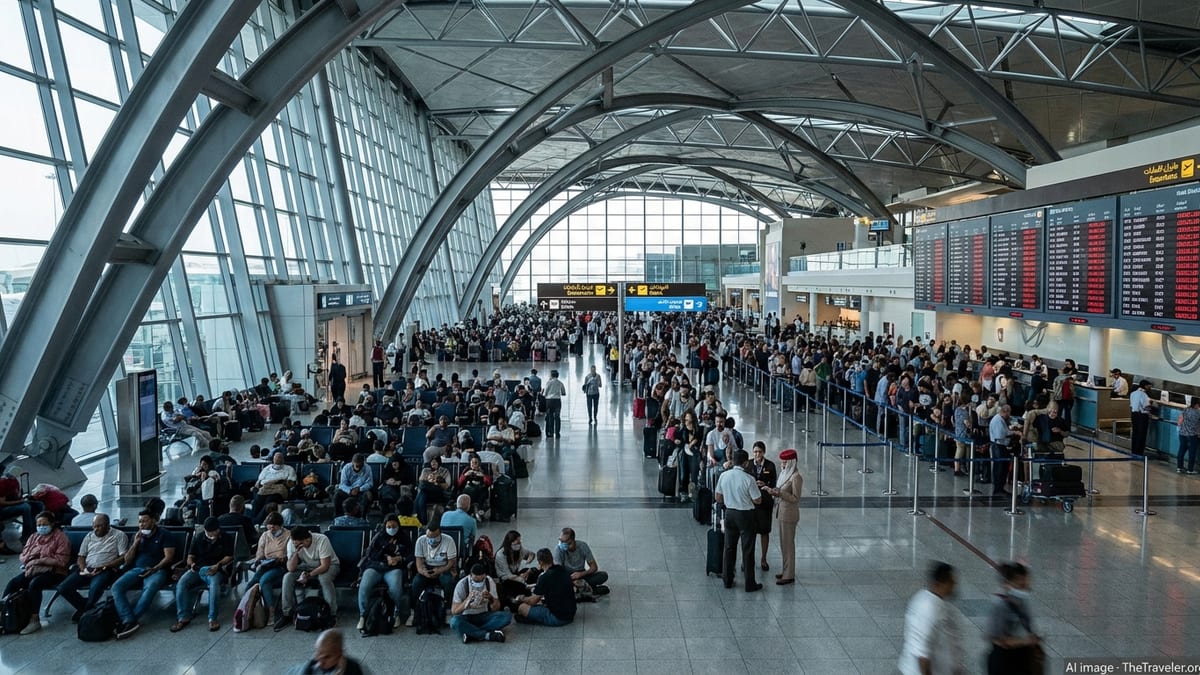
For passengers on the ground, the operational complexities translate into crowded terminals, packed waiting areas and heightened anxiety over missed commitments. Accounts shared via social media and local forums describe extended queues at check-in, repeated boarding announcements followed by holds, and late-night waits as airlines work through revised slot allocations.
Those already in transit are facing longer routings as aircraft skirt sensitive airspace. Published analyses of recent flight tracks into and out of India show deviations that add significant flying time, raising fuel burn and operating costs. These additional burdens can, in turn, filter through to higher fares, particularly on routes where capacity has been cut.
Travellers relying on Chennai as a cost-effective gateway to the Gulf, Europe or North America may now find that itineraries involve either longer layovers or premium pricing. Budget-conscious passengers, including migrant workers and students who form a substantial share of the traffic between South India, West Asia and Sri Lanka, are among those most exposed to these shifts.
Consumer advocates in the region have been drawing attention to the importance of clear communication, flexible rebooking policies and fair refunds when flights are cancelled or heavily delayed for security or geopolitical reasons. Airlines’ public advisories in recent months have increasingly emphasised advance notifications and digital self-service options, but real-world experiences reported by travellers remain mixed.
Airlines and regulators adapt to an evolving risk map
According to publicly available statements, aviation regulators and ministries in the region are closely tracking the evolving situation in West Asia and its effects on international operations. Authorities have highlighted coordination with airlines and airports with an emphasis on maintaining safety and gradually restoring predictability for passengers.
Carriers operating from Chennai and Colombo are, in parallel, refining their contingency plans. These include flexible fleet deployment, more conservative scheduling on routes that traverse or approach affected airspace, and closer coordination with partner airlines to offer re-accommodation options when individual sectors are cancelled.
Industry analyses suggest that such disruptions could recur as long as the security environment in key West Asian corridors remains fluid. Airlines may increasingly favour routes and hubs that allow for rapid rerouting without major detours, potentially reshaping traditional traffic flows between South Asia, the Gulf and long-haul destinations.
For Chennai and Colombo, both heavily reliant on international connectivity for tourism, trade and labour mobility, the current wave of delays and cancellations underscores a broader vulnerability. As carriers and regulators recalibrate, travellers are being urged, through public advisories and media reports, to monitor flight status closely, allow extra time for connections and prepare for itineraries that may change with little notice.