


Paraga Beach is one of Mykonos’ most photographed shorelines, a golden crescent packed with daybeds, big-name beach clubs and DJs. Yet for all the hype, the average visitor’s experience rarely stretches beyond a reserved lounger and a late-afternoon party. Look a little closer, and this compact bay reveals a quieter, more characterful side that many people never notice, even if they spend an entire day here.
Get the latest updates straight to your inbox!
The Beach With Two Souls: Party Strip vs Quiet Corners
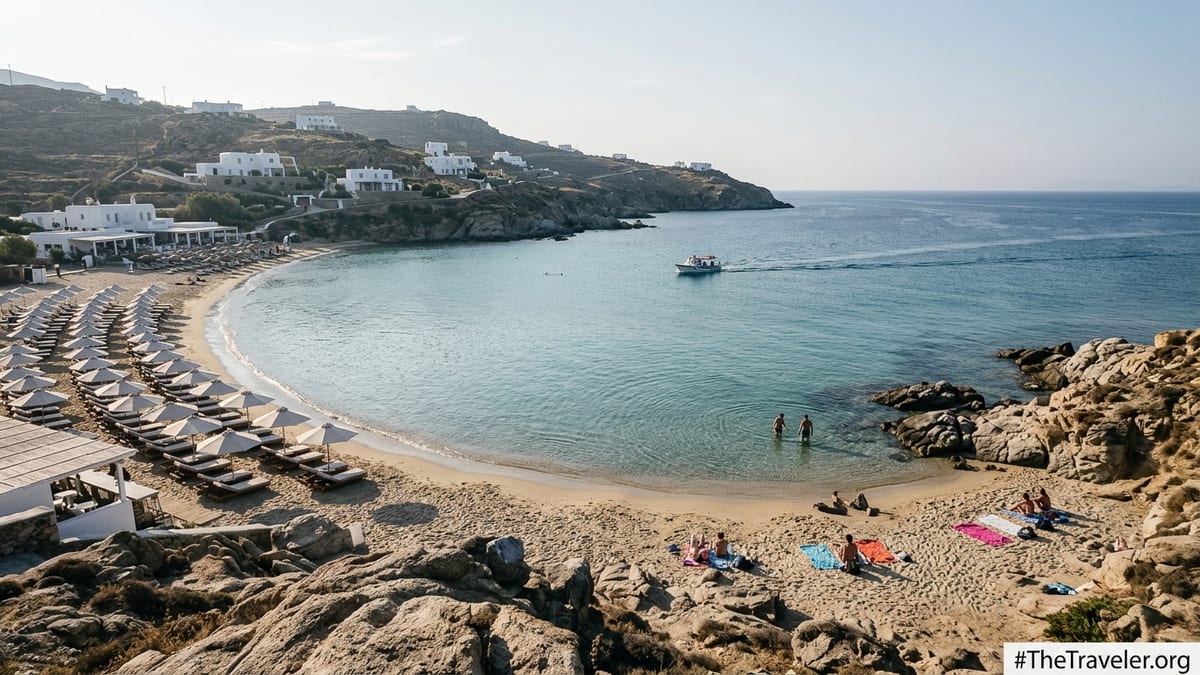
Paraga is often described by locals as a beach with two souls, and you notice it as soon as you step onto the sand. The busy, central section is lined with tightly packed sunbeds in front of venues such as SantAnna, Kalua and newer setups linked to restaurants like Roka. Music bleeds across the bay, staff shuttle Aperol spritzes to the water’s edge and minimum spends can feel closer to a nightclub table than a traditional beach day. Yet only a few minutes’ walk away, there are patches of sand and rocks where you can still lay down a towel for free and hear little more than waves and conversation.
Most visitors are funneled straight from the bus stop or water taxi to the closest set of organized loungers. It is easy, you do not have to think about it and staff are actively out front encouraging you in. What many do not realize is that Paraga’s character changes subtly every 50 meters or so. The left-hand side as you face the sea is more built-up and club-focused, while the right-hand side, edging toward the Scorpios headland, tends to attract independent travelers, naturists and locals who prefer a quieter swim. Walking the full length of the beach before you commit to a spot is the simplest way to experience both sides.
If you arrive before 11 am, the difference feels even starker. In the early hours, the sand in front of the big clubs can be almost empty, cleaners are still dragging rakes through the shoreline and the entire bay is bathed in a soft, glassy light. Head toward the rocks at either end at this time and you may only share the cove with a few campers or sunrise swimmers. By mid-afternoon, when most day trippers finally appear, these quieter edges are often already claimed by those who knew exactly what they were looking for.
Recognizing this dual personality is key to getting more out of Paraga. If you only ever see it between 3 pm and sunset from a single sunbed, you are experiencing the beach on its most generic setting. Step back, walk ten minutes in either direction, and you are suddenly on a very different Mykonos shoreline.
Hidden Rocky Coves and Surprisingly Good Snorkeling
Paraga is not famous as a snorkel spot in the way that wilder northern Mykonos beaches are, yet its rocky edges and clear, usually calm water create much better underwater conditions than many visitors expect. At both ends of the bay, low granite outcrops shelter pockets of deeper water where fish congregate around the rocks. On the right-hand side, walking toward the Scorpios peninsula, the sand gives way to flat shelves of rock and boulders that drop quickly into a turquoise channel. Regulars slip in here with masks and fins for a quick circuit along the shore before the day’s parties begin.
Most first-timers never see this side of Paraga because from the central strip the rocks look uncomfortable and uninviting. With appropriate footwear and a basic snorkel set, however, they become an informal adventure zone. You can wade in from a natural “step” in the rocks, float above stripy fish and sea urchins clinging to the stone, and follow the coastline toward the Scorpios jetty. Visibility on calm mornings is often several meters, especially before boats start coming and going. It is a different rhythm from the sand, and one that rewards a bit of curiosity.
There is a similar, though slightly smaller, rocky pocket on the left-hand side as you walk toward Platis Gialos. Here the water is shallow and well protected from the prevailing wind, which makes it good for less confident swimmers who still want a bit of interest under the surface. Families sometimes wander over here after their children grow restless on the sunbeds. Away from the speakers, the soundscape changes to the gentle clink of rigging from anchored boats and the splash of kids jumping from the rocks.
The one thing you will not find is formal snorkel rental right on the sand. Beach shops near the bus stop and small mini markets selling inflatables and sunscreen stock basic masks and tubes in summer, though quality varies. If snorkeling is a priority, pack your own lightweight set so you do not depend on what happens to be in stock that week. It is a small effort that opens up an entirely different layer of Paraga that countless visitors overlook.
Free Sand, Budget Corners and How to Avoid Surprise Sunbed Bills
Mykonos has become synonymous with pricey sunbeds, and Paraga is no exception. During high season, a front-row pair of loungers with an umbrella in front of a big-name club can run to a substantial minimum spend, often tied to food and drink. Staff will usually quote a flat rental rate, but the real cost appears once you factor in those minimums. Travelers swapping stories online from recent summers mention examples such as paying a mid-range restaurant price for a club sandwich, burger and water delivered to their sunbeds in the central section of Paraga, which quickly pushes a “casual” beach day into three-figure territory for two.
What most people miss is that you are not obliged to pay those prices to enjoy the same stretch of water. By Greek law the shoreline strip remains public, and there are small pockets of genuinely free sand at both ends of Paraga, as well as gaps between organized sections where you can lay a towel. They are not always obvious at first glance, partly because loungers are packed closely together in front of the clubs, but if you keep walking past the final row of daybeds you will usually find a modest open area used by locals and budget travelers. These sections tend to fill first in the morning and they shrink as operators expand their setups, so arriving early is important if you want a free patch.
Even if you do decide to go for a bed, you can avoid surprises by asking three very specific questions before you sit down. First, confirm the price per bed and umbrella. Second, clarify whether that rate is just a rental fee or includes a minimum spend. Third, ask if you are allowed to consume your own water or snacks. At some Paraga venues, guests have been caught out by assuming that the quoted bed price was the total, only to discover an additional spend requirement at checkout. A two-minute conversation with the beach staff at the entrance, ideally confirmed again with the person seating you, will save an awkward debate later.
For those happy to forgo waiter service, there are a few smart ways to keep costs low. The mini market by the bus stop sells cold drinks, fruit and simple picnic items at normal island prices. Many independent travelers pick up supplies there and then walk to the quieter side of the bay, effectively swapping the club experience for a simple seaside picnic. Others use the more affordable, semi-organized sections attached to smaller tavernas above the beach where bed prices and menu items tend to be gentler than at the headline clubs a few doors down. None of this is obvious when you step off the bus into a wall of music and branding, which is exactly why so many visitors end up paying more than they need to.
Walking Paths, Sea Taxis and Scenic Approaches Most People Skip
Paraga may look like an endpoint when you arrive by bus from Mykonos Town, but in reality it sits on a string of linked beaches along the island’s south coast. There is a rough but well-used coastal path that runs from Platis Gialos through Agia Anna to Paraga, and then continues over the headland to Paradise. Many visitors never realize it exists, yet it is one of the simplest and most scenic mini-hikes you can do on Mykonos without special gear. The path is mostly compacted earth and rock, passable in sturdy sandals or trainers, with beautiful views across to the island of Delos and a patchwork of bays spread out below.
Walking from Platis Gialos to Paraga in the morning takes roughly 20 to 30 minutes at an easy pace, including time for photos. You pass small chapels, whitewashed villas and a series of tiny coves where locals swim before work. Approaching Paraga on foot from this direction puts you above the bay first, which gives you a sense of its shape and the difference between the lively center and quieter edges. It also means you can scout the beach from above before committing to a spot. Many seasoned visitors plan their day around this walk, stopping for coffee in Platis Gialos, then wandering to Paraga for a swim and lunch.
On the water, small sea taxis operated by long-established local companies shuttle between Ornos, Platis Gialos, Paraga, Paradise, Super Paradise and beyond in peak season. These wooden boats operate like a floating bus line, stopping at simple jetties or floating pontoons marked as “water stations” along the coast. The service is popular with people staying in one bay who want to sample another without dealing with parking or buses. Because the route passes so close to Paraga, you can use it as an easy way to combine beaches in a single day: morning at Paraga, lunch at a taverna in Platis Gialos, then back again for sunset.
Arriving by sea taxi also subtly changes your first impression of Paraga. Instead of stepping into the middle of the crowds from the bus stop, you glide in from the water, seeing the curve of the beach, rock formations and club structures all at once. From this angle, the quieter rocky ends and free sand sections are much easier to spot. It is a small logistical choice that has an outsized effect on how you experience the place, and yet it is one most short-stay visitors never consider.
The Last Echoes of Camping Culture on Paraga’s Hillside
Long before Paraga became associated with high-end beach clubs, it was part of a looser, more bohemian circuit of backpacker campgrounds. Simple sites right behind the sand attracted travelers who would pitch their own tents or crash in basic bungalows, then shuffle down to the beach barefoot every morning. Over the last decade, that original camping footprint has shifted and in some areas given way to more permanent structures and hostel-style accommodation, but the spirit of “low-key Paraga” has not completely vanished.
Several budget-oriented properties still operate on or just above the bay, offering shared facilities, dorm rooms or no-frills cabins that appeal to younger travelers and festival-style groups. Their communal bars and pool areas often look straight out over Paraga, giving guests a front-row view of both sunrise and sunset without the beach club price tag. Even if you are not staying there, a quick walk up the hillside paths behind the sand offers a glimpse of this parallel universe: clotheslines, sandy flip-flops, sunset beers around simple plastic tables and music far more laid-back than what blasts from the big-name venues below.
For visitors who feel that modern Mykonos has become too polished, these remnants of camping culture provide a welcome counterpoint. You can still meet people comparing ferry schedules, swapping island tips and debating which beach has the clearest water rather than which champagne brand to order. Dropping into one of these hillside bars for an early evening drink is a way to experience a more informal Paraga, especially on nights when the main clubs are booked for private events or high-profile DJs.
It is worth noting, however, that facilities and standards vary, and not every place that markets itself as “camping” is a traditional campground in the classic sense. Many now operate more like hybrid hostels or simple resorts. If you are considering staying in this part of Paraga, read recent guest feedback, especially around noise levels, shuttle services to town and whether the on-site mini markets and cafeterias are open for the full season. Even if you ultimately choose to sleep elsewhere, knowing that this more affordable layer exists helps you understand why Paraga still draws such a diverse crowd.
Authentic Food, Simple Taverns and Where Locals Actually Eat
One of the easiest mistakes to make at Paraga is assuming that the only food option is whatever is listed on the laminated beach club menu pinned to your lounger. In reality, the area immediately around the beach hides a mix of simple tavernas, casual cafes and takeaway stands that provide a more traditional, and often more affordable, way to eat. Some are tucked just behind the first line of beach venues, partially hidden by trees and hotel walls, which means many day visitors never walk far enough to find them.
To the left of the bay, toward Agia Anna and Platis Gialos, a handful of long-running tavernas serve grilled fish, Greek salads, saganaki and carafes of house wine on shaded terraces overlooking the sea. Locals working in nearby hotels and shops often suggest these places when asked where they eat on their break. They might not have the social media presence of the clubs on the sand, but they are where you are more likely to find a fisherman eating late lunch at 4 pm or staff from the beach clubs grabbing a quick plate of baked vegetables after their shift.
Back up by the bus stop, basic canteens and snack bars do brisk trade in gyros, souvlaki and simple omelettes for people heading down to or back from the beach. Grabbing a takeaway pita here and carrying it to the free section of sand is one of the simplest budget hacks on the island. You still get the view and sea breeze, just without the marked-up salads and cocktails. If you are staying in self-catering accommodation nearby, the small mini market by the bus drop-off stocks enough fresh fruit, cheese and bread to make a respectable beach picnic without needing to detour into Mykonos Town.
Perhaps the biggest thing many visitors miss is that you do not need to choose between a club day and real Greek food. It is perfectly possible to enjoy a mid-morning swim at Paraga, have a traditional lunch at a family-run taverna on the slope above, then drift back down for a sunset drink at a stylish bar. Treating the area as a small neighborhood rather than a single venue unlocks a much richer day, and it spreads your spending to the independent businesses that have helped keep this corner of the island welcoming even as trends change.
Sunrise, Shoulder Seasons and Other Rarely Seen Moods
Photos of Paraga that dominate social media tend to show it at its busiest: every bed occupied, DJs in full swing and the sun dropping behind Delos in a blaze of orange. Those scenes are real, especially in July and August, but they are only one version of the beach. Early mornings, shoulder-season weeks in late May or late September, and the first half of October reveal a much softer side that many short-stay visitors never witness simply because their schedules are so packed.
At sunrise on a calm day, Paraga can feel almost unrecognizable. The sand is freshly groomed, the only movement comes from liveaboard yachts swinging gently on their anchors and the line of beach clubs stands silent, shutters half down. A few insomniac photographers, fitness-minded locals and guests from nearby camp-style accommodations share the scene. Walking the length of the beach at this hour gives you uninterrupted views of the rock formations, tiny chapels on the hill and the chain of bays toward Platis Gialos, all in a low, golden light that never makes it into daytime party shots.
Outside peak weeks, the entire bay slows down. Beach clubs still operate, but securing a front-row bed is less of a competitive sport, music volumes are often lower and staff have more time to chat. On a mild September afternoon, for instance, you might find a mix of late-season couples, digital nomads escaping the city and locals taking their own holidays after the August rush. Prices for accommodation near Paraga can soften a little compared with high summer, and paths along the coast are less crowded, which makes walks to Paradise or Platis Gialos more enjoyable.
Of course, off-peak visits come with trade-offs: certain venues may shorten their hours or close entirely outside core summer months, and sea taxi schedules can be reduced. Yet for many travelers, these are small prices to pay for the chance to see Paraga as more than a backdrop to a single big day out. If your itinerary is flexible, even timing your beach day for a weekday rather than a Saturday can dramatically change your experience. The beach does not stop being beautiful when the speakers are quieter.
FAQ
Q1. Is there any part of Paraga Beach where I can lay a towel for free?
Yes. At both ends of the bay and in small gaps between organized loungers you will usually find public sand where you can put your own towel without charge, especially if you arrive earlier in the day.
Q2. How expensive are sunbeds at Paraga Beach?
Prices vary widely by venue and season, but front-row pairs at major beach clubs in high summer can reach high double digits or more once minimum spends are included. Always ask for both the bed price and any required food and drink spend before you sit down.
Q3. Is Paraga Beach suitable for families with children?
Yes, especially in the morning when the vibe is calmer and music is lower. The water is generally clear and relatively sheltered, though you should watch for rocks along the shoreline and avoid the busiest sections in late afternoon if your children are sensitive to noise.
Q4. Can I walk from Paraga to other beaches?
Yes. There is a coastal path linking Paraga with Platis Gialos in one direction and Paradise in the other. The walk takes around 20 to 30 minutes each way, with some uneven sections where closed shoes are helpful.
Q5. Is snorkeling at Paraga worth it?
It can be. The rocky areas at both ends of the beach offer clearer water and more fish than the central sandy strip. While it is not a world-class reef, bringing a basic mask and snorkel can make your swim more interesting, especially in the morning before the water gets busy.
Q6. How can I reach Paraga Beach without renting a car or ATV?
You can take a frequent bus from Mykonos Town to the stop above the beach in summer, or use the sea taxi service that runs between south-coast beaches such as Ornos, Platis Gialos, Paraga and Paradise. Both options are popular and remove the stress of parking.
Q7. Are there genuinely local or traditional places to eat near Paraga Beach?
Yes. Simple tavernas on the slopes toward Agia Anna and Platis Gialos, as well as snack bars and a mini market near the bus stop, serve more traditional and budget-friendly options compared with the high-end beach club menus.
Q8. What is the atmosphere like in the evening at Paraga?
In peak season, afternoons blend into early-evening parties at the main clubs, while the quieter ends of the beach empty out. In shoulder seasons or on quieter days, evenings can feel more relaxed, with people lingering for sunset drinks and dinner rather than full-scale parties.
Q9. Is Paraga a good area to stay overnight?
It can be, particularly if you want to be close to the beach and clubs while still having access to more affordable hostel, camping-style or simple hotel options on the hillside. Just be sure to check recent reviews regarding noise and transport connections to town.
Q10. When is the best time of day to experience Paraga Beach without crowds?
Early morning, roughly from sunrise until late morning, is usually the quietest time, with softer light, fewer people and lower music levels. Outside of July and August, weekdays also tend to be calmer than weekends.