


Most travelers arrive in Juan les Pins with a single image in mind: a sunbed by the sea, Aperol in hand, and the glittering bay stretching out toward the Cap d’Antibes. Walk a block or two inland, however, or follow the coast away from the busy strip, and a very different resort quietly appears. Pine groves where jazz legends once played to the stars, rocky paths with near-silent coves, unfussy family bistros and lived-in residential streets all sit just beyond the postcard view. For curious visitors willing to look past the famous seafront, Juan les Pins becomes less of a beach day-trip and more of a place with its own stories, rhythms and everyday life.
Get the latest updates straight to your inbox!
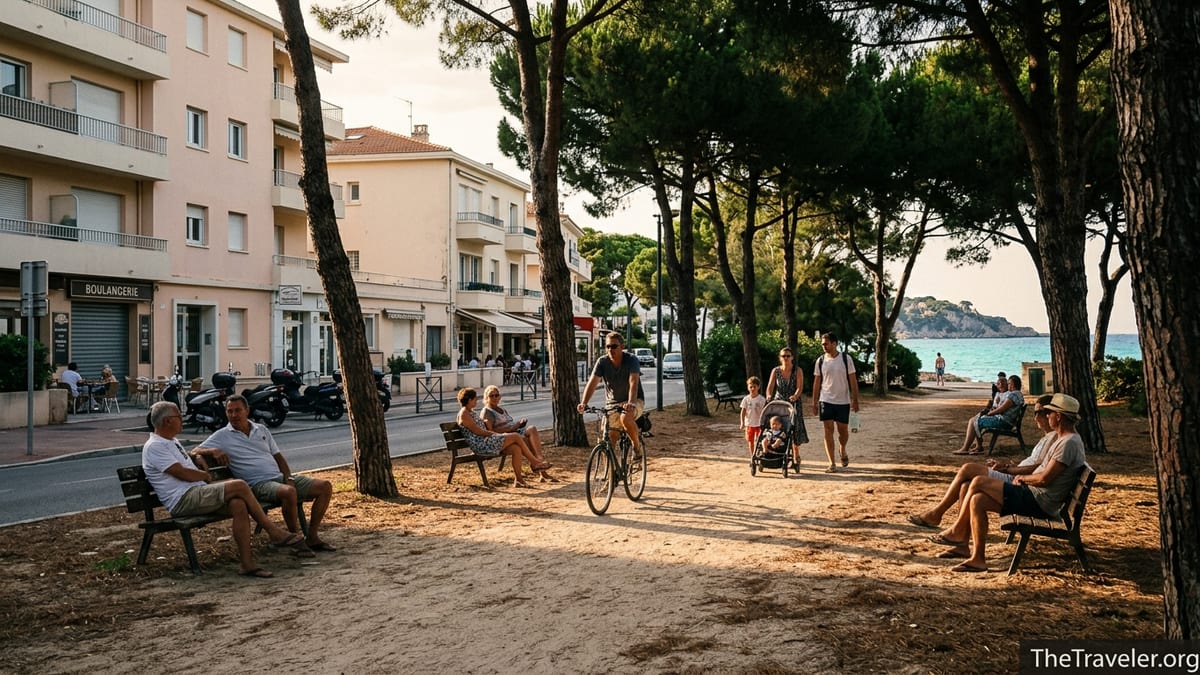
The Real Heart of Juan les Pins: La Pinède and Its Backstreets
Stand on the main seafront road in high season and Juan les Pins can feel almost one-dimensional: restaurant terraces, beach clubs, ice cream stands, traffic. Step just behind this frontage into La Pinède, the central pine grove, and the resort instantly changes mood. This pocket of shaded parkland is the “green lung” of Juan les Pins, a remnant of the stone pine forest that gave the town its name. Locals cut through here on their way home from work, parents push strollers under the trees, and older residents occupy the same benches every morning to read the paper. In late afternoon, the light slants through the pine needles, and the noise of the seafront fades into little more than a background hum.
Much of what visitors miss lies in the streets that radiate inland from La Pinède. A few minutes’ walk north brings you onto quieter residential avenues lined with 1950s apartment blocks, modest villas and corner bakeries where a coffee and croissant will usually cost far less than at the beach. Around Boulevard du Président Wilson and the streets behind it, small grocery stores, hairdressers and neighborhood cafés reveal Juan les Pins as a town that functions all year, not just a summer set-piece. This is where you hear more French than English, see schoolchildren with satchels, and understand that the resort identity is only half the story.
For an easy way to feel this contrast, buy a takeaway slice of pissaladière or socca from a local boulangerie off the main drag and eat it on a bench in La Pinède. The people around you will usually be residents on their lunch break, grandparents supervising toddlers in the play area, or teenagers heading to the beach after school rather than other tourists checking maps. In a destination where the seafront can feel curated, the pine grove and its surrounding backstreets offer an everyday authenticity that many short-stay visitors simply never notice.
Tracing Jazz Legends Where the Pines Meet the Sea
Juan les Pins is famous in music circles for Jazz à Juan, one of Europe’s longest-running jazz festivals, yet many summer visitors are barely aware of its presence beyond a poster or two. The key site is Pinède Gould, the southern section of the pine grove that opens toward the beach. For most of the year it is an ordinary park: jogging route, playground, dog walkers, kids kicking footballs in the dust. In July, it transforms into an open-air amphitheater where international artists play with the Mediterranean as a backdrop and the crowns of the pine trees as a natural roof.
Even if your trip does not coincide with the festival, it is worth seeking out the discreet traces of this musical history. Near the park you can find a series of handprints set into the pavement, left by jazz greats who have performed at Jazz à Juan over the decades, a Riviera echo of the Hollywood Walk of Fame. Legends from Miles Davis and Ella Fitzgerald to more contemporary performers have played here, yet many beach-focused visitors walk straight past the plaques on their way to a sun lounger.
On early summer evenings in the weeks around the festival, you can often hear sound checks floating over the pines, free music for anyone sitting in the park with a picnic or a simple takeaway pizza. Locals know that you do not need a front-row seat to enjoy the atmosphere. Families settle onto blankets well outside the paid area, teenagers cluster around park benches, and joggers keep their usual route while a world-class trumpet solo drifts across the jogging path. For a visitor, lingering to listen for half an hour is a way of joining a long-running local ritual, one that has shaped Juan les Pins’ identity far more deeply than any beach club.
Beyond the Sand: The Sentier du Littoral and Cap d’Antibes
From the busy beaches of central Juan les Pins, many travelers can see the wooded peninsula of Cap d’Antibes but never quite make it there. That is a shame, because walking even a short section of the Sentier du Littoral, also known as the Tirepoil coastal path, shows a completely different side of the area. The official trail starts at Plage de la Garoupe, roughly a ten-minute drive or short bus ride from Juan les Pins, and winds along the southern edge of the cape for a few kilometers. Rough-hewn stone paths, staircases cut into the rock and sections right at sea level give the impression that you have left the resort entirely.
The walk itself is not technically difficult in dry weather but feels wild compared with the manicured seafront. Worn rock underfoot, spray from waves on breezy days, low windswept shrubs and the sharp scent of pine create a sense of immersion that can be startling if your only experience of the Riviera is a row of beach umbrellas. Small coves appear below you, some with ladders fixed into the rock where confident swimmers slip into the clear water. In high season, a picnic, water and good shoes are all you really need for a half-day circuit before returning to Juan les Pins for a late-afternoon swim.
Visitors with a little more time often link the coastal path to a full loop of Cap d’Antibes on foot, starting at the railway station in Juan les Pins and finishing in Antibes old town. This 12 to 14 kilometer route, depending on the variant, passes everything from tiny fishermen’s boats at Port de l’Olivette to guarded gates of private villas overlooking Billionaires’ Bay. Train travelers, however, usually miss this possibility. They see Cap d’Antibes as a distant headland rather than a reachable landscape that can be explored at human scale directly from Juan les Pins.
Daily Life in the Residential Quarters
Just a few streets inland, Juan les Pins gives way to calm neighborhoods that most visitors rush past in taxis or buses. Around the area sometimes known as La Colle and into the gentle hills toward Antibes, the streets become steeper and quieter. Here you are more likely to find laundry hanging from balconies, children playing football in parking courtyards and elderly residents chatting on stoops than souvenir stands. Apartment blocks from the 1960s share space with renovated villas and modest modern residences, painting a picture of an ordinary French coastal town that happens to have a resort attached.
These districts are where you find the kinds of businesses that rarely appear on travel brochures but say a lot about how a place works. Tiny Tunisian or Moroccan grocers selling olives and preserved lemons next to a tabac, a neighborhood bar that serves an inexpensive plat du jour at lunchtime to regulars, a family-run bakery where every customer seems to be greeted by name. Prices are often noticeably lower than on the waterfront, and menus are written primarily with locals in mind rather than tourists deciding between burgers and club sandwiches.
For visitors staying in an apartment rental rather than a hotel, walking ten minutes inland at the start of the day can change their relationship with the town. Shopping for fruit and vegetables at a small independent market rather than the supermarket near the beach, buying fresh bread from a side-street boulangerie, and stopping for a quick standing coffee at the counter of a bar-tabac while locals check the lottery results all offer small but telling glimpses into Juan les Pins outside the summer spectacle. It also spreads your spending to places that rely on year-round trade rather than a brief high season.
Local Flavors Far from the Beach Menus
Beachfront restaurants in Juan les Pins cater to a broad international audience, which means menus filled with predictable hits, from pizzas and salads to burgers and cocktails with familiar names. Step back a few blocks or into the streets toward Antibes, and the food scene becomes more distinctive. Here you will find small bistros offering simple Provençal dishes like daube niçoise, local fish of the day served with fennel and olive oil, or stuffed vegetables using recipes common in nearby Nice. These places are rarely glossy, and their terraces are more likely to overlook a residential street than the sea, but they represent the cuisine residents actually eat.
Many short-stay visitors never realize that a modest set lunch menu exists away from the seafront, often at prices significantly lower than a main dish in a beach club. A straightforward two-course formule at a neighborhood restaurant can include a starter of tomato salad with local olive oil followed by grilled sardines or roasted chicken with ratatouille, plus a glass of house wine, at a cost that would barely cover a cocktail on the sand. These meals also tend to follow the rhythm of French working life, with a busy service between midday and 2 pm, and a quieter evening crowd outside July and August.
Curious eaters might also notice the multicultural layers of Juan les Pins in its food. Kebabs and Middle Eastern snack bars serve as quick options for teenagers and late-night crowds, while North African patisseries tempt locals with honey-drenched pastries and mint tea. Italian influence is strong in the region, so a small family-run pizzeria down a residential side street can be a better bet than its glitzier counterpart on the promenade. By intentionally walking away from the water when hunger strikes, you open yourself to a more varied and grounded dining experience than many visitors ever encounter.
Slow Evenings: From Apéro in the Square to Night Trains
Juan les Pins has a reputation for its nightlife, with beach clubs morphing into late-evening venues and music spilling onto the promenade. What most outsiders miss are the slower, more local evening rituals playing out a few streets back. Early in the evening, residents drift to small squares and street-corner terraces for apéro, the pre-dinner drink that is as much about conversation as it is about alcohol. Older couples might share a carafe of chilled rosé, groups of friends gather around plates of olives and tapenade, and solo drinkers read the paper over a beer.
As the light fades, the contrast between the seafront and the interior streets becomes even more dramatic. While the main drag fills with strolling visitors comparing restaurant menus, inland streets can be almost tranquil, with the soft murmur of televisions behind shuttered windows and the occasional clink of cutlery from balconies. If you stroll these roads around 9 pm, you may walk for several minutes without seeing another tourist, even in peak summer. It is a reminder that Juan les Pins is still part of a wider residential commune rather than a purpose-built resort.
For travelers staying without a car, the modest-sized train station is another underappreciated asset that shapes local life. Commuters use it daily to reach jobs in Nice or Cannes, students travel to university, and families take quick day trips along the coast. Many visitors only see it on arrival and departure, yet in practice it means you can spend a lazy late afternoon in Juan les Pins, enjoy a relaxed dinner inland, and still catch an evening train to Nice, Cannes or even Monaco without needing to navigate busy coastal roads. Understanding this rail rhythm opens up more flexible and less car-dependent ways to experience the Riviera from a Juan les Pins base.
The Takeaway
Seen only from its famous seafront, Juan les Pins can appear interchangeable with other Riviera resorts: a line of restaurants facing the bay, life organized around sunbeds and cocktails, a seasonal buzz that fades when the weather cools. Step beyond that narrow strip, and a richer, more surprising place emerges. The pine grove at the town’s center reveals a slower, shadier core; the jazz legacy continues to echo through summer evenings; the coastal path out on Cap d’Antibes offers drama and solitude that the beachfront cannot; and the residential streets inland show how people actually live on this stretch of coast.
For travelers, the difference between a generic beach stay and a memorable visit often comes down to small choices. Turn inland instead of always following the sea, look for the quiet café one block back from the main road, use the train station as a gateway to nearby towns, or set aside a morning for the Sentier du Littoral instead of another day on a sunbed. None of these require insider access or special connections, only a willingness to see Juan les Pins as more than a seafront and to let its overlooked corners speak for themselves.
FAQ
Q1. Is Juan les Pins worth visiting if I am not a big beach person?
Yes. While the sandy beaches are a major draw, the pine grove, coastal walks on Cap d’Antibes, jazz heritage and everyday residential neighborhoods make Juan les Pins appealing even if you are not focused on sunbathing.
Q2. How far is the Cap d’Antibes coastal path from central Juan les Pins?
From the center of Juan les Pins, it is roughly a short drive or bus ride to Plage de la Garoupe, where the main coastal path begins. Walkers with time can also reach the cape on foot, combining town streets with the seafront for an extended outing.
Q3. Do I need hiking experience to walk the Sentier du Littoral?
Basic fitness and good shoes are usually enough in dry conditions. The path includes rocky sections and steps close to the sea, so it suits confident walkers rather than those with serious mobility issues, but it is not a technical mountain hike.
Q4. Is Jazz à Juan only for serious jazz fans?
No. The festival attracts dedicated jazz listeners, but it also has a relaxed open-air atmosphere that appeals to casual visitors. Even those who do not attend concerts often enjoy the free sound checks and general buzz around Pinède Gould in July.
Q5. Are there affordable food options away from the seafront?
Yes. A few blocks inland you will find neighborhood bistros, bakeries and snack bars where prices are often lower than on the beach and menus feature more everyday French and Mediterranean dishes.
Q6. What is the best way to experience local life in Juan les Pins?
Spend time in the pine grove and residential streets rather than only on the promenade, shop at small groceries and bakeries inland, and have an early evening drink at a modest café where most of the customers are locals rather than visitors.
Q7. Is Juan les Pins a good base for exploring the rest of the Riviera?
Yes. The local train station connects directly to Antibes, Cannes, Nice and other coastal towns, so you can take day trips easily while returning to a smaller, more relaxed base at the end of the day.
Q8. Does Juan les Pins feel very different outside the main summer season?
Outside July and August, beach clubs are quieter and some seasonal venues close, but the residential areas, local shops and train connections remain active, giving the town a more everyday coastal feel than in high summer.
Q9. Are there family-friendly activities away from the crowded beaches?
Families often enjoy the playgrounds in La Pinède, easy sections of the coastal path with supervised swimming spots, and simple picnics under the pines or on quieter stretches of shoreline away from the town center.
Q10. How much time should I plan to see Juan les Pins beyond the seafront?
A full day is enough to get a feel for the pine grove, some residential streets and perhaps a short coastal walk, but two or three days allow you to combine local exploration with relaxed time on the beach and day trips along the coast.