


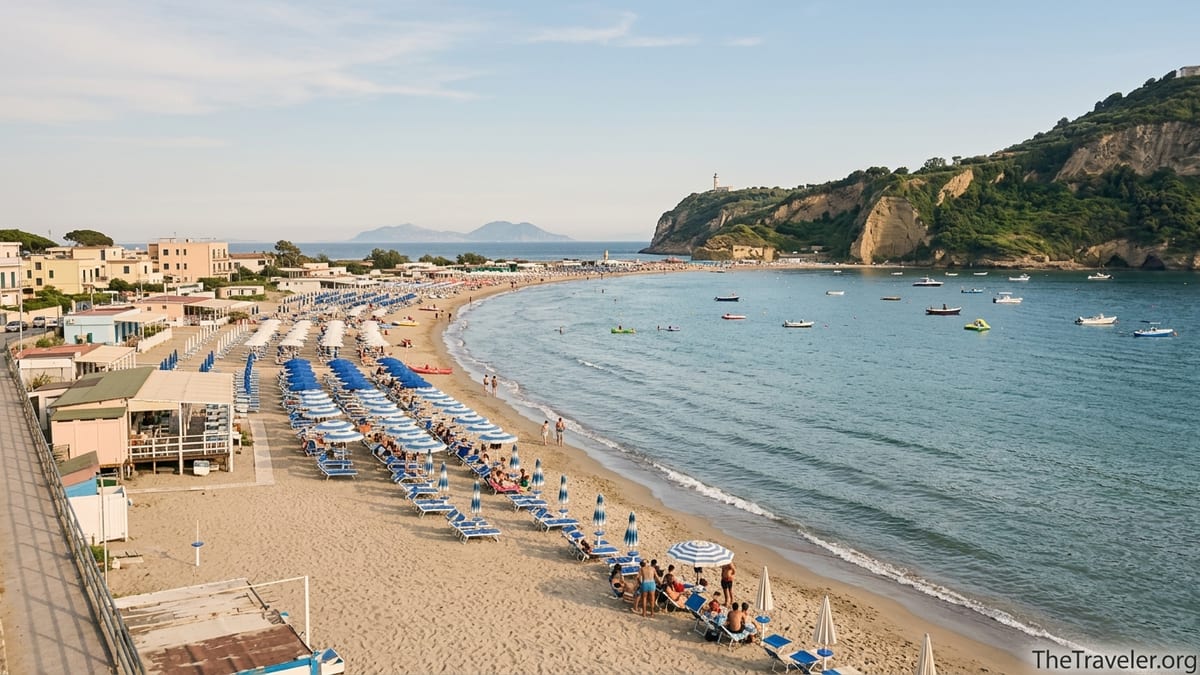
On paper, Miseno sounds like the kind of place that should already be overrun. It has a long sandy beach looking toward Capri, a marina curled under a dramatic headland, and Roman ruins scattered between pastel houses. Yet what surprised me most, arriving from Naples with sunscreen and big expectations, was how thoroughly local it still feels. Miseno is not a polished resort. It is a lived-in corner of the Campi Flegrei where Neapolitans come to swim, gossip, eat seafood and watch the light change over the bay, and visitors are simply folded quietly into that routine.
Get the latest updates straight to your inbox!
A Naples Beach Escape That Is Still Neapolitan
Miseno is not its own municipality but a frazione of Bacoli, in the volcanic Campi Flegrei area roughly 15 kilometers west of Naples. On the map, it sits at the very tip of a narrow peninsula, wedged between the Tyrrhenian Sea and Lago Miseno, a coastal lagoon that was once part of the Roman naval base of Misenum. In practical terms, it feels like the last stop of greater Naples: the city’s concrete edge gradually gives way to low pastel houses, fruit trucks parked under plane trees, and the faint smell of the sea drifting in from both sides.
Many visitors reach Miseno on summer “Bus del Mare” services that connect Naples neighborhoods like Vomero with the beaches of Miliscola and Capo Miseno in about an hour, or by combining the Cumana train to Fusaro with a short local bus ride. Seasonal shuttles run along the Baia–Miseno–Miliscola strip, linking archaeological Baia with the lidos of Miseno. Even in high season, these buses feel more like commuter lines than tourist transport: teenagers with beach bags, grandparents with folding chairs, and families loaded with umbrellas rather than rolling suitcases.
That arrival sets the tone. Instead of emerging into a resort promenade, you step down near simple bars, newspaper kiosks and bakeries selling warm sfogliatelle alongside beach toys. The soundtrack is Neapolitan, not international: rapid-fire Italian, snatches of local dialect, and the metallic click of coffee cups in saucers. For a place with such accessible natural beauty, the lack of obvious tourist infrastructure is striking.
What makes Miseno special is that it still functions primarily as a seaside neighborhood for Bacoli residents and Napolitani on a day out, rather than a destination reshaped to meet foreign expectations. Prices reflect that. A mid-morning espresso at a bar near the port is usually around 1.20 to 1.50 euros, and a cornetto rarely exceeds 2 euros. Even at beachfront bars, a glass of house white wine hovers at local, not luxury, levels.
First Impressions on the Lido di Miseno
The best way to feel Miseno’s local character is to walk the length of Lido di Miseno, the broad sandy curve that runs between Capo Miseno and neighboring Miliscola. The beach is divided into privately run lidos, each with its own color-coded umbrellas and low-key branding, interspersed with small free stretches of sand. Rather than international hotel chains, you find family-run operations with names like Lido Saturday or Miseno Café lido, where the people renting you a sunbed might well be the owners themselves.
On a June weekday, I paid about 15 to 20 euros for a full day package for two people at one of the simpler lidos: two sunbeds, an umbrella and access to showers and changing cabins. On peak August weekends, the same setup can climb toward 25 to 30 euros, but advance reservations are still done by phone or WhatsApp, often by messaging the owner directly. More often than not, regulars simply walk in and are greeted by name.
Everything about the scene feels local. Groups of friends in their twenties arrive on scooters and mopeds, pulling off helmets to reveal perfectly styled hair. Parents unpack coolers with homemade parmigiana di melanzane and foil-wrapped panini. Elderly men in neatly pressed swim trunks stake out front-row seats and alternate between the water, the bar counter, and long conversations with the lifeguards. There are inflatable flamingos and Bluetooth speakers, but they are props in a Neapolitan family day rather than Instagram accessories aimed at visiting influencers.
If you want to experience this world without feeling like an intruder, it helps to follow the local rhythm. Arrive early, between 9:00 and 10:00, claim a spot, and join the mid-morning pilgrimage to the bar for a caffe freddo or a lemon granita. Lunch peaks between one and three, when the beach briefly empties and the shaded terraces fill with plates of spaghetti alle vongole and fried anchovies. By late afternoon, the sun softens and families reappear for a second swim, stretching the day almost until sunset.
The Porticciolo: Where Fishing Boats Outnumber Yachts
Walk away from the long sands of Lido di Miseno and you reach the small port area known as the porticciolo, or Porticciolo Casevecchie. Here the local feeling intensifies. Fishing boats moor side by side, many of them painted in fading blues and reds, their decks cluttered with nets and plastic buckets. A handful of larger pleasure craft and charter boats share space with working vessels, but the overall scale is human and slightly chaotic in that endearing southern Italian way.
Along Via Miseno, modest seafood trattorias occupy ground-floor spaces facing the water. At Da Fefè, a long-running restaurant just steps from the moorings, the menu highlights dishes like linguine with grouper ragù and seared tuna, made with fish that often arrives via the little boats outside. Diners praise its relaxed atmosphere and fair value for money, and the crowd is noticeably mixed: local couples on a weeknight date, family tables celebrating birthdays, and a smattering of out-of-towners who look pleasantly surprised at how unpretentious the setting is.
A few doors away, smaller spots such as Miseno a ‘Mmare cater to the boating community and locals who stroll down for a simple plate of fried calamari and a beer with a marina view. Prices are aligned with everyday Neapolitan dining rather than coastal glamour: a generous seafood pasta might run 15 to 20 euros, with house wine by the carafe for a few euros per person. There are no printed English menus taped to the door. Instead, staff often recite the day’s options, occasionally switching into basic English if they sense you are struggling with Italian.
This port area is also where you see how Miseno remains connected to the workaday world. Fishermen mend nets in the afternoons, small trucks deliver crates of vegetables and local wine to restaurants, and young staff on seasonal contracts share cigarettes and jokes between shifts. As sunset approaches, the sky behind Capo Miseno turns shades of pink and orange, reflecting off both the sea and the surface of Lago Miseno on the opposite side. It is one of the most spectacular, and least advertised, evening light shows on this coast.
Capes, Craters and Quiet Hikes: Miseno’s Wild Edge
Beyond beach clubs and seafood lunches, Miseno has a surprisingly wild side. Capo Miseno, the headland that closes the bay, rises as a tuff cliff typical of the Campi Flegrei, with steep faces dropping into the sea and scrubby Mediterranean vegetation clinging to its slopes. A footpath, sometimes referred to as the Sentiero del Faro di Capo Miseno, climbs toward the lighthouse at the tip of the cape, offering sweeping views across the Gulf of Naples to Capri, Ischia and Procida.
This is not a manicured hiking trail with visitor centers and souvenir shops. Instead, it feels like a local secret: used by dog walkers, trail runners and a handful of photographers in the know. The route can be stony and uneven in places, and on hot days you will want sturdy shoes, water and a hat. In return, you are rewarded with a perspective on Miseno that few day trippers ever see, including a bird’s eye view of the long ribbon of sand, the lagoon and the low-rise houses of Bacoli.
Even closer to sea level, you can glimpse the underlying geology at small coves and rocky outcrops along the base of the cape. Boat tours from nearby Baia and Bacoli sometimes include stops near Capo Miseno, highlighting the yellow tuff formations and the way downcut rock contrasts with the bright blue water. These are reminders that Miseno is not just a beach town but part of one of Europe’s most active volcanic systems, albeit in a quietly simmering rather than eruptive phase.
For visitors interested in the area’s ancient past, a short bus ride or drive from Miseno leads to the Museo Archeologico dei Campi Flegrei, housed in the Aragonese castle of Baia. Exhibits include finds from the Roman naval base at Misenum, statues and decorations from nearby villas, and reconstructions of the partially submerged nymphaea and bath complexes along the coast. It is striking to move from a morning swim in the bay to glass cases displaying objects that once belonged to admirals, emperors and their entourages who used these same waters nearly two thousand years ago.
Eating and Drinking Where Locals Do
Food in Miseno follows the rhythms of Bacoli and wider Campania: seafood first, with seasonal vegetables and simple pastas as supporting actors. At lidos such as Miseno Café or Marina Beach Miseno along Via Dragonara, you are likely to find menus centered on grilled catch of the day, plates of mixed fried fish and classics like spaghetti alle vongole. Prices tend to be more reasonable than on the Amalfi Coast or Capri, especially if you stick to daily specials and house wines.
One of the pleasures of eating in Miseno is how many places blur the line between bar, café, lido and restaurant. In the morning you might order a cappuccino and brioche in a simple beachfront bar. By lunch, that same counter is turning out plates of insalata di mare and steaming bowls of pasta e fagioli with mussels. Later still, the lights dim, the music comes up just a notch, and the same room becomes a casual aperitivo spot serving spritzes and local Falanghina by the glass.
For a more elevated experience, travelers sometimes pair a day in Miseno with dinner at Caracol, the Michelin-starred restaurant perched above nearby Capo Miseno, accessed through the Cala Moresca hotel. While this is technically outside the immediate beach neighborhood and aims at a destination-dining audience, its tasting menus still draw on Campi Flegrei ingredients and views that locals resolutely claim as their own. It is a reminder that high-end gastronomy can coexist with simple port trattorias within the same small radius.
Wherever you choose to eat, it pays to follow local habits. Book Friday and Saturday evenings in advance, especially from late June to early September, and do not be surprised if tables only begin to fill after 8:30 or 9:00 p.m. In many family-run places, menus might be verbally updated depending on what came off the boats that morning. If you ask for recommendations and signal openness to whatever is freshest, you are likely to be rewarded with dishes that never make it onto printed cards.
Getting Around and Practical Details
Part of what keeps Miseno feeling local is the way people move through it. Cars are useful for reaching the area, but once there, narrow streets, limited parking near the beach, and summer traffic make walking and buses more practical. Many Neapolitans who do not own cars rely on the Cumana train to Pozzuoli or Fusaro, then switch to local buses toward Bacoli and Miseno. Seasonal “mare” routes add capacity in summer, specifically targeting beachgoers without turning the area into an isolated resort bubble.
If you are staying in central Naples, budget around an hour to an hour and a half to reach Miseno by public transport, depending on connections and traffic. Train and bus tickets together usually stay under 5 to 7 euros each way per person, noticeably cheaper than ferries to islands like Capri or Ischia. For groups or travelers with bulky beach gear, taxis and ride-hailing services can reduce travel time but push costs into the 60 to 80 euro range round trip, especially in peak season and with return trips at sunset.
Once in Miseno, you can comfortably explore on foot. The distance from the main lido area to the porticciolo is walkable in 15 to 20 minutes, with Lago Miseno almost always in view on one side and distant silhouettes of Ischia and Procida on the horizon. Simple seafront promenades and lakeside walkways, lined with bars and restaurants such as Roof & Sky near the lagoon, give you plenty of excuses to stop for a drink, a gelato or a plate of fried seafood.
In terms of seasonality, July and August bring peak crowds, particularly on weekends, when families from Naples and inland Campania descend early and pack the lidos. Late May, June and September often strike the best balance for visitors: warm enough to swim, most services operating, yet with enough space on the sand to appreciate the relaxed local dynamic. Even then, you are more likely to hear Neapolitan and Italian than English or other foreign languages, which is exactly what gives Miseno its particular charm.
How to Blend In and Respect the Local Rhythm
Because Miseno functions first as a local seaside community, visitors have a chance to slip into an existing rhythm rather than bending a place to their own. Simple gestures go a long way. Greeting staff with a “buongiorno” or “buonasera,” ordering at the counter like everyone else, and taking the time to return plates and glasses rather than leaving them scattered on the sand are all noticed and appreciated. This is a beach where people often know each other by name, and regulars treat their favorite lido almost like an extension of their living room.
Dress codes are relaxed but not careless. Swimsuits and flip-flops are standard on the sand, yet locals usually cover up with a light dress, T-shirt or pareo before stepping into a bar or restaurant. Loud, drunken behavior is uncommon, even during high season weekends. Aperitivo hours are social but family-friendly, with children running between tables and grandparents staking out shaded chairs while younger generations circulate.
Because many businesses are small family operations, patience is essential. Service may slow at peak lunch hours when a single kitchen handles both takeaway orders and seated diners. Rather than demanding speed, lean into the slower tempo: order an extra drink, watch the sunlight move across the lagoon, and accept that your day in Miseno is anchored more to the rhythm of the tide than to the clock on your phone.
Above all, remember that you are stepping into a seaside life that exists even when the tourists are gone. In winter, the same bars welcome locals for espresso and card games; the same fishermen work the bay; the same families stroll Lago Miseno on Sunday afternoons. Treat the place with the kind of respect you would offer if you were visiting a friend’s neighborhood, and Miseno will reveal itself as something richer than a simple beach escape.
The Takeaway
What makes Miseno so surprising is not its scenery, although the combination of sandy beach, volcanic headland and mirror-like lagoon is undeniably striking. Nor is it the food, though plates of clams, mussels and fried anchovies here can easily rival those in more famous coastal destinations. The real surprise is how little the area has rearranged itself around tourism, despite being so close to a major city and so blessed with natural and historical assets.
In Miseno, you do not find multilingual touts, souvenir shops every few meters or menus translated into five languages. You find working marinas, small family lidos, modest apartment blocks, school groups on summer outings, grandparents reading newspapers under umbrellas, and teenagers rinsing sand off scooters before heading home at dusk. Travelers are welcome, but the place belongs clearly and confidently to the people who live and spend their summers there.
For visitors willing to embrace that reality, Miseno offers a rare kind of coastal experience on the Bay of Naples: one that feels authentically Neapolitan rather than curated, shaped by local priorities rather than global expectations. You can still swim in clear water with views of Capri, eat seafood caught a few hours earlier, and watch the sun set behind Ischia. But you do so from a plastic chair at a family bar or a sunbed on a lido where most of the conversations around you are about school schedules, football and neighborhood gossip.
If you arrive in Miseno expecting a resort, you may initially be thrown by its modest facades and everyday clutter. If you stay long enough to recognize faces, rhythms and small rituals, you may find that what seemed ordinary at first is exactly what makes it unforgettable. More than any postcard-perfect panorama, it is this sense of being folded gently into local life that lingers long after the sand has been shaken from your shoes.
FAQ
Q1. Where exactly is Miseno and how do I get there from Naples?
Miseno is a seaside district of Bacoli, about 15 kilometers west of Naples in the Campi Flegrei area. Most travelers take the Cumana train from central Naples to stations like Fusaro or Torregaveta, then connect to a local bus toward Bacoli and Capo Miseno. In summer, additional “Bus del Mare” routes run directly from some Naples neighborhoods to the Miliscola and Miseno beach area.
Q2. Is Miseno a good alternative to Capri or the Amalfi Coast?
Yes, if you are looking for a more local, low-key experience. Miseno offers long sandy beaches, volcanic scenery and good seafood at everyday prices, but it lacks the polished resort infrastructure, designer shopping and nightlife of Capri or Positano. It is best suited to travelers who value authenticity over glamour.
Q3. What is the beach at Miseno like?
Lido di Miseno is a wide sandy bay facing the Tyrrhenian Sea, divided into privately run lidos with sunbeds and umbrellas, plus some free public stretches. The water is generally calm and shallow near the shore, making it popular with families. On summer weekends it can be very busy with Neapolitan day trippers.
Q4. How much should I budget for a beach day at a lido?
For two people, expect to pay roughly 15 to 25 euros total on a normal summer weekday for two sunbeds and an umbrella at a mid-range lido, rising to around 25 to 30 euros on peak August weekends. Food and drinks are extra but typically priced in line with everyday Neapolitan cafés and trattorias.
Q5. Are there free public areas on the beach?
Yes. Between the organized lidos there are sections of free public beach where you can spread your own towel and umbrella without paying for facilities. These areas can fill up quickly on busy days, so arrive early if you prefer the free sections.
Q6. Is Miseno suitable for travelers who do not speak Italian?
Basic English is spoken in some bars, restaurants and lidos, especially in summer, but Miseno is not heavily geared toward foreign tourism. Learning a few simple Italian phrases and being patient with communication goes a long way. Menus may not always be translated, so be prepared to ask for explanations or daily recommendations.
Q7. What is the best time of year to visit Miseno?
Late May, June and September usually offer warm weather and swimmable water with fewer crowds than July and August. High summer brings the most vibrant local atmosphere but also heavier traffic, busier lidos and higher demand for restaurant tables, especially on weekends and holidays.
Q8. Besides the beach, what else is there to do?
Beyond swimming and sunbathing, you can walk up to Capo Miseno and its lighthouse for panoramic views, stroll around Lago Miseno, explore the small port area, or visit nearby sites such as the archaeological museum in Baia and Roman remains scattered across Bacoli. Boat trips along the Campi Flegrei coast are also available in season.
Q9. Is Miseno expensive compared with other coastal areas?
Overall, Miseno tends to be more affordable than high-profile destinations like the Amalfi Coast or Capri. Beach services, meals and drinks are priced for local customers, though certain upscale restaurants in the wider area can be more costly. Transport from Naples by train and bus is relatively inexpensive.
Q10. Can I base myself in Miseno or is it better as a day trip?
Miseno works well as both. Many visitors come for day trips from Naples, combining beach time with a seafood lunch. However, staying in Bacoli or the Miseno area overnight offers a quieter alternative to the city, with calmer evenings and the chance to enjoy early-morning swims or sunset walks without watching the clock for return transport.