


More news on this day
A week after two East Midlands Railway passenger services collided near Bedford, killing a driver and injuring well over 100 people, investigators and rail engineers are still piecing together how one of the most serious UK rail accidents in decades unfolded and what it means for passengers who rely on the busy Midland Main Line.
Get the latest news straight to your inbox!
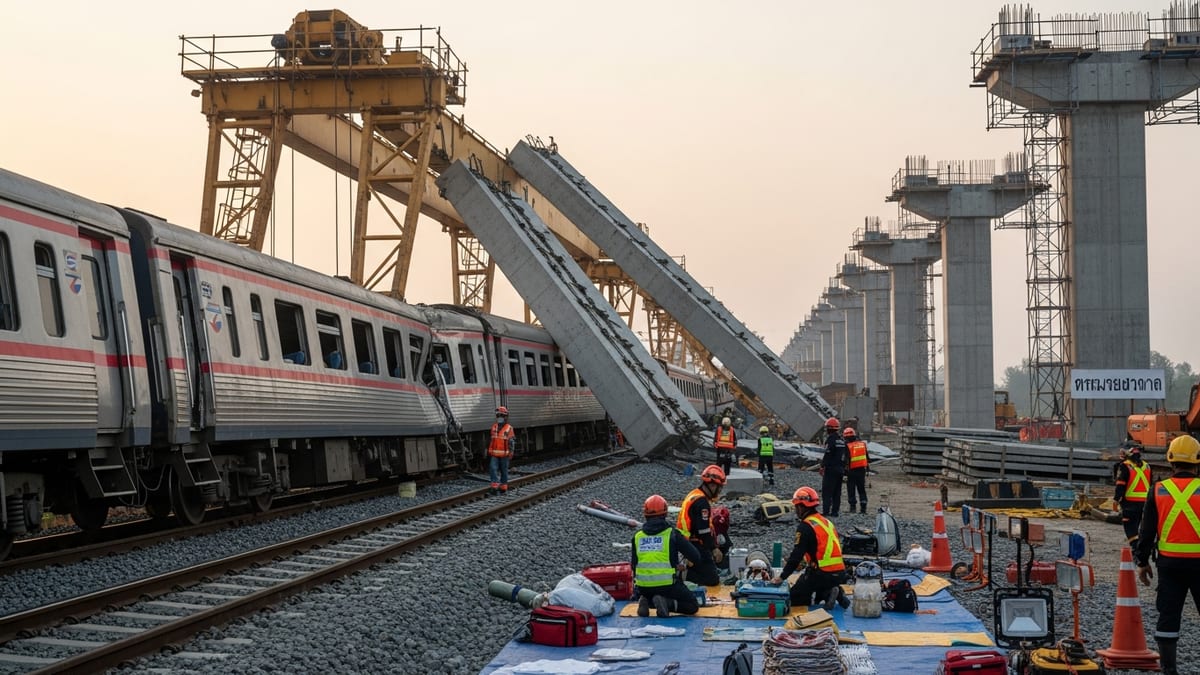
How the collision unfolded near Bedford
The collision occurred on the evening of Friday 19 June near Elstow, just south of Bedford, on the Midland Main Line between Bedford and Luton. Two East Midlands Railway services, both heading south, were involved. One train was stationary on the line when it was struck from behind by another service travelling at an estimated 49 miles per hour.
British Transport Police described the incident as a major collision involving packed commuter and intercity services at the height of the Friday evening peak, with emergency calls received shortly after 5.15pm. News footage and photographs showed significant damage to the leading vehicles of the moving train and to the rear of the stationary service, with debris scattered along the track and overhead power equipment visibly distorted.
Reports from passengers gathered by national broadcasters and local media describe a sudden, violent impact that threw people from their seats and left carriages dark and filled with dust. Despite the scale of the crash, the trains remained upright and on the tracks, a factor rail specialists suggest helped prevent even greater loss of life.
The crash immediately severed one of the principal north–south rail arteries into London St Pancras, forcing a rapid response from emergency services, rail staff and local agencies as hundreds of people were evacuated from the trains and surrounding area.
Casualty figures and the human toll
The driver of the moving train, 60‑year‑old Shaun Burton, died at the scene. His name was released in the days after the crash, and public tributes from his family, colleagues and rail unions have highlighted his long service on the railway and the shock felt across the industry.
Initial reports spoke of around 90 injured passengers and crew. Updated information from ambulance services and British Transport Police later indicated that the total number of injured eventually exceeded 150, as more people came forward with serious and minor injuries in the days after the crash. A significant number were treated at the scene for cuts, fractures and shock, while others were transported to hospitals across the East of England and London.
By Monday 22 June, publicly available statements indicated that eight people remained in a critical condition. A further update on Friday 26 June reported that 36 people were still in hospital a week on from the collision, three of them in critical condition, with others described as seriously or moderately injured.
Community leaders, rail staff and local clergy have organised gatherings and a service of reflection at Elstow Abbey, close to the crash site, to acknowledge the scale of the trauma for those on board and for residents who witnessed the aftermath. Commentators across national and regional outlets have noted that this is the first fatal collision between two passenger trains on a British mainline in many years and one of the most serious in terms of casualties in more than two decades.
Early findings from the safety investigation
The Rail Accident Investigation Branch (RAIB) released an initial report during the week, providing the first technical outline of what is known so far. According to this preliminary account, the southbound East Midlands Railway service driven by Shaun Burton passed a red signal shortly before the impact, entering a section of track where another EMR train was standing.
Data examined by investigators indicates that brakes were applied around nine seconds before the collision, reducing speed but not enough to avoid striking the rear of the stationary train. The interim findings confirm that both services were operating on the same line and that there was no derailment, although damage to vehicles and infrastructure was extensive.
Industry analysis in specialist and general media has focused on the signalling layout and the presence or absence of additional train protection systems designed to intervene if a train passes a red signal at speed. Questions are being raised about whether all possible layers of protection were active on the route and whether any technical faults contributed to the sequence of events.
The RAIB has stressed in its public material that the initial report is not a full explanation of the causes. A comprehensive investigation, expected to take many months, will examine human factors, signalling design, operational procedures, maintenance records and the performance of emergency systems before issuing final safety recommendations.
Impact on rail services and the Midland Main Line
The crash brought immediate and severe disruption to services on the Midland Main Line, one of the key routes linking London with the East Midlands and South Yorkshire. In the hours after the collision, operators suspended trains through the affected section, with many services terminating at Bedford or Luton and others cancelled entirely.
Public travel updates from East Midlands Railway and other operators over the weekend of 20–21 June warned of reduced timetables, extended journey times and overcrowding on alternative routes. Replacement road transport and diversions via other main lines were arranged, but capacity remained constrained as engineers began what was described as a complex recovery operation to remove damaged carriages and assess the condition of the tracks and overhead cables.
Network Rail has reported that both trains have now been removed from the site and that work to repair and reinstate overhead power lines and signalling equipment is close to completion. The track formation and supporting structures in the Elstow area have been inspected and, where required, renewed.
By Saturday 27 June, national and regional outlets were reporting that the Midland Main Line is expected to reopen on Monday, restoring through services between London St Pancras, Bedford and destinations further north. Passengers are being advised to check revised timetables, as some temporary speed restrictions and residual delays are likely while systems are tested and normal patterns of operation resume.
Safety questions and what comes next
The Bedford collision has reignited debate about rail safety, signalling resilience and investment in train protection technology on some of the UK’s busiest routes. Comment pieces and specialist analysis have pointed out that Britain’s railways remain among the safest in Europe, with very few fatal accidents involving passenger trains in recent years, but have also stressed that this crash occurred on a modern, electrified mainline equipped with multiple safety systems.
Particular scrutiny is focusing on why a train was able to pass a red signal and travel far enough to strike another passenger service, and whether any additional layers of automatic protection could or should have intervened sooner. Attention is also turning to the condition and design of the signals protecting the section where the stationary train was waiting, and to the operational context, including traffic levels, communication protocols and any technical alerts in the minutes leading up to the crash.
Rail unions and passenger groups are closely watching the RAIB inquiry and internal reviews by Network Rail and East Midlands Railway, calling for full transparency and for any safety recommendations to be implemented rapidly across comparable parts of the network. Commentators note that previous major rail accidents have often led to significant upgrades in signalling, rolling stock and procedures, and there is an expectation that the Bedford crash will produce similar far‑reaching lessons.
For now, published information suggests that the investigation remains at an early stage. More detailed findings will emerge in interim and final RAIB reports over the coming months. As the line prepares to reopen and injured passengers continue their recovery, attention is turning to how the railway can reduce the already low risk of such a high‑impact collision happening again on one of the country’s most important intercity corridors.