


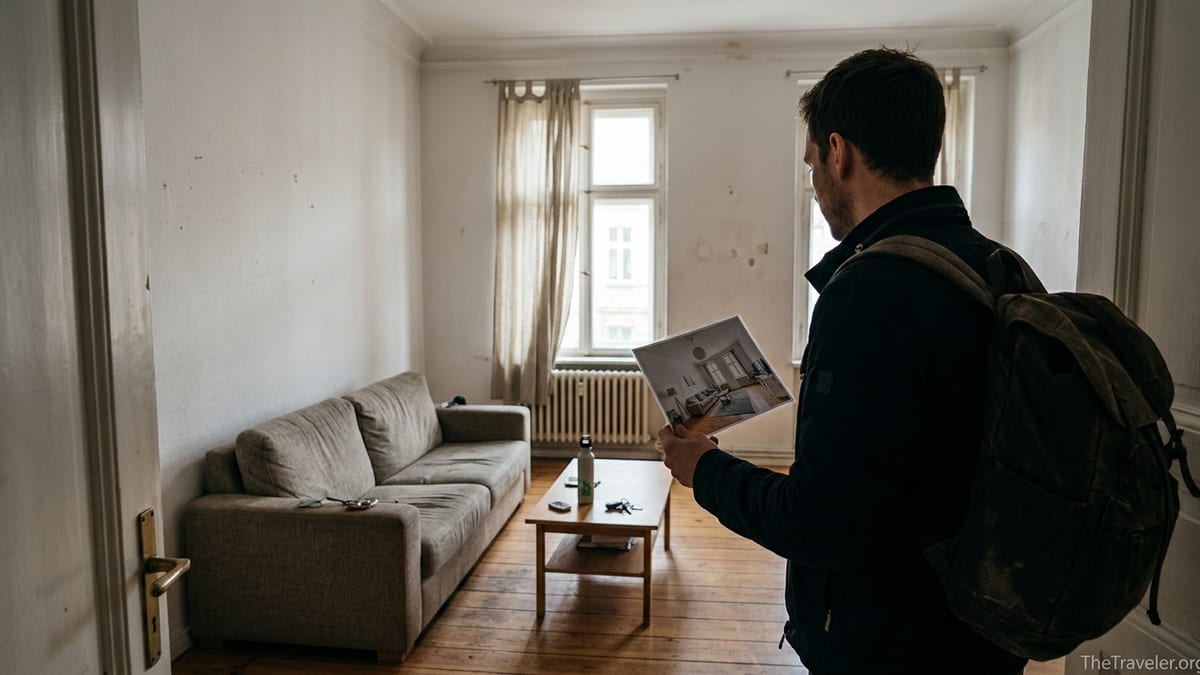
The first time I unlocked the door to an Airbnb that looked nothing like its photos, I thought I had made a mistake: wrong address, wrong floor, wrong city. The listing showed sunlight pouring through big windows onto blonde wood floors. The reality was a dim one-bedroom in a 1970s building on a traffic-clogged avenue, its once-white walls now nicotine beige. That jolt of disappointment was my introduction to one of the biggest truths about Airbnb: even honest listings can feel wildly different from their photos.
Get the latest updates straight to your inbox!
Why Photos Shape Our Expectations So Powerfully
On any booking platform, photos are the closest thing a traveler has to a promise. Airbnb listings in particular lean on imagery to sell not only a bed for the night but a lifestyle: café tables on tiny balconies in Lisbon, trailing plants in Brooklyn lofts, steaming hot tubs beside A-frames in Colorado. A well-framed photograph suggests light, space, and mood, and it is easy to read that mood as reality. When you see a studio in Paris glowing at golden hour, your brain quietly assumes every hour in that apartment will feel the same.
Hosts know this. Many follow professional advice to shoot at the brightest time of day, open every curtain, turn on every lamp, and angle the camera from a corner to capture as much floor as possible. Hospitality consultants point out that a wide-angle lens is almost a standard tool for serious hosts now because it makes compact city apartments look more generous than their square footage suggests. The result is a visual language that favors aspiration, not accuracy.
Airbnb itself encourages strong visuals. The company promotes verified photos and has introduced internal photo-confirmation tools that ask hosts to take new images of the same corners of bedrooms and living rooms to check that current conditions roughly match what is advertised. Yet those checks are limited, and they focus on whether something exists, not how it feels. The bed might be there, the balcony might be there, but the soft light and abundance of space implied by the original photos are much harder to guarantee.
As a traveler, the gap between mood and reality is where disappointment lives. You are not just renting a set of amenities. You are renting the story the pictures told you. When the story unravels on arrival, even technically accurate listings can feel misleading.
The Most Common Ways Listings Differ From Reality
After more than a decade of staying in Airbnbs across cities like New York, Athens, Rio de Janeiro, and Tokyo, I have noticed the same patterns repeating. They do not always involve outright deception. More often, they are the product of flattering choices that snowball into a very different impression of a space.
Space is the biggest culprit. In Barcelona’s Gothic Quarter, for example, I once booked what looked like a spacious one-bedroom for around 140 dollars a night in late spring. In the photos, the living room had a long sofa facing a generous coffee table, a clear walkway to the kitchen, and room to spare around a dining set for four. In person, the same room required you to turn sideways just to squeeze past the table, and the sofa was effectively pressed against the kitchenette. The wide-angle lens and careful staging had taken a 350-square-foot apartment and made it feel, online, like 500.
Lighting is a close second. A classic example is a basement unit advertised as feeling “bright and airy” because the host shot it at noon, every light on, with exposure boosted in editing. A friend paid about 110 dollars a night for such a place in Toronto and arrived on a winter evening to find a room that felt more like a windowless storage unit. All the lamps were there, exactly as pictured, but with no natural light and a low ceiling, the space felt oppressive. Technically, the listing was not lying. Emotionally, it felt like a bait-and-switch.
Then there is wear and tear. Hosts often use photos taken when a place was freshly renovated: grout still white, sofa cushions still firm, rugs still vibrant. Years later, those same photos can remain online even if the apartment has faded. A seaside flat in Lisbon might show pristine hardwood floors and crisp linen bedding, but salt air is unforgiving. By the time you arrive, there may be swelling in the wood, rust on balcony railings, and towels that have seen hundreds of washes. None of this is catastrophic, but it is jarring if the images have not kept up.
When It Crosses the Line Into Misleading
Not every discrepancy is benign. Sometimes, the differences between photos and reality drift into what many travelers would reasonably call misleading. The clearest red flag is when a major feature that sold you on the listing turns out to be something else entirely on arrival.
Location is a common flashpoint. There are documented cases of guests in U.S. cities turning up to find that a “downtown” listing is actually several miles away in a different neighborhood altogether, or a “steps from the beach” condo that requires a fifteen-minute drive inland. Sometimes, the photos show views from a different floor or even a different building in the same complex, which lets the host rely on technically accurate interior shots while the bigger promise, proximity, slips.
Amenities can be just as contentious. Consider a mountain cabin promoted with steaming hot tub photos and language about “soaking under the stars.” On arrival, some guests have discovered the tub locked, out of service for the season, or available only at an extra nightly fee that was not mentioned in the description. Others have booked “private pool” villas in Southern Europe only to arrive and find that the beautiful blue rectangle in the photos is, in reality, a pool shared with three other apartments in the same compound.
Airbnb’s official refund framework for “bad experiences” focuses on material inaccuracies: the wrong number of bedrooms, missing kitchens, malfunctioning heating or cooling, or serious cleanliness issues. Travelers can generally request help within 72 hours, document the problem, and in some cases be rebooked or refunded. But plenty of guest stories show a gray zone where a place technically matches the listing and the photos, yet feels so far from the impression they created that trust frays. This is where expectations, not policy, become the real battleground.
How Hosts Use Photography to Their Advantage
When you scroll Airbnb, it helps to remember that you are rarely looking at neutral documentation. You are looking at marketing photography. Professional operators and experienced hosts treat each listing like a miniature ad campaign, and they lean on every visual tool they can to make their space stand out in a crowded search grid.
Staging is one of those tools. Before a shoot, hosts often remove clutter, bring in extra plants or cushions, and temporarily add items such as record players or coffee table books to create a sense of personality. A minimal studio in Berlin might be peppered with design magazines and artisanal ceramics just long enough to capture a sense of cool that is difficult to maintain between guests. When you arrive, you might find a much barer room because anything not nailed down becomes another thing that can be broken or stolen.
Editing is another. Brightening photos, warming the color temperature, and slightly adjusting saturation are standard, and Airbnb does not forbid this as long as the content remains truthful. Yet those subtle tweaks can change the entire character of a space. A concrete-walled loft shot in flat, gray light can feel austere or cold. Add some warmth and a slight lift in contrast, and suddenly it reads as cozy and industrial-chic. Hosts know that guest favorites and top-quality badges on Airbnb are influenced by ratings and reviews, so an inviting first impression is not just vanity; it can be a revenue driver.
Then there is what hosts choose not to show. Many omit less attractive angles: the view of the neighboring wall two feet from your only window, the busy bar directly beneath your bedroom, the parking lot that replaces the leafy garden mentioned in the text. The listing is not lying; it is curating. Yet when you book based on thirty perfect angles and discover a glaring omission, the gap between expectation and reality can feel like dishonesty, even when the host stayed within the letter of the rules.
Reading Listings Like a Pro: What Photos Really Tell You
The good news is that with a more skeptical eye, you can often predict how different a listing might feel in person. The goal is not to catch hosts out but to recognize the limits of photography and decode what is hiding between the pixels.
First, pay attention to photo variety. A trustworthy listing tends to show repeating angles of the same rooms, capturing both glamorous and mundane details: inside closets, under-sink areas, hallways, and street views. If a two-bedroom apartment in Athens shows only close-ups of cushions, coffee mugs, and art but few wide shots of each room, it is worth pausing. Decorative vignettes are easy to stage. They do not tell you much about square footage, natural light, or wear.
Second, study light and windows. Ask yourself: in how many photos can you clearly see the window itself, not just sunlight pouring from an unseen source? If you never see the window frames or actual views, there is a chance you are looking at carefully timed, lamp-heavy shots that will not translate into an airy feel day-to-day. In humid cities or dense historic centers where windows can be small or obstructed, this matters more than you might think.
Third, cross-check the photos with the written description and recent reviews. Does the text promise “quiet” but several recent guests mention traffic noise or a late-night bar below? Does the listing call the place “spacious” while reviewers refer to it as “cozy” or “tiny but cute”? Those kinds of soft contradictions are your best clues that the photos are flattering. In practice, you might accept a snug studio in Rome for 95 dollars a night if you know what you are walking into, but feel cheated by the same place if you booked expecting room to spread out.
What To Do When Your Airbnb Is Not As Pictured
Even with all the vigilance in the world, you can still arrive to a place that does not feel like its online self. In that moment, emotions run high. You are tired, you are carrying luggage, and the last thing you want is to negotiate with a stranger about square footage or wall color. It helps to know, in advance, what your options realistically look like.
If a discrepancy is serious and objective, such as a missing bedroom, a broken shower, or a property that is clearly in a different neighborhood than described, start by documenting everything. Take your own photos that mirror those in the listing as closely as possible: the same angle on the living room, the same view from the balcony, the same shot of the kitchen area. Then message the host through Airbnb’s platform describing the issues calmly and concretely, and give them a chance to respond.
If the host is unresponsive or dismissive and the issue rises to the level of a material inaccuracy or serious cleanliness or safety problem, you can escalate to Airbnb support. The platform’s refund and rebooking policies generally require you to act quickly, often within about 72 hours of check-in for home stays, and to communicate through the app so there is a written record. In some cases, Airbnb will help you find an alternative place to stay or partially or fully refund nights you cannot or will not use.
For softer gaps, such as a smaller-than-expected living area or more worn furniture, the reality is more nuanced. Airbnb tends to weigh whether the listing and photos can reasonably be said to represent the place, even if they present it in its best light. You might have little formal recourse if the only difference is that the place feels gloomy or compact compared with what you imagined. At that point, the decision becomes personal: stay and adjust expectations, or leave and absorb the cost if refunds are not forthcoming.
Setting Yourself Up for Fewer Surprises
Over time, I have changed how I book Airbnbs to account for the difference between photos and reality. The aim is not to chase perfection but to minimize the odds of an ugly surprise that derails a trip. That starts with prioritizing transparency over charm in listings. I now gravitate toward places with plenty of unglamorous photos, clear shots of bathrooms and exteriors, and hosts who mention minor flaws in the description, such as “second-floor walk-up” or “some street noise on weekends.” Paradoxically, that honesty often signals a more reliable experience than a flawless gallery ever could.
I also pay close attention to review language that implicitly grades the accuracy of photos. Remarks like “exactly as pictured,” “looked just like the photos,” or “even better in person” are gold. In contrast, repeated comments such as “smaller than expected,” “a bit darker than in the photos,” or “could use some updating” are quiet signals that the gap between online and offline is real. On a recent trip to Mexico City, I skipped a 90-dollar-a-night apartment with impeccable images because three reviews in a row used the phrase “felt more like a hostel room” despite private-bathroom photos.
Finally, I now book with a hierarchy of must-haves and nice-to-haves in mind. Must-haves are things like a functional kitchen, working Wi-Fi, and sufficient beds, which I cross-check obsessively between photos, amenities, and reviews. Nice-to-haves are the mood elements that photos sell so well: dreamy light, beautifully styled shelves, Instagram-ready courtyards. If those turn out to be less impressive in person, I can shrug it off. That mental shift alone has made Airbnb stays feel less like a gamble and more like a calculated choice.
The Takeaway
My biggest surprise about Airbnb was not that some hosts stretch the truth with their photos. It was how easy it is, as a guest, to let those photos spin an entire fantasy about what a trip will feel like. A listing might be only a few square meters smaller than you imagined or a little dimmer than the images suggested, but the emotional impact of that difference can be enormous after a long flight and high expectations.
Airbnb is slowly adding tools like photo verification, quality badges, and more transparent review sorting to bridge that gap. Yet the most powerful protection still lies with travelers learning to read listings with a more critical eye. When you treat photos as marketing, not a promise, and rely equally on reviews, descriptions, and your own questions to the host, the platform becomes far less risky.
In the end, the goal is not to eliminate all surprises. Some of the best Airbnb experiences come from the unexpected: a courtyard that feels more magical than the photos showed, a city view that turns out to be wider, a host who has added thoughtful touches since the last guest posted their review. The art of booking well is learning to distinguish the pleasant surprises from the preventable disappointments, and to remember that every polished photo hides a real, imperfect space behind it.
FAQ
Q1. Why do so many Airbnbs look bigger in photos than in real life?
Hosts frequently use wide-angle lenses, shoot from room corners, and brighten images to capture as much space and light as possible. Those techniques are common in real estate photography and can make small studios or compact city apartments look significantly larger than they feel when you are actually standing inside them.
Q2. How can I tell if an Airbnb’s photos are likely to be accurate?
Look for a mix of polished and practical images: clear photos of every room, bathrooms, hallways, and exterior views. Check recent reviews for phrases like “exactly as pictured” or “looked just like the photos,” and be cautious if guests repeatedly mention that the place felt smaller, darker, or more worn than expected.
Q3. What should I do if my Airbnb looks very different from the photos when I arrive?
Start by documenting the differences with your own photos, ideally from similar angles as the listing. Message the host through Airbnb describing the issues clearly and give them a chance to respond. If there are serious inaccuracies, missing amenities, or hygiene problems, contact Airbnb support promptly with your evidence to request help, a rebooking, or a refund.
Q4. Can I get a refund if the Airbnb is smaller or darker than it seemed online?
It depends on how Airbnb evaluates the discrepancy. The platform tends to focus on objective issues like incorrect number of rooms, missing facilities, or major cleanliness or safety problems. If the space technically matches the listing but feels less spacious or bright than the photos suggested, you may have limited formal recourse, though you can still discuss a partial solution with the host.
Q5. Are hosts allowed to edit or enhance their listing photos?
Hosts are generally allowed to adjust brightness, contrast, and color to present their space as attractively as possible, as long as the images remain truthful. Using wide-angle lenses and staging decor is also common. What crosses the line is adding or removing significant features in editing or using photos of a different property, which would be considered misleading.
Q6. How can I avoid being misled by amenities shown in photos, like pools or hot tubs?
Do not rely on photos alone. Read the amenities list and full description carefully to see if features like pools, hot tubs, parking, or air conditioning are explicitly listed and whether they are described as private or shared. Scan reviews for mentions of those amenities, and if anything is unclear, message the host with direct questions before booking.
Q7. Are newer Airbnb listings riskier because they have fewer reviews?
New listings can be riskier because there is less independent feedback to confirm whether photos and descriptions match reality. That does not mean you should avoid them entirely, but you may want to be more cautious: examine the photos closely, read the description line by line, and consider messaging the host to ask specific questions about space, light, and any features that are important to you.
Q8. Why do some listings hide less attractive details in their photos?
Hosts often curate their photo sets to emphasize strengths and minimize weaknesses, much like any advertisement. They may avoid showing unappealing views, nearby construction, or worn fixtures. While that kind of selective framing is common, it can feel misleading if important context is omitted, which is why reviews and detailed descriptions are so valuable.
Q9. Does Airbnb do anything to check that listing photos are still accurate over time?
Airbnb has introduced internal tools that encourage hosts to submit updated photos of key spaces so the platform can verify that major features and layouts still match what is being advertised. However, not every photo is checked, and normal wear and tear may not be fully reflected, so guests should still treat images as a best-case snapshot, not a guarantee of current condition.
Q10. What is the best way to protect myself from disappointment when booking an Airbnb?
Combine a careful reading of photos with close attention to recent reviews and the written description. Prioritize listings with detailed images, honest-sounding notes about minor drawbacks, and consistent guest feedback about accuracy. If a particular feature is crucial to your stay, confirm it with the host in writing before you book so you have a clear record of what was promised.