


Many travelers land at Calgary International Airport, scan the horizon for the Rockies and immediately board a shuttle to Banff. Calgary is often treated as a launchpad, a practical stop between the airport and the mountains. Yet anyone who lingers even 24 hours discovers a city that is far more than a gateway. Calgary is a dynamic cultural, culinary and creative hub whose story is still catching up to its reputation. For travelers willing to slow down, it can completely reshape how Alberta is experienced.
Get the latest updates straight to your inbox!
The City Behind the “Gateway to the Rockies” Label
Calgary welcomes well over ten million visitors a year, a number that surprises many Canadians who still picture it only as an oil town and Stampede site. That visitor volume is fueled not just by the nearby Rockies but by a busy convention calendar, a dense festival season, and a growing reputation for food, film and culture. In 2025 the city hosted more than two hundred conventions and major events, from industry trade shows at the expanded BMO Centre on Stampede Park to niche gatherings focused on energy transition and tech startups. For travelers, that means the city’s calendar is rarely quiet, even when the ski lifts slow down.
Geographically, Calgary matters because of how efficiently it connects the prairies to the mountains. Calgary International Airport (YYC) sits roughly 17 kilometers from downtown, and a taxi or rideshare typically covers the distance in about 20 to 30 minutes depending on traffic. Calgary Transit’s Route 300 bus offers a cheaper option, linking the airport with the CTrain light rail system and downtown hotels. That practicality shows up in everyday decisions for visitors: whether you are heading to an office tower on 8 Avenue or catching a bus to Canmore, the city is designed so the airport is not an isolated outpost, but an integrated first stop.
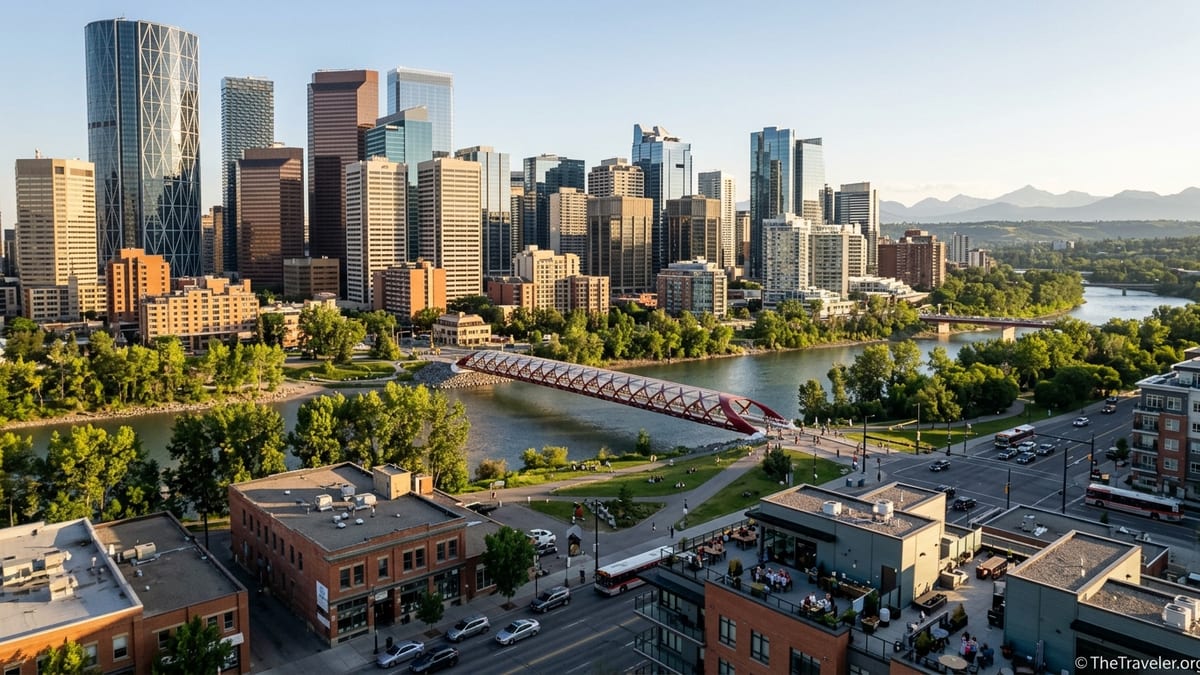
Yet the more important point is experiential. Spend a jet lagged evening strolling along the Bow River instead of racing to Banff, and the city quickly feels less like infrastructure and more like a living place. Runners circle Prince’s Island Park at dusk, families crowd patios in Kensington, food trucks line up near Eau Claire, and by the time the downtown towers begin to glow after sunset, Calgary has already argued persuasively that it deserves a chapter of your trip, not just a sentence.
A Culture and Events Scene Hiding in Plain Sight
Calgary’s most famous cultural moment is the Calgary Stampede each July, when rodeo events, concert headliners and midway rides take over the city for ten days. Many travelers build their entire itinerary around it, then assume Calgary is quiet the rest of the year. In reality, the Stampede is just the most visible peak in a stacked cultural calendar that runs through all four seasons.
Downtown and the Beltline host year round festivals that visitors regularly stumble into by accident. A September stay might coincide with the Calgary International Film Festival, where movie lovers queue on Stephen Avenue for premieres, including large productions shot in southern Alberta and local indie films. In autumn, the Rocky Mountain Wine & Food Festival at the BMO Centre brings together wineries, craft distilleries and some of Calgary’s most talked about restaurants, turning the exhibition halls into a maze of tasting booths and chef-run sampling stations. Even winter has its own brightness, from Chinatown’s Lunar New Year celebrations to light installations along the RiverWalk and in East Village.
Several major cultural projects are also reshaping the core. The ongoing revitalization of Stampede Park, including a major expansion of the BMO Centre, is designed to cement Calgary’s role as a national convention hub, drawing year round business travel that helps support restaurants, hotels and performance venues throughout the city. Just north of the tracks, the Arts Commons complex around Olympic Plaza continues to host everything from Calgary Philharmonic Orchestra performances to touring Broadway productions. For travelers, this web of venues means the odds of finding a worthwhile show on any given night are far higher than the city’s “gateway stop” reputation suggests.
From Oil Town to Tech, Film and Creative Capital
Calgary’s economy is still closely linked to energy, but for visiting travelers the more interesting story is how visibly the city is diversifying. You can see it in the banners for tech conferences outside the Telus Convention Centre, the co working spaces that have replaced former bank offices along 9 Avenue, and the film crews that now appear regularly in downtown alleys and prairie outskirts.
The Calgary Film Centre on the city’s southeast side has become a central piece of that shift. Purpose built sound stages and production facilities have helped attract large film and TV projects to the region, from prestige series set against imagined American landscapes to streaming films that rely on the nearby Rockies for dramatic backdrops. The Centre is now part of more than half a million square feet of studio and production space spread around the city, including additional facilities operated by private studios. For travelers, this manifests in subtle and sometimes charming ways: a familiar skyline seen later in a streaming series, a boutique hotel lobby hosting cast and crew in between shoots, or a local bar server casually mentioning they just wrapped as an extra on a western.
Downtown, the transformation is also visible in the kind of office tenants that occupy the towers. Tech firms and creative agencies increasingly share space with energy companies. Public art installations, including the widely photographed “Wonderland” sculpture in front of the Bow building, signal a city that is reimagining its public realm. Visitors staying in the core can easily walk between corporate offices, design studios, live music venues and independent galleries within a few blocks. That mix gives Calgary an energy that feels closer to Denver or Austin than the outdated stereotype of a purely conservative oil capital.
The Food and Drink Scene That Outshines Its Reputation
For years, Calgary’s culinary reputation outside Canada was little more than “good steaks.” While there is no shortage of excellent beef on the menu, the contemporary reality is broader and far more interesting. Over the last decade, a wave of chef driven restaurants, craft breweries and cocktail bars has reshaped neighborhoods like the Beltline, Inglewood, Kensington, Bridgeland and Mission into dense, walkable dining districts.
A visitor staying near 17 Avenue SW, for example, can spend an evening hopping from a bustling ramen shop to a modern Mexican restaurant, then end the night with a locally roasted espresso or a cocktail built around small batch Canadian whisky. In Inglewood, former industrial spaces now house breweries, distilleries and taprooms where travelers might sample a flight of hazy IPAs or barrel aged sours while chatting with locals about the latest Flames trade rumors. Across the river in Kensington, streetside patios fill quickly on warm evenings, offering everything from Afghan dumplings to plant forward brunch menus.
Events help knit these individual venues into a collective story. The Rocky Mountain Wine & Food Festival returns each fall with dozens of restaurant booths and beverage producers, offering visitors an efficient, if indulgent, way to sample Calgary’s food and drink scene in one place. Smaller neighborhood festivals, pop up markets and collaborative dinners are frequent enough that a traveler who checks local listings for their weekend stay will likely find something within walking or short rideshare distance of their hotel. The result is that Calgary now competes credibly with much larger cities for travelers who plan trips explicitly around what and where they will eat.
A City Built for Moving, Not Just Passing Through
One of the reasons Calgary works so well as a base for exploring Alberta is that it is easy to move around. The CTrain light rail system runs on two primary lines that cross downtown along 7 Avenue, where travel within the core is free between stations. Trains fan out to communities such as the northwest university district and the south end of the city, and most suburban stations connect to local bus routes. For a traveler staying in a downtown hotel, that means reaching the university, a hockey game at the Saddledome, or the entertainment district near 17 Avenue typically requires only a short walk to a station and a straightforward ride.
From the airport, Calgary Transit’s Route 300 bus provides a direct link to central neighborhoods, joining the CTrain network at McKnight–Westwinds Station and continuing toward the core. The fare is significantly cheaper than a taxi or rideshare, and the associated day pass allows unlimited travel on buses and trains within the city on the same day. Budget conscious travelers who are comfortable wheeling luggage onto public transit often report paying only a fraction of what a door to door car service would cost while still arriving downtown in under an hour.
Beyond city limits, Calgary anchors a growing web of regional transit. Shuttle operators run frequent services from the airport and downtown to Canmore, Banff and Lake Louise, usually taking around an hour and a half to reach Banff depending on traffic and weather. In addition, intercity bus companies now offer scheduled service from downtown Calgary to destinations across southern Alberta, including the Rockies and Edmonton, which means travelers without rental cars have credible options for reaching the mountains or other cities. When you factor in the relatively compact urban footprint, plentiful rideshares and a bike path network that follows both the Bow and Elbow rivers, Calgary feels less like a stopover and more like a smartly organized jumping off point.
Neighbourhoods That Reward Slow Travel
Calgary’s neighborhoods are where travelers most clearly feel that the city is more than a gateway. The downtown core is dominated by glass and steel towers, but just a short walk or CTrain ride away, areas with distinct personalities unfold. Inglewood, one of the city’s oldest neighborhoods, stretches along 9 Avenue SE with brick storefronts that now house vintage shops, record stores, design boutiques and cafes. A traveler could spend an entire afternoon browsing shelves of Canadian fiction, sampling small batch chocolates, and lingering over a late lunch in a converted warehouse bistro.
Kensington, across the Bow River from downtown, combines leafy residential streets with a compact commercial strip. Here visitors find indie cinemas, small bookstores, casual bistros and bakeries that buzz from morning to late evening. On weekends, cyclists and joggers stream along the river pathways, making it easy to pair a coffee run with a scenic walk back toward Prince’s Island Park. Farther afield, the East Village has transformed from a neglected district into a showcase of urban redevelopment, with condominiums, a striking public library building nearby, and a riverfront promenade that feels tailor made for sunset strolls.
Calgary’s river pathway system ties these areas together. More than three hundred kilometers of paved and gravel paths follow the Bow and Elbow rivers, linking parks, neighborhoods and downtown in a continuous loop. For visitors, that network functions like an outdoor subway line. You can rent a bicycle or e scooter in the core, follow the path past the Peace Bridge’s red latticework, stop at a riverside café for lunch, then continue to a brewery patio in Sunnyside, all without navigating major roads. It is in these small, everyday movements that Calgary reveals itself not as a staging area for mountain adventures, but as a destination where daily life is itself worth experiencing.
Calgary as a Smart Base for the Rockies and Beyond
Calgary’s central role in Alberta travel becomes clearest when you zoom out. From a single downtown hotel, travelers can realistically plan day trips or overnight excursions to very different landscapes and then return to an urban base with strong dining and cultural options. The classic route west along the Trans Canada Highway leads to Canmore and Banff, where visitors hike, ski or simply wander mountain streets before heading back to the city the same evening. In summer, when daylight stretches late, it is entirely feasible to enjoy a morning museum visit in Calgary, spend an afternoon on a lakeside trail in Banff National Park, and still be back downtown for a late dinner.
To the east, the landscape opens into the badlands around Drumheller, where dinosaur fossils and hoodoos create a completely different atmosphere. South of the city, rolling ranchland leads toward Waterton Lakes National Park and the U.S. border, while to the north, the highway points toward Red Deer and Edmonton. Calgary’s role as a transport hub, with its international airport and extensive highway connections, therefore matters not just for logistics but for flexibility. Travelers can adjust plans around weather, wildfire smoke, or personal energy levels while remaining anchored in a city that offers plenty to do even on a rest day.
Many visitors find that basing themselves in Calgary for several nights, instead of hopping constantly between mountain hotels, brings practical benefits too. Accommodation prices in the city are often more moderate and predictable than in peak season resort towns. Car rental depots cluster around the airport and near the core, making it easy to pick up a vehicle only for days when it is truly needed. And for those who prefer not to drive, the combination of shuttles, intercity buses and organized tours provides multiple pathways into the mountains and back again without the stress of winter roads or summer congestion.
The Takeaway
Calgary matters more than most travelers realize because it quietly solves problems and adds layers of experience across an Alberta itinerary. It simplifies logistics between flights and mountain highways, but also offers a rich cultural calendar, a serious and varied food scene, and neighborhoods that reward unhurried exploration. Its evolving role as a tech, film and creative center brings a sense of forward momentum that visitors can feel in everything from public art to the kind of conferences filling hotel ballrooms.
Most importantly, Calgary gives travelers options. On a clear day, you can still look west from downtown and see the Rockies’. jagged outline, a constant reminder of the adventures that wait beyond the city limits. Yet even if weather or timing keep you in town, there is more than enough in Calgary itself to justify the stay. Treating the city as a mere layover means missing a vital part of Alberta’s contemporary story. Give it a full day or two, and you may find that the most memorable part of your trip happens not on a mountain trail but on a Calgary patio at sunset, watching the glass towers catch the last light of the prairie sky.
FAQ
Q1. Is Calgary worth visiting if I am mainly interested in Banff and the Rockies?
Yes. Calgary adds culture, food, and flexibility to a Rockies focused trip. Many travelers now spend two or three nights in the city before or after visiting Banff to enjoy festivals, restaurants and urban walking along the river pathways.
Q2. How long should I stay in Calgary to see the main highlights?
A stay of two full days and nights is enough to explore downtown, the river paths, a couple of neighborhoods like Inglewood or Kensington, and at least one major museum or performance. With three days, you can add more dining and perhaps a day trip while still sleeping in the city.
Q3. What is the easiest way to get from Calgary airport to downtown without renting a car?
The most budget friendly option is Calgary Transit’s Route 300 airport bus, which connects to the CTrain light rail network and downtown hotels. Taxis and rideshares are faster and more direct, typically taking about 20 to 30 minutes depending on traffic.
Q4. Is it realistic to visit Banff as a day trip from Calgary?
Yes, many visitors use Calgary as a base for day trips. Travel time by car or shuttle to Banff is usually around an hour and a half each way in good conditions, making it feasible to hike or sightsee during the day and return to Calgary for dinner.
Q5. Does Calgary have a strong food and nightlife scene?
Calgary’s dining and nightlife are far stronger than its old reputation suggests. Areas such as 17 Avenue SW, Inglewood, Kensington and the Beltline offer a dense mix of restaurants, breweries, cocktail bars and late night cafes within easy walking or short rideshare distance.
Q6. Is Calgary safe and walkable for visitors staying downtown?
Most visitors find downtown Calgary, the Beltline and nearby neighborhoods reasonably walkable, especially around the river pathways and main commercial streets. As in any large city, it is wise to stay aware of your surroundings at night and use transit or rideshares for longer trips.
Q7. Do I need a car to enjoy Calgary itself?
No. If you are staying in or near the core, you can rely on walking, the CTrain, buses, bikes and rideshares. A rental car becomes most useful for exploring the mountains or more remote areas outside the city.
Q8. What is the best time of year to visit Calgary?
Summer offers warm weather, festivals and easy access to the Rockies, while early fall brings colorful foliage and food events. Winter can be cold but appeals to travelers combining city time with skiing or other snow sports in the nearby mountains.
Q9. Is Calgary still mainly an oil and gas city?
Energy remains important, but Calgary is increasingly diversified, with visible growth in tech, film, tourism and creative industries. Visitors will notice this in the types of events at convention centers, the presence of film crews, and the variety of businesses occupying downtown office towers.
Q10. Can Calgary work as a base for visiting other parts of Alberta besides the Rockies?
Yes. From Calgary you can reach the badlands around Drumheller, ranch country to the south, and cities like Red Deer and Edmonton by car, bus or organized tour. The city’s central location and airport connections make it an effective hub for exploring multiple regions within Alberta.