


Gamla Stan, Stockholm’s Old Town, looks compact on the map. Many visitors stroll Västerlånggatan once, photograph Stortorget, then leave believing they have “done” it. Yet the island is a tight maze of medieval alleys, courtyards and viewpoints where the most evocative corners are easy to miss if you simply follow the crowds. With a bit of planning and a willingness to duck down side streets, you can experience an older, quieter Gamla Stan that locals still recognize as their everyday neighborhood.
Get the latest updates straight to your inbox!
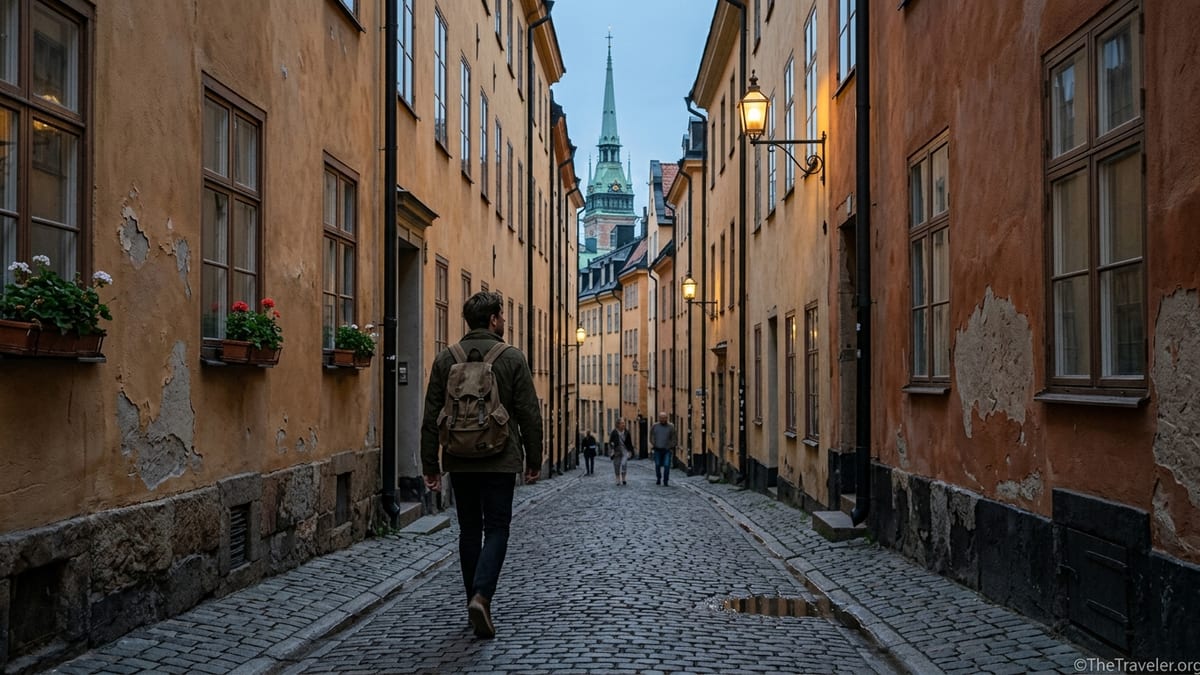
Start with a Smart Route, Not Just the Main Shopping Street
Most people enter Gamla Stan via Västerlånggatan, the busy north–south artery lined with souvenir shops. It is worth walking once for orientation, but if you stay there you will miss almost everything that makes the Old Town memorable. A better approach is to treat Västerlånggatan and Österlånggatan as rough “spines,” then spend most of your time on the smaller cross lanes that climb toward the ridge of Prästgatan and the alleys descending toward Skeppsbron and Munkbrokajen.
A practical route for a first visit is to start at the bridge from central Stockholm near the Gamla Stan metro station, walk a short stretch of Västerlånggatan south, then deliberately turn uphill into one of the side alleys such as Tyska Brinken or Sven Vintappares Gränd. Within two minutes the noise drops and you find yourself among crooked townhouses with shallow steps, old wooden doors and lanterns. From here you can zigzag toward Stortorget, then loop down toward the waterfronts, rather than marching straight through the middle in a single line.
Time of day matters. If you want to see the streets relatively empty, try to start around 8:00 or 9:00 in the morning, before most tour groups and day trippers arrive. In summer, that also lets you walk in softer light that makes the yellow and rust-colored facades glow, which is ideal if you like photography. Late evening, after dinner, is another good time to wander, when shop shutters are down and the Old Town feels more like a residential neighborhood again.
Allow at least half a day for this approach, even though Gamla Stan is small. With four to six hours you can explore the central ridge, both waterfronts, a museum or church, and still have time for a long fika break at a café such as Chokladkoppen on Stortorget or a quieter spot along Österlånggatan.
Hunt for Alleys: From Mårten Trotzigs Gränd to Blind Courtyards
Gamla Stan’s character is defined by its alleys, some of which are barely wide enough for two people to pass. The most famous is Mårten Trotzigs Gränd, which narrows to less than a meter wide and climbs in a steep staircase between Västerlånggatan and Prästgatan. The alley is named after a German-born merchant who owned property here in the late 1500s. It is an undeniably photogenic spot, but to experience it properly, walk the steps slowly once from each direction instead of just stopping for a quick picture in the tightest point.
Similar, less crowded passages radiate from the ridge streets. Look for tiny openings such as Staffan Sasses Gränd, a blind alley off Västerlånggatan, where the stone walls rise close on both sides and dead-end into old doorways and windows. These cul-de-sacs are ideal places to pause and listen: you will often hear church bells from Storkyrkan or the low rumble of ferries on the water, layered over the echo of footsteps on cobblestone.
Some alleys carry clues to their past in the names. Bollhusgränd, for instance, recalls royal ball game houses that once stood nearby and later became a theater and then the Finnish Church. Others, like Skeppar Olofs Gränd or Pelikansgränd, tie directly to medieval trades and taverns. Taking a few minutes before your trip to note a short list of these names will help you read the street signs as you wander, turning a simple stroll into a small history lesson without needing to join a formal tour.
If you want an even more atmospheric experience, detour off the busiest routes after dark. Many of the cross alleys are dimly lit by single lanterns mounted on facades. In winter, light spilling from apartment windows high above emphasizes how close the houses are to each other. Just be mindful of residents and keep voices low; these are not museum sets but lived‑in backyards and shortcuts.
Look Up, Not Just Ahead: Facades, Plaques and Details
One of the easiest ways to miss Gamla Stan’s historic corners is to walk at eye level. Many of the most intriguing details sit above the shop signs and awnings. On Stortorget, for example, the row of colorful houses includes facades with patterns of white stones and a famous cannonball embedded high on one corner. Locals point it out as a relic from past conflicts. On nearby streets, decorative iron wall anchors form dates and initials, marking renovations from the 1600s and 1700s.
As you move along Prästgatan, pause whenever you see a carved stone set into a wall. Some are medieval rune stones reused as building material, with Viking‑age inscriptions partially visible around later plaster. Without looking up, it is easy to walk straight past them. Similarly, tiny black or green plaques sometimes mark the homes of notable Swedes, former guild houses or sites where historical events took place. These do not demand a full stop, but slowing down to read one or two brings the street to life.
Windows and doors also tell stories. On side streets off Österlånggatan, you can still find heavy wooden doors with intricate iron hinges and peepholes, often lower than modern street level after centuries of paving. Many ground floors show traces of old shopfronts: wide openings now bricked up, or small display windows that hint at how goods were once sold straight onto the alley. Even the gutters and downpipes, often painted in muted reds and greens, form part of a visual language that rewards any visitor who takes the time to scan above shoulder height.
For photography, a simple rule works well: every time you enter a new alley or square, spend 30 seconds slowly turning in a full circle, looking up to the rooftops. You will almost always spot something beyond the souvenir displays: a crest, a carved stone face watching from a second‑floor corner, or a tiny roof terrace hidden behind dormer windows.
Anchor Yourself with a Few Key Sights, Then Get Lost Between Them
To explore Gamla Stan without missing its core history, it helps to pick three or four major landmarks as loose anchors and then allow yourself to drift between them via side streets. Stortorget, the central square, is an obvious starting point. It is framed by the former stock exchange building and colorful merchant houses, and today hosts the Nobel Prize Museum, which presents the story of the Nobel Prize and its laureates. Current adult admission is generally in the mid‑100 SEK range, with reduced prices for students and seniors and free entry for children and youth, and tickets include access to guided tours at set times.
From Stortorget, it is a short walk to Storkyrkan, Stockholm Cathedral, which has served as a coronation and royal wedding church. Stepping inside gives you a different kind of quiet from the streets outside, and the interior’s brick vaults and famous wooden Saint George and the Dragon sculpture offer a sharp contrast to the compact alleys surrounding it. A modest entrance fee is usually charged for tourists, while services are open to worshippers.
Your third anchor could be the Royal Palace, which dominates the northeastern edge of Gamla Stan. While many visitors watch the changing of the guard in the courtyard, fewer step around to explore the streets just behind the palace walls, where Slottsbacken slopes down past ocher‑colored townhouses and quieter lanes lead toward Skeppsbron and the waterfront. Even if you do not go inside the palace apartments, walking the perimeter gives you a sense of how the medieval town wrapped itself around the royal seat.
Once you know where these anchors sit, resist the urge to follow the most obvious route between them. Instead, when walking from the palace back toward Stortorget, try taking Trångsund and then cutting up into the small passages that run parallel to the cathedral, rejoining the square from a different angle. Between the cathedral and Västerlånggatan, lanes like Kindstugatan and Kåkbrinken feel noticeably more intimate than the main shop streets yet keep you within a couple of minutes of the landmarks in case you need to reorient yourself.
Find Hidden Corners by Following Everyday Life
Gamla Stan is not just a tourist district. Around the back of the main streets you will find recycling rooms, schoolyards, offices and residential entrances that quietly reveal how people live in the Old Town today. One way to discover more intimate corners is simply to walk in the direction that locals with grocery bags or backpacks are going, rather than where tour groups are drifting. These small streams of everyday movement often lead to passages and back alleys that are not marked on simple tourist maps.
Courtyards are particularly worth seeking out. In some places, thick wooden gates stand open during the day, revealing inner yards shared by several stairwells. You might see bicycles stacked against walls, laundry lines or a single tree pushing up through cobblestones. Enter respectfully, move quietly and avoid photographing people’s windows, and you can still enjoy a short glimpse of Gamla Stan as home rather than backdrop.
Look also for small, lived‑in details. A row of boots outside a narrow doorway on Prästgatan in winter hints at how short the staircases are inside. Flower boxes high above street level show how residents create pockets of green in a dense stone landscape. On lesser‑known alleys off Österlånggatan, workshop windows reveal art studios, frame makers or small design offices, far removed from the trinket shops visible on the main drags.
If you are visiting in the colder months, these everyday signs can be more telling than the facades themselves. In January or February, for example, only the most essential tourist shops remain open late, but lights in upper‑floor windows and the smell of cooking drifting into the street underscore that Gamla Stan is still a living neighborhood after the day visitors have gone.
Pause in Historic Cafés and Viewpoints Instead of Only Landmarks
Cafés and viewpoints can serve as informal waypoints that keep your exploration grounded and give you time to absorb what you have seen. On Stortorget, Chokladkoppen is a long‑established café housed in one of the square’s colorful buildings, offering hot drinks, simple meals and outdoor seating in warmer months. Prices are typical for central Stockholm: expect to pay roughly the equivalent of a few dozen Swedish kronor for a coffee or hot chocolate and more for a light lunch. Sitting here for half an hour between alley explorations lets you watch the rhythm of the square, from delivery carts in the morning to buskers and tour groups later in the day.
For something a little less exposed, walk a few minutes to Österlånggatan or one of the cross streets like Köpmangatan, where you will find smaller cafés and ice cream bars tucked into older buildings. A spot such as Gamla Stans Glass & Café, on a side street off the eastern spine, gives you a base close to the water while still surrounded by stone facades and narrow lanes. In good weather, taking your coffee to a bench on the nearby quays lets you look back at the Old Town from the outside, seeing how the dense cluster of roofs sits on its island.
Viewpoints are another way to ensure you are not missing the bigger picture. While Gamla Stan itself is relatively flat, walking to the bridges at each end offers rewarding perspectives. From the bridge toward Södermalm, you can look back at the Old Town’s skyline: church spires, the palace bulk and the patchwork of gables. From the northern side toward Norrmalm, glance down at the ferries shuttling to the archipelago and back. These views help you understand how small Gamla Stan really is, and how easily you can cover it on foot if you allow yourself to double back and crisscross.
Using cafés and viewpoints in this way breaks your visit into manageable segments. Instead of trying to see “everything” in one push, you move from stop to stop, weaving in a couple of lesser‑known alleys or courtyards between each rest. This makes the Old Town feel larger and more layered, even though it remains an island you can walk across in ten to fifteen minutes if you stick to the main streets.
Join a Themed Walk, Then Revisit Places on Your Own
Guided walks can be an efficient way to uncover stories you would never notice on your own, provided you use them as a starting point rather than the whole experience. In Gamla Stan, options range from broad historical tours that cover royal politics and medieval trade to narrower themes like ghost walks after dark or food walks that include tastings at traditional restaurants and specialty shops. Many of these run daily in high season and on weekends the rest of the year, typically lasting 1.5 to 2 hours.
Prices for such tours vary, but you can expect to pay the equivalent of a few hundred Swedish kronor per person for a small‑group experience booked through a local operator. Free walking tours also operate from time to time, where you tip the guide at the end instead of paying up front. Ask at your hotel or tourist information point in central Stockholm for current offerings, or check notice boards near the Gamla Stan metro exit where independent guides sometimes advertise schedules.
The key is not to treat the tour as your only pass through the Old Town. Make a simple habit of marking two or three spots during the walk that you want to return to later on your own. That might be a quiet courtyard mentioned briefly by the guide, a church interior you did not have time to see properly, or a side alley you only glimpsed while the group moved past. After the tour, revisit those places at your own pace, perhaps early the next morning or late in the evening, when you can linger without a group timetable.
If you are traveling with children or teenagers, a guided museum visit can serve the same function. At the Nobel Prize Museum on Stortorget, for instance, guided tours are often included in the admission price and offer short explanations of exhibits and stories about laureates. Let that visit give you a narrative thread, then look for plaques, street names or shops linked to science, literature or peace work as you walk the surrounding streets.
The Takeaway
Exploring Gamla Stan without missing its historic corners and hidden spots is less about covering distance and more about the way you move. By stepping off the main shopping streets, following side alleys like Mårten Trotzigs Gränd and Staffan Sasses Gränd, and looking up at facades for plaques and strange details, you quickly move from postcard views into a quieter, more personal Old Town.
Using a few key landmarks as anchors, pausing in historic cafés, and joining a themed walk or museum tour all help you create a layered visit that combines big narratives with small observations. Most importantly, giving yourself time to wander without a rigid checklist lets everyday scenes catch your eye: boots outside doorways, laundry lines in courtyards, office workers cutting through narrow passages.
In a compact place like Gamla Stan, these unscripted moments often become the memories that last longest. Plan a loose route, build in rest stops, and trust your curiosity, and you will leave feeling you have encountered not only Stockholm’s most famous historic district but also the lived‑in city behind the guidebook highlights.
FAQ
Q1. How much time do I need to explore Gamla Stan properly?
For a first visit, plan at least half a day, or around four to six hours. That gives you time to see key sights, wander side alleys, visit one museum and enjoy a relaxed café stop.
Q2. What is the best time of day to avoid crowds in Gamla Stan?
Mornings before around 10:00 and evenings after dinner are usually quieter, especially outside the peak summer months. Starting early lets you enjoy nearly empty alleys and softer light.
Q3. Is it worth visiting the Nobel Prize Museum on Stortorget?
Yes, if you have any interest in science, literature or peace history. The museum is compact, tickets are moderately priced for central Stockholm, and guided tours are often included, adding helpful context to the rest of your walk.
Q4. Are there still genuinely hidden spots in such a touristy area?
While Gamla Stan is popular, many narrow alleys, blind courtyards and back streets remain quiet, especially away from Västerlånggatan and Stortorget. By turning into small passages and looking for open courtyard gates, you can still find corners with few or no other visitors.
Q5. Can I explore Gamla Stan on my own, or do I need a guided tour?
You can easily explore on your own with a basic map or phone, but a guided walk can add stories you might otherwise miss. A good strategy is to take one themed tour, note places you like, then return later independently to wander at your own pace.
Q6. What should I wear for walking the alleys and cobblestones?
Wear comfortable, flat shoes with good grip, as many streets are uneven cobblestone and some alleys have steep steps. In cooler months, bring a windproof layer, gloves and a hat because the narrow streets can feel colder than open areas.
Q7. Are there good places to take a break without losing the historic atmosphere?
Yes. Cafés around Stortorget, such as those in the colorful houses, and smaller spots along Österlånggatan or nearby side streets offer classic fika in historic interiors. In good weather, benches on the quays around the island let you rest while looking back at the Old Town skyline.
Q8. Is Gamla Stan suitable for travelers with limited mobility?
Parts of Gamla Stan are challenging because of cobblestones, slopes and steps, especially in alleys like Mårten Trotzigs Gränd. The main streets and squares are more manageable, but wheelchair users and those with mobility issues may need to plan routes carefully and focus on flatter areas and wider streets.
Q9. How can I experience Gamla Stan beyond the typical souvenir shops?
Spend less time on Västerlånggatan and instead explore Prästgatan, the smaller cross alleys and the streets behind the Royal Palace. Look for independent boutiques, galleries, churches and courtyards, and consider joining a history or food‑focused walk rather than a generic city tour.
Q10. Is Gamla Stan safe to walk around at night?
Gamla Stan is generally considered safe, and many people stroll the streets in the evening. As always, use normal city awareness, stick to lit streets and be considerate of residents by keeping noise down in the narrow alleys.