


I thought I knew what to expect from Temppeliaukio Church. Every guidebook photo showed the same circular copper ceiling and pale wooden pews. But nothing in those carefully framed images prepared me for the shock of stepping straight off an ordinary Helsinki street and into a sanctuary carved from raw Finnish bedrock, where sunlight spills across rough stone and the air hums as if it remembers every piece of music ever played here.
Get the latest updates straight to your inbox!
From Quiet Square to Cathedral of Stone
Temppeliaukio sits in the Etu-Töölö district, a short walk from Helsinki’s Kamppi area. From outside, it barely looks like a church at all. You approach along a residential street, pass a modest sign and then climb a low granite rise that could just as easily be part of a playground. Only when you notice the circular copper dome and the discreet glass entrance cut into the rock do you realize you are standing on the roof of one of Finland’s most unusual buildings.
The transition from the city to the interior is abrupt. One moment, you are on Lutherinkatu, perhaps with the number 2 tram still rattling in your ears. The next, you are moving down a gently curving corridor, the noise dropping away as concrete and stone begin to absorb the sound. The temperature shifts slightly cooler and the light turns soft and indirect, filtered through the rock above.
The church was finally completed in 1969 after decades of false starts. Plans for a church on this site existed as early as the 1930s, but World War II and budget cuts repeatedly delayed construction. When architects Timo and Tuomo Suomalainen were finally able to realize their winning design, they did something radical for the time: rather than creating a tall spire, they carved a sanctuary directly into the granite outcrop, preserving the original rocky character of the square.
Today Temppeliaukio can hold around 750 people, yet it still feels like a hidden space, a hollowed-out cave just beneath the surface of an ordinary neighborhood. It is this tension between the modest exterior and the drama awaiting inside that catches most visitors off guard. You do not so much enter the church as step down into the earth.
Light, Copper and Raw Rock: An Interior That Feels Alive
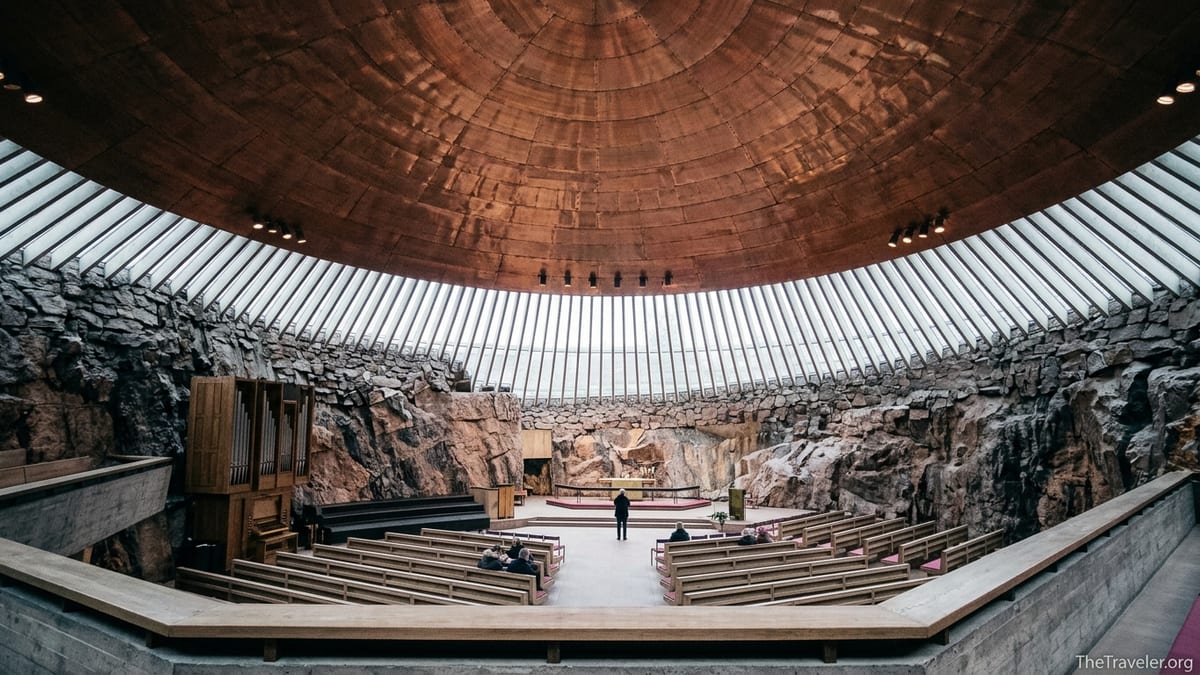
Once you emerge into the main hall, the first thing that hits you is the rock itself. The walls are not smoothed into polite uniformity. They are the exposed, virtually unworked granite of Helsinki’s bedrock, sliced and stacked into concentric rings that still bear the marks of excavation. In places, you can walk close enough to touch the rough surface and feel how cold and slightly damp it remains, even in summer.
Above this uneven stone rises the famous copper dome, a shallow saucer of metal that seems to hover over the space. It is made from long bands of copper, coiled almost like a record, supported by slender concrete ribs. Around the base of the dome, a continuous ring of glass lets in daylight. On clear days, that light lands in wide bands across the rock, picking out different shades of pink, gray and brown as the hours pass. On winter afternoons, when the Finnish sun barely clears the horizon, the light is diffuse and bluish, giving the whole interior a quiet, underwater feeling.
The furnishings are deliberately simple. The pews are pale birch, designed by the same architects who conceived the building, and the floor is plain. There is little decoration beyond a modest altar and a cross set against the rock. Even the pipe organ, built by Finnish organ maker Veikko Virtanen, feels integrated rather than imposed. Its 43 stops and more than 3,000 pipes are arranged to echo the geometry of the walls, so your eye reads it as another architectural element rather than a separate object.
It is easy to understand why design students from abroad make pilgrimages here. In a city that also boasts the white neoclassical Helsinki Cathedral and the granite mass of Kallio Church, Temppeliaukio looks like a manifesto: proof that a sacred space can be powerful without being ornate, that raw material and natural light can be more moving than gilded altarpieces.
The Sound That Makes Strangers Go Silent
Even if you come for the architecture, it is often the sound that stays with you. Temppeliaukio is one of Helsinki’s favorite concert venues, not because it is grand, but because the acoustics are extraordinary. The untreated rock surfaces, the circular layout and the low metal dome work together to create a warm, enveloping resonance that professional musicians compare to some of the best concert halls in Europe.
When I visited on a weekday morning, the pews were dotted with tour groups from Germany, Japan and the United States. People were chatting in low voices, pointing at the dome, checking their phones. Then a staff member announced that a short organ demonstration was about to begin. The lights dimmed slightly, and the first notes rose from behind the altar, deep and quiet. Within seconds, the background noise evaporated. Camera shutters stopped clicking. Even the children in bright snowsuits froze in place.
The organist moved from a slow chorale to a fragment of Sibelius, the notes blooming against the stone. Sound seemed to come from everywhere at once. It did not blast from speakers but wrapped itself around you, lingering just a heartbeat longer than expected before fading into silence. After the final chord, there was a pause, then a soft collective exhale and scattered applause that felt almost reluctant, as if no one wanted to break the moment.
Locals time their visits to coincide with these musical interludes. In summer, you might find a lunchtime concert offered for a modest fee, featuring anything from classical cello suites to contemporary Finnish choral works. Some travelers only realize this when they see the sign at the entrance, then quickly reshuffle their afternoon to stay an extra 40 minutes. For many, that unplanned concert becomes the highlight of their day in Helsinki, more vivid in memory than any number of museum labels.
Tickets, Opening Hours and What It’s Really Like to Visit
Temppeliaukio functions both as an active Lutheran parish church and as one of Helsinki’s most visited attractions, drawing roughly half a million people each year. To manage this, the church charges an entrance fee during most visiting hours while keeping worship services free. At the time of writing, adult tickets are generally in the single-digit euro range, with children and certain days, such as some Friday periods, often free or discounted. Prices can change, so it is worth checking the latest information shortly before you go.
Opening hours vary more than many visitors expect. On recent schedules, weekday visiting hours have tended to fall roughly between late morning and late afternoon, with shorter hours on Saturdays and limited public access around Sunday services. There are also occasional closures for weddings, funerals or private concerts. Travelers who arrive to find the doors locked often assumed a church would keep “typical” hours and did not realize how frequently the timetable shifts.
Crowds depend heavily on the time of day and season. Midday in July, when cruise ships dock in Helsinki, tour buses line the surrounding streets and the line for tickets can stretch out onto the rock above the entrance. In contrast, a Monday or Tuesday morning in late September can feel almost contemplative, with only a few independent travelers and local office workers stopping in on their break. If you value quiet, aim for the first hour after opening or the final hour before closing, and avoid large public holidays when domestic visitors swell the numbers.
Inside, expect a visit of 30 to 45 minutes if you are not staying for a concert. Many people walk a slow circuit of the main floor, then climb to the balcony level for a different perspective on the dome and rock formations. Photo taking is allowed during visiting hours, but staff repeatedly remind groups to keep voices low and to respect rope barriers around the altar. It is not unusual to see a guide gently ask someone to remove a hat or lower a raised phone during a moment of music or prayer.
Planning Your Time and Budget Around the Rock Church
Most travelers pair Temppeliaukio with other nearby sights in the Töölö area. The Sibelius Monument in its lakeside park lies roughly a 15 to 20 minute walk away, making a natural combination for a half day focused on Finnish design and culture. Some choose to start at the Rock Church right after breakfast, then continue to the monument and finish with a late lunch at a café back toward Kamppi. Others do it in reverse, timing their arrival at Temppeliaukio for a scheduled concert.
In terms of budget, it helps to think of the church visit as comparable to a small museum fee in Western Europe. An adult paying an entrance ticket, picking up a printed leaflet and perhaps buying a postcard or two from the modest gift counter might spend the equivalent of a light Helsinki lunch. Families appreciate that children under a certain age are often admitted for free, which can significantly lower the cost compared to a major art museum or zoo outing.
Travelers using a city transport card will find access straightforward. Several tram and bus lines stop within a few blocks, and the walk from Helsinki Central Railway Station takes about 20 to 25 minutes at a relaxed pace. In winter, factor in icy sidewalks on the approach; the rock around the church can be slick after snowfall, and locals tread carefully, using the metal railings even for short climbs.
One practical tip many visitors only learn on arrival is that ticket sales typically stop about ten minutes before the posted closing time. If you show up at 4:55 p.m. for a 5 p.m. close, you may find that the doors have effectively shut for the day. To avoid disappointment, treat the last 20 to 30 minutes of the schedule as a buffer and plan to arrive earlier.
Finding Stillness Amid Tour Groups and Selfie Sticks
Because Temppeliaukio is on so many tour itineraries, it can be easy to assume that any sense of sacred quiet has been lost to constant camera clicks. Yet many travelers come away surprised at how peaceful the space can feel, even when every pew is occupied. Part of this is the architecture: the rock absorbs much of the sound, and the circular layout disperses noise rather than focusing it in one echoing nave.
There are practical ways to carve out your own pocket of calm. On busy days, head straight for the side sections near the organ or slip up to the balcony and sit toward the back. Groups tend to cluster near the central aisle and altar, leaving the outer edges relatively empty. If you sit quietly for ten minutes, resisting the urge to capture every angle on your phone, you begin to notice small details: a hairline crack in the granite filled with quartz, a faint pattern on the copper where thousands of fingers have brushed the railings on their way to a seat.
Occasionally, an impromptu performance turns the space into a shared moment of stillness. A visiting choir might stand at the front and sing a short piece unannounced, or a violinist might test the acoustics with a brief solo before a formal concert. In those moments, strangers of different languages and backgrounds fall into the same listening posture, a reminder that this is not just an architectural attraction but a living church and performance venue.
For those seeking a more explicitly spiritual experience, attending a regular Lutheran service can feel very different from visiting during tourist hours. The entrance is usually free, and the lighting and atmosphere shift noticeably. Hymns in Finnish and Swedish rise under the dome, and the space that moments before felt like a spectacle becomes an intimate parish church again, grounded in a weekly rhythm that long predates the arrival of mass tourism.
Context: How Temppeliaukio Fits Into Helsinki’s Design Story
Temppeliaukio does not exist in isolation. It is part of a broader Helsinki story in which everyday life, design and landscape are tightly interwoven. Walk a short distance in almost any direction and you encounter other expressions of this: the bold lines of modernist apartment blocks, the rational grid of tram tracks, the way parks and rocky outcrops are allowed to remain wild in the middle of the city.
Compared to the iconic outline of Helsinki Cathedral, with its white facade and steps facing Senate Square, Temppeliaukio is almost invisible from afar. Yet architects and students of design often place the Rock Church at the center of any discussion about Finnish modernism. Its decision to leave the rock exposed, to celebrate imperfection rather than hide it behind plaster, resonates with contemporary ideas about sustainability and honest materials.
For visitors, this context matters practically as well. Many combine a stop at the church with a visit to the Design Museum or the Amos Rex art museum, building a day that traces a line through the city’s creative identity. A traveler might start at a café in the Punavuori design district, browse Finnish glass and textiles in local boutiques, then catch a tram to Töölö for the Rock Church before finishing the evening at a concert in the nearby Finlandia Hall.
If you return to Temppeliaukio at different times of year, you see how it shifts with the city around it. In December, visitors shuffle in from the early afternoon darkness, brushing snow from their coats, and the copper dome glows against the rock like a secret hearth. In high summer, sunlight pours through the skylight ring late into the evening, and the church becomes a cool refuge from the brightness outside, a place where you can sit in shadow and hear the muffled echo of a choir rehearsal.
The Takeaway
Temppeliaukio Church succeeds because it does not try to overwhelm you with size or ornament. Instead, it quietly rearranges your expectations of what a sacred space can be. You arrive imagining a conventional church and discover a chamber carved into the city’s geological bones, where copper and concrete amplify the texture of stone and natural light becomes the main decoration.
Nothing prepared me for how quickly the place felt personal. Sitting halfway up the balcony, watching a beam of sunlight slide across the granite and listening to the final vibrations of an organ chord fade into silence, I realized that the most memorable thing about Temppeliaukio is not its fame or its photo-friendly dome. It is the way it invites you, however briefly, to slow down, lower your voice and pay attention to the simple fact of being held by rock and sound.
For travelers passing through Helsinki, the Rock Church is more than a box to tick between market halls and harbor views. With a bit of planning around opening hours and concerts, it can become a touchstone in your itinerary, a place where the city’s love of design, nature and quiet encounters comes into sharp focus. Few attractions manage to feel at once utterly modern and ancient. Temppeliaukio is one of them.
FAQ
Q1. Where is Temppeliaukio Church located in Helsinki?
Temppeliaukio Church is in the Etu-Töölö district, a short walk northwest of the Kamppi area and roughly 20 to 25 minutes on foot from Helsinki Central Railway Station.
Q2. Do I need a ticket to visit Temppeliaukio Church?
Yes, during regular visiting hours there is usually an entrance fee for sightseeing visitors, while worship services are typically free. Ticket prices are modest but can change, so it is sensible to check current rates shortly before your visit.
Q3. How much time should I plan for a visit?
Most visitors spend 30 to 45 minutes exploring the interior, walking up to the balcony and taking photographs. If you attend a concert or organ demonstration, plan for about an hour in total.
Q4. When is the best time of day to avoid crowds?
The quietest times are usually right after opening and in the last hour before closing on weekdays outside the peak summer season. Midday in July and August, especially when cruise ships are in port, is often the busiest.
Q5. Are concerts held regularly at the Rock Church?
Yes. Temppeliaukio is a popular concert venue thanks to its acoustics, and there are often organ recitals, choral performances or chamber music events. Schedules change, so check upcoming programs if music is a priority for you.
Q6. How do I get to Temppeliaukio Church by public transport?
You can reach the church by several tram and bus lines that stop within a few blocks in Töölö. Many visitors also walk from the center, combining the church with nearby sights such as the Sibelius Monument.
Q7. Is photography allowed inside the church?
Photography for personal use is generally allowed during visiting hours, but you are expected to keep noise to a minimum and avoid flash, especially during concerts or moments of prayer.
Q8. Is the church accessible for visitors with reduced mobility?
Access routes and interior paths are designed to be as level as possible, and there are no long flights of stairs on the main floor. However, some balcony areas and the rocky surroundings outside may be challenging, so it is advisable to check the latest accessibility details if you use a wheelchair or have limited mobility.
Q9. Can I attend a regular church service at Temppeliaukio?
Yes. As an active Lutheran parish church, Temppeliaukio holds services, often on Sundays and some weekdays. These are usually free to attend, and visitors are welcome to join respectfully.
Q10. What should I wear when visiting Temppeliaukio Church?
There is no strict dress code, but it is respectful to dress modestly, cover shoulders and remove hats inside. In winter, wear warm layers and shoes with good grip, as the rock around the entrance can be slippery.