


The day I finally visited Temppeliaukio Church in Helsinki, better known as the Rock Church, the forecast promised only light showers. Instead, a sudden burst of Nordic rain swept across Töölö just as I stepped off the tram, turning polished granite streets slick and dark. By the time I reached the low stone mound of the church, I was damp, mildly annoyed and ready to rush through yet another famous landmark. Within an hour, standing under its copper dome while raindrops drummed softly above and light filtered through the ring of skylights, I felt exactly the opposite. Getting caught in the rain at Temppeliaukio Church made me notice details, slow down and ultimately appreciate this unusual space far more than if the skies had stayed clear.
Get the latest updates straight to your inbox!
Arriving Soaked at a Church in the Rock
Temppeliaukio Church sits quietly in the residential Etu Töölö district, about a fifteen minute walk or a short tram ride from Helsinki Central Station. From the street it barely looks like a church at all. What you first see is a rough ring of blasted granite rising out of a neighborhood square, with only a hint of a circular copper dome visible from certain angles. In heavy rain, the stone darkens several shades, and the discreet entrance on Lutherinkatu can be easy to miss as you hurry along under an umbrella.
When I arrived, the wind was pushing sheets of rain along Fredrikinkatu and over the small square leading to the church. A handful of other visitors were doing the same awkward dance: debating whether to shelter under a nearby pine tree, pull up jacket hoods or simply make a dash for the glass doors. A tour group from Germany had clearly timed things better. They were already inside, their guide’s folded umbrella dripping by the coat rack as she handed out printed diagrams of the building.
At the ticket counter just inside the entrance, my glasses fogged with the sudden warmth. Admission prices change occasionally, but on this visit the fee for an adult sightseeing ticket was roughly the cost of a simple lunch in Helsinki, with children, students and seniors paying less and parish events remaining free. I hesitated for a moment, water still running from my sleeves, then decided that being indoors under solid rock and copper was worth every euro. It turned out to be the best decision of the day.
Because of the rain, most visitors lingered near the doorway, peeling off wet coats and adjusting backpacks. Instead of rushing straight to the main space, I paused too, listening to the muffled patter on the dome and the low hum of conversation in different languages. That small delay would shape how I experienced everything that followed.
First Glimpse of the Copper Dome in the Rain
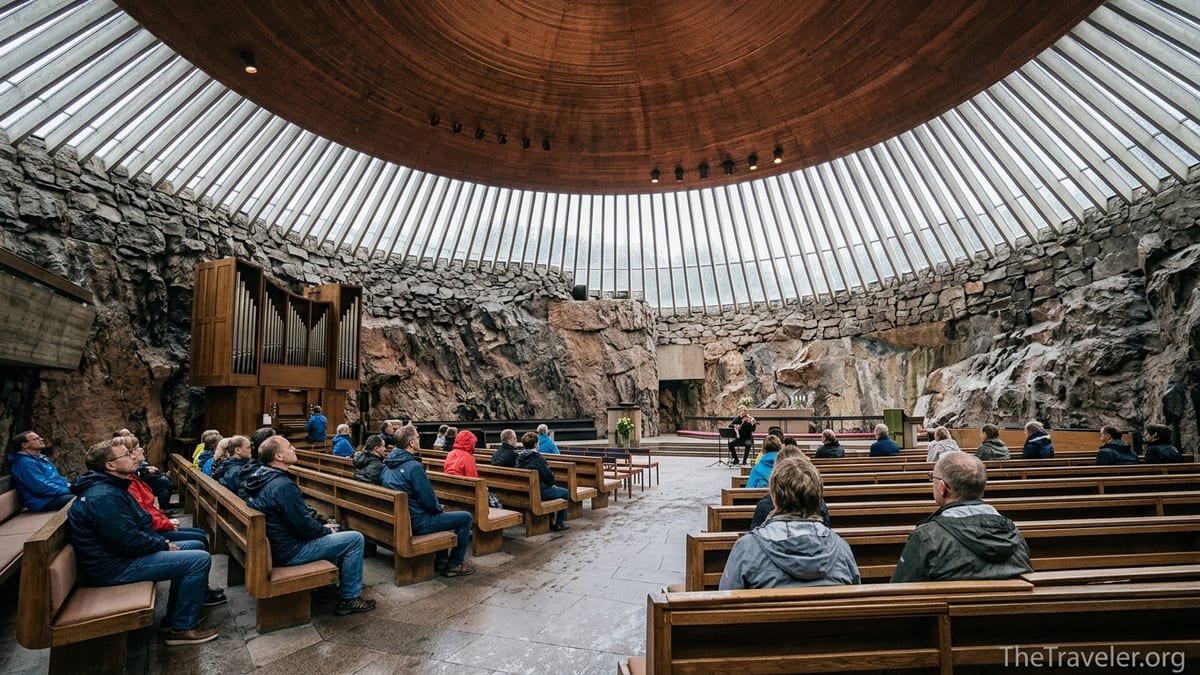
Turning the corner into the main hall of Temppeliaukio is a quiet kind of surprise. One moment you are in a modest foyer; the next, the rock walls open out around you in a sweeping circle, ringed by wooden pews, with a broad altar wall framed by a natural ice-age crevice of exposed granite. Above, a shallow copper dome coils toward the center like a tightly wound ribbon, supported by thin concrete beams that spring from the rock.
On dry, bright days, photos show the church drenched in sunlight, with clear beams of light falling through the band of 180 glass panes that wrap the dome. In the rain the effect is more subtle and, to my mind, more beautiful. The skylight ring becomes a soft halo, the light cooler and more diffused. Tiny droplets cling to the exterior glass and the copper overhead takes on a muted, almost velvety sheen. The contrast between the cool blue-grey of the wet rock and the warm, slightly oxidized copper is especially striking.
As I slid into one of the low wooden pews near the middle, I could still hear the weather outside, but only just. Every now and then a heavier gust sent a faint, irregular tapping across the dome that rippled through the space like distant percussion. Because the church is largely nestled into the bedrock, you do not see the rain so much as sense it. The outside world feels held at a slight distance, softened by the circular walls and the low dome overhead.
That initial impression would likely have been different on a bright summer morning or in the late glow of a long Nordic evening. Yet the rainy half-light made the building’s geometry feel more intimate and tactile. You notice the rough chisel marks in the rock, the fine seams where copper strips overlap, and the way the skylight’s steel framework glints even on a dull day.
How Weather Changes the Acoustics and Mood
Temppeliaukio is famous for its acoustics. Musicians talk about how the unfinished rock walls diffuse sound and how the copper dome projects it evenly around the hall. The church regularly hosts everything from classical organ recitals to Finnish folk performances, and recordings made here often highlight its rich, lingering reverberation. Experiencing this on a rainy day added an extra layer to the soundscape.
As the hall filled, a pianist stepped quietly toward the grand piano near the altar and began to play a slow, reflective piece. The notes unfolded into the space with extraordinary clarity, yet there was no harsh echo. The rough granite surfaces seemed to catch and scatter each tone, so that the music felt present but never overwhelming. In between phrases, you could just make out the faint patter of rain filtered through tons of rock and copper. Instead of breaking the spell, it deepened it, like a natural metronome ticking somewhere above.
Rain also changes how people behave inside the church. On sunny days, many visitors treat Temppeliaukio as a quick stop: a few minutes for photos, a glance around, then back out into the city toward the Sibelius Monument or the harbor. In wet weather it becomes a refuge. The pews fill with people shrugging off damp jackets, exchanging quiet looks of relief. A pair of local schoolchildren, their reflective rain pants still flecked with water, sat in the front row, listening wide-eyed as the music washed through the hall instead of being hustled along to the next stop.
With nowhere dry to rush back to, I found myself sitting longer, listening more carefully. I began to notice how a single cough at the back of the hall bloomed and faded, how the organist tested a chord and then seemed to wait, counting heartbeats until the sound thinned into silence. In that moment, the weather outside was not an inconvenience; it was part of the composition of the visit itself.
Architecture that Feels Different in Bad Weather
Temppeliaukio Church was completed in 1969, after architects Timo and Tuomo Suomalainen won a competition with a design that preserved as much of the original granite outcrop as possible. Rather than building a tall steeple, they cut into the rock and set a low copper dome on top, encircled by a skylight that lets in natural light year-round. The result is an unusual hybrid: simultaneously subterranean and flooded with daylight.
In the rain, that design choice reveals its logic. Because the church sits partially underground, the climate inside remains relatively stable even when the weather swings outside. Helsinki’s wind can be sharp and unforgiving along the harbor or Kaisaniemi Park, but here, a short walk away, the rock absorbs and moderates the chill. The sound of traffic from nearby streets and tram lines is dampened. What would have been an ordinary shelter from a shower, like ducking into a café on Mannerheimintie, becomes instead a fully enveloping architectural experience.
From certain seats you can look up and see the fine gap between the dome and the stone perimeter wall, where the glass panels rest. On a wet day, water streaks and droplets subtly shift the quality of light, turning hard edges soft and giving the copper a slightly darker hue. The long, continuous benches made of pale wood feel warmer to the touch by contrast with the rock. Visitors run their fingers along the rough granite and then rest their hands on the smooth backrests. The building quietly encourages you to sense temperature, weight and texture more acutely.
There are no heavy stained glass windows to filter color, no glittering mosaics to distract the eye. The decoration is essentially the rock itself, the circular rhythm of the copper and the understated altar wall where a natural crevice in the stone serves as the focal point. On a rainy afternoon, without strong sunlight to dramatize the space, this minimalism feels calm and resolute rather than austere. The church does not compete with the weather; it absorbs it.
Practical Tips for Visiting in Rain, From Transport to Tickets
Helsinki’s weather can shift quickly in any season, and showers are common from spring through autumn. Planning a visit to Temppeliaukio Church on a rainy day is not only realistic but often rewarding. If you are staying near the main railway station or in the Kamppi area, you can either walk in about twenty minutes or take a tram toward Töölö, getting off a short stroll from the church. Many visitors underestimate how slippery polished stone and metal can become, so footwear with decent grip is wise.
Opening hours for sightseeing change depending on church services, private events and the time of year. It is common for hours to be reduced on Sundays or for the church to close briefly in the middle of the day for weddings or funerals. Before setting out, it is worth checking the current day’s schedule via Helsinki’s official tourism information or the parish’s own announcements. On rainy days, curtains of visitors can arrive all at once between closures, so expect a short queue at peak times and allow extra minutes if you are catching a ferry or train later.
Ticket pricing varies, but admission typically costs less than many of Helsinki’s larger museums. Families can often save with reduced children’s tickets, and people attending scheduled worship services or certain community events may enter without a sightseeing fee. Online booking platforms used by city tours sometimes include timed-entry tickets to Temppeliaukio in their packages, which can be convenient when group buses arrive during bad weather. If you prefer a quieter experience, aim for the first or last open hour of the day, when tour groups are fewer and the space feels more contemplative.
Inside, there is a small area where you can leave dripping umbrellas and adjust your layers. Because of the polished floor surfaces, staff sometimes put out additional mats on particularly wet days to prevent slipping. Photography is generally allowed during sightseeing hours, but be prepared for rules to tighten during concerts or services. The best photos I saw were taken not from the central aisle but from the upper rows or side galleries, where you can frame the dome, organ pipes and raw rock in a single wide shot, even when low clouds outside flatten the light.
Why the Rain Made Me Appreciate the Space More
Had I visited Temppeliaukio on a clear summer morning when Helsinki’s outdoor terraces were busy and the Baltic shimmered in the distance, I might have treated it like another stop on a checklist of architectural highlights. The rain removed that option. With the streets outside shining dark and umbrellas bobbing past the narrow windows, there was little temptation to hurry away. I started to pay attention to smaller details: the gentle curve of each pew, the way the altar flowers echoed the colors of moss on the rock, the discreet plaques explaining the building’s story.
Being damp and slightly uncomfortable at the start also sharpened the sense of relief as the space wrapped around me. The heavy stone underfoot, the subtly warm wood, and the cocooning curve of the dome worked together to create a feeling of shelter that was both physical and psychological. That feeling would exist in any weather, but on a day when the outside world was cold and grey, it was impossible to ignore.
I noticed, too, how the rain leveled the experience between visitors. A well-dressed business traveler with a rolling suitcase ended up sharing a pew with a group of backpackers and a local grandmother who had simply ducked in while walking home with groceries. All of us had arrived seeking a break from the weather. All of us sat quietly, heads tilted toward the same circle of light above. In a city known for its design shops, saunas and sea views, this simple act of pausing together in a rock-cut room felt unexpectedly moving.
Leaving the church later, the rain had slowed to a fine mist. The granite steps outside gleamed, and the low copper dome seemed to emerge more clearly from its ring of stone, as if newly washed. I realized that without the earlier downpour I might have paid more attention to photographing the building for social media and less to listening, touching the rock and watching the light shift. The bad weather had replaced any sense of haste with a kind of enforced attention, and the church had rewarded that attention generously.
The Takeaway
Temppeliaukio Church is one of Helsinki’s most visited attractions for good reason. It is a rare building that feels at once modern and timeless, public and deeply intimate. Many visitors remember the copper dome, the rock walls or the acoustics. I remember, most vividly, how it felt to arrive cold and wet, step down into the circular hall and discover a calm, glowing space that held the storm at bay.
If your time in Helsinki is marked by unpredictable weather, resist the urge to save the Rock Church for a sunny window in your schedule. Instead, consider planning your visit precisely when the clouds roll in. Bring a waterproof jacket, accept that your shoes may squeak on the floors, and allow yourself to sit longer than you normally would. Listen for the faint rhythm of rain above the music, notice how the light softens around the skylight ring, and run your hand along the cool granite as you leave.
In a city defined by its relationship with the sea and its long, dark winters, Temppeliaukio’s genius lies in how it turns climate and geology into allies rather than adversaries. Getting caught in the rain there did not spoil my visit. It completed it, revealing the church not just as a piece of remarkable architecture, but as a place designed to welcome you exactly as you are, weather and all.
FAQ
Q1. Where is Temppeliaukio Church located in Helsinki?
Temppeliaukio Church sits in the Etu Töölö district, a short walk or tram ride northwest of Helsinki Central Station, near Lutherinkatu and Fredrikinkatu.
Q2. Do I need a ticket to enter Temppeliaukio Church?
During sightseeing hours there is usually an admission fee for visitors, while regular worship services and some parish events remain free of charge.
Q3. How do opening hours change in bad weather?
Weather does not normally affect opening hours, which instead vary according to services and private events, so it is wise to check the day’s schedule in advance.
Q4. Is it worth visiting Temppeliaukio Church on a rainy day?
Yes. Rain softens the light, subtly enhances the acoustics and often encourages visitors to sit longer, making the atmosphere especially calm and reflective.
Q5. How long should I plan to spend inside the church?
Most travelers spend 30 to 60 minutes, but on a rainy day you may appreciate staying longer to listen to music and watch the changing light.
Q6. Can I attend a concert at Temppeliaukio Church?
The church frequently hosts concerts, from organ recitals to choir performances, and tickets are typically sold separately from standard sightseeing admission.
Q7. Is photography allowed inside Temppeliaukio Church?
Photography is generally allowed during regular visiting hours, but flash and loud shutter sounds may be restricted during concerts or religious services.
Q8. How do I get to Temppeliaukio Church by public transport?
You can reach the church by several tram and bus lines that run from central Helsinki toward Töölö, followed by a short walk through the residential streets.
Q9. Is the church accessible for visitors with limited mobility?
Access routes and interiors are designed to accommodate most visitors with mobility challenges, though some seating areas and steps may require assistance.
Q10. What else can I combine with a visit to Temppeliaukio Church?
Many travelers pair it with nearby sights in Töölö, such as the Sibelius Monument, Helsinki Music Centre or a walk along the waterfront toward Hietaniemi.