


Temppeliaukio Church was never supposed to be the highlight of my time in Helsinki. It was one of those places I had seen in guidebooks and scrolled past with a shrug: a church carved into rock, a copper dome, lots of tour groups. On my carefully plotted Google map, it sat outside my walking route, sidelined by waterfront saunas, design stores, and a ferry to Suomenlinna. Then a local stepped in, gently edited my plans, and the Rock Church went from a maybe to a must. Within an hour of stepping inside, I understood exactly why.
Get the latest updates straight to your inbox!
How Temppeliaukio Ended Up on My Map
The change of heart started, fittingly, over coffee. I was at a small cafe off Runeberginkatu, nursing a cinnamon bun and trying to compress Helsinki into a single winter’s day. The woman at the next table, a lawyer on her lunch break, glanced at my open map and asked if I needed help. We compared notes: I had queued the central library Oodi, a dip in the Allas Sea Pool, and a tram ride around the city. She scanned my list, nodded at most of it, then frowned.
“You are skipping Temppeliaukio?” she asked. When I admitted I thought it looked touristy and expensive for “just a church,” she laughed. She explained that yes, there is a modest entrance fee during visiting hours for tourists, usually under ten euros, but that most locals see it as one of the most original pieces of architecture in the country. It is where school choirs sing, world-class musicians test its near-perfect acoustics, and hurried office workers pop in for ten minutes of quiet.
She pointed out that it was only about a ten to fifteen minute walk from Kamppi, barely a detour from my route to the seaside. She even pulled out her phone, checked the day’s fluctuating opening hours on the church’s official site, and warned me that short closures for weddings or recitals were common. “Go in the next hour, it is quieter,” she said. With a local’s confidence behind me, I closed my laptop, zipped up my coat, and headed north into Töölö.
The walk itself set the tone. Helsinki’s city center thinned into a residential grid of early 20th century buildings, small grocery stores, and trams rattling toward the stadium. Nothing about the neighborhood screamed “major attraction.” When I finally turned onto Lutherinkatu, I almost missed the church entirely. Instead of a steeple, there was a low, round form sunk into the rock, its copper dome just peeking above street level, ringed by modest apartment blocks.
First Impressions: From Bare Rock to Copper Light
Temppeliaukio Church belongs to that rare category of sights that reveal almost nothing from the outside. At street level, you find a rugged outcrop of Finnish bedrock, with a discreet entrance cut into the stone. A small sign, a few clusters of visitors, and that is it. There is no towering facade or stained-glass rose window to announce what waits below.
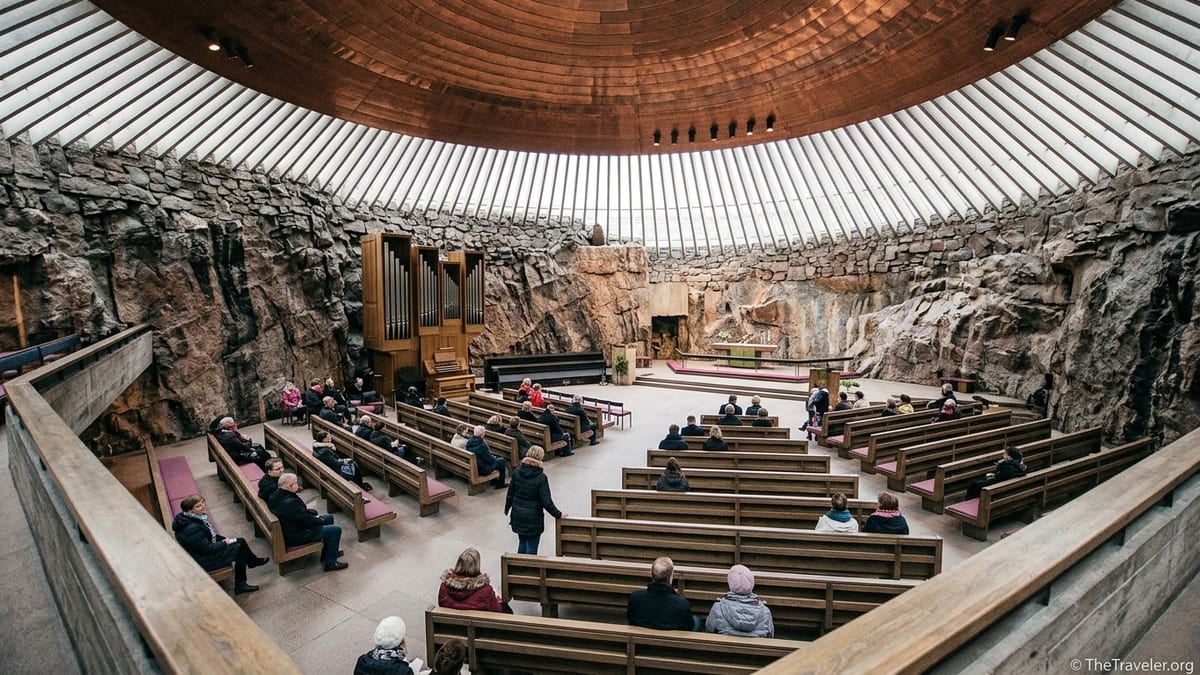
Once inside, you follow a short corridor and emerge into a single, circular space that feels both cavernous and intimate. The church has been literally excavated out of two-billion-year-old granite, leaving the walls raw, with drill marks and natural fissures still visible. It holds around 700 to 750 people, but the rough stone absorbs echoes and chatter, softening the atmosphere so it never quite feels like a crowd. A wide crevice in the rock forms the backdrop to the altar, a reminder that this is not a decorative stage set but a landscape adapted for worship.
Above, the famous copper dome floats like a shallow bowl, wrapped in coils of aged copper that spiral in toward the center. Around its base, 180 narrow skylights slice between the dome and the rock, washing the interior with cool Nordic light. On a bright day, the effect is almost weightless, as if the roof has detached from the earth and the walls are lit from within. On the winter afternoon I visited, the snow outside bounced extra light inside, turning the stone surfaces a gentle silver.
There are details that reward slow looking. Simple wooden pews radiate around the circular floor plan. The organ, with thousands of pipes arranged in vertical ranks, stands against the rock like a metallic forest. The architects, brothers Timo and Tuomo Suomalainen, designed nearly everything, down to the minimalist fixtures. The result is a space that feels cohesive, as if it had grown rather than been built.
Listening to the Rock: Sound, Silence and Everyday Life
My local lunch companion had insisted I try to time my visit for music. Concerts here range from classical organ recitals to choral performances, and the space is in constant demand because of its extraordinary acoustics. I arrived between scheduled events, but even in an ordinary hour, sound behaves in surprising ways. A single note from the organ during a short demonstration seemed to hang in the air, wrapping around the circle before disappearing into the rock.
Most visitors come for less than an hour, often as part of a city sightseeing tour that makes a quick stop at the Rock Church. A few clusters of cruise passengers snapped their photos, listened to the brief audio explanations available at the entrance, and moved on. In contrast, I noticed a handful of locals who had clearly paid no mind to the tourist rhythm. A man in office attire sat three rows from the altar, eyes closed, coat folded beside him. A young woman lit a small candle near the side wall, stayed for five quiet minutes, and left without taking a single picture.
On many days, you can catch an informal mini-recital without planning ahead. When tour organizers or solo musicians test the organ or practice a short piece, the notes spill over the pews for anyone present to hear, effectively turning a normal visit into an impromptu concert at no extra cost. Several travelers I spoke with outside mentioned that they had stumbled upon a fifteen-minute piano or violin performance, which for them justified the entrance fee more than any photo.
It is also worth noting that the church functions fully as a parish church. During services, baptisms, and weddings, tourist access pauses, which explains the sometimes irregular opening hours published day by day. One local couple described getting married here on a snowy February afternoon, the rock walls lit by candles, the copper dome gleaming faintly above. To them, this was not just a showpiece of Finnish modernism, but the family church where major life moments unfolded.
Practicalities: Tickets, Timing and What to Expect
Many travelers, myself included, hesitate when they hear that there is an entrance fee for such a short visit. Temppeliaukio Church remains free for worshippers attending services, but during most visiting hours there is a small charge for tourists, typically under 10 euros for adults, with reduced prices for students and children. The money goes toward maintenance and staffing, and the system helps regulate the flow in a space that welcomes hundreds of thousands of visitors every year.
Buying a ticket is straightforward. You can purchase a day ticket at the entrance desk, or buy in advance through common ticketing platforms linked from Helsinki visitor sites and the church’s own pages. Same-day online tickets can be practical in peak summer, when buses and cruise excursions swell the lines out front. Some city passes for Helsinki include entry, which can be cost-effective if you are already planning to visit multiple paid attractions.
Opening hours are the one element you truly must check on the day, as they change frequently. While some guides still list broad daily ranges, in practice the schedule is tailored to events. A typical weekday might list several visiting blocks with short closures in between, such as 10:00 to 13:00, closed for a private ceremony, then open again mid-afternoon. Around major holidays like Independence Day or Christmas, hours may be shorter or adjusted, although the church remains open to visitors nearly year-round.
In terms of logistics, the Rock Church is conveniently close to the city center. From Helsinki Central Station, it is roughly a one-kilometer walk, or a few stops by tram followed by a short uphill stroll. Even in winter, the route is easy to manage with good shoes. Many visitors combine it with a stop at the nearby Hietaniemi cemetery and beach, or with coffee along Fredrikinkatu. If you have only a layover in Helsinki and want to pair one major sight with a sense of everyday life, Temppeliaukio fits neatly into a two or three hour window.
Why It Matters: Finnish Design, Nature and Quiet Radicalism
My initial reluctance to visit Temppeliaukio came from a familiar place: the suspicion that something heavily promoted must be overhyped. What I found instead was a concise lesson in Finnish values. The church manages to be bold without being showy, rooted in nature without resorting to sentimental motifs, and thoroughly modern while remaining a deeply functional community space.
In architectural terms, the decision to carve into existing bedrock rather than build upward was radical when the church opened in 1969. Earlier design competitions in the 1930s and 1950s had proposed more conventional tall churches. The Suomalainen brothers took a different path, allowing the granite outcrop to dictate the form. It meant working with the limitations and possibilities of the site: keeping the natural crevices, following the curve of the rock, and leaving the drill holes visible rather than polishing them away.
This attitude mirrors broader Finnish design, where materials and landscape tend to take the lead. It is the same logic that shapes the low-profile villas on rocky coastlines or the large windows in lakeside saunas that frame the forest instead of hiding it. In Temppeliaukio, you feel that philosophy the moment you touch the walls. They are cool, uneven, and unvarnished, not an illusion painted to look like stone but the actual rock of Helsinki under your feet.
The space also challenges assumptions about what a church must look like. There are no soaring stained-glass windows, no marble columns, no gilded altarpiece. Yet the atmosphere is distinctly sacred, not because of ornament, but because of proportion, light, and sound. For some visitors, particularly those more accustomed to traditional European cathedrals, this contrast is precisely what lingers afterward. You leave not with memories of statues or frescoes, but with the sensation of sitting inside a circle of rock while soft daylight and organ notes filter down from above.
Making the Most of Your Visit
Despite how compact the experience is, there are several ways to deepen a stop at Temppeliaukio beyond simply walking in, taking a photo, and walking out. The first is to slow down. Give yourself at least 30 to 45 minutes, even if on paper it looks like a fifteen-minute attraction. Sit in different sections of the pews, observe how the light changes as clouds pass, and listen to the ambient murmur of multiple languages fading into a mostly respectful hush.
If audio guides are available during your visit, consider investing the small additional fee or downloading a reputable guide in advance. Many explain subtle features you might otherwise miss, such as the way the copper dome’s 22 kilometers of wiring were laid, or how the rough texture of the rock was calculated to produce its distinctive acoustics. Knowing that there are no traditional bells, but instead a recorded carillon broadcast from speakers on the exterior wall at certain times of day, adds an extra layer of curiosity if you are outside when they chime.
Try, if possible, to visit at two different times of day, especially in summer when the light is long. Morning light tends to be softer and cooler, while late afternoon may bring warmer tones and more pronounced shadows along the rock. In winter, late morning to early afternoon gives you the best chance of catching the limited daylight. Travelers with flexible itineraries sometimes stop in briefly on arrival day, then return for a scheduled evening concert later in the week, experiencing the church as both a tourist sight and a performance venue.
Finally, balance your time inside with a short circuit around the exterior. Climb the rocky mound that surrounds the dome, where locals walk dogs and children clamber over the stone. From up here, the copper roof looks almost like a landed spacecraft, its patinaed surface streaked with decades of weather. Turn around and the rest of Helsinki unfolds: tram wires, apartment balconies, a glimpse of the stadium towers. It is a reminder that this extraordinary space is embedded in an ordinary district, integrated into daily life rather than isolated on a hilltop.
The Takeaway
By the time I stepped back out onto Lutherinkatu, the light had already started to thin. Snow squeaked underfoot, and a bus unloaded a fresh wave of visitors who filed toward the entrance. I thought back to my original itinerary, the one that had relegated Temppeliaukio Church to a distant pin, and felt quietly grateful for the stranger in the cafe who had insisted I redraw the map.
In the end, the Rock Church was not memorable because it is on every list of things to do in Helsinki, or because it photographs well for social media. It mattered because it captured, in a single glance and a single breath, so much of what Helsinki does best: thoughtful design, respect for nature, and an instinct for calm in the middle of a busy city. It showed that even in an era of crowded bucket lists, some places still have the power to surprise you.
If you find yourself in Helsinki with only a few spare hours, do not be deterred by the talk of entrance fees, variable hours, or tour groups. Check the day’s schedule, walk up through Töölö, and descend into the rock. Sit quietly, listen, and let the copper dome gather the city’s light above you. Temppeliaukio may not be on your list at first, but chances are it will stay with you long after you leave.
FAQ
Q1. Where is Temppeliaukio Church located in Helsinki?
Temppeliaukio Church, often called the Rock Church, is in the Töölö district, roughly a one-kilometer walk northwest of Helsinki Central Station.
Q2. Is there an entrance fee to visit Temppeliaukio Church?
Yes, during normal visiting hours tourists pay a modest entrance fee, generally under 10 euros for adults, with discounts for students and children.
Q3. Do I need to book tickets in advance?
Advance tickets are not strictly necessary, but in summer or on busy cruise days buying online or via a city pass can reduce waiting and ensure entry.
Q4. How much time should I plan for a visit?
Most visitors spend 30 to 60 minutes inside, which allows time to sit, listen, walk around, and possibly catch a short musical performance or organ demonstration.
Q5. Are the opening hours the same every day?
No, hours vary from day to day and can change with little notice due to services, weddings, and concerts, so it is important to check the schedule on the day of your visit.
Q6. Can I attend a church service at Temppeliaukio?
Yes, regular Lutheran services and special ceremonies are held here, and attending worship is free, though visitors are expected to respect the religious setting.
Q7. Is the Rock Church suitable for children and families?
Yes, families are welcome. The space is compact and visually striking, but parents should encourage children to move quietly and avoid climbing on pews or railings.
Q8. What is the best way to get there without a car?
Walking from the city center is easy, and several tram and bus lines stop within a few minutes’ walk, making public transport the simplest option for most visitors.
Q9. Are photography and video allowed inside?
Individual visitors can usually take personal photos, but flash, tripods, and disruptive filming are discouraged, and rules may be stricter during services or concerts.
Q10. Is Temppeliaukio Church accessible for visitors with limited mobility?
Yes, the main entrance and interior have step-free access, and staff are accustomed to assisting visitors who use wheelchairs or have other mobility needs.