


Far in the northwest corner of Finnish Lapland, Pallas–Yllästunturi National Park stretches across a long chain of rounded fells, old pine forests and wind‑combed marshes. It is one of Finland’s largest and oldest protected areas, home to the country’s classic Hetta–Pallas trekking route and some of its cleanest air, yet most international visitors have never heard of it. While other parks draw the headlines, Pallas–Yllästunturi remains a place where you can hike for hours with only reindeer for company, soak in a lakeside sauna halfway along a long‑distance trail, or ski through silent forest under the northern lights. For travelers willing to go a little farther north, it quietly delivers some of the most rewarding experiences in the country.
Get the latest updates straight to your inbox!
A Legendary Landscape Hiding in Plain Sight
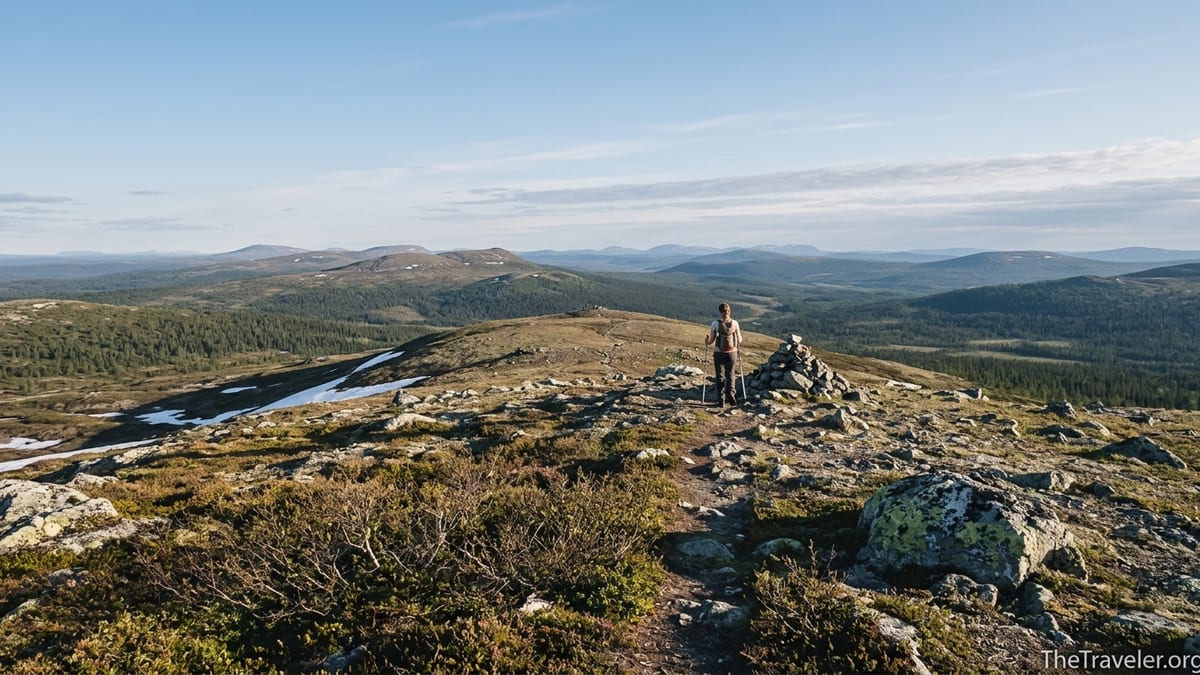
Pallas–Yllästunturi National Park runs for roughly 100 kilometers between the fells of Ylläs in the south and Hetta in the north. It blends the former Pallas–Ounastunturi National Park, established in 1938, with surrounding fell and forest areas, making it one of Finland’s most historic protected landscapes. The terrain is classic Lapland fell country: smooth, treeless summits with wide horizons, separated by forested valleys, lakes and mires. In clear weather the views from fells like Taivaskero or Laukukero feel almost Himalayan in scale, but without the crowds or technical terrain.
What sets this park apart is the sense of space and continuity. There are around 500 kilometers of marked trails for summer and winter combined, from short nature walks near visitor centers to multi‑day routes over the fells. Yet outside a few popular viewpoints, it rarely feels busy. Even in July you can walk for long stretches on the Hetta–Pallas route and see only a handful of other hikers. At the same time, this is not remote in the intimidating sense. Roadheads, villages and several ski resorts sit just outside the boundaries, so you can plan trips that feel wild but still end the day in a heated hut or hotel if you want.
Compared with better‑known Finnish destinations like Oulanka National Park’s Karhunkierros Trail or Nuuksio near Helsinki, Pallas–Yllästunturi flies under the radar internationally. Domestic hikers know it well, but foreign visitors often default to parks that feature heavily in brochures and social media. That relative anonymity is exactly why it feels underrated. While other parks have started to struggle with parking shortages and crowded lookouts in high season, here the infrastructure quietly supports substantial use without overwhelming the landscape or the visitor experience.
Accessible Wilderness Without the Crowds
One reason many travelers underestimate Pallas–Yllästunturi is that it sounds far away. In reality, reaching the park is comparatively straightforward. Most visitors fly into Kittilä Airport, which in winter and summer has direct connections from Helsinki and seasonal flights from other European hubs. From Kittilä it is about a 45‑minute transfer to the Ylläs villages of Äkäslompolo or Ylläsjärvi, where trails start right from the edge of town. Buses also run from Rovaniemi to Hetta and the Pallas area, connecting with trains from the south, so it is possible to arrive entirely by public transport.
Once you are there, the wilderness feels surprisingly close. In Äkäslompolo, for example, you can have breakfast at a guesthouse, walk ten minutes past the last cabins, and suddenly be on a marked fell trail heading toward Kesänkitunturi. In winter, groomed cross‑country ski tracks fan out from the Ylläs ski resort into the park, allowing even novice skiers to glide through old pine forest with views of the fells. Yet because the area is so extensive, people quickly disperse. A family doing a one‑kilometer nature loop near the Kellokas Visitor Centre has a different experience from a couple ski touring up to the open fell plateau of Kukastunturi, even though they start from the same car park.
The park’s network of wilderness and reservation huts is another layer of accessibility that keeps it underrated. Along routes like Hetta–Pallas, hikers can plan each day’s distance between open “autiotupa” huts that are free to use on a first‑come basis, with optional reservable huts nearby for those who want to guarantee a bed. At Sioskuru, roughly 13 to 15 kilometers south of Hetta, two huts, a kota‑style shelter and a campfire site cluster around a stream and small lake, making it a logical first or second overnight on the trek. About halfway along the route, at Hannukuru, hikers find several huts, tent platforms and a small wood‑heated public sauna where, for a modest fee paid in advance or by mobile app, they can soak tired legs in the evening before returning to their sleeping bags.
Because accommodation options extend beyond tents, the park works for a wide range of visitors. Some hikers backpack the full Hetta–Pallas route over three to five days, carrying a tent for flexibility but choosing huts when they arrive early. Others base themselves at Lapland Hotels Hetta, the historic Pallas Hotel, or small cabins around Äkäslompolo and make long day trips onto the fells, secure in the knowledge that there is a hot shower and restaurant meal waiting at the end. This blend of real wilderness and comfortable retreat is part of what makes Pallas–Yllästunturi so compelling yet strangely overlooked among international travelers who often expect Arctic landscapes to require extreme self‑sufficiency.
Year‑Round Adventures for Hikers, Skiers and Cyclists
Many national parks in Europe operate with a short high season; in Pallas–Yllästunturi the year is naturally divided into several distinct adventure windows. In June and early July, as the snow finally melts from the higher fells, the park enters its quietest hiking period. Days are long, often with midnight sun conditions, but some trails can still hold snow patches and be wet from thaw. For experienced hikers this shoulder season is a chance to walk routes like Hetta–Pallas in relative solitude, using boardwalks over boggier sections and accepting that waterproof footwear really matters.
By late July and August, the ground has dried and families start to appear on shorter circuits. The three‑kilometer Varkaankurunpolku Nature Trail near Ylläs is a common choice for visitors with younger children: a manageable distance with footbridges, gentle climbs and interpretive signs in both Finnish and English. At the other end of the spectrum, strong hikers might link the Hetta–Pallas section with additional days south toward Ylläs, turning a 55‑kilometer classic into a 100‑plus‑kilometer traverse between villages. Cyclists also arrive in this period. The park has designated summer cycling routes, including a popular gravel loop around the fell chain promoted by local operators; mountain bikers can ride all day on rolling trails and forest roads and see more reindeer than people.
September is arguably when the park is at its most photogenic. The brief “ruska” autumn color season transforms dwarf birch, willow and undergrowth into bands of red, orange and gold, while the first frosts sharpen distant views. Daytime temperatures are cool but manageable, often between 0 and 10 degrees Celsius, and biting insects have largely disappeared. Hikers on the Pallas ridge can spend their days under clear blue skies and their evenings watching for the northern lights from hut doorsteps or campsite fire rings. Because school holidays are over, trails feel less busy even as domestic photographers and nature lovers time their visits for the colors.
In winter, Pallas–Yllästunturi becomes a different kind of underrated playground. Ylläs is one of Finland’s major downhill ski resorts, with dozens of pistes and more than 300 kilometers of cross‑country tracks radiating into the surrounding forest. Much of this network runs within the national park boundary, yet the experience is quiet and low‑key compared to well‑known Alpine destinations. Skiers can buy a day pass, rent classic or skate skis from a shop in Äkäslompolo, and ski loops that cross frozen lakes and climb to fell shoulders with views over snow‑covered spruce valleys. Independent travelers who prefer human‑powered backcountry experiences use marked winter trails and snowshoe routes to reach fell summits like Taivaskero, always checking conditions and weather forecasts in advance due to Arctic temperatures and limited daylight.
The Classic Hetta–Pallas Route and Other Signature Experiences
For many, Pallas–Yllästunturi’s underrated status crystallizes in one experience: the Hetta–Pallas route. Often described as Finland’s oldest marked hiking trail, it traditionally runs roughly 50 to 55 kilometers between the village of Hetta and the Pallas hotel area, sticking as much as possible to open fell crests. In practice, hikers customize it. Some take a boat shuttle across Lake Ounasjärvi from Hetta to start directly at the first fell ascent; others choose to walk the lakeshore out of town. Many allot three days, staying at Sioskuru and Hannukuru, while those wanting a gentler pace stretch it to four or five days and include shorter side trips to viewpoints or ravines.
What makes this route special is not extreme elevation gain but sustained exposure to wide horizons. After the initial climb, the path often stays above the treeline for hours, weaving from one rounded summit to the next. On clear days, hikers look out across wave after wave of low fells, with clouds throwing moving shadows across the landscape. Reindeer commonly graze on the slopes, and in late summer cloudberries and bilberries line sections of the trail. Facilities are practical rather than polished: simple log huts with bunks, wood stoves and gas cookers, pit toilets tucked into the trees, and signed fire sites with ready‑cut firewood managed by the state forestry agency.
Beyond Hetta–Pallas, the park offers a series of shorter signature outings that few foreigners have heard of. Near the Pallas Hotel, a half‑day loop over Taivaskero takes hikers to a summit where part of the 1952 Olympic flame relay was lit. The path is rocky but waymarked, and on a clear afternoon it delivers sweeping views in all directions, with almost no built structures in sight. In the southern section, popular day hikes include the ascent of Kukastunturi from Äkäslompolo and the loop around Lake Kesänkijärvi, where a demanding accessible trail leads to a lean‑to shelter with a campfire site reachable by all‑terrain wheelchairs with assistance.
For those who prefer wheels to walking, gravel riders and bikepackers are slowly discovering the park. A four‑day loop, widely circulated in bikepacking circles, uses quiet forest roads and designated cycling trails to circle the fell chain. Riders might start in Äkäslompolo, pedal past Aakenus fell, cross the more open landscapes near Pallas and return through the Ylläs side, sleeping in a mix of campgrounds and rental cabins. Because services are spaced roughly a day’s ride apart, with small supermarkets and cafes in villages like Äkäslompolo and Raattama, cyclists can travel relatively light while still experiencing long stretches of genuine solitude.
Cultural Layers and Everyday Lapland Life
Another reason Pallas–Yllästunturi feels underrated is that it is not just a natural landscape; it is woven into the everyday life of Lapland. The park lies within the traditional reindeer herding areas of the Sámi and Finnish Lapland communities. Visitors constantly encounter reindeer, not as staged attractions but as semi‑domesticated animals moving through their pastureland. Hikers on the Hetta–Pallas route might wake to the sound of antlers clacking against hut walls as a curious animal investigates, while cyclists share gravel roads with small herds trotting between forest patches.
The history of tourism here reaches back to the 1930s, when early ski courses and guided winter trips introduced southern Finns to the fell landscapes around Pallas and Ounastunturi. The original Pallas Hotel, with its functionalist architecture, became a symbol of Lapland tourism, later rebuilt and renovated after wartime damage but still operating today with direct access to trails from its doorstep. In Hetta, Lapland Hotels Hetta serves both package tourists and independent hikers, some flying in for a week of winter aurora hunting, others staying a single night before setting off on the fell route with backpacks and fuel bottles.
Local guiding companies, many family‑run, add small‑scale human warmth that rarely makes it into glossy brochures. A snowshoe guide from Hetta might explain how her grandparents used to travel across the frozen lakes by kicksled to visit neighbors. A reindeer herder offering short sleigh rides near Ylläs could casually mention that his animals spend much of their lives roaming within the park, grazing lichen from old spruce trunks that depend on the protected status of the forest. Conversations like these ground the landscape in living culture, reminding visitors that this is not a theme park but home.
Day‑to‑day logistics also reflect a blend of tourism and local life. In midsummer, a traveler walking the Hetta–Pallas route might do their final food shop at the small S‑market in Hetta, buying rye bread, cheese, porridge oats and coffee alongside local residents stocking up for the weekend. On the Ylläs side, ski shops that rent downhill gear in winter switch to hiking boots, trail running shoes and mountain bikes in summer. Cafes near trailheads serve cinnamon buns and salmon soup to a mix of hikers counting kilometers and villagers catching up on the week’s news. These routines give the park area an authenticity that can be harder to find in destinations built almost entirely around seasonal tourism.
Practicalities: Costs, Seasons and How to Plan
For travelers used to Western European prices, Pallas–Yllästunturi sits in the middle range. The national park itself has no entrance fee, and use of most day shelters and open wilderness huts is free. Costs enter the picture with transport, accommodation, and elective comforts. A one‑way bus ticket from Rovaniemi to Hetta typically runs at a moderate price comparable to other long‑distance Finnish routes, and shared airport transfers from Kittilä to Ylläs are priced similarly to resort shuttles elsewhere in Lapland. Basic guesthouse rooms in Hetta or Äkäslompolo often fall in the lower end of typical Lapland hotel pricing outside peak holiday weeks, while full‑service hotels, glass‑roofed aurora cabins and ski‑in‑ski‑out apartments climb toward the higher bracket, especially during Christmas and school holidays.
Hikers who use the hut network can keep overnight costs low. Open wilderness huts require no booking but operate on the principle of sharing space and leaving the hut clean and stocked with firewood for the next visitors. Reservation huts, which guarantee a sleeping place, are booked in advance via the national parks system website for a modest per‑person nightly fee that is low compared with private cabin rentals. Public saunas on routes like Hetta–Pallas, such as the one at Hannukuru, charge a small usage fee payable online, which supports maintenance and firewood supply. Food on the trail is usually brought in from supermarkets in gateway villages, while restaurant dinners in hotels and ski resort restaurants are a treat at the end of or between hikes.
Seasonal timing shapes both experience and cost. December to March is the main winter season, with higher accommodation prices, especially close to Christmas and the February ski holiday period in Finland. This is when downhill pistes and long cross‑country tracks around Ylläs are fully operational, and many international visitors choose to stay in resort apartments with kitchenettes to manage meal costs. Late March and early April often offer excellent spring skiing with more daylight and slightly softer temperatures. June and early July can be relatively quiet but buggy; mosquito headnets and repellent are inexpensive insurance bought locally if needed. Late August and early September attract hikers chasing autumn colors. By late September, some summer services wind down while winter operations are yet to begin, making it a transitional but peaceful time for experienced, self‑reliant visitors.
Planning is straightforward once you know where to look. The official national parks website provides up‑to‑date information on trail conditions, hut maintenance breaks, fire risk restrictions and any seasonal closures. Visitor centers at Kellokas (Ylläs), Pallas and Hetta offer free maps, route suggestions tailored to fitness levels, and real‑time advice on weather and trail surfaces. Many independent travelers arrive with only a rough idea, then refine their plans in person after talking with rangers. A common pattern is to book the first and last nights’ accommodation, leave a margin in the middle, and then decide on day hikes, a short overnight to a hut, or a full Hetta–Pallas traverse depending on conditions and how everyone in the group feels.
The Takeaway
Pallas–Yllästunturi National Park rarely appears on “must see in Europe” lists, yet it offers a combination of attributes that many travelers subconsciously search for: big views without technical difficulty, infrastructure without crowds, and a sense of everyday life continuing at the edges of wild space. It is a place where you can step off a bus from Rovaniemi, cross a lake by small ferry and be on a three‑day fell hike within hours, or land at Kittilä, ride a shuttle to Ylläs and be skiing through old forest by afternoon.
Its underrated status is partly a matter of geography and branding. Names like Karhunkierros, Levi and Rovaniemi have built international recognition, while “Pallas–Yllästunturi” remains a mouthful that rarely fits on a brochure cover. But for travelers willing to look beyond the most marketed spots, that anonymity is a gift. It means more space on the ridgelines, more quiet moments at hut doorsteps, more chances to hear just wind and reindeer bells instead of trail chatter.
Whether you come for a single day’s hike above the treeline, a multi‑day crossing between Hetta and Pallas, or a week of skiing and sauna‑hopping based in Ylläs, Pallas–Yllästunturi delivers a version of Lapland that feels both timeless and lived‑in. It is not a park that shouts for attention. It rewards those who choose to listen.
FAQ
Q1. Where is Pallas–Yllästunturi National Park located?
Pallas–Yllästunturi lies in Finnish Lapland, north of the Arctic Circle, roughly between the villages of Hetta in the north and Äkäslompolo and Ylläsjärvi in the south.
Q2. How do I get to the park without a car?
Most visitors fly or take the train to Rovaniemi or Kittilä, then continue by bus or shuttle to Hetta, Pallas or the Ylläs villages, where trails and ski tracks start right from the settlements.
Q3. What is the best time of year to visit?
For hiking, late July to early September offers the driest trails and, in early autumn, beautiful colors. For skiing and snowshoeing, January to early April usually has good snow and established winter trails.
Q4. Do I need to book huts in advance?
Many wilderness huts are open and free on a first‑come basis, but some reservation huts along popular routes like Hetta–Pallas must be booked in advance, especially in peak season.
Q5. Is the Hetta–Pallas trail suitable for beginners?
The route is non‑technical but crosses open fells in potentially harsh weather, so it suits reasonably fit hikers with basic backpacking skills and good clothing. Guided trips are a good option for first‑timers.
Q6. Can I visit with children?
Yes. Short nature trails such as Varkaankurunpolku near Ylläs work well for families, and older children with hiking experience can manage sections of longer routes as day trips.
Q7. Are there services like shops and restaurants inside the park?
There are no villages inside the park, but gateway communities such as Hetta, Äkäslompolo, Ylläsjärvi and Raattama have supermarkets, cafes, restaurants and accommodation within short drives or walks of trailheads.
Q8. Is wild camping allowed?
Camping is generally permitted near designated rest spots, huts and campfire sites in line with park rules. In some zones it is more restricted, so always check current guidance from visitor centers or official information.
Q9. Can I see the northern lights in Pallas–Yllästunturi?
Yes. From roughly September to March, clear dark nights often bring aurora displays, and the lack of light pollution on the fells makes the park an excellent place to watch them.
Q10. Are there marked trails for cycling and winter activities?
There are specific summer cycling routes and extensive winter cross‑country ski networks, especially around Ylläs and Pallas, plus snowshoe and winter hiking trails maintained when conditions allow.