


Across the Arctic north of Norway, Sweden and Finland lies Sápmi, the homeland of the Sámi people. For travelers, this is not just another “Lapland” stop for northern lights and snow photos. It is one of Europe’s most distinctive living Indigenous cultures, with its own languages, seasonal rhythms and relationship to reindeer and fragile Arctic landscapes. Approached with respect, Sámi culture offers a rare kind of travel experience: immersive, small scale and rooted in everyday life rather than staged spectacle.
Get the latest updates straight to your inbox!
Sápmi: A Cross-Border Homeland Unlike Anywhere Else
The first thing that makes Sámi culture so unique is its geography. Sápmi is not a country on any European map but a cultural region that stretches across northern Norway, Sweden, Finland and into Russia’s Kola Peninsula. Towns like Kautokeino and Karasjok in Norway, Jokkmokk and Kiruna in Sweden, and Inari in Finland are all key centers of Sámi life, each with its own mix of languages, traditions and modern Indigenous institutions.
In Karasjok, for example, travelers can visit the Sámi Parliament of Norway and Sápmi Park, where exhibits and storytelling explain how reindeer herding, land use and language connect to political rights and identity today. In Inari, the Sámi Cultural Centre Sajos and nearby reindeer herding communities make it clear that this is not a theme park version of “Lapland” but the administrative and cultural heartland of the only Indigenous people within the European Union.
Because Sápmi crosses borders, travelers can experience different national approaches to Sámi rights within a single trip. In Norway and Sweden, for instance, reindeer herding is restricted by law to Sámi herders, while in Finland non Sámi can also hold reindeer herding rights, which has shaped local politics and livelihoods. Moving between Tromsø in Norway, Kiruna in Sweden and Inari in Finland, you see how one culture adapts to three different state systems while keeping a strong sense of shared identity.
This cross-border reality also creates an unusually rich cultural landscape for visitors. Within a few days you might hear Northern Sámi in Kautokeino, South Sámi further south in Sweden, and Inari or Skolt Sámi in eastern Finnish Lapland, all alongside Scandinavian and Finnish languages. Place names, road signs and even museum labels often appear in multiple languages, reminding travelers that Sápmi is layered on top of the states you are used to seeing on a map.
A Living Reindeer Culture, Not Just a Winter Attraction
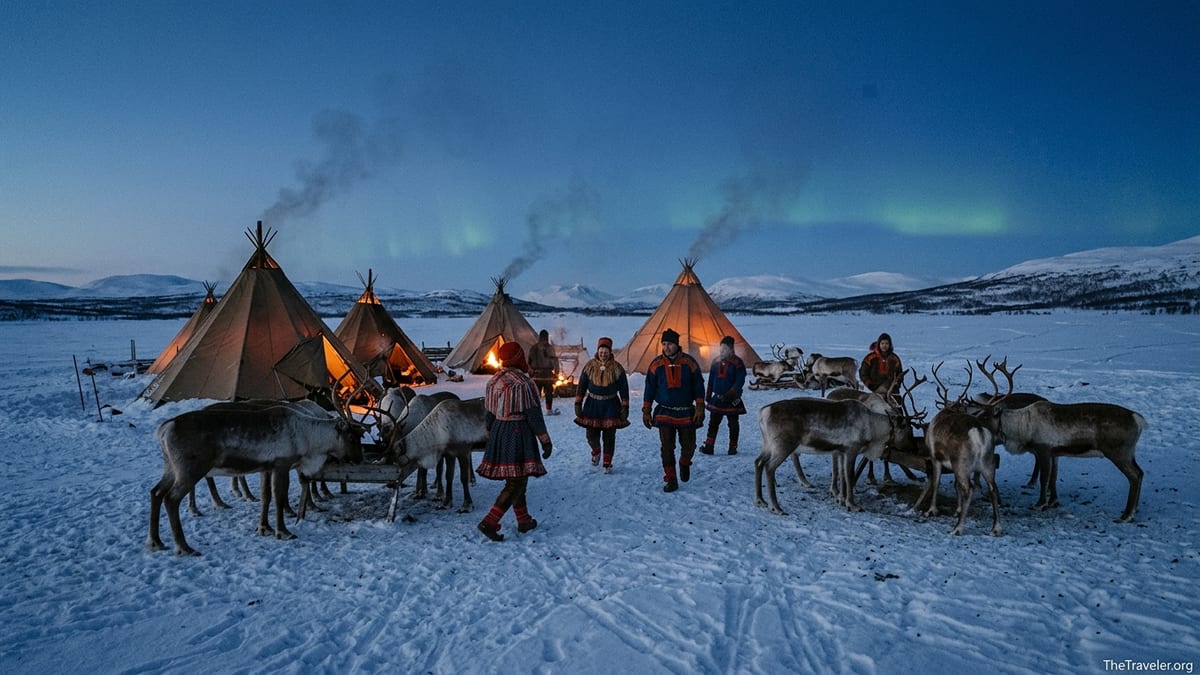
For many visitors, the iconic image of Sámi culture is a reindeer pulling a sled across a snowy plateau under the northern lights. Those scenes can still be experienced on trips near Tromsø, Alta or Kiruna, but what makes Sámi reindeer culture truly unique is that it is a year-round, family-based livelihood rather than a seasonal show for tourists.
Ethical tour operators in northern Norway, such as small Sámi family outfits near Tromsø or in Kautokeino, invite guests to meet the herd, feed reindeer, and then sit by the fire in a lavvu (a traditional tent) while hosts explain migration routes, climate challenges and the practicalities of herding in the 21st century. A half-day visit that includes reindeer feeding, a short sled ride, a simple hot meal like bidos (a traditional reindeer stew) and storytelling typically costs in the region of 150 to 220 euros per adult in the high winter season, reflecting the small-group, high-cost nature of life in the Arctic.
Elsewhere in Swedish Lapland, experiences around villages such as Mettäjärvi or near Jokkmokk focus less on sledding and more on slow time with a herd. Guests may spend three hours helping to feed reindeer, learning to handle a lasso, and then sharing a coffee and smoked meat around the fire while hearing about grazing rights and the pressure of mining projects on pastureland. In autumn, multi-day “slow life” stays in Finnmark or around Lake Inari let visitors follow herding families during seasonal movements, sometimes sleeping in basic cabins without running water and joining in everyday tasks like chopping wood and checking fences.
Compared with other European rural experiences such as Tuscan farm stays or French vineyard tours, Sámi reindeer experiences are more nomadic and often physically demanding. Herding is dictated by weather, predators and snow conditions, so even short visits can involve last-minute changes. Travelers who accept this unpredictability get a rare window into a livelihood that still shapes land use, politics and identity across the entire region.
Traditional Knowledge, Food and Design Woven Into Daily Life
Another reason Sámi culture stands out is the way traditional knowledge is still woven into everyday life. The Sámi concept of eight seasons, for example, does not match the standard four-season calendar most visitors know. Instead, it divides the year according to subtle shifts in snow, light, reindeer behavior and plant life. Guides may describe “spring-winter” as the time when snow is still deep but the sun has real warmth, ideal for long days out with the herd, while “autumn-winter” is defined more by ice conditions and reindeer migrations than by temperatures alone.
Sámi food traditions give travelers a direct taste of this seasonal knowledge. In Tromsø or Karasjok, you might be served thin-sliced smoked reindeer heart, cloudberries with cream, or fresh fish from Arctic fjords alongside flatbread made over an open fire. In Kiruna, family-run Sámi restaurants often highlight ingredients like angelica, mountain sorrel and reindeer bone broth, explaining how nothing from the animal is wasted. A typical lunch menu might offer a bowl of bidos for around 20 to 25 euros, while a full multi-course tasting menu featuring reindeer, Arctic char and foraged herbs can reach 80 euros or more per person.
Handicrafts, known as duodji, are another living form of knowledge. In markets like the annual winter festival in Jokkmokk or smaller shops in Inari, travelers find knives with handles made from birch burl and reindeer antler, hand-woven belts with geometric patterns that show regional identity, and pewter-embroidered leather bracelets. Prices vary widely but a simple, hand-made bracelet might cost around 40 to 60 euros, while a custom knife can easily run to several hundred euros. Responsible shops and cooperatives are usually Sámi owned or have clear labels naming the craftsperson, which is important in a region where mass-produced “Lapland souvenirs” are also common.
Even clothing carries layers of meaning. The traditional gákti, often seen during festivals or family celebrations, is not a costume for tourist photos but a garment that signals where the wearer and their family come from, and sometimes their marital status. Some ethical tourism guidelines published by Sámi institutions in Finland explicitly warn against non Sámi actors dressing up in fake costumes for performances. Travelers who understand this are more likely to seek out real cultural encounters rather than staged “Lapland shows” that borrow Sámi imagery without community involvement.
Music, Storytelling and Language: Intangible Heritage You Can Hear
While reindeer and snow dominate many brochures, the intangible aspects of Sámi culture are often what stay with travelers the longest. Central among these is joik, a distinctive form of singing that does not simply describe someone or something but is meant to evoke their presence. During many small-group evening programs near Tromsø or in Karasjok, hosts will sing a joik dedicated to a grandparent, a particular reindeer or even a local mountain, explaining how it is less a “song about” and more a musical portrait.
Hearing joik inside a lamplit lavvu, with the sound of the fire and the faint jingle of reindeer bells outside, feels very different from a stage performance at a big city festival. Yet Sámi music is also part of contemporary art and politics. Artists such as Máret Ánne Sara and modern Sámi musicians incorporate joik elements into experimental works addressing land rights and environmental change. Visitors who time their trip with events like the winter markets in Jokkmokk or Easter festivals in Kautokeino may encounter concerts that blend joik with rock, electronic or choral music.
Language is another powerful part of the experience. Northern Sámi, the most widely spoken Sámi language, sounds quite different from Scandinavian languages and is more closely related to Finnish and Estonian. In places like Inari, multilingual signage in Finnish, Swedish, Norwegian and multiple Sámi languages is common. Joining a guided walk in which the guide shifts between Sámi and English gives travelers a sense of how language carries knowledge about snow types, grazing conditions and kinship that does not translate neatly into English.
Storytelling also bridges past and present. Around a campfire, hosts might recount memories of childhood migrations with the herd, but they may just as easily discuss recent legal cases over wind farms, mining or fishing rights. This blend of oral history, myth and very current politics is one of the clearest reminders that Sámi culture is not a frozen relic from the “age of explorers” but a living, changing society grappling with globalization and climate change.
Ethical Sámi Tourism: How to Travel with Respect
Because Sámi culture has become a selling point in northern European tourism, questions of ethics are central to any visit. Sámi institutions, including the Sámi Parliament in Finland, have published principles for responsible and ethically sustainable Sámi tourism that emphasize community control, informed consent and realistic representation. These guidelines encourage visitors to choose Sámi owned or Sámi led businesses, to avoid attractions that exoticize the culture or treat reindeer as mere photo props, and to respect working areas such as corrals and calving grounds.
In practice, this means reading the “about us” section carefully when booking an experience. Operators based near Tromsø, Alta, Kiruna or Rovaniemi who introduce themselves as multi-generation reindeer herding families, share their Sámi names, and explain how tourism fits around herding obligations are usually more trustworthy than generic “Lapland adventure” brands that present anonymous staff in borrowed costumes. Some Sámi-led operators cap group sizes at 10 to 20 guests, limit the duration of sled rides to reduce stress on animals, and prioritize time for dialogue and questions over entertainment.
Ethical travel also involves behavior on the ground. Visitors are asked not to enter corrals or approach reindeer without permission, not to walk on marked grazing areas, and to follow instructions about photography, especially when it involves children or sacred sites. In summer, when the ground is fragile, staying on marked paths and boardwalks protects lichen and tundra that reindeer depend on in winter. In winter, guests are often reminded to keep noise low during calving time or other sensitive periods.
Finally, respect includes how you talk about your trip afterward. Instead of framing the experience as a “cute reindeer show,” travelers can explain to friends that they visited the homeland of an Indigenous people, learned about land rights and climate impacts, and contributed financially to small family businesses in remote communities. For many Sámi hosts, that kind of informed storytelling by visitors is as important as the direct income from tourism.
Planning Your Trip: Seasons, Costs and Key Hubs
Experiencing Sámi culture is possible at any time of year, but what you encounter will differ dramatically by season. From December to March, snow-based activities dominate. In the Tromsø region, a typical day trip that combines reindeer sledding, feeding and a cultural program with joik and storytelling can last 4 to 6 hours and cost in the region of 180 to 250 euros per adult, including transport from the city. In Alta or Kiruna, prices are similar, though small family-run outfits may charge slightly less for shorter visits that focus on feeding and storytelling rather than sledding.
Spring and early summer open up different experiences, such as watching river ice break-up, fishing with local guides, or joining short hikes that follow traditional reindeer migration paths. In Finnmark, some families offer early summer visits on coastal islands where reindeer graze, reached by small boat. These trips often accept only 4 to 8 participants at a time and may cost 150 to 300 euros per person for a full day including meals. Autumn is prime time for “slow life” stays that last two or three days and revolve around berry picking, wood chopping, mending fences and preparing meat and hides for winter.
Logistics vary by hub. Tromsø and Alta in Norway, Kiruna in Sweden, and Ivalo or Rovaniemi in Finland are the most common gateways, with regional flights linking them to Oslo, Stockholm or Helsinki. From there, bus routes run north toward Karasjok, Kautokeino or Inari. Travelers on tighter budgets often base themselves in a city hostel or mid-range hotel, then join day trips to Sámi hosts in nearby valleys. Those with more time might combine a coastal Hurtigruten voyage with inland stays in Karasjok or Kautokeino, or travel by overnight train to Kiruna and on by bus to smaller villages.
Accommodation costs mirror other Arctic destinations. In winter, a basic but comfortable guesthouse room in a Sámi-run lodge near Inari or Jokkmokk might start around 120 to 170 euros per night for two people, including breakfast. More remote cabins with full board and guided activities can climb to 250 euros per person per night. Travelers willing to visit in shoulder seasons such as late September or early April often find better availability and more time for conversation with hosts, along with lower prices.
The Takeaway
What sets Sámi culture apart from many other European travel experiences is that it is both deeply traditional and fully contemporary. Travelers are not stepping into a reconstructed “ancient village” but into living communities where smartphones and snowmobiles exist alongside ancestral joik and duodji. Reindeer herds still move with the seasons, but they do so in landscapes increasingly shaped by wind farms, roads and climate change, subjects your hosts may discuss as readily as they describe childhood winters.
If you approach Sápmi as more than a backdrop for northern lights photos, you will discover one of Northern Europe’s most distinctive forms of cultural immersion. Sharing coffee around a fire in a lavvu, listening to joik drift into the Arctic night, or helping to feed a herd before they move to new grazing grounds, you become a guest in an ongoing story rather than a spectator at a show. That sense of entering a living Indigenous homeland, with all its beauty and complexity, is what makes Sámi culture such a uniquely rewarding experience for thoughtful travelers.
FAQ
Q1. Where can I have the most authentic Sámi cultural experience?
Karasjok and Kautokeino in Norway, Jokkmokk and Kiruna in Sweden, and Inari in Finland are strong hubs, especially when you book with Sámi owned or Sámi led operators.
Q2. Is it ethical to go on reindeer sledding tours?
It can be, if you choose Sámi run tours that treat sledding as a small part of a broader cultural visit, limit group sizes and prioritize animal welfare and storytelling.
Q3. How expensive are Sámi cultural experiences?
Half-day winter visits with reindeer feeding, a short sled ride and a hot meal often cost around 150 to 220 euros per adult, while multi-day “slow life” stays are higher.
Q4. Do I need to visit in winter to experience Sámi culture?
No. Winter brings sledding and deep snow, but spring, summer and autumn offer hiking, fishing, berry picking and slower, more everyday glimpses of reindeer life.
Q5. Can I take photos of Sámi people and reindeer?
Always ask permission first, especially when photographing people, children or sacred sites. Many hosts are happy to be photographed if you ask respectfully.
Q6. What should I wear when visiting a reindeer camp?
Dress for Arctic conditions: thermal base layers, windproof outerwear, insulated boots, gloves and a hat. Many operators provide extra overalls and boots if needed.
Q7. How can I tell if a Sámi experience is genuine?
Look for tours that clearly state who the Sámi hosts are, explain their family background, focus on dialogue rather than performances, and are recommended by local tourism boards.
Q8. Is northern lights viewing automatically part of Sámi tours?
In winter many evening visits take place under dark skies, so you may see the aurora if conditions are right, but it is never guaranteed and should not be the only reason to go.
Q9. Are Sámi cultural experiences suitable for children?
Yes, many family-run camps welcome children, especially for feeding reindeer and listening to stories, though very young children may find long, cold sled rides tiring.
Q10. How can I support Sámi communities beyond tourism?
Buy duodji directly from Sámi craftspeople, attend Sámi festivals and exhibitions, read Sámi authors and artists, and share accurate information about Sápmi when you return home.