


For many visitors, Finland’s excellent schools are as intriguing as its forests and lakes. At the heart of this national success story stands the University of Helsinki, a 17th‑century institution that today trains a large share of Finland’s teachers, drives education research and shapes policy at every level. For travelers curious about how this small Nordic country built one of the world’s most admired education systems, understanding the role of the University of Helsinki offers a revealing window into Finnish society itself.
Get the latest updates straight to your inbox!
The Oldest University in Finland and a National Reference Point
Founded in 1640 in Turku and later moved to Helsinki, the University of Helsinki is the oldest and largest university in Finland. It has grown into a comprehensive institution with around 31,000 degree students across 11 faculties, including educational sciences, humanities, medicine, law and social sciences. In global rankings, it typically appears around the top 100 to 150 universities worldwide, giving Finland a visible flagship on the international academic stage. This status means that when Finnish education is discussed abroad, the University of Helsinki is usually one of the first institutions mentioned.
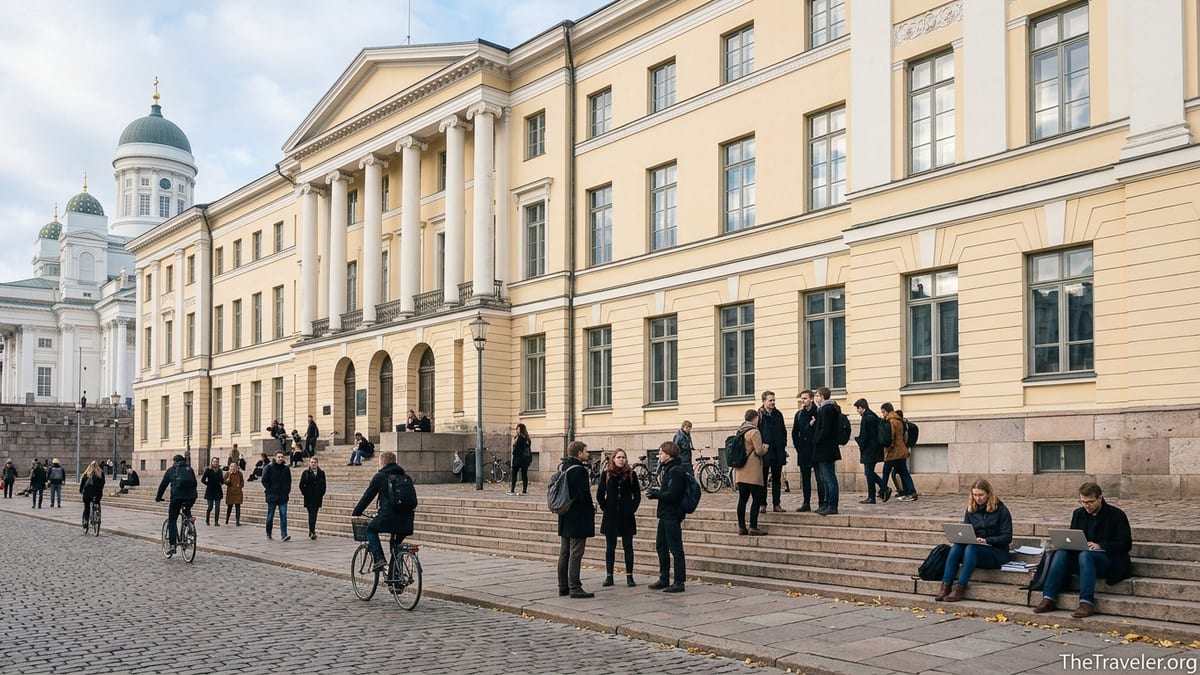
For visitors walking around central Helsinki, the university’s influence is immediately visible. The historic City Centre Campus surrounds Senate Square, just steps from the white Helsinki Cathedral and the Government Palace. Many of the classical buildings visitors photograph on a walking tour still house the core of Finland’s academic life, including lecture halls, libraries and research centers. The university’s presence here is more than aesthetic. It physically links scholarship, government and public space, symbolizing how education is woven into the fabric of Finnish democracy.
The University of Helsinki’s national role is also formal. It is regularly consulted in government working groups on school reform, curriculum changes and teacher education. Researchers from the Faculty of Educational Sciences sit on advisory boards for the Ministry of Education and Culture, shaping everything from digital learning strategies to how schools support special needs students. When Finland rethinks its education system, it is often research, pilot projects and expert opinion from the University of Helsinki that anchor the discussion.
For a traveler who drops into a public lecture at the university’s main building or browses an exhibition at the Helsinki University Museum, it quickly becomes clear that this is not just a campus. It is a national institution with cultural, political and social reach far beyond its lecture rooms.
Training the Teachers Behind Finland’s School Success
Perhaps the most direct way the University of Helsinki shapes Finnish education is through teacher training. In Finland, teaching is a master’s-level profession. Primary and secondary teachers are educated at universities, not short-cycle colleges, and the University of Helsinki’s Faculty of Educational Sciences is one of the main providers of this training. Each year, student teachers complete their practical training in university-affiliated teacher training schools, which are often compared to teaching hospitals in medicine. These schools combine real classrooms with systematic observation, mentoring and research projects.
One of the best-known examples is the Viikki Teacher Training School in eastern Helsinki. A tram ride from the city center takes you to this campus where visiting educators frequently come to observe Finnish teaching methods in action. Here, university students learning to teach mathematics, Finnish, English or history spend weeks at a time planning lessons, teaching small groups and reflecting on their practice under the supervision of experienced mentor teachers. Classrooms are fitted with observation rooms and recording equipment so that lessons can be analyzed in detail. The model allows Finland to keep the bar high: only students who complete this demanding mix of theory and practice can qualify as teachers.
The University of Helsinki has also internationalized its teacher training. The Subject Teacher Education Programme in English, often called STEP, offers pedagogical studies for those who want to become subject teachers but need or prefer English as their working language. This program attracts international students and Finnish returnees who may have studied abroad. For a prospective teacher from, say, the United States or India considering a career in Finland, STEP is often the entry point. It helps explain why foreign visitors on Helsinki’s trams and in its cafes sometimes overhear conversations about lesson planning and classroom management in accented English as well as Finnish.
Crucially, the university’s teacher education is tightly linked to research. Students are introduced to comparative education studies, learning psychology and assessment research produced at the same institution. When new topics such as digital literacy, climate education or socio-emotional learning become important, they are first explored through pilot studies and then integrated into teacher training. This feedback loop between research and classroom practice is one reason Finland continues to be seen as a laboratory for modern schooling, and it rests heavily on the University of Helsinki’s capacity.
Research and Reform: From Policy Labs to Real Classrooms
The University of Helsinki not only trains teachers but also produces much of the research that guides Finnish education policy. Its Faculty of Educational Sciences runs projects on topics ranging from early childhood education and special needs support to learning analytics and multilingual classrooms. When Finnish authorities or international organizations such as the OECD analyze why Finland has historically performed well on learning assessments, they often draw on data and expertise generated in these research groups.
A recent example is the national reform of teacher education, a major government initiative supported by the Ministry of Education and Culture. The University of Helsinki is one of the central partners, using dedicated funding to pilot new ways of organizing teaching practice, mentoring novice teachers and integrating digital tools into training. For instance, some practice schools now experiment with co-teaching models where a student teacher and an experienced teacher share responsibility for a group, while lessons are simultaneously used as research material on collaborative teaching. These experiments help Finland adapt to challenges such as teacher workload, inclusive education and increasingly diverse classrooms.
The university also plays a broader societal role through public debate. Professors of education regularly appear in Finnish media commenting on homework policies, standardized testing or changes in the national curriculum. For example, when Finland introduced its phenomenon-based learning elements in the basic education curriculum, academics from Helsinki were widely quoted assessing both the opportunities and the limitations of this innovation. Their participation helps keep the public conversation grounded in evidence rather than short-lived trends.
For travelers with a professional interest in education, this research presence is tangible. Conferences and study tours often start at the University of Helsinki, where visitors attend seminars on topics like equity in schooling or digital pedagogy before heading out to visit local schools. It is not unusual to see groups of teachers from Italy, Singapore or Canada filing into a lecture hall on the City Centre Campus in the morning, then continuing to a suburban comprehensive school in the afternoon armed with questions they developed together with university researchers.
A Bilingual, Multilingual University Shaping Language Policy
Finland has two national languages, Finnish and Swedish, and the University of Helsinki is officially bilingual in both. This status carries legal responsibilities. The university must offer a substantial number of professorships with Swedish as the teaching language, and many degree programs allow students to complete coursework and exams either in Finnish or in Swedish. It is also the only university in Finland that offers full academic education in Swedish in fields such as medicine, veterinary medicine and journalism. This makes the institution a cornerstone in securing high-level education for the Swedish-speaking minority across the country.
At the same time, the University of Helsinki has become increasingly multilingual. English now plays a major role as a language of instruction and research, especially at the master’s and doctoral levels. The university offers several full degree programs in English, particularly in fields like data science, environmental change, neuroscience and educational sciences. International students who enroll in these programs can take free Finnish-language courses, which helps them integrate into daily life, apply for part-time jobs in the city and eventually access positions that require some Finnish proficiency.
Walking through the university’s main campus around lunchtime illustrates this linguistic mix. In the student cafeteria, you may hear a group of trainee teachers discussing assessment criteria in Finnish, a Swedish-speaking medical student ordering coffee, and an international master’s group negotiating a group project in English. Notices on bulletin boards are often trilingual: Finnish, Swedish and English. This environment reflects, and in turn influences, the broader Finnish education system, which increasingly serves students with diverse linguistic backgrounds and aims to balance national languages with international openness.
The university’s language policy has ripple effects on schools across the country. Research on bilingual and multilingual education informs how basic education curricula deal with Swedish as a second national language, foreign languages like English and German, and support for pupils whose first language is something else entirely, such as Somali or Russian. When municipalities design new language-support models for immigrant children, they frequently consult reports and guidelines produced by University of Helsinki researchers. For visitors interested in how small countries manage multilingualism, the campus is a living case study.
Champion of Equity and Inclusive Education
Finland’s school system is often praised for its emphasis on equity rather than competition, and the University of Helsinki plays a central role in sustaining this ethos. Teacher education programs place strong emphasis on inclusive pedagogy, special needs education and support for pupils from different social and cultural backgrounds. Student teachers learn not only how to deliver subject content, but also how to identify learning difficulties early, cooperate with school psychologists and work with assistants in classrooms that include students with a wide range of abilities.
In practice, this means that in university-affiliated training schools, visitors can see small groups receiving targeted support during lessons, co-teaching arrangements where a special needs teacher and a subject teacher share the classroom, and flexible seating and learning materials adapted to different needs. For example, in a 7th-grade Finnish language class, some pupils might work with printed texts while others use tablets with speech support applications or dyslexia-friendly fonts. Each of these arrangements often reflects research carried out at the university’s Faculty of Educational Sciences or in collaboration with hospitals and child development clinics.
The university is also active in evaluating how well Finnish schools are meeting equity goals. Studies from Helsinki-based researchers have examined, for instance, whether students in rural areas receive the same quality of instruction as those in big cities, or how socio-economic background still influences educational outcomes despite the country’s comprehensive school system. Findings from these studies have prompted municipal authorities to adjust resource allocation, such as directing more support staff or smaller class sizes to schools in disadvantaged neighborhoods.
For international visitors exploring districts like Kontula or Malmi in Helsinki, where many families have immigrant backgrounds and incomes vary widely, the impact of these decisions is evident in local schools. The University of Helsinki’s research and teacher training helps ensure that even in areas with complex social challenges, schools remain inclusive spaces committed to providing each child with the support they need.
An International Gateway for Education Professionals and Curious Travelers
The University of Helsinki is also a gateway through which Finland shares its education expertise with the world. The university regularly organizes intensive courses, summer schools and customized study visits for foreign teachers, school leaders and policymakers. Many of these programs combine lectures on the Finnish education system with school visits in the Helsinki region and nearby cities such as Espoo and Vantaa. Participants might spend a morning learning about curriculum design in a seminar room on the City Centre Campus, then travel by commuter train to observe a mathematics lesson in a comprehensive school in Espoo in the afternoon.
Some programs target specific audiences. For example, there are short courses focused on early childhood education, special needs education or digital learning environments, often hosted in collaboration with the university’s teacher training schools. Education export units within the university have worked with partners in countries from Central Asia to Latin America, helping them adapt elements of the Finnish model, such as play-based early years curricula or teacher mentoring structures, to local conditions. While Finland is cautious about claiming that its system can be simply copied elsewhere, the University of Helsinki has become a key node in these international exchanges.
For general travelers rather than education professionals, the university still offers multiple points of contact. Public lectures on topics like learning, brain research or societal change are frequently advertised on notice boards and social media, and many are open free of charge. The main library in the Kaisa House building, a striking modern structure a few blocks from the train station, welcomes visitors who wish to see how a contemporary Nordic academic library functions. Cafes and student restaurants on campus are open to the public, giving visitors an authentic taste of everyday university life, complete with student-priced lunches crowded with trainee teachers and researchers.
These experiences make it clear that the University of Helsinki is not an isolated ivory tower. It is an open, permeable institution where international and local currents meet, and where people from diverse backgrounds encounter the Finnish way of thinking about education as a public good.
The Takeaway
The University of Helsinki plays an outsized role in Finnish education because it simultaneously acts as a teacher training center, research powerhouse, policy advisor, guardian of bilingualism and international ambassador. From the Viikki Teacher Training School where future teachers refine their craft, to multilingual master’s programs that attract students from all over the world, the university’s activities ripple out into every corner of Finland’s classrooms.
For visitors to Helsinki, this means that the stately university buildings around Senate Square and the lively student quarters in Kallio and Viikki are more than picturesque backdrops. They are the engine rooms behind a school system that has influenced global thinking on how to combine equity, quality and teacher professionalism. Whether you attend a public talk, tour a training school or simply share a cafeteria table with student teachers comparing lesson plans, you are stepping into the living heart of Finnish education.
FAQ
Q1. Why is the University of Helsinki so central to Finnish teacher education?
The University of Helsinki hosts one of Finland’s largest faculties of educational sciences and operates its own teacher training schools, where student teachers complete supervised teaching practice as part of their master’s-level studies.
Q2. Can international students study education at the University of Helsinki?
Yes. Several master’s programs related to education are offered in English, and the Subject Teacher Education Programme in English provides pedagogical studies for future subject teachers.
Q3. What makes the university’s teacher training schools special?
They function like teaching hospitals for education. Real pupils attend these schools, while student teachers plan and deliver lessons under the guidance of experienced mentors and researchers who systematically observe and analyze classroom practice.
Q4. How does the University of Helsinki influence national education policy?
Its researchers advise the Ministry of Education and Culture, sit on curriculum and reform working groups, and provide evidence from large-scale studies that policymakers use when revising curricula and teacher education guidelines.
Q5. Is the University of Helsinki really bilingual?
Yes. Finnish and Swedish are both official languages of instruction and administration, and many programs allow coursework and exams in either language, while English is widely used in international degrees and research.
Q6. How does the university support inclusive education in Finnish schools?
Teacher education emphasizes special needs pedagogy, and research projects from the Faculty of Educational Sciences guide how schools organize support services, co-teaching and individualized learning plans for diverse learners.
Q7. Are there opportunities for visiting educators to learn about the Finnish system on site?
Yes. The university regularly hosts study visits, short courses and tailored programs that combine seminars on the Finnish system with school visits in the Helsinki region.
Q8. Do you need to speak Finnish to study at the University of Helsinki?
For English-language degree programs, Finnish is not required for admission, although learning some Finnish is recommended for everyday life and broadening future career options in Finland.
Q9. How visible is the University of Helsinki in the city itself?
Its main campus surrounds Senate Square in central Helsinki, and additional campuses in areas like Viikki and Kumpula host faculties, training schools and research centers that are integrated into the urban landscape.
Q10. Why should a traveler interested in education visit the University of Helsinki?
Visiting offers a chance to see where Finland’s teachers are trained, attend public lectures, experience multilingual academic life and better understand the research and values driving the country’s admired school system.