


Landing at Zanzibar’s Abeid Amani Karume International Airport and heading straight to the white sands of Jambiani is a classic east-coast beach move. The journey is straightforward, but choosing between an on-the-spot taxi, a prebooked private transfer or an increasingly popular shared shuttle can affect your budget, comfort and how smoothly your first hours on the island go. This guide walks you through each option, with real-world examples, up-to-date price ranges and practical tips for couples, families and solo travelers, plus advice on whether it makes sense to combine Jambiani with nearby Paje in one stay.
Get the latest updates straight to your inbox!
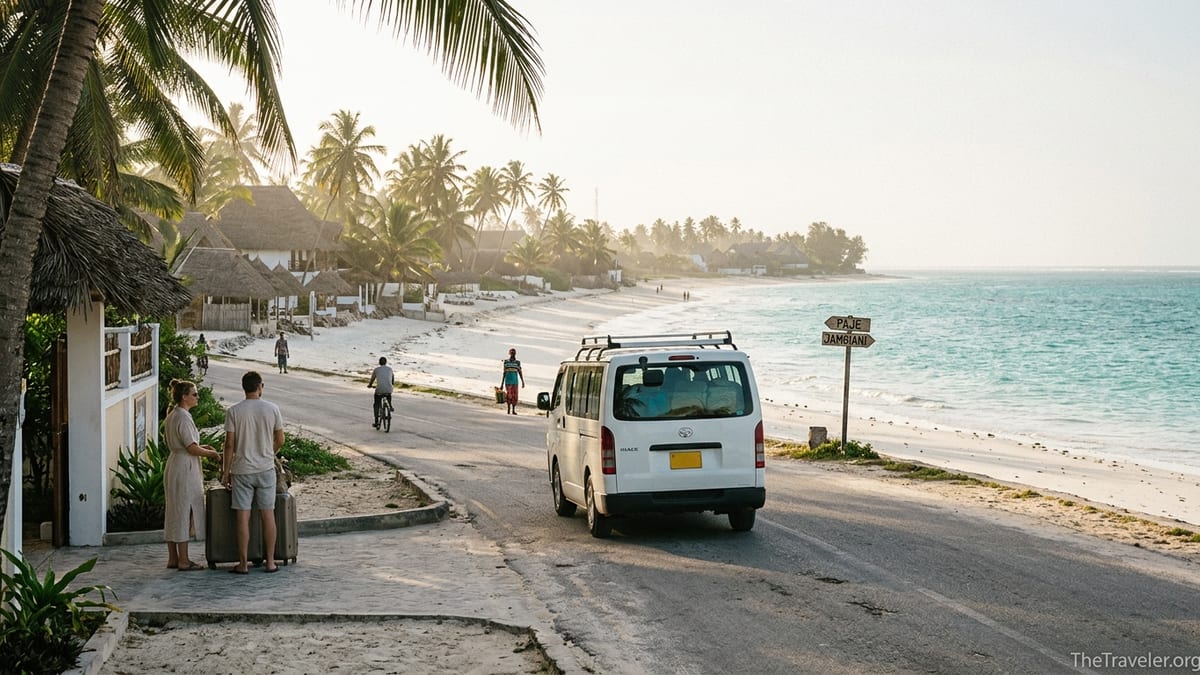
Understanding the Route from Zanzibar Airport to Jambiani
The main airport serving Zanzibar, Abeid Amani Karume International Airport (ZNZ), sits just outside Stone Town on Unguja Island. Jambiani lies on the southeast coast between Paje and Makunduchi, spread along roughly 5 kilometers of beach. Road distance from the airport to Jambiani is about 55 to 60 kilometers depending on your exact hotel location, and typical driving time is around 50 to 70 minutes in normal traffic on mostly paved roads.
Most drivers follow the same general route: leaving the airport area, skirting past Stone Town on the main road toward the island’s south, then turning east to cross the island and eventually dropping down the east coast via Paje to Jambiani. If your driver uses Paje as a reference point, that is normal. Jambiani is only about 8 to 10 kilometers south of Paje, roughly a further 10-minute drive along the coastal road, so it is common for local operators to quote “Paje / Jambiani” together for transfers.
The road is almost entirely surfaced, but expect occasional speed bumps, narrow village sections and slower trucks. Night driving is common because many long-haul flights arrive after dark, but it is wise to allow extra time after sunset and in heavy rain. For most arrivals, planning on about one hour door to door from the airport to a beach hotel in central Jambiani is realistic.
Because there are no app-based ride-hail services operating reliably from the terminal area and no train or official bus into the beach zones, you will be choosing between an airport taxi, a prearranged private transfer, or a scheduled shared shuttle service. Public minibuses known as dala-dalas exist, but they do not run direct from the airport to Jambiani and require multiple changes in town, which many visitors find too slow and uncomfortable, especially after a flight.
Taxi from Zanzibar Airport to Jambiani: What to Expect
For many travelers the simplest choice is a straightforward airport taxi. As you exit customs at ZNZ you will see a line of independent drivers and a few desks representing local taxi groups. Vehicles are typically older sedans or small minibuses such as Toyota Alphards or HiAces. There are no meters, so the fare is negotiated per car in advance. For the airport-to-Jambiani route, recent on-the-ground reports and rate lists from local operators suggest a typical one-way taxi price of roughly 35 to 50 US dollars for up to three passengers, depending on your bargaining skills, time of day and season.
A common real-world scenario: a couple arriving on an evening flight in July might agree 40 US dollars in cash with an airport driver for a direct ride to a mid-range hotel in central Jambiani. The same route booked via a hotel’s preferred driver might be quoted at 45 to 50 US dollars, reflecting a small mark-up for reliability and coordination. Larger vehicles able to comfortably carry a family of four or five with several big suitcases might cost nearer 50 to 60 US dollars.
Taxis are door-to-door and usually reasonably fast. Travel time is typically around one hour if you travel outside Stone Town rush-hour times and your hotel is not at the far southern end of the village. Drivers are used to late arrivals and will usually help load luggage and wait while you change a small amount of cash or purchase a SIM card at the airport. Tipping is appreciated rather than mandatory; rounding up by a few dollars for good service is customary.
The main downsides of taking a taxi without prebooking are price uncertainty and the need to negotiate when you may be tired from travel. To minimize surprises, check a recent airport price list from a reputable local transfer site before you fly so you know roughly what is fair. Having the amount written down in US dollars or Tanzanian shillings and confirming “total for the car, not per person” with the driver before you get in helps avoid misunderstandings.
Prebooked Private Transfers: Stress-free and Family-friendly
Prebooked private transfers are increasingly popular because they remove the hassle of negotiation and help you lock in a clear price and meeting point before arrival. Several types of providers offer this service: beach hotels that arrange a driver, local transfer companies that operate fleets of taxis and minibuses, and international booking platforms that connect you with Zanzibar-based drivers. In all cases, the vehicle is reserved just for your party and goes directly from the airport to your Jambiani accommodation.
Price-wise, private transfers from ZNZ to Jambiani generally sit in the same band as taxis or slightly above, but the advantage is predictability. As of mid-2026, realistic one-way prices for a standard private car or small minivan range from about 35 to 60 US dollars per vehicle depending on group size, the booking channel and how flexible you are with pick-up times. For example, a family of four with two large checked bags plus hand luggage might prebook a modern minivan with air conditioning for around 45 to 55 US dollars via a local operator, with the driver meeting them in the arrivals hall holding a sign with their name.
For families, private transfers are usually the easiest solution. You can specify that you need child seats, extra luggage space for kitesurfing equipment, or a stop at a supermarket on the way to pick up bottled water and snacks. Many operators are happy to add a 10 to 15-minute shop stop at no extra cost if you request it in advance, which can be especially useful if you are heading straight to a quiet stretch of Jambiani where shops close early.
Private transfers also suit travelers arriving very late at night or alone. Knowing the name and phone number of your driver in advance, and having them expect you even if your flight is delayed, brings peace of mind. Most companies communicate via WhatsApp and will track delays if you share your flight number. Payment is often possible in multiple ways: cash to the driver in US dollars or Tanzanian shillings, or prepayment by card to the booking platform. If you choose to pay cash on arrival, carrying clean, recent US banknotes in smaller denominations is advisable.
Shared Shuttles and The Zanzibus: Budget-friendly Options
For budget-conscious travelers, shared shuttles between Zanzibar Airport, Stone Town and the southeast coast are an attractive middle ground between a private taxi and navigating public dala-dalas. One of the best-known services operating this route is The Zanzibus, which runs scheduled shared minibuses connecting the airport and Stone Town with beach areas including Paje and Jambiani. These services use modern minibuses with air conditioning and luggage space, picking up several passengers whose flight times and destinations roughly align.
Shared shuttle prices are usually quoted per person rather than per vehicle. As a rough guide, a one-way seat on a shared shuttle from the airport to Paje or Jambiani might cost somewhere in the region of 10 to 20 US dollars per person, depending on the operator, season and whether the shuttle runs direct or via Stone Town. For example, a solo backpacker might prebook a seat on a late-morning Zanzibus departure from the airport to Jambiani for a fare lower than a private taxi while still enjoying door-to-door drop-off at their guesthouse.
The trade-off is flexibility. Shared services typically run at set times each day, timed to match clusters of incoming flights. If your flight is delayed beyond a certain buffer, you may be moved to a later departure if space permits, or you might need to top up for a private transfer. Journeys can also take slightly longer than a taxi because the shuttle may detour via Paje and make multiple drops along Jambiani Beach. Still, for many solo travelers and couples without tight schedules, spending 70 to 90 minutes on the road instead of 60 is a reasonable compromise for the savings.
When booking a shared shuttle, be as precise as possible about your hotel name and location. Jambiani stretches along the coast with clusters such as Mchangani, Kibigija and Mfumbwi, and some shuttles group drops by area. If you are staying in a small guesthouse without a big sign, send the pin location as well as the name. Also check luggage conditions. Most shuttle operators are fine with one suitcase and a cabin bag per person, but may charge extra for large sports bags or kitesurfing gear, which are common in Paje and Jambiani.
Luggage, Surf Gear and Traveling with Kids
The Zanzibar east coast is a magnet for kitesurfers and long-stay beachgoers, which means airport transfers often involve more than a small suitcase. If you are traveling with surfboards, kite bags or diving equipment, informing your transfer provider well in advance is essential. Standard sedans can struggle with long boards, while a Toyota HiAce or similar minibus can swallow several large bags without problems. Many private transfer companies specifically mention that they welcome sports gear but may need to send a larger vehicle at a modest surcharge.
For a concrete example, a kitesurfing couple heading to a camp near Jambiani with two board bags and two checked suitcases might be quoted around 50 to 60 US dollars for a private minivan transfer from the airport, versus roughly 40 to 45 US dollars for a small car that might be cramped. On a shared shuttle they may pay a small supplement, but it can still come out cheaper than two separate taxis. Clarifying dimensions and weight in advance avoids last-minute reshuffling in the parking lot.
Families with young children should pay special attention to vehicle type, seatbelts and child seats. Local taxis do not routinely carry car seats, but many prebooked transfer companies can provide them on request, often asking for the child’s age or approximate weight in advance. A family of four traveling with a stroller and several soft bags may find a private minivan at 50 US dollars far more convenient than squeezing into a standard car at 40 US dollars, especially after a long-haul flight arriving late in the evening.
Luggage security is generally good, but as always, keep valuables and important documents in a small bag on your lap rather than in the trunk. If your route includes a stop in Stone Town to pick up cash or groceries before continuing to Jambiani, ensure at least one adult stays with the vehicle at all times. It is rare to have problems, yet basic precautions help ensure the journey stays stress-free.
Travel Time, Road Conditions and Safety on the Beach-hotel Route
Driving from Zanzibar Airport to Jambiani is not a long-distance expedition, but it is a real cross-island trip. Under good conditions the drive is around 50 to 60 minutes. However, add time for peak hour traffic near Stone Town, heavy rain, night driving or multiple drop-offs on shared shuttles. If you arrive in the mid-afternoon during the high season, giving yourself 1 hour 15 minutes between landing and reaching your hotel is more comfortable and avoids rushing to make dinner reservations or activities.
The main roads are tarmac, but expect a patchwork of surfaces, some faded road markings and frequent speed bumps at village entrances. Drivers familiar with the route know where police checkpoints and narrow bends are located and adapt their speed accordingly. Self-driving is possible for experienced drivers who are comfortable with local conditions, but most visitors prefer to let a local driver handle the journey, especially at night when pedestrians, bicycles and animals can be harder to see.
Safety in the vehicle is broadly good when you choose a reputable operator or hotel-arranged driver. Seatbelts may not always be available on older minibuses, so if this is a priority for you or you are traveling with children, request a newer vehicle when booking. It is normal for drivers to take phone calls using hands-free or speaker mode; if you feel the driving is too fast or distracted, politely ask them to slow down. Zanzibar drivers are used to tourists and usually respond well to calm, clear requests.
Once you reach Jambiani, your driver will usually take you right up to your hotel entrance, even if that means turning off the main coastal road onto a sandy track. Some properties are tucked down narrow lanes, and in heavy rain the final few meters can be muddy. Wearing practical shoes rather than flip-flops for the transfer and keeping a small torch handy if you arrive after dark can make those last steps easier.
Combining Jambiani with Paje: Is It Worth It?
Paje and Jambiani sit close together along the same stretch of southeast coastline, just 8 to 10 kilometers apart, and many visitors wonder whether to split their beach time between both villages. The key difference is atmosphere. Paje is busier, with a backpacker and kitesurfing hub feel, music on the beach and more nightlife. Jambiani is generally quieter and more spread out, with a relaxed village vibe and fewer late-night bars, although this can vary with exact location and season.
In practical terms, moving between Paje and Jambiani is easy. A taxi between central Paje and central Jambiani typically takes about 10 to 15 minutes and costs the equivalent of roughly 5 to 10 US dollars for the car, depending on bargaining and time of day. Some travelers choose to base themselves in Jambiani for a calmer stay and take occasional evening taxis to Paje for dinner or kite-scene nightlife, returning by prearranged car before it gets too late.
If you have a week or more on the east coast, doing three or four nights in Paje followed by three or four nights in Jambiani can give you two distinct experiences without adding much travel time. You can easily arrange a short transfer between the two through your hotels, often for a modest fee, and spend the rest of the time on the same lagoon and reef system. For shorter trips of 3 to 4 nights total, however, it usually makes more sense to pick one base to avoid packing and unpacking.
From an airport-transfer perspective, note that prices from Zanzibar Airport are usually identical or very similar for Paje and Jambiani, since they are on the same route and only minutes apart. If your arrival transfer is booked to Paje but you later decide to stay in Jambiani, contact the provider in advance to update the address so they can factor in the extra few kilometers. In most cases, this will involve only a small price adjustment, if any.
Practical Booking Tips: Money, Timing and Communication
The two biggest choices you will make are whether to prebook or take your chances on arrival, and whether to share or go private. If you are traveling in high season months such as July, August, December or early January, prebooking at least your arrival transfer is wise, particularly for late-night flights. A confirmed booking with your name, flight number and hotel written down means a driver will be waiting even if your flight is delayed or immigration queues are slow.
Many travelers choose to pay in US dollars for transfers, although Tanzanian shillings are increasingly accepted. Cards are sometimes possible when paying through an online platform in advance, while cash is still standard if you arrange through a small local operator or pay the driver directly. Bring notes in smaller denominations to avoid change problems. If you prefer to pay in local currency, you can withdraw cash from ATMs in the airport arrivals area or in Stone Town before heading to Jambiani.
Communication usually happens on WhatsApp. After booking, save your driver or company’s number and keep them updated if your flight is significantly delayed. Sending a short message when you land helps them coordinate pick-up at the right time. For shared shuttles, double-check where to meet; some services wait just outside the main terminal exit, while others have a small sign or desk. If you do not see your driver, stay in the main public arrivals area rather than walking off to the car park on your own, and call or message the number you were given.
If you have any special needs, such as limited mobility, extra luggage, a surfboard or a child seat, mention these clearly while booking. For example, you might write that you are “two adults with one 23 kg suitcase each, one cabin bag and one 150 cm kiteboard bag,” or that you are “two adults and one 3-year-old needing a child seat.” Clear details up front help operators send the right vehicle and avoid last-minute reassignments or extra charges at the airport.
The Takeaway
The journey from Zanzibar Airport to Jambiani sets the tone for your time on the island. With a bit of planning, it can be a smooth, almost effortless slide from plane seat to beach lounger. Expect roughly an hour on the road to cover the 55 to 60 kilometers from the airport to your chosen hotel, and budget in the region of 35 to 60 US dollars per vehicle for a private taxi or transfer, or around 10 to 20 US dollars per person for a shared shuttle when available.
Taxis from the rank offer flexibility and immediate departure, ideal if you are used to negotiating and are not arriving late with tired kids. Prebooked private transfers are the most comfortable choice for families, groups with surf gear and anyone arriving after dark, while shared shuttles work well for solo travelers and couples watching their spending who do not mind a few extra minutes on the road and shared drop-offs.
Jambiani’s laid-back, village feel makes it an excellent base, and its proximity to livelier Paje means you can always take a short taxi for a change of scene rather than splitting your stay if time is tight. Whatever option you choose, confirming key details in advance, communicating clearly with your driver and being realistic about road conditions will help ensure that your first real experience of Zanzibar is the sight of turquoise water and white sand instead of a stressful scramble in the airport car park.
FAQ
Q1. How long does it take to get from Zanzibar Airport to Jambiani?
The drive usually takes about 50 to 70 minutes depending on traffic, time of day, weather and the exact location of your hotel along Jambiani Beach.
Q2. How much should I expect to pay for a taxi from the airport to Jambiani?
Recent typical fares range from roughly 35 to 50 US dollars per car for up to three passengers, with larger vehicles or late-night rides sometimes costing slightly more.
Q3. Is it cheaper to prebook a private transfer or take a taxi on arrival?
Prices are often similar, but prebooking gives a fixed, written quote and avoids bargaining when you are tired, while taxis from the rank can be slightly cheaper or more expensive depending on negotiation.
Q4. Are there shared shuttles from Zanzibar Airport to Jambiani?
Yes, several operators run shared minibuses from the airport and Stone Town to Paje and Jambiani, charging per person and operating at set times that match common flight arrivals.
Q5. Can I take public transport like a dala-dala from the airport to Jambiani?
There is no direct public minibus from the airport to Jambiani; you would need to travel via town and change vehicles, which is time-consuming and uncomfortable after a flight for most visitors.
Q6. Do transfer companies provide child seats for families?
Many prebooked private transfer providers can supply child seats if requested in advance, but standard taxis usually do not carry them by default, so specify your needs clearly.
Q7. Is it safe to travel from the airport to Jambiani at night?
Transfers at night are common and generally safe with reputable drivers, although you should expect slightly slower speeds, limited lighting in villages and a journey time closer to an hour or a little more.
Q8. How much does it cost to travel between Paje and Jambiani by taxi?
A short taxi ride between central Paje and central Jambiani usually takes about 10 to 15 minutes and commonly costs the equivalent of around 5 to 10 US dollars per car.
Q9. Should I stay in both Paje and Jambiani or choose just one?
If you have a week or more, splitting time between livelier Paje and quieter Jambiani can work well; for shorter trips, choosing one base avoids unnecessary packing and transfers.
Q10. Can I pay for my airport transfer by card or should I bring cash?
Many online bookings allow card payment in advance, but paying the driver on arrival is usually done in US dollars or Tanzanian shillings in cash, so carrying some smaller notes is recommended.